How does MP3 work?


Free Download Mp4Gain
picture

How does MP3 work?

mp3 compression

1. The common name for portable MP3 player. a portable player
used to play music in MP3 format (now compatible with wma, wav and other formats).
MP3 Compression

Portable MP3 Player was originally developed by Korean Wenguang Su and Huang Dingxia (Moon & Hwang) Invented in 1997 and applied for related patents Detailed explanation of the
technology development of the MP3 format Format, which is designed to drastically reduce the amount of audio data, while for most users the playback quality is not appreciably degraded from the original uncompressed audio. It was invented and standardized in 1991 by a group of engineers from the Fraunhofer-Gesellschaft research organization in Erlangen, Germany. MPEG-1 Audio Layer 3, often referred to as MP3, is one of the most popular lossy compression and digital audio encoding formats today. There is no noticeable drop in sound quality compared to the original uncompressed audio. It was invented and standardized in 1991 by a group of engineers from the Fraunhofer-Gesellschaft research organization in Erlangen, Germany. General information MP3 is a data compression format. It discards pulse code modulation (PCM) audio data that is not important to the human ear (similar to how JPEG is lossy image compression), resulting in a much smaller file size. Various techniques are used in MP3, including psychoacoustics, to determine which parts of the audio can be discarded. MP3 audio can be compressed at different bit rates, providing a variety of trade-offs between data size and sound quality. The MP3 format uses a hybrid conversion mechanism to convert the time domain signal to the frequency domain signal: * 32-Band Polyphase Integrating Filter (PQF)
* Modified 36 or 12 tap discrete cosine filter (
MDCT); each subband size is independently selectable between 0…1 and 2…31 However, due to the unprecedented popularity of MP3, the success of any other format is currently unlikely. MP3 not only has extensive client software support, but also has a lot of hardware support, such as portable media players (referring to MP3 players), DVD and CD players.
The development of
MPEG-1 Audio Layer 2 encoding started with the German Deutsche Forschungs- und Versuchsanstalt für Luft- und Raumfahrt (later called Deutsches Zentrum für Luft- und Raumfahrt, German Space Center) Digital Audio Broadcasting (DAB) managed by Egon Meier-Project Engelen . This project is funded by the European Union as a EUREKA research project, and its name is commonly known as EU-147. The study period for EU-147 was from 1987 to 1994.
By 1991 there were already two proposals: Musicam (called Layer 2) and ASPEC (Adaptive Spectrum Sensing Entropy Coding). The Musicam method proposed by Philips of the Netherlands, CCETT of France, and the Institut für Rundfunktechnik of Germany was chosen due to its simplicity, robustness against errors, and lower computational effort in high-quality compression. The Musicam format based on subband coding is a key factor in determining the MPEG audio compression format (sampling rate, frame structure, data header, sample points per frame). This technology and its design philosophy are fully integrated into the definition of ISO MPEG Audio Layer I, II and later Layer III (MP3) formats. The standard was developed by Leon van de Kerkhof (Layer I) and Gerhard Stoll (Layer II) under the auspices of Prof. Mussmann (University of Hannover).
A working group consisting of Leon Van de Kerkhof from the Netherlands, Gerhard Stoll from Germany, Yves-François Dehery from France, and Karlheinz Brandenburg from Germany absorbed design ideas from Musicam and ASPEC and added their own design ideas to develop MP3 , which can play MP2. Sound quality from 192kbit/s to 128kbit/s.
All of these algorithms eventually became part of the first group of MPEG standards, MPEG-1, in 1992, resulting in the ISO/IEC 11172-3 international standard published in 1993. Further work on MPEG audio eventually became part of the MPEG-2 standard, a second group of MPEG standards developed in 1994, officially known as ISO/IEC 13818-3, first published in 1995.
The compression efficiency of an encoder is usually defined by the bit rate, since the compression rate depends on the number of bits.


Free Download Mp4Gain
picture


Mp4Gain Main Window
picture


Mp4Gain Features
picture


Free Download Mp4Gain
picture

What is the MP3 compression principle?

What is the MP3 compression principle?

Mp3 Volume Booster

In fact, there are many audio compression technologies and MP3 compression technology is not the best.

Volume Booster

But now it seems that it is still mainstream.
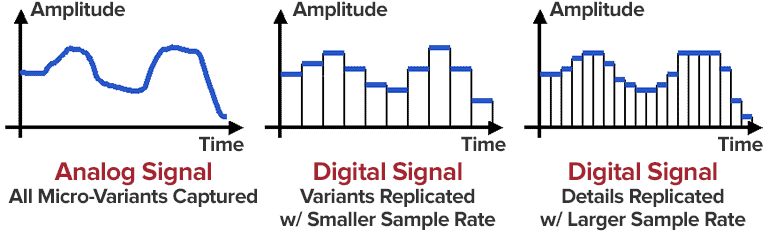
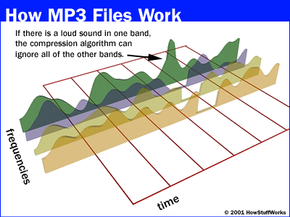
Musical signals have many redundant components, including spacing and information that the human ear cannot distinguish (such as weak signals mixed with a strong background). The CD sound is not compressed and uses a fixed sampling frequency of 44.1 kHz, which can ensure good playback of maximum dynamic music. Of course, the amount of data is the same where the amount of information is less, so there is a possibility of compression. The audio bandwidth of 20 ~ 20 kHz (upper CD player can be extended up to 2 Hz) has become the current music standard. To reduce sound distortion, MP3 adopts an encoding algorithm called “sensory encoding technology”: the audio file first undergoes spectral analysis during encoding, and then the noise level is reduced by filter, and then the remaining components are quantized by quantization The bits are scattered and arranged, and finally an MP3 file with a higher compression ratio is formed, and the compressed file can achieve a sound effect closer to the original sound source during playback . Although it is a lossy compression, its biggest advantage is very little sound distortion in exchange for a higher compression ratio. And now MP3 adopts a variable compression ratio (VBR) compression technology similar to Dolby AC-3. The sampling compression ratio depends on the amount of information in the music, and the masking effect of the human ear is used to reduce redundant data.

Mp3 Increase Volume

Mp3 Increase Volume

mp3 increase volume

First we need to understand how an mp3 works, how it compresses the original wav to a tenth of its size, to understand why we always need to normalize all the volumes of the different mp3s.

increase mp3 volume

Mp3 Increase Volume

A wav saves a lot of information, including information that humans cannot hear, also redundant information and ends up taking up a lot of space on the hard drive or on flash drives.

This has generated from the beginning the need to ensure that the different mp3s have a constant or similar volume when comparing some mp3s with others.

This currently with Mp4Gain can be applied to the most used audio and video formats.

Let’s understand a little how the compression of an mp3 works:

MP3 encoding is mainly composed of 3 main functional modules, including hybrid filter bank (subband filter and MDCT), psychoacoustic model, quantization encoding (bit mapping and bit factoring, and Huffman encoding).
1. Hybrid filter bank. This part includes two parts of the subband filter bank and MDCT. Subband filterbank encoding completes the mapping of the sampled signal from time domain to frequency domain and decomposes the specified audio signal into 32 subbands through the bandpass filterbank for output. All 32 subbands output by the subband filter bank have the same bandwidth, while the critical bandwidth derived from the psychoacoustic model is not. Therefore, to match each scaling factor band for encoding to the critical band, it is necessary to transform subband signals into MDCTs. Once the output of the subband filter bank is sent to the MDCT filter bank, each bank is subdivided into 18 frequency lines, resulting in a total of 576 frequency lines. Next, the number of bits allocated to the 576 spectral lines is determined using the signal-to-mask ratio of the computed subband signals in the psychoacoustic model.

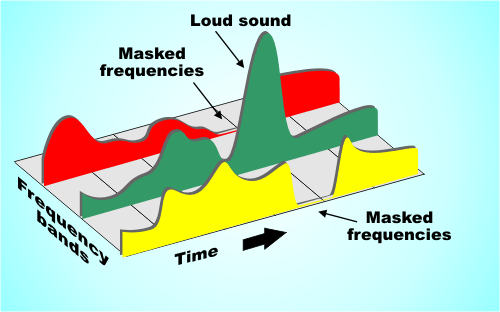
2. Psychoacoustic models. The psychoacoustic model takes advantage of the masking effect of the human auditory system to remove a large number of irrelevant signals, in order to achieve the effect of compressing the audio data. To accurately calculate the masking threshold, the signal is required to have better resolution in the frequency domain, so the signal is Fourier transformed before using the psychoacoustic model. MPEG-I provides two psychoacoustic models. The first model is easy to compute and provides adequate accuracy when encoding at high bit rates. The second model is more complex and is generally used when encoding at lower bit rates. Psychoacoustic model II is generally used in MP3 encoding. The purpose of the psychoacoustic model is to find the masking threshold value of each subband and use it to control the quantization process. The implementation process of the psychoacoustic model generally consists of first using FFT to obtain the spectral characteristics of the signal and find the tonal components (some called musical components) and the non-tonal components (or noise components) at each frequency point according to the spectral features; The curve determines the masking domain value of each tonal component and non-pitch component at other frequency points; finally, the general masking domain of each frequency point is obtained and converted to the coding subband. For noise generated after quantization of the spectral value emitted by the subband filter bank, if the noise can be controlled below the masking threshold, the final compressed data decoded result may be indistinguishable from the original signal. The masking ability of a given signal depends on its frequency and loudness, so the end result of the psychoacoustic model is the signal-to-mask ratio (signal to mask ratio), which is the ratio of the intensity of the signal and masking. limit.

What differentiates MP3 from AAC? Part 3

What differentiates MP3 from AAC? Part 3

AAC or MP3

WAV audio file

M4A vs MP3

WAV is a waveform audio format. This is a high-quality audio file that is often used like a CD. WAV files are not compressed and therefore take up more disk space than MP3 or AAC.

Because WAV files are not compressed (called a “lossless” format), they contain more data, resulting in a better, more subtle, and more detailed sound. A WAV file typically requires 10MB of audio per minute. By comparison, MP3 takes up about 1 MB per minute.

WAV files are supported by Apple devices, but are not commonly used except by audiophiles.

WMA audio file
WMA stands for Windows Media Audio. This is a file type popularized by Microsoft Corporation who invented it. It is the default format used by Windows Media Player on Mac and PC. It competes with MP3 and AAC formats and offers compression and file sizes similar to those formats. Not compatible with iPhone and iPad.

AIFF audio file
AIFF stands for Audio Interchange File Format. Another uncompressed audio format, AIFF, was invented by Apple in the late 1980s. Like WAV, it takes up about 10MB of storage space per minute of music. Because it does not compress audio, AIFF is a higher quality format preferred by audiophiles and musicians. Because it was invented by Apple, it is compatible with Apple devices.

Apple Lossless Audio File
Another Apple invention, the Apple Lossless Audio Codec (ALAC), is the successor to AIFF. Released in 2004, it was originally a proprietary format. Apple made it open source in 2011. Apple Lossless balances smaller file sizes with better sound quality. Its files are typically about 50% smaller than uncompressed files, but with less sound quality loss than MP3 or AAC.

FLAC audio file
Free Lossless Audio Codec) is an open source audio format popular with audiophiles. You can reduce the file size by 50-60% without degrading the audio quality too much. FLAC is not supported on iTunes or iOS devices, but will work with other software installed on your device.

What is the best way to listen to music on your car smartphone? Part 2

What is the best way to listen to music on your car smartphone? Part 2

BLUETOOTH

What are the benefits of connecting a USB cable and listening?

Bluetooth

If you connect a USB cable to listen, you can upload your smartphone at the same time you play music. Therefore, you do not have to worry about running out of battery on your smartphone, even if you play music for a long time.

In addition to better sound quality than Bluetooth, there is less delay time. For example, when watching a video in a car, the image and sound may not be synchronized with Bluetooth, but with USB, the gap is small.

What are the disadvantages of connecting a USB cable and listening?
Since a cable is required, the audio area tends to be crowded. If it is too long, the pendant cable will not only be neglected, but can also be trapped on the gear lever or on the steering wheel, which is dangerous.

Connect and play with the voice entry (AUX)
If you are using a smartphone with a headphone connector and the navigation or audio system of the car has a hole to connect the AUX terminal, you can use this connection method using the cable for the AUX connection.

This is a method for connecting a smartphone directly to the audio system of a car. The price of the aux cable varies from one pin to another, but you can listen to good quality music for about 1000 yen.

What are the benefits of connecting an audio input (AUX)?
Like USB, AUX has a cable connection, so it does not have a load function. However, since it is a dedicated audio terminal, you can enjoy music with a better sound quality.

If you want to focus on sound quality, the AUX connection is the most recommendable.

What are the disadvantages of connecting the audio input (AUX) to listen?
As with USB cables, it is filled with more cables around the audio. Also, if you want to load at the same time, you will need more cables. The USB cable can be used for both domestic use, but the AUX cable is rarely used, so it is a nuisance to prepare it for the car.

In addition, recently, some smartphones do not have a headphone connector, so there is a tendency to prepare many things.

YouTube quietly changed its loudness playback policy to achieve full average

YouTube quietly changed its loudness playback policy to achieve full average

YouTub Loudness

Youtube 14 lufs

loudness youtube

YouTube quietly adjusted its playback volume to -14 LUFS, achieving full equalization. The way YouTube regulates volume at first didn’t use -14 LUFS, which is an exact value. Starting in 2015, they turned down the volume on music videos relatively loudly to avoid freaking out about the volume when switching videos, resulting in a bad experience. ., Set the volume to a low level and reproduce almost the same volume, the overall loudness value set is about -13 LUFS.

What is LUFS? It is short for loudness units relative to full scale, which is the unit used in EBU R128, and EBU R128 is a set of guidelines for standardizing loudness and the maximum allowable audio signal level. The average volume of the overall sound is calculated and then the average volume is calculated and the difference between the volume and the desired volume can be adjusted.

TV stations, radio and online music streaming platforms will play the volume for processing, which can avoid the phenomenon of turning up the volume to attract attention, which is what we call volume competition. After averaging the volume, you can reduce unnecessary volume and focus more on sound quality. TIDAL, Amazon Music, and YouTube now use the same method to manage loudness. Average loudness can provide a better user experience and be more consistent across platforms. This is good for the listening experience and cross-platform management, and it can also avoid the problem of volume competition.

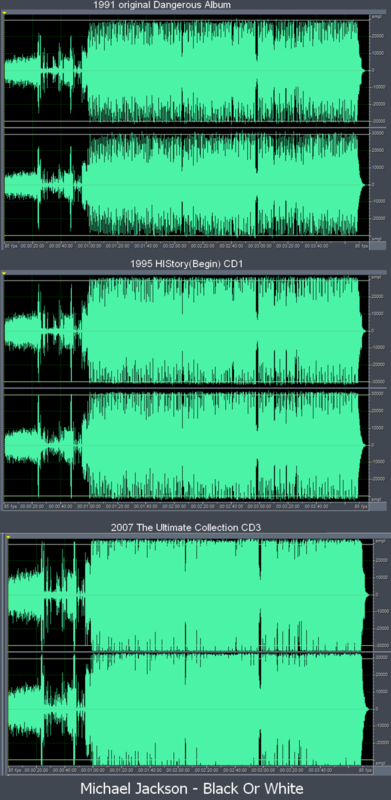
The volume of Michael Jackson’s Black or White has increased year after year in the various versions released between 1991 and 2007.

So do we need to start standardizing all sounds produced at -14 LUFS? Of course, no. Although many platforms have been averaging, there are still platforms that have not yet used the LUFS standard. For example, Spotify has not yet used this standard. Generally speaking, we don’t use the same volume and mix processing for soft rock and folk music. songs; and, conversely, this result will cause several songs of different key to sound at the same volume. In fact, most music has different volume settings in response to the performance of the music content during the CD release and initial mixdown. Like a jazz performance with a wide dynamic range and a volume of -18 LUFS or a hardcore 1990 techno, it can sound the same volume as a string quartet

MP3 louder MP4 louder

MP3 louder MP4 louder

Audio Loudness

Since music and videos were digitized, given the process that needs to be performed to digitize audio and video, users have encountered a large difference or disparity in the volume level of audio files or audio files. The videos.

But for many years there was no software capable of normalizing the volume of these audio or video files to ensure that the volume and loudness were consistent and all had the same volume level.

Audio Loudness

Increase volume of audio and video formats

But it is absolutely necessary to be able to boost the loudness or increase the volume level of these videos and audio files to be able to boost the loudness.

Because in order to achieve a consistent reproduction without volume level disparity, it is essential to boost the loudness and normalize the volume level, be it of videos such as MP4 or audios such as mp3. Although it is important to note that mp4gain can boost the loudness and volume of the main audio and video formats.

Increase mp3 volume

Initially, only the volume of MP3s was increased, but over time mp4gain allowed to increase the volume of video formats such as mp4 and also of audio formats such as AAC.
So today mp4gain can normalize the volume of the main audio and video formats.

How to make mp3 louder

Mp4gain is the answer to make MP3 sound louder or videos louder and also major audio formats louder.

And actually the way to use mp4gain is very simple Because all you need is to press the button to process these files and with that you can process one or more files in batch and get the volume of your videos or files to increase. musicals.

Amplifier mp3 volume

It’s not really just about boosting the volume.
What mp4gain does is something much more sophisticated and much more professional.

Because it really optimizes the volume making it sound at its highest possible level by doing what is called dynamic normalization, where everything is audible. That there are no sounds that listen to us But it also preserves the dynamics of the sound and allows for example additional processes that you can choose If you want to perform such as re-equalizing the sound especially if it is an old recording.

That is, mp4gain does not simply amplify the volume, it does much more than that, it actually performs an evaluation and analysis of each frame. Remember that there are 44100 frames per second at least, and it optimizes each of those frames in each of the frequencies and bands to achieve that the result really better both the loudness and the volume level as well as the audio quality.

Mp4gain can at the same time convert the file into a different format all done in one pass.

Mp3 louder

Mp3 louder

Increase MP3 Volume

One of the things that we all look for on the internet is an audio program is that it allows us to make the loudness of our mp3 (or any other popular udio and even video file)

MP3 Louder

increase mp3 volume

As we said, it is not only about increasing the volume of an mp3, but about being able to increase the volume of a flac, ogg, aac, etc file and also about video such as increasing the volume of an mp4, avi, etc.

Mp4Gain is the answer to this need, as it can boost loudness, increase loudness, increase the volume of our maudios and videos with a single click. You can even do the batch normalize. That is, with a single click to make our audio or mvideo file sound louder.

And obviously it is the best audio and video louder that exists, for a reason it is used even on television channels, radio broadcasters F.M. and even audio and video production houses, in addition to universities.

mp3 volume booster

As we said before, it is not only an mp3 volume booster, but it really is a volume booster of the main audio and video formats.

increase volume of mp3

For years, we were eagerly looking for how to increase the loudness or increase the volume of the mp3s. Until Mp4Gain appeared, which manages to increase the volume of a flac, increase the volume of an mp4, increase the volume of an aac, etc.

make mp3 louder

Of course, it’s not just about making audio or video sound louder, but about making it sound louder in the right way. For this, it has been necessary to achieve an algorithm according to this time in which the quality of audio and of the devices that reproduce the audio is very demanding.

Today it is not only a matter of normalizing the volume of an mp3, mp4, aac, etc. But to make it sound better too. For this, Mp4Gain takes into account absolutely how the encoding process happens, to be able to take into account each band and each process and thus be able to reconstruct and improve the audio or video and improve and boost its loudness and its volume, but it manages to improve the sound .

Mp4Gain is definitely the answer if you are looking to achieve make you mp3 louder.