How does MP3 work?


Free Download Mp4Gain
picture

How does MP3 work?

mp3 compression

1. The common name for portable MP3 player. a portable player
used to play music in MP3 format (now compatible with wma, wav and other formats).
MP3 Compression

Portable MP3 Player was originally developed by Korean Wenguang Su and Huang Dingxia (Moon & Hwang) Invented in 1997 and applied for related patents Detailed explanation of the
technology development of the MP3 format Format, which is designed to drastically reduce the amount of audio data, while for most users the playback quality is not appreciably degraded from the original uncompressed audio. It was invented and standardized in 1991 by a group of engineers from the Fraunhofer-Gesellschaft research organization in Erlangen, Germany. MPEG-1 Audio Layer 3, often referred to as MP3, is one of the most popular lossy compression and digital audio encoding formats today. There is no noticeable drop in sound quality compared to the original uncompressed audio. It was invented and standardized in 1991 by a group of engineers from the Fraunhofer-Gesellschaft research organization in Erlangen, Germany. General information MP3 is a data compression format. It discards pulse code modulation (PCM) audio data that is not important to the human ear (similar to how JPEG is lossy image compression), resulting in a much smaller file size. Various techniques are used in MP3, including psychoacoustics, to determine which parts of the audio can be discarded. MP3 audio can be compressed at different bit rates, providing a variety of trade-offs between data size and sound quality. The MP3 format uses a hybrid conversion mechanism to convert the time domain signal to the frequency domain signal: * 32-Band Polyphase Integrating Filter (PQF)
* Modified 36 or 12 tap discrete cosine filter (
MDCT); each subband size is independently selectable between 0…1 and 2…31 However, due to the unprecedented popularity of MP3, the success of any other format is currently unlikely. MP3 not only has extensive client software support, but also has a lot of hardware support, such as portable media players (referring to MP3 players), DVD and CD players.
The development of
MPEG-1 Audio Layer 2 encoding started with the German Deutsche Forschungs- und Versuchsanstalt für Luft- und Raumfahrt (later called Deutsches Zentrum für Luft- und Raumfahrt, German Space Center) Digital Audio Broadcasting (DAB) managed by Egon Meier-Project Engelen . This project is funded by the European Union as a EUREKA research project, and its name is commonly known as EU-147. The study period for EU-147 was from 1987 to 1994.
By 1991 there were already two proposals: Musicam (called Layer 2) and ASPEC (Adaptive Spectrum Sensing Entropy Coding). The Musicam method proposed by Philips of the Netherlands, CCETT of France, and the Institut für Rundfunktechnik of Germany was chosen due to its simplicity, robustness against errors, and lower computational effort in high-quality compression. The Musicam format based on subband coding is a key factor in determining the MPEG audio compression format (sampling rate, frame structure, data header, sample points per frame). This technology and its design philosophy are fully integrated into the definition of ISO MPEG Audio Layer I, II and later Layer III (MP3) formats. The standard was developed by Leon van de Kerkhof (Layer I) and Gerhard Stoll (Layer II) under the auspices of Prof. Mussmann (University of Hannover).
A working group consisting of Leon Van de Kerkhof from the Netherlands, Gerhard Stoll from Germany, Yves-François Dehery from France, and Karlheinz Brandenburg from Germany absorbed design ideas from Musicam and ASPEC and added their own design ideas to develop MP3 , which can play MP2. Sound quality from 192kbit/s to 128kbit/s.
All of these algorithms eventually became part of the first group of MPEG standards, MPEG-1, in 1992, resulting in the ISO/IEC 11172-3 international standard published in 1993. Further work on MPEG audio eventually became part of the MPEG-2 standard, a second group of MPEG standards developed in 1994, officially known as ISO/IEC 13818-3, first published in 1995.
The compression efficiency of an encoder is usually defined by the bit rate, since the compression rate depends on the number of bits.


Free Download Mp4Gain
picture


Mp4Gain Main Window
picture


Mp4Gain Features
picture


Free Download Mp4Gain
picture

MP3 file format

MP3 file format

Mp3

1. Overview:

Video to MP3 Converter

the MP3 file is made up of a frame, the frame is the smallest unit of the MP3 file. The full name of MP3 should be MPEG1 Layer 3 audio file. MPEG
(Moving Picture Experts Group) translates into Chinese as Moving Picture Experts Group, which refers to the compression standard for moving video and audio.
sound part of the MPEG1 standard, also called MPEG. The audio layer is divided into three layers based on compression quality and encoding complexity, namely
Layer-1, Layer2 and Layer3, which correspond to the three sound files of MP1, MP2 and MP3 respectively, and use different
levels of audio files according to different purposes. The higher the level of MPEG audio encoding, the more complex the encoder and the higher the compression ratio. The compression ratio of MP1 and MP2 is 4:1 and
6:1-8:1 respectively, while MP3 compression ratio is up to 10:1-12:1, i.e. one minute of CD-quality music requires 10MB
of storage space without compression, but only about 1 MB after encoding with MP3 compression. However, MP3 uses a lossy compression method for audio signals. In order to reduce the degree of sound distortion, MP3 adopts “sensory encoding technology”, that is, the spectrum analysis of the audio file is done during encoding, and then the noise level. I know
filtered with a compressed file filter can achieve a sound effect closer to the original sound source during playback. 2. The whole structure of MP3 files: MP3 files are roughly divided into three parts: TAG_V2 (ID3V2), Frame, TAG_V1 (ID3V1)

ID3V2 contains information such as author, composer, album, etc. The length is not fixed, which expands the amount of ID3V1 information.
A series of frames, the number of which is determined by the file size and frame length. The length of each FRAME of the
frame
may or may not be fixed, and is determined by the bitrate
.
Each frame is divided into two parts: frame header and data entity Header
from
box Records the bit rate, sample rate, version, and other mp3 information, and each box is independent of each other.
ID3V1 contains the author, composer, album and other information, and the length is 128BYTE. 3. FRAME format of MP3: each FRAME has a FRAMEHEADER frame header, the length is 4BYTE (32 bits), there may be two CRC check bytes after the frame header, the existence of these two bytes depends on the frame information. FRAMEHEADER Bit 16 , if 0 there is no control after the frame header, if 1 there is control. The control value is 2 bytes, followed by FRAMEHEADER, followed by the frame entity data. The format is as follows: FRAMEHEADER CRC (free) MAIN_DATA 4 BYTE 0 OR 2 BYTE The length is calculated from the frame header 1. The FRAMEHEADER frame header format is as follows: AAAAAAAA AAABBCCD EEEEFFGH IIJJKLMM

The meanings of the 13 characters in the table header are as follows:
Sign Length Position Description
(bit) (bit)
A 11 (31-21) Frame Sync (all bits set)
B 2 (20,19) MPEG audio version
00 – MPEG version 2.5
01 – reserved
10 – MPEG Version 2
11 – MPEG Version 1
C 2 (18,17) Layer Description
00 – reserved
01 – Layer III
10 – Layer II
11 – Layer I
D 1 (16) Protection bit
0 – CRC protected (16-bit CRC follows header)
1 – Not protected
E 4 (15,12) Rate index bits
bits V1,L1 V1,L2 V1,L3 V2,L1 V2,L2 V2,L3
0000 free free free free free free free
0001 32 32 32 32 32 8 ( 8)
0010 64 48 40 64 48 16 (16)
0011 96 56 48 96 56 24 (24) 0100
128 64 56 128 64 32 (32)
0101 160 80 64 160 80 64 (40)
0110 1 2 6 2 1 2
112 56 (56)
1000 256 128 112 256 128 64 (64)
1001 288 160 128 288 160 128 (80)
1010 320 192 160 320 192 160 (96)
1011 352 224 192 352 224 112 (112)
1100 384 256 224 384 384 256 128 (128)
1101 416 320 256 416 320 256 (144)
1110 448 384 320 448 384 320 (160)
1111 bad bad bad bad bad
NOTES: All values ​​are in kbps
V1 – MPEG Version 1
V2 – MPEG Version 2 and Version 2.5
L1 – Layer I
L2 – Layer II
L3 – Layer III

Mp3 converter

Mp3 converter

MP3 Converter

Convert mp3’s.

Video to MP3 audio

As we explained in previous articles, the mp3 is the result of the compression from a wav. With the purpose of reducing the size to make it easier to transmit it over the internet and that when stored it occupies less space on a hard drive or in a memory.

Finally, the conversion and compression, although it discards information to be able to be compressed, is based on psychoacoustic models, which guarantees that if it has enough bit rate, the mp3 will not be easily distinguishable when compared to its original wav.

Mp3 Converter, for what?

There are two possible paths. One is to convert a file in any format to mp3 and another is to take an mp3 and convert it to one of many available audio formats.

In either case if you use a high quality converter like Mp4Gain you will get a very high quality conversion.

We do not recommend using online converters, they usually produce results that we will later regret. Free is usually expensive.

Convert an mp3 to another format

This option, although it will not replace the data discarded when committing or encoding the mp3, will nevertheless give it a noticeable quality if we use a bait rate of more than 192.

Convert another format to mp3

This will also generate, if we use Mp4Gain, a high quality mp3, if we choose a bit rate higher than 192. Perhaps 256 would be optimal.

Remember that Mp4Gain is the best audio and video converter on the market. And at a very good price, it is really worth it.


convert video to mp3


It is possible with Mp4Gain to extract the audio from any video format to an mp3 and obtain a very high quality mp3, for example youtube to mp3

Advantages and disadvantages of MP3 technology

Advantages and disadvantages of MP3 technology

In the Internet age, MP3 became a de facto standard for digital audio files. With the popular Napster peer-to-peer application, music lovers can exchange MP3 files so they can get songs without paying for them. This article has been written to highlight the advantages and disadvantages of MP3, as well as to help you decide if you want to convert your existing music files in some other format to MP3 or not.

Advantages of MP3

The advantage of MP3 is its high fidelity. The quality of an MP3 file is determined by its bit rate. The bit rate is measured in kilobits per second. The bit rate of an MP3 file can range from 8 kbps to 320 kbps. You should save your songs at 160kbps if they don’t like it very much and don’t put them at the top of the list of MP3 players. Keep your songs at 192kbps if you like them a little. Use 256kbps for the songs you like. And using 320kbps for your all-time favorite songs. Anyway, even a 320kbps MP3 doesn’t sound as good as the song’s WAV file version. But a 320kbps MP3 takes up four times less space than a WAV file. To use an analogy, an MP3 file is a WAV file, which is a JPEG image to a BMP image.

The second advantage is that it can be played by many types of devices, such as CD players and Apple’s iPod. You can also play MP3 files with multimedia players like Winamp, Windows Media Player or QuickTime. The third advantage of MP3 ID3 tags. The ID3 tag of an MP3 file stores the artist name, song title, year, and genre. You can also create your own playlists.

Another benefit of MP3 is that encoding is easy. It’s easy to rip audio CDs, and as easy as burning custom MP3 CD-R files. The encoding speed is also very fast, it also depends on the speed of the CD drive. It takes very little time to produce MP3 files. You can use lossless audio compression if you have a lot of free disk space and lossy audio compression if you have little free disk space. MP3 LAME encoders, as they are free and open source, so that everyone can contribute to their development.

Another point in favor of MP3 is that the distribution is simple. MP3 files can be downloaded through HTTP or FTP sites. You can also distribute MP3 files through portable storage devices, such as USB flash drives. You can also buy MP3s from online music stores like iTunes and eMusic.

You can also use a server to transmit these files. The MP3 stream uses a playlist format, such as M3U (meaning MP3 URL) or PLS. MP3 Streaming is also used by Internet radio stations. You can embed MP3 streams with the help of a Flash player. You can have different rates of dial-up and broadband connections. MP3 audio is not saved on the hard disk.

Problems with MP3

A downside to MP3 is that it takes up quite a lot of storage space. Since an MP3 file usually takes up to 5 megabytes (MB) of disk space, the number of files that can be stored is limited. Also, the relatively large size of an MP3 file makes downloading the file slow if you have a slow Internet connection.

Another problem is that the song may skip in random places. This occurs especially if you have a slow computer and simultaneously with several programs that are hogging the processor. It is not technically free. You will also need an MP3 decoder if you want to convert audio from MP3 format to WAV format. The MP3 format has very little security available. For example, people using the Morpheus file sharing service had their computers accessible by hackers.

Another limitation is that this file is not the highest format fidelity for audio files. Other audio formats, such as Ogg Vorbis and Advanced Audio Coding (AAC), are superior to MP3 in terms of quality. AAC is the format used in Apple iTunes player. However, MP3 is still the most popular audio format in the world.

The advantages and disadvantages of MP3, which I have listed, will help you make an appropriate decision before going for music download next time.

How is an mp3 analyzed inside?

How is an mp3 analyzed inside?

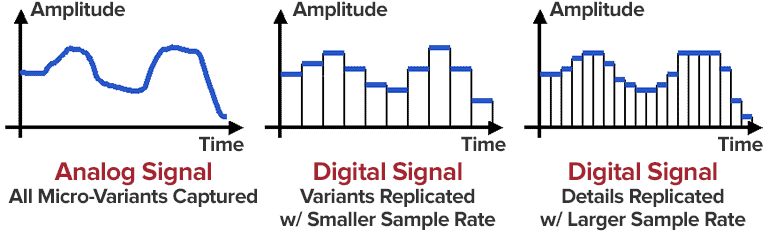
MP3 is the acronym for MPEG 1 Layer 3 and is a lossy digital audio format developed by MPEG (Moving Picture Experts Group) in conjunction with the Franunhofer Institute of Technology to include it as an audio format for the MPEG-video format. 1. It is currently an ISO (International Organization for Standardization) standard. The reason it has become so popular is that it allows for high sound quality in very little storage space: About 650 songs can be recorded on a 650MB CDROM, in instead of the 15 that we could store following the format of traditional CD-Audio. Furthermore, it is possible to adjust the quality of the output file by adjusting the bitrate (sampling rate and number of bits per sample), which will be proportional to the size of the output file. Thanks to its small size, high quality and versatility, it became a standard for streaming.

It was said at the beginning that MP3 is a lossy algorithm, this means that the original and encoded sound are not exactly the same. For this, the MP3 takes advantage of the “deficiencies” of the human ear, specifically 3 of them:

Limits of hearing in frequency: The human ear is only capable of hearing frequencies that are approximately between 20 and 20,000 KHz, with which the rest are filtered and discarded as they would not add relevant information to the encoded signal. Also, the closer you are to the 2-4 Khz range (and harder to hear as the frequency gets closer to the extremes of hearing), the more audible it will be.
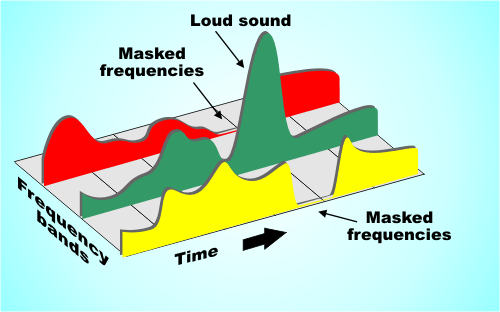
Masking effect: When 2 signals of similar frequency overlap, human hatred is only able to hear the one with the highest power (volume), therefore, the rest can be eliminated without appreciable loss of quality.
Stereo redundancy: Sometimes there is redundancy between the 2 channels and, furthermore, below a certain frequency, the human ear is not able to distinguish the directionality of the sound with which a single channel can be encoded and add to the other certain complementary information to not lose the spatial sensation of the other channel.
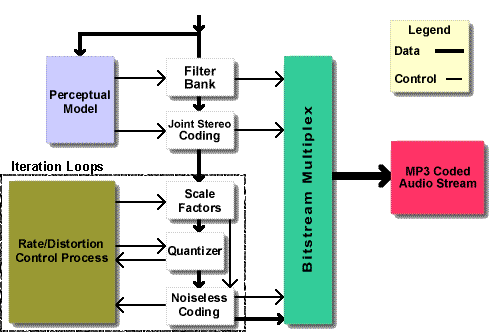
To carry out the three previous proposals, a system based on subbands is used in which the signal is filtered using several filters in order to have the signal separated into sub-signals, each covering a frequency range. Each of these bands is compared to a psychoacoustic model that determines which bands are important and which can be removed.

Specifically, a hybrid polyphase / MDCT (Modified Discrete Cosine Transform) filter bank is used: A filter bank is a set of band-pass filters that aim to separate the original signal into several frequency bands; A multiphase / MDCT hybrid filter bank is nothing more than a normal filter bank together with a block capable of doing the discrete cosine transform (MDCT).

The choice of which bands are maintained and which are removed is made by calculating the masking threshold, that is, it analyzes each audio sub-signal and calculates the amount of noise that can be input (signal is replaced by noise to save storage space) in function of the frequency, taking into account that a frequency masks signals of a higher frequency than yours rather than lower, without being noticeable to the human ear.

The following figure outlines the process described above:

The following figure represents the structure of an mp3 file:

As can be seen, an Mp3 file is made up of different frames which in turn are made up of an Mp3 header and MP3 data. Each of the frames is independent, that is, a person can cut the frames of an MP3 file and then play them back. The graph shows that the header consists of a sync word that is used to indicate the beginning of a valid frame. Following are a series of bits that indicate that the analyzed file is a standard MPEG file and whether or not it uses layer 3.

MP3 undoubtedly owes its success to Internet music downloads and portable audio players capable of playing the format. First, Discman compatible with MP3 were born, which allowed transporting 175 songs per cd instead of the usual 6. Subsequently, MP3 players based on a (small back then) flash memory were born. These had the advantage of being much smaller and lighter than portable CD players, but with the initial disadvantage that flash memory was small and expensive. Initially these devices had 64 or 128 MB memory, which allowed them to store between 16 and 32 songs. Currently these devices are sold with a memory of 1,2,4 or even 8GB. This allows them to store between 256 (for the 1Gb model) and 2048 (for the 8GB model)