The mp3 phenomenon


Free Download Mp4Gain
picture

The mp3 phenomenon

MP3

The MP3 music format (MPEG-1 Layer 3) is one of the most widely used digital audio formats in the world. It is compatible with all portable and stationary audio devices. In May 2017, the developers of the format announced his “death”.

mp3

On April 23, 2017, the Technicolor and Fraunhofer IIS licensed commercial program was canceled: the last patent included in the program expired, making the format standard in the public domain. Can we say that the days of the most popular format are numbered? MP3 development began in the late 1980s at the Fraunhofer Institute for Integrated Circuits (IIS).

In 1987, the University of Erlangen-Nuremberg and Fraunhofer IIS teamed up to work on the EU147 EUREKA Digital Audio Broadcasting (DAB) project. The first result of the alliance’s work was the LC-ATC codec, which made it possible to encode stereo music in real time. The next step was the development of an optimal frequency domain (OCF) coding algorithm, which already had some of the characteristics of the future MP3 codec. For the first time, it is possible to encode music in good quality at 64 kbps for a mono signal. OCF was the beginning of the path towards the standardization of MPEG (Moving Picture Expert), an organization, responsible for the development and implementation of international standards for the compression and transmission of digital video and audio content.

In 1989, MPEG received 14 proposals for the implementation of an audio coding standard, so participants were invited to combine their developments. This led to the emergence of four potential candidates, including MUSICAM from the Institute of Broadcasting Technology IRT and Philips and ASPEC (Adaptive Spectral Perceptual Entropy Coding), which is the result of further enhancements to OCF Fraunhofer IIS, as well as contributions from the University of Hannover in collaboration with AT&T and Thomson. After extensive testing, MPEG proposed combining MUSICAM and ASPEC to create a family of three encoding methods: Level 1: a low-complexity version of MUSICAM; level 2 – MUSICAM codec; Level 3 (later called MP3): based on ASPEC.

Technical development of the MPEG-1 standard was completed in December 1991. In 1994, Fraunhofer IIS introduced the world’s first MP3 encoder, the L3enc, and in 1995 the Fraunhofer researchers unanimously accepted “.mp3” as the file extension for MPEG Layer 3 [1]. Thanks to the compression algorithm used in the MP3 audio format, the size of the data required to reproduce the recording and ensure the quality of sound reproduction is significantly reduced to 10-12 times the original, depending on the recording bit rate. . Bit rate refers to the encoding / decoding rate of a digital audio stream; sound quality improves with increasing bit rate. The MP3 format has the following bit rates: 32 kbps (very low quality, acceptable only for voice), 96 kbps, 128 kbps (medium quality), 160 kbps, 192 kbps, 256 kbps, 320 kbps (highest best quality). The principle of the compression algorithm is as follows: during the compression process, the audio codecs analyze the signals, focusing on the audible fragments, which are saved for later playback or transmission.

This rules out sounds beyond the perception range of the human ear (20 to 20,000 Hz). That is why MP3 is called lossy. There are three ways to encode MP3 files: constant bit rate (CBR), variable bit rate (VBR), and medium bit rate (ABR). CBR is the default encryption mode. In this mode, the bit rate is constant for the entire file. This means that each part of the MP3 file uses the same number of bits. Regardless of the complexity of a piece of music, the encoder uses the same bit rate, so the quality of the final file is variable. Complex parts will be of lower quality than simpler ones. The main advantage of this mode is that the size of the final files does not change and can be accurately predicted.

When encoding in VBR mode, the user selects the desired quality on a scale of 9 (lowest quality, highest distortion) to 0 (highest quality / lowest distortion). The codec then tries to maintain a certain quality throughout the file by choosing the optimal number of bits for each part of the audio recording. The main advantage is the ability to specify the level of quality to be achieved, but a significant disadvantage is the unpredictability of the final file size. In ABR mode, the user sets the bit rate and the encoder tries to keep the average bit rate constantly while using higher bit rates for the parts of the music that require more bits. The


Free Download Mp4Gain
picture


Mp4Gain Main Window
picture


Mp4Gain Features
picture


Free Download Mp4Gain
picture

Size and quality of MP3 files

Size and quality of MP3 files

MP3 File

The MP3 file format is an “open format” supported by most manufacturers.

mp3 file

The MP3 format is one of the most common digital audio encoding formats. One feature of MP3 audio encoding is lossy encoding. However, the coding is based on a special model that takes into account the peculiarities of auditory perception. Therefore, the presence of losses does not lead to catastrophic sound degradation.

MP3 files have become a de facto standard and are compatible with the most popular operating systems, many CD and DVD players, and other devices.

Interestingly, the standard describes the actual storage format and not the way the sound is encoded. As a result, there are many tools available to play MP3 audio.

Special codecs are used to encode audio in MP3 format.
An audio codec can be of two types: hardware codec and software codec.

Hardware coding is done by special microcircuits.
Software coding is done using special computer programs.

Audio quality in MP3 format (all other things being equal) depends on the compression ratio (read the amount of loss) and the encoding program. That is why brand name players using well-known brand codecs and audio signal processing systems are significantly superior in playback quality to conventional devices assembled from standard assemblies.

The quality of actual playback depends on the size of the media data stream. The amount of data stream is sometimes called the stream width. There is a special term: bit rate. The data flow rate is defined in kilobits per second and is denoted kbs, kbps, kb / s. Recording can be encoded in several ways: constant bit rate and variable bit rate. Variable bit rate helps preserve details by increasing the amount of data.

Not all bit rates are suitable for high-quality music playback

How is an mp3 analyzed inside?

How is an mp3 analyzed inside?

MP3 is the acronym for MPEG 1 Layer 3 and is a lossy digital audio format developed by MPEG (Moving Picture Experts Group) in conjunction with the Franunhofer Institute of Technology to include it as an audio format for the MPEG-video format. 1. It is currently an ISO (International Organization for Standardization) standard. The reason it has become so popular is that it allows for high sound quality in very little storage space: About 650 songs can be recorded on a 650MB CDROM, in instead of the 15 that we could store following the format of traditional CD-Audio. Furthermore, it is possible to adjust the quality of the output file by adjusting the bitrate (sampling rate and number of bits per sample), which will be proportional to the size of the output file. Thanks to its small size, high quality and versatility, it became a standard for streaming.

It was said at the beginning that MP3 is a lossy algorithm, this means that the original and encoded sound are not exactly the same. For this, the MP3 takes advantage of the “deficiencies” of the human ear, specifically 3 of them:

Limits of hearing in frequency: The human ear is only capable of hearing frequencies that are approximately between 20 and 20,000 KHz, with which the rest are filtered and discarded as they would not add relevant information to the encoded signal. Also, the closer you are to the 2-4 Khz range (and harder to hear as the frequency gets closer to the extremes of hearing), the more audible it will be.
Masking effect: When 2 signals of similar frequency overlap, human hatred is only able to hear the one with the highest power (volume), therefore, the rest can be eliminated without appreciable loss of quality.
Stereo redundancy: Sometimes there is redundancy between the 2 channels and, furthermore, below a certain frequency, the human ear is not able to distinguish the directionality of the sound with which a single channel can be encoded and add to the other certain complementary information to not lose the spatial sensation of the other channel.
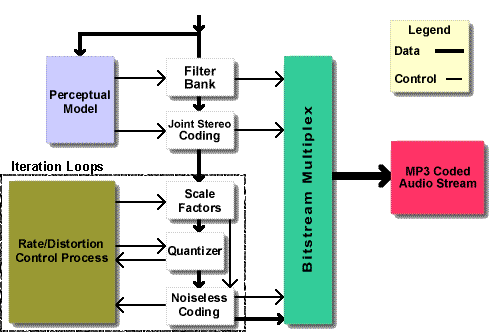
To carry out the three previous proposals, a system based on subbands is used in which the signal is filtered using several filters in order to have the signal separated into sub-signals, each covering a frequency range. Each of these bands is compared to a psychoacoustic model that determines which bands are important and which can be removed.

Specifically, a hybrid polyphase / MDCT (Modified Discrete Cosine Transform) filter bank is used: A filter bank is a set of band-pass filters that aim to separate the original signal into several frequency bands; A multiphase / MDCT hybrid filter bank is nothing more than a normal filter bank together with a block capable of doing the discrete cosine transform (MDCT).

The choice of which bands are maintained and which are removed is made by calculating the masking threshold, that is, it analyzes each audio sub-signal and calculates the amount of noise that can be input (signal is replaced by noise to save storage space) in function of the frequency, taking into account that a frequency masks signals of a higher frequency than yours rather than lower, without being noticeable to the human ear.

The following figure outlines the process described above:

The following figure represents the structure of an mp3 file:

As can be seen, an Mp3 file is made up of different frames which in turn are made up of an Mp3 header and MP3 data. Each of the frames is independent, that is, a person can cut the frames of an MP3 file and then play them back. The graph shows that the header consists of a sync word that is used to indicate the beginning of a valid frame. Following are a series of bits that indicate that the analyzed file is a standard MPEG file and whether or not it uses layer 3.

MP3 undoubtedly owes its success to Internet music downloads and portable audio players capable of playing the format. First, Discman compatible with MP3 were born, which allowed transporting 175 songs per cd instead of the usual 6. Subsequently, MP3 players based on a (small back then) flash memory were born. These had the advantage of being much smaller and lighter than portable CD players, but with the initial disadvantage that flash memory was small and expensive. Initially these devices had 64 or 128 MB memory, which allowed them to store between 16 and 32 songs. Currently these devices are sold with a memory of 1,2,4 or even 8GB. This allows them to store between 256 (for the 1Gb model) and 2048 (for the 8GB model)