What are the advantages of the MOV format?


Free Download Mp4Gain
picture

The MOV format is a type of multimedia file that works with Apple Inc.’s QuickTime player. At one time, it was the only format for visual audio file types, but it has had a lot of competition with other file types, such as AVI, AMV. , FLV, Real Media and many more. MOV offers advantages over similar file types because it offers simplicity in editing, is extremely popular, and integrates well with other programs.

MOV

The MOV file type made its first appearance in the early 1990s when Apple started using its QuickTime media player. The player has evolved over time, becoming more complex and more functional, but its file type has been kept simple. The simplicity of the MOV format offers the greatest advantage over other multimedia formats.

MOV FORMAT

A MOV format file consists of multiple tracks that contain a variety of information. As with professional audio recording tapes, MOV files can be cut and edited without having to rewrite code, as some of its competitors would require. The audio and video components of each file are stored on separate tracks and can be manipulated by time and content. The effects are housed on their own tracks and allow editors to make different transitions and add other extras without touching the video track. In addition, the file’s text track allows editors to insert items such as captions or credits without permanently changing the entire movie.

The MOV format has been around for much longer than other types of files used for the same purpose, and has therefore enjoyed great popularity. There are thousands of MOV files available, all with video or animation or a combination of the two. Another key advantage is that all of these files can be easily played with QuickTime Player, a program available for free.

The other main domain point of MOV is its ability to integrate seamlessly into programs. Using MOV files with PowerPoint is a good example, because MOV multimedia files can become part of the PowerPoint presentation program, allowing you to view videos along with text on the screen. MOV is also often found on websites that automatically play videos. Once again, its simplicity enables novice website builders to have a more professional multimedia presentation.

The MOV format has been around for many years and this longevity has given it many advantages over the competition. It stands out for its simple design, easy editing, popularity, and ability to integrate with other media. For these reasons, the MOV format has been used by many media enthusiasts and is still widely used.


Free Download Mp4Gain
picture


Mp4Gain Main Window
picture


Mp4Gain Features
picture


Free Download Mp4Gain
picture

What are the advantages of the AVI format?

Audio Video Interleave (AVI) is a means of digitally storing multimedia audio and video content in a file for playback. Introduced in the early 1990s, the AVI format is a built-in feature of the Windows computer operating system (OS). AVI format files use the .avi file extension and consist of a header tag followed by a series of information blocks. The header part of the AVI format file provides details about the content of the file, such as width, height, and frame rate, while the information blocks store the actual audio and video data. One of the main advantages of the AVI format is its ability to be played on most computers in the world.

AVI format

To play a media file of any format, including AVI format, compatible software that understands the details of the file content is required. When the appropriate software program is not available to open and play a media file, the user is presented with a message box stating that Windows can open the file. Options are provided to allow the user to select the program from a list of available programs or use the web to locate the program. The AVI format usually eliminates the need to select a program.

AVI FORMAT

In the years after the AVI format began, many video techniques were introduced that were not conceived during the definition of the AVI specification. Also, the compression systems used to optimize space requirements when writing AVI files are not as effective as the techniques used in developing newer multimedia formats. As such, the AVI format requires approximately 5 megabytes (MB) of storage space per hour of video and does not support the ability to specify media details such as aspect ratios, time codes, or audio sample rates below. 32 kilohertz (kHz).

Many new media file formats are making their way onto the Internet, including Ogg, MOV, and NUT. Motion Picture Experts Group (MPEG), however, is emerging as a default standard and its popularity is growing. Software programs to support the creation and playback of MPEG media files are included in Windows and Mac operating systems.

H.265 codec, let’s find out the advantages

The H.265 video codec represents the latest type of video compression present today in video surveillance products whose development has been driven by the increasing demand for high definition resolutions, the rapid development of imaging technology and, in particular , by UHD standards that include resolutions such as 4K UHD and 8K UHD.

H265 Practical applications

In modern video surveillance applications, such as commercial companies, public places and large-scale industrial areas, the main goal is to find the perfect link between decoding and data storage. Apparently, the introduction and development of the H.265 standard offers vast possibilities for improvement in the video surveillance industry while also tackling issues such as lack of network bandwidth or the quality of data transmission.

Compared with old coding standards like MPEG and H.264, H.265 can double the data compression ratio, improving the quality of videos with a low bit rate. Also, it supports 4K UHD resolution.

Ultimately, we can say that H.265 is capable of reducing the data rate required to encode high definition video by almost 50%. The same goes for the bitrate, which can be reduced by about 40% compared to FullHD. This enables the IP camera to deliver smooth video with low bandwidth, which in turn leads to a reduction in storage space.

Finally, the H.265 codec offers several benefits for devices using a 4G mobile connection.

The H.265 codec is mainly characterized by the following aspects:

Higher compression efficiency than H.264. With the same resolution, H.265 has a lower bit rate than H.264.
Supports high definition video formats.
It supports 20 to 60 frames per second for video decoding and has the same flexibility as H.264 with a maximum support of 172 fps.

Although H.265 encoding is of recent development, it is already present in many video surveillance products such as IP cameras and NVRs with maximum resolutions supported up to 4K.

Mpeg-4, start the countdown in Europe

Countdown to a double shutdown, which will force millions of Europeans to change their television or mount a special decoder. In fact, the first (small) television revolution is eight months away: as of January 1, digital terrestrial broadcasts will use only Mpeg-4 encoding, abandoning the now-old Mpeg-2.

 MPEG-2  MPEG-4

As of July 2022 the second (major) revolution: all transmissions will go in Dvb-t2 (the second digital terrestrial transmission standard), with Hevc encoding (which allows greater compression than simple Mpeg-4 and therefore more channels and / or better quality). A double revolution made necessary by the arrival of 5G, which from 2022 will also use the 700 Mhz frequencies that televisions now use.

video quality

It is good to arrive prepared for these dates, taking into account everything that is at stake. On the one hand, the risk not only of not being able to see terrestrial digital but also of not being able to enjoy the advantages of Hevc, soon adopted by other platforms (such as Netflix, which has already announced it).

On the other hand, the possibility of being able to have state incentives for switching to a suitable television or decoder: 25 euros per hour provided only for a small audience of users (over 75, exempt from the Rai rate and with a maximum income of 8 thousand euros per year), but in the future perhaps extendable by means of new decrees to a greater number of users. The earliest deadline: January 2020 Mpeg-4 Mpeg-4 is the normal encoding that we are used to having on internet videos since the early days of broadband, while Mpeg-2 dates back to the days of DVD. AND

He first manages to bring more content in the same space (disk or radio) and therefore even thanks to this step it will be possible to start releasing some frequencies for 5G of the 700 MHz band. The good news is that for more than one Europeans of the decade have MPEG-4, but according to Mise’s estimates there are around 10 million still stationary on MPEG-2.

Please note that the change in frequencies will be gradual, from January 2020 to December 2021, in the various regions of Italy (according to a roadmap defined by the Government). Two years in which it could also happen that, apart from the Mpeg-4 issue, due to this move it will be necessary to intervene in the condominium system for a readjustment. To understand if our TV (now prehistoric) fits into these, simply connect to the HD channels of digital terrestrial (from 501 onwards): if an error message appears and we cannot see the signal, it means that we do not have the MPEG-4.

They are high definition channels precisely because the best compression allows you to increase the amount of usable data for the same amount of space. Or to occupy less while maintaining the same amount of data (that is, the same number of channels with standard quality), which is precisely the advantage of being able to release frequencies of 700 MHz for 5G. It is enough to take a very cheap “zapper” decoder to adapt TV to MPEG-4, but perhaps it could be an opportunity for a more substantial upgrade, which looks to the future.

Second deadline: July 2022 After just over two years, in fact, we will already need support for DVBT-2 and Hevc codecs, which make signal transmission and compression even more efficient. Which means the possibility both of saving other frequencies and, above all, of changing many of the current channels to 4K. Since January 2017, all televisions integrate the two technologies by law. If we have a TV released before this date, it will be good to do an internet search to read if its specs include Dvbt-2 and Hevc.

However, if not, it may be helpful to wait a little longer before switching to a new model. Until July 2020 we do not need those two technologies for digital terrestrial; If we still do not perceive our TV as obsolete, for our uses, we must wait. If nothing else, in this way we can save money by buying a television that by then will not be so recent but will already be equipped with DVBT-2 and Hevc. It is also possible that the Government will slightly expand the audience of the beneficiaries of the television bonus . if we find, on a deadline, with several families that are not yet equipped with compatible devices. One reason to accelerate the switch to Hevc could be the adoption of Netflix. That thanks to the new codec it will be possible to give 4K even to those who have a line that is not really ultra-broadband and offer 8K content to a wider audience of people.

AAC improvements over MP3

Advanced Audio Coding is designed to be the successor to MPEG-1 Audio Layer 3, known as MP3 format, which was specified by ISO / IEC at 11172-3 (MPEG-1 Audio) and 13818-3 (MPEG-2 Audio).

AAC

Blind tests in the late 1990s showed that AAC demonstrated higher sound quality and transparency than MP3 for files encoded with the same bitrate.

The improvements include:

higher sampling frequencies (8-96 kHz) than MP3 format (16 to 48 kHz);
up to 48 channels (MP3 supports up to two channels in MPEG-1 mode and up to 5.1 channels in MPEG-2 mode);
Arbitrary bit rates and variable frame length. Standardized constant bit rate with bit deposit);
higher efficiency and simpler filter bank (instead of hybrid MP3 encoding, AAC uses pure MDCT);
higher coding efficiency for stationary signals (AAC uses a block size of 1024 or 960 samples, allowing more efficient coding of sample blocks than MP3 576);

Aac Logo Vectors Free Download
higher coding precision for transient signals (AAC uses a block equal to 128 or 120 samples, allowing more precise coding of blocks of MP3 192 samples);
possibility of using derivatives of the Kaiser-Bessel window function to eliminate spectral dispersion at the expense of enlarging the main lobe;
much better management of audio frequencies above 16 kHz;
more flexible joint stereo (different methods can be used in different frequency ranges);
additional modules (tools) added to increase compression efficiency: TNS, Back Prediction, PNS, etc. These modules can be combined to form different encoding profiles.
In general, the AAC format allows developers more flexibility in codec design than MP3 and corrects many of the design choices made in the original MPEG-1 audio specification. This increased flexibility often leads to multiple simultaneous encoding strategies and consequently more efficient compression. However, in terms of whether AAC is better than MP3, the advantages of AAC are not entirely conclusive, and the MP3 specification, while dated, has proven surprisingly robust despite notable flaws. AAC and HE-AAC are better than MP3 at low bit rates (typically less than 128 kilobits per second). This is especially true at very low bit rates where superior stereo, pure MDCT encoding, and better transform window sizes let MP3 compete.

While the MP3 format has almost universal hardware and software support, mainly because MP3 was the format of choice during the crucial early years of music sharing / distribution over the Internet, AAC is a strong competitor due to some unwavering support from the industry.

How AAC works

AAC is a wideband audio coding algorithm that takes advantage of two main coding strategies to dramatically reduce the amount of data required to represent high-quality digital audio:

Components of the signals that are perceptually irrelevant are discarded.
Excess in the encoded audio signal is removed.
The actual encoding process consists of the following steps:

The signal is converted from the time domain to the frequency domain using the Forward Modified Discrete Cosine Transform (MDCT). This is done using filter banks that take an adequate number of time samples and convert them to frequency samples.
The signal in the frequency domain is quantized based on a psychoacoustic model and encoded.
Internal error correction codes are added.
The signal is stored or transmitted.
To avoid corrupted samples, a modern implementation of the luhn mod N formula is applied to each frame.
The MPEG-4 audio standard does not define a single or small set of highly efficient compression schemes, but rather a complex set of tools to perform a wide range of bitrate encoding operations, from low speech to audio encoding. high quality and musical synthesis.

The ‘MPEG-4 family audio coding algorithm covers the range from low speech coding bit rate (up to 2 kbit / s) to high quality audio coding (at 64 kbit / s per channel and higher).
AAC offers sample rates between 8 kHz and 96 kHz and any number of channels between 1 and 48.
In contrast to MP3’s hybrid filter bank, AAC uses Modified Discrete Cosine Transform (MDCT) in conjunction with increasing window lengths of 1024 or 960 points.

What is the AAC format and what are the advantages over mp3?

Designated heir to MP3, it is the most widely used encoding format today. Compatible with YouTube, iPhone and Android, among others

AAC

More than twenty years of honorable career, which have allowed music to become truly “pop” and spread throughout the world, regardless of the playback device you use. This is the rather heavy legacy of MP3, a multimedia format created between the late 1980s and early 1990s by Italian engineer Leonardo Chiariglione. In its place we now find AAC, the audio file encoding standard developed by Bell Labs, Fraunhofer Institute, Dolby Labs, Sony, and Nokia at the beginning of the last century.

AAC

A lossy codec, AAC is considered a standard by both ISO (acronym for International Organization for Standardization) and IEC (acronym for International Electrotechnical Commission) and is an integral part of the MPEG-2 and MPEG-4 specifications. After a few years “in the shadow” of MP3 encoding, today AAC encoding is by far the most widespread and adopted: it is the standard or default audio format for YouTube, iPhone, iPod, iPad, Nintendo DSi, Nintendo 3DS. , iTunes, DivX Plus Web Player, PlayStation 3 and is compatible with PlayStation Vita, Wii, Sony Walkman MP3, Android and BlackBerry.

Differences from MP3 files

The reason for this success is explained by the numerous improvements that this standard presents compared to the one conceived by Chiariglione. First of all, the AAC can guarantee better audio playback quality with the same file size (and therefore bit rate). This is because AAC encoding has a greater variety of samples (8 to 96 kilohertz, as opposed to 16 to 48 kilohertz samples allowed by the MP3 format) and supports a greater number of channels of audio playback (up to 48 channels).

This is combined with the increased flexibility and flexibility of AAC encoding, which allows engineers to design and implement encoding and decoding algorithms according to their needs. This flexibility encourages real competition, leading to more efficient and effective algorithms. Translated into simple words, an audio file converted with an AAC encoder at the same bit rate will guarantee, as already mentioned, better playback quality than many other competitive lossy formats.

Sample Rate

Sample Rate

The seconds are defined by taking as a time sample the period of oscillation of the light waves emitted by a cesium 133 atom in a particular atomic transition.

As we have already observed in the dedicated paragraph, sound is generated by small variations in atmospheric pressure that propagate in space and time and until the end of the 40s of the last century it could only be transduced by the human auditory system or by the microphone devices used. for the transmission of signals by radio but it cannot be stored in any type of support dedicated to mass cultural diffusion. In fact, there were already several technologies dedicated to the memorization of sound waves but they were either of poor quality and diffusion such as phonographs and gramophones or were used only experimentally or were dedicated to communications between military devices.

The only vehicle to transmit sound events for musical purposes was still the score that had to be interpreted by a human interpreter and, if someone wanted to listen to a certain piece of music, they had to go to a theater or concert hall that had it on the bill. We emphasize that the performance (as well as the listening) was unique and non-repeatable and the only memory capable of preserving the sounds was the human. All this until 1948, when in the United States Columbia patented the first 33 rpm vinyl record in the 25 and 30 cm formats and where the waveform (as previously happened with 78 rpm records) was printed in micro-grooves that were They developed in a spiral along the surface of the disk and were read by one of the giradichi heads.

The following year (1949) another type of media dedicated to the preservation and reproduction of sound was also introduced on the market: the first magnetic tape recorders wound on reels and later in 1964 Philips commercialized the four-track cassette in Europe. The era of massive musical (and cultural) enjoyment has begun, which after hundreds of years has profoundly and definitely changed our relationship with the world of sounds.

All the means and systems for storing sound waves that we have just exposed (in addition to others that I have not considered appropriate to mention here) belong to the world of analog audio since the information or rather the representation of the sound wave is produced in a continuous and analogous to the original changes in atmospheric pressure. This is because analog recording devices (transducers or microphones) transform changes in atmospheric pressure into changes in the voltage of an electrical signal, which can be stored on mechanical (vinyl records) or electromagnetic (magnetic tapes) media. to be eventually reproduced one or more times at later times. This, in addition to being a transcendental technological revolution, has also greatly influenced the diffusion of music in society, the role of music within it and the development of languages ​​closely linked to the sound or musical arts.

In 1971 a new revolution began which, however, this time is strictly technical (from the cultural and social point of view it only amplifies and accelerates the process of global dissemination of information already underway): the birth of digital audio. In fact, in that year the research laboratories of NHK (Japanese public television radio) created the first digital audio recorder that, using the PCM (Pulse Code Modulation) technique patented by the British A.

Sampled signal

We have said that sampling a signal means measuring its amplitude (y) in each sampling period, obtaining a discrete signal in time and continuous in amplitude:

Sample rate

At this point, however, we are faced with a question: how often to sample the signal? Theoretically we can say that the shorter the sampling period, the less information will be lost between one sample and the next, obtaining a digital signal more similar to the original up to the ideal limit (infinitely small period) in which the analog signal and the sampled.

Sample rate

In practice, however, there are technological limits in the construction of ADC converters that do not allow us to achieve such short periods. Therefore, we must start from the assumption that the samples must be taken with a speed dependent on the variation of the signal and this speed depends on the harmonic component of higher frequency that will determine the sampling period.

Analog and digital

First of all, a fundamental distinction is necessary: ​​what is meant by an analog signal and what is meant by a digital signal. Sampling is in fact an analog-to-digital conversion, and to understand how this is accomplished, it is necessary to understand what the subjects of this transformation are.

The classic definition of “analog” and “digital” is as follows.
The analog signal is one in which the variation is continuous in time.
The digital signal is one in which the variation in time occurs in a discrete way.
Pay attention to this definition because it expresses a very simple concept but at the same time misunderstood.

Let’s use some examples to get the concept down.
As a first example, let’s think of a watch with hands (suppose it is of the type in which the second hand moves continuously and not broken).

This clock not only marks the hours, minutes and seconds, but also any other type of fraction that we want to imagine: half seconds, tenths, hundredths, etc. As difficult as it is for the eye to distinguish the different moments, we know that the clock continuously passes through every instant of time that we can imagine.

Let’s think instead of a digital clock, those that indicate the time with numbers on a screen. This clock will mark the hours, minutes and seconds, activating the latter one by one; We do not see half seconds, tenths and so on: from 10:10:01 to 10:10:02 (for example) the clock will always read 10:10:01.

The watch with hands can be defined as an analog device, while the other watch, which provides only discrete, but not continuous measurements, is called digital.

A second example: let’s think about two different ways to monitor the level of a signal: the first, the classic needle VU-meter, typical of old mixers; the second, the column of bright LEDs, typical for example of equalizers.

The VU-meter, for reasons exactly analogous to those of the hand watch, is an analog device; The LED column, which only provides discrete data, is a digital device.

So what does it mean to sample a signal?

It means finding a discrete representation for something that originally has continuous variation.
The purpose is obvious: where, for example, to modify the analog recording of a voice, we must first convert the sound energy into electrical energy (through a microphone), then transform the electrical energy into the magnetic property of a tape ( through a tape recorder) and finally intervene with mechanical modifications to the tape itself (editing operations with manual cutting and pasting of the tape), with a digital recording, in which the electrical energy supplied by the microphone is converted directly In digital samples, that is, in discrete number data, it will be possible to modify the register through an electronic calculator capable of analyzing and modifying the data.

Sampling and time (frequency and Nyquist theorem)

The first practical problem that sampling is faced with is establishing how many times in a given period of time the signal must be measured for the sampling to be accurate, and the resulting digital signal can be converted back into an analog signal without losing or changing certain characteristics of the original signal.

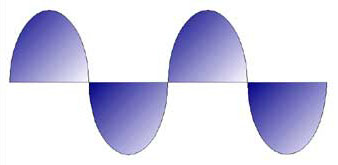
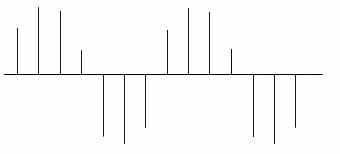
Take as an example the classic elementary sinusoid, like the one in the figure.

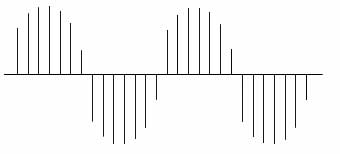
Let’s say we have a device that takes, over a certain period of time, a certain number of samples of the signal: for example, 14 samples per period of the sinusoid.
We will obtain a series of samples like the one in the figure:

We see that the original sinusoid is still intuitive, so it is possible to reconstruct it and reverse the procedure.
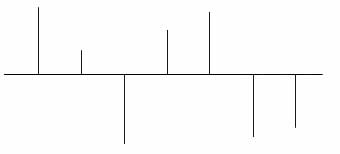
But imagine halving the sample rate, that is, doubling the time between one measurement and another.
We will obtain a different series of samples, less dense than the previous one:

The sine wave can still be guessed, but it is clear that we have lost some of the original information.
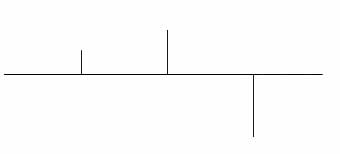
Halving again, the situation becomes almost critical:

Here it is already very difficult to trace the original signal.
By reducing more by half, all traces of the sine wave are lost:

Therefore, we understood that there is a critical point, below which the sampling frequency cannot fall, under penalty of total loss of information.

Sample rate, a clear explanation about what the sample rate is

Let’s proceed in order and start from the sampling frequency, defined as the number of times per second in which our AD converter will measure the electrical signal placed at its input: it is measured in Herz (Hz).

Obviously, the greater the number of “photographs” that we take of our electrical signal in one second, the greater its fidelity to the “original” sound wave. At the same time, obviously, our converter will be obliged to spend a greater amount of “energy” (faster information processing speed, greater storage space, etc.) which therefore translates into a different quality of components and obviously at a higher cost.

La tasa de muestreo

Sampling rate

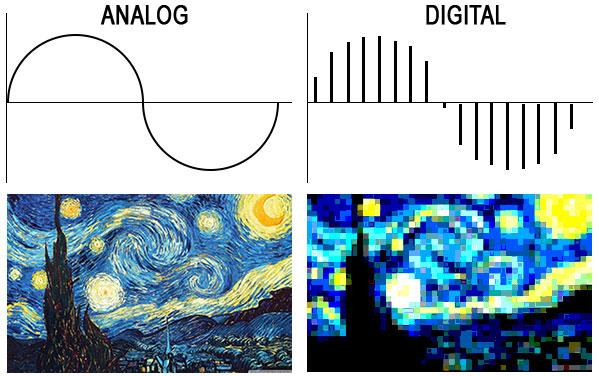
On the left an analog wave (a sine wave) in the time / amplitude domain and an image of Vincent Van Gogh’s “Starry Night” which, for our teaching purposes, we intend to be very high resolution. On the right, a quick reconstruction of the same sampled analog waveform and the same photograph reproduced with a much smaller number of pixels.

Well, if it were that simple, there wouldn’t be a bit of fun. Let’s go back to the diagram of the AD converter at the end of the previous article. Surely you have noticed that the first block through which our signal passes is the so-called “Anti-aliasing filter”, nothing less than a low pass filter.

Coooooooooooosaaaaaaaaaaaaaaaaaa !? Do we want to faithfully reproduce our signal in the digital domain and the first thing we do is pass it through a filter to change its frequency component (remove all components above a certain frequency)?

Yes my dear … you need to share a minimum (but I swear, a minimum) of signal theory to tell you a bit about the “Nyquist-Shannon Sampling Theorem” (for the “fetishists” – no offense, for course …. I am also part of it: of the mathematical treatment, take a look at the related Wikipedia page where you can find a good perspective), based on which, to sample an analog signal without loss of information (that is, to be able to re-enter it – then convert it DA – into the analog domain without “noticeable” differences compared to the original signal) it is necessary that the number of samples taken per second (the sampling frequency) is at least twice the maximum present frequency into the signal to be sampled, Therefore, it is worth introducing frequencies in the digital signal that do not exist in the original analog signal (the calls, and hence the filter name, alias frequencies).
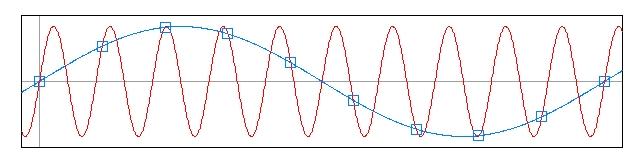
The aliasing phenomenon occurs because we do not have enough samples to describe the trend of the higher frequencies, which are therefore translated into the digital signal as lower frequencies, although nonexistent in the original signal. See this beautiful image always taken from the omniscient Wikipedia. In red the sinusoid sampled at intervals not sufficient to reconstruct it, and in blue the frequency alias (lower) that originates from the points we have taken.

La tasa de muestreo

Sampling rate

As we already know, the human ear is sensitive, at most (at an early age and in good hearing health), to frequencies around 20 KHz; In theory, our anti-aliasing filter should be set at 40,000 Hz and that should be our sample rate, but since it is practically impossible to build a filter with such a steep slope in analog, we opted for a filter with less steep slope and so both leaves the signal to sample frequencies slightly higher than 20,000 Hz (which we don’t hear, but there are), sampling at a slightly higher frequency. Therefore, the minimum sample rate used is equal to 44,100 samples per second.

Obviously, technological development and, nevertheless, the opinion and experience of many professionals (which I personally share very modestly) have in any case led to the awareness that, having set the minimum limit of 44,100 Hz (we will see later, it is the sampling frequency of the files that make up an audio CD), sampling at higher frequencies certainly leads to better results both from the point of view of signal manipulation (passing through a plug-in, the sum of two or more signals within a DAW, etc.) and from a listening point of view.

Later we will return to the topic, we will develop it further and we will begin to understand the logic with which the converter assigns a value in “machine language” to the different samples taken during the sampling phase.