Digital sound encoding


Free Download Mp4Gain
picture

Digital sound encoding

Digital audio

The development of methods for encoding audio information as well as moving images (animation and video recordings) occurred with a delay relative to the types of information discussed above.

Digital Audio

A computer is a digital device, that is, an electronic device in which a discrete signal is the operating signal. Today’s computers operate on discrete signals that carry binary values, conventionally designated as “yes” and “no” (at the electrical level: 0 volts and V volts, for some non-zero value of V). With a one-step binary signal, you can transfer information about one of two positions: 0 (“yes”) or 1 (“no”). Using N binary signals in one step, you can transfer information about one of 2 N positions (2 N is the number of combinations of zeros and ones for N signals). The interaction of all the blocks that make up a computer occurs through the exchange and processing of one or more binary signals simultaneously. They are all control codes as well as the information that is processed itself, everything is represented on the computer in the form of numbers. For this reason, audio signals in digital equipment are also represented as numbers.

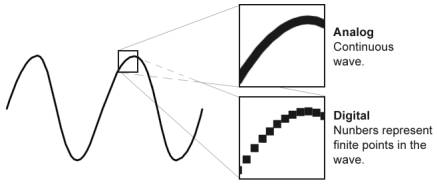
So how can you describe an analog audio signal in digital form? A real audio signal is a complex waveform, a certain complex dependence of the amplitude of a sound wave in time. In Fig. 2 shows a graph of a real sound wave.

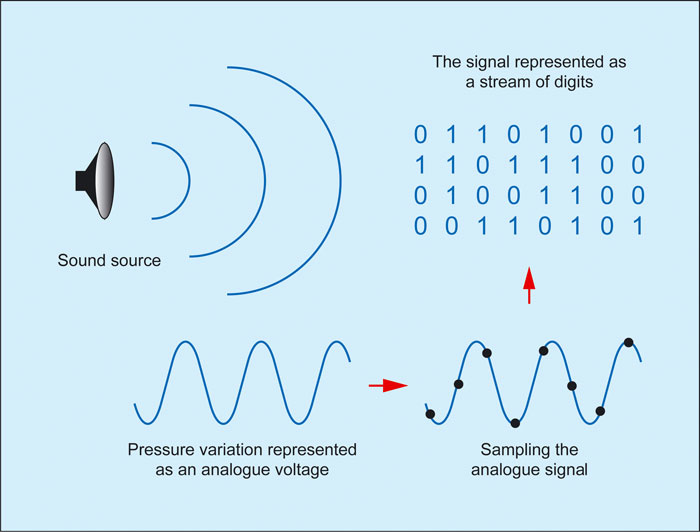
For computer processing, an analog signal must somehow be converted to a sequence of binary numbers. Let’s proceed as follows. We will measure the voltage at regular intervals and write the obtained values ​​into the computer memory. This process is called sampling (or digitization).

Converting an analog audio signal to digital is called analog-to-digital conversion or digitizing. The process of this transformation consists of:

carry out measurements of the amplitude of an analog signal with a certain time interval: sampling,

subsequent recording of the amplitude values ​​obtained in numerical form – quantification.

The time sampling process is the process of obtaining the instantaneous values ​​of an analog signal converted into a specific time step, called a sampling step.

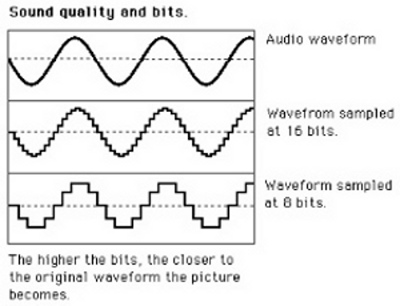
The higher the sample rate (that is, the number of samples per second) and the more digits assigned to each sample, the more accurately the sound will be represented. But this also increases the size of the sound file. Therefore, depending on the nature of the sound, the requirements for its quality and the amount of memory occupied, some compromise values ​​are chosen.

The number of signal measurements taken in one second is called the sample rate or sample rate, or sample rate (from English “sampling”). Obviously, the smaller the sampling step, the higher the sampling frequency (that is, more often amplitude values) and therefore the more accurate representation of the signal we get.

The human ear does not notice the gradation of the received signal. Here the following analogy can be drawn. Each person watched movies in the cinema and before their eyes on the screen there was a continuous and fluid action: but, in fact, a filmstrip is a series of still and discrete images that move at a high speed of 24 frames per second . Since human eyes are characterized by a certain inertia, they are easy to fool, which the filmmakers use extremely cleverly. Our ears are also somewhat imperfect and can be tricked in this way, representing a continuous analog signal as a sequence of rapidly changing instantaneous voltage values. But unlike a film strip, changing the “sound frame” happens thousands of times faster.

Now, to record each individual amplitude value, it must be rounded to the nearest quantization level. This process is called amplitude quantization. In more formal terms, amplitude quantization is the process of replacing the actual (measured) values ​​of the signal’s amplitude with values ​​that approximate with some precision. Each of the 2 N possible levels is called the quantization level, and the distance between the two closest quantization levels is called the quantization step. Quantization of signal values ​​introduces additional interference into the signal spectrum, called quantization noise or division noise … Quantization noise (error) refers to the signal that makes the difference between the signals reconstructed original and digital audio tracks. This difference results from the rounding of the measured signal values.


Free Download Mp4Gain
picture


Mp4Gain Main Window
picture


Mp4Gain Features
picture


Free Download Mp4Gain
picture

Methods used to compress digital audio.

Methods used to compress digital audio.

Audio Encoding

Information compression methods when working with sound.

Audio Encoding

The larger the memory capacity of the WT card, the more realistic the sound will be (as more samples are stored in memory, they are recorded at a higher resolution). The General MIDI standard describes more than 200 instruments; To store your sound samples (tables), at least 8 MB of memory is required (at least 20 KB for each sample).

Known WF (Wave Form) method of sound generation, based on the transformation of sounds into complex mathematical formulas and the subsequent application of these formulas to control a powerful processor in order to reproduce the sound; from WF synthesis expect an even better reality (relative to FM and WT technologies) of musical instruments playing with limited volumes of sound files.

To reduce data flow, other analog (non-PCM) encoding methods are used. For example, a coding technique based on known characteristics of an analog signal is known to significantly reduce the amount of data stored; with the so-called -The encoding of the analog signal is converted into a digital code determined by the logarithm of the magnitude of the signal (and not by its linear transformation). The disadvantage of this method is the need to have a priori information about the characteristics of the original signal.

Conversion methods are known that do not require a priori information about the original signal. When differential pulse code modulation (DPCM, Differential Pulse Code Modulation) persists single signal difference between current and previous levels (the difference requires a digital representation of fewer bits than the full amplitude value). With delta modulation (DM, delta modulation), each sample consists of a single bit, which determines the sign of the change in the original signal (increase or decrease); Delta modulation requires a higher sample rate. Differential PCM technologies involve the accumulation of errors over time, so special measures are taken to periodically calibrate the ADC.

The most common when recording received audio is adaptive pulse code modulation (ADPCM, Adaptive Pulse Code Modulation), using 8- or 4-bit coding for the difference signals. The technology was first applied by Creative Labs and provides data compression up to 4: 1.

However, other audio information compression / decompression methods (software) are often used; Among them, the most popular lately is the MP3 format developed by Fraunhofer IIS (Fraunhofer Institute Integrierte Schaltungen, www.iis.fhg.de) and by THOMSON (the full specification of the MP3 format is published on the website www.mp3tech.org ). The full name of the MP3 standard sounds like MPEG-Audio Layer-3 (where MPEG is the essence of the Moving Picture Expert Group, not to be confused with the MPEG-3 standard designed for use in high definition television).

MP3 encoding of data occurs through the allocation of independent independent data blocks: frames. To do this, the original signal during encoding is divided into equal length parts, called frames, and encoded separately (to further reduce the amount of data, compression is applied using the Huffman algorithm); When decoding, the signal is formed from a sequence of decoded frames. The encoding process takes a significant amount of time; decoding (during playback) is done on the fly.

The MP3 format provides the best sound quality with the smallest file size. This is achieved by taking into account the peculiarities of human hearing, including the effect of masking a weak signal from one frequency range with a stronger signal from an adjacent range (when it occurs) or a strong signal from the previous frame, causing a temporary decrease in the ear’s sensitivity to the signal of the current frame (in other words, minor sounds are eliminated, which are not heard by the human ear due to the presence at this / previous moment of another – louder sound). It also takes into account the inability of most people to distinguish signals that are below a certain power level, different for different frequency ranges. This process is called adaptive coding, and it saves at least sound details that are meaningful from the point of view of human perception. The compression ratio (hence the quality) is not determined by the MP3 format, but by the width of the data stream during encoding.

Audio encoding and processing. Audio encoding

Audio encoding and processing. Audio encoding

Audio encoding

There are three main types of audio digits:

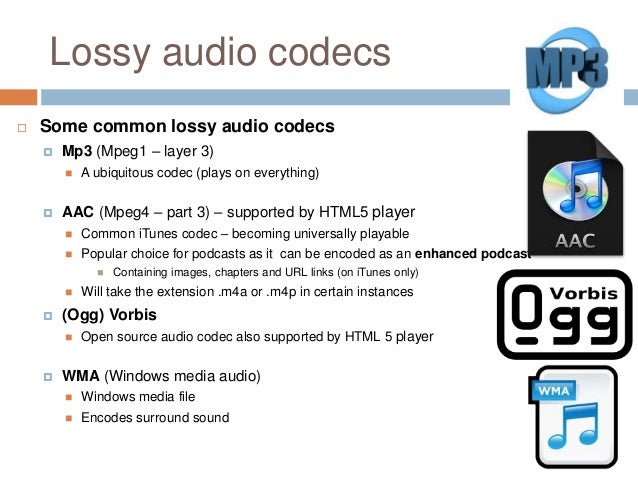
lossless & lossy audio encoding

format – no compression;
format (lossy) – lossy compression;
format (lossless): lossless compression.
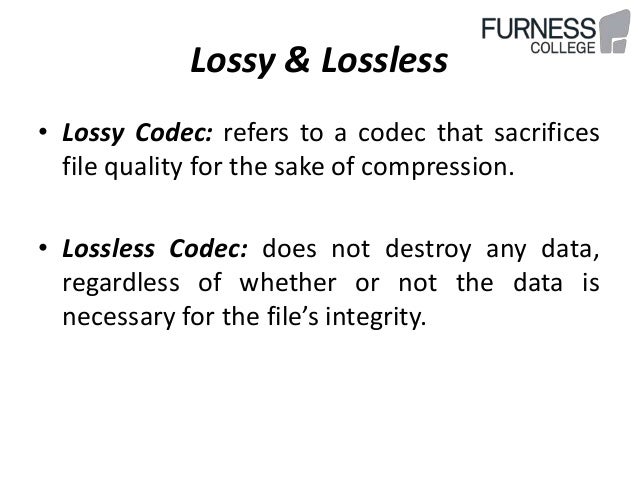
Lossy compression: technology in which there is a significant reduction of the encoded file compared to the original, due to the removal of information that is not perceived by the human ear.

The downside of this technology is the fact that the compressed file will never be identical to the original.

Lossless – Lossless compressed audio formats, including:

FLAC (Free Lossless Audio Codec)
APE (mono audio)
WV (WavPack)
These formats are capable of converting CD to digital format while maintaining quality. As an example, you can take a CD, convert it to WAV, then WAV to FLAC, then go back from FLAC to WAV, and then burn it to a blank CD and you have an absolutely identical copy of your source.

What format does the music sound with the best quality?
The most popular is the lossless FLAC format, and one of the most widely used CD to FLAC conversion programs is EAC (Exact Audio Copy).

Of all the parameters of digital audio, it is necessary to pay attention first of all to the following indicators:

sampling rate (precision of digitizing an analog signal in time),
bit rate (the amount of information contained in the file in terms of one second).

The sample rate is the frequency at which digital audio is processed. The most common sample rate for quality audio formats is 44.1 kHz.

It is generally accepted that a high bit rate guarantees the best quality; this is true, but only if the source file is of good quality. A high-quality MP3 should have a bit rate of 320 kbps, but a high-quality FLAC format generally has a bit rate of 900 kbps or more.

What is the best quality music format?
In addition to the audio formats themselves, for high-quality music sound, high-quality reproduction equipment is also needed: speakers, amplifiers, headphones. In other words, if you use cheap desktop speakers and headphones, you won’t be able to fully enjoy high-quality sound and unleash the full potential of lossless formats.

Without going into technical details, the following formats can be recommended:

For listening at home, I recommend the best FLAC format in my opinion. For an audio player, the MP3 format with a bit rate of at least 320 kbps is a good solution. Personally, I only use the FLAC format on all devices, since the volume of the microSD cards allows you to store a sufficient amount of data on the player.

As for the equipment for high-quality music playback, I advise you to pay attention to the following brands:

If inexpensive acoustics do not suit you and you are a fan of high-quality sound equipment (Hi-Fi or Hi-End), then everything is in your hands and you are limited only by your budget, I will not give recommendations.

Audio encoding and processing. Audio encoding

There are three main types of audio digits:

format – no compression;
format (lossy) – lossy compression;
format (lossless): lossless compression.
Lossy compression: technology in which there is a significant reduction of the encoded file compared to the original, due to the removal of information that is not perceived by the human ear.

The downside of this technology is the fact that the compressed file will never be identical to the original.

Lossless – Lossless compressed audio formats, including:

FLAC (Free Lossless Audio Codec)
APE (mono audio)
WV (WavPack)
These formats are capable of converting CD to digital format while maintaining quality. As an example, you can take a CD, convert it to WAV, then WAV to FLAC, then go back from FLAC to WAV, and then burn it to a blank CD and you have an absolutely identical copy of your source.

What format does the music sound with the best quality?
The most popular is the lossless FLAC format, and one of the most widely used CD to FLAC conversion programs is EAC (Exact Audio Copy).

Of all the parameters of digital audio, it is necessary to pay attention first of all to the following indicators:

sampling rate (precision of digitizing an analog signal in time),
bit rate (the amount of information contained in the file in terms of one second).

The sample rate is the frequency at which digital audio is processed. The most common sample rate for quality audio formats is 44.1 kHz.

It is generally accepted that a high bit rate guarantees the best quality; this is true, but only if the source file is of good quality.

WHAT IS BLUETOOTH APTX?

WHAT IS BLUETOOTH APTX?

Bluetooth aptX

The popularity of wireless headphones grows every year. The trend is due to the convenience of its use, since the method of communication with the device via Bluetooth does not imply interference with cables, which gives the user greater freedom of movement.

Bluetooth APTX

Little by little, smartphone manufacturers are ditching the 3.5mm headphone jack as well, forcing modern device owners to keep up. That said, sound quality doesn’t always come with comfort. Good classic headphones often outperform their wireless counterparts on this parameter. But with the recent arrival of lovers of Qualcomm AptX technology to listen to music, headphones no longer have to choose between sound quality and ease of use. Now AptX, as well as AptX HD, can be seen more and more in the specifications of the devices. What is technology, how does it work and what is needed to assess its capabilities, we will consider.

What you need to know about listening to wireless audio

Let’s start with what Bluetooth is. This is a form of wireless data transmission over a short distance between compatible devices. The standard refers to wireless personal area networks (WPAN) and allows communication using radio waves. Radio communication is implemented in the ISM range of 2.4-2.4835 GHz, and is used in various devices, including home appliances, smartphones, computers, and others. However, the Bluetooth protocol supports point-to-point and point-to-multipoint connections. Full music streaming via Bluetooth technology is ensured by the following sound quality characteristics:

Sampling (or sampling) frequency. This is the number of sound volume measurements per second, that is, the frequency with which the analog signal is converted to a digital matrix. The parameter is measured in hertz or kilohertz (Hz, kHz). Therefore, the higher the sampling frequency, the better the sound is transmitted.
Audio encoding depth (sampling bit depth). This is the amount of data required to encode the discrete levels of digital audio loudness, measured in bits. In simple words, the bit depth determines the measurement precision of the incoming signal and the higher the bit depth, the higher the sound quality and at the same time increases the volume of the sound file.
Information transfer rate or bit rate. This is the amount of data transmitted per unit of time. In this case, we are talking about the transfer of audio data from the device to the headphones. That is, the higher the value, the more data is transmitted and processed during the same time, which improves sound quality. Bit rate is measured in kilobits per second (kbps or kbps).

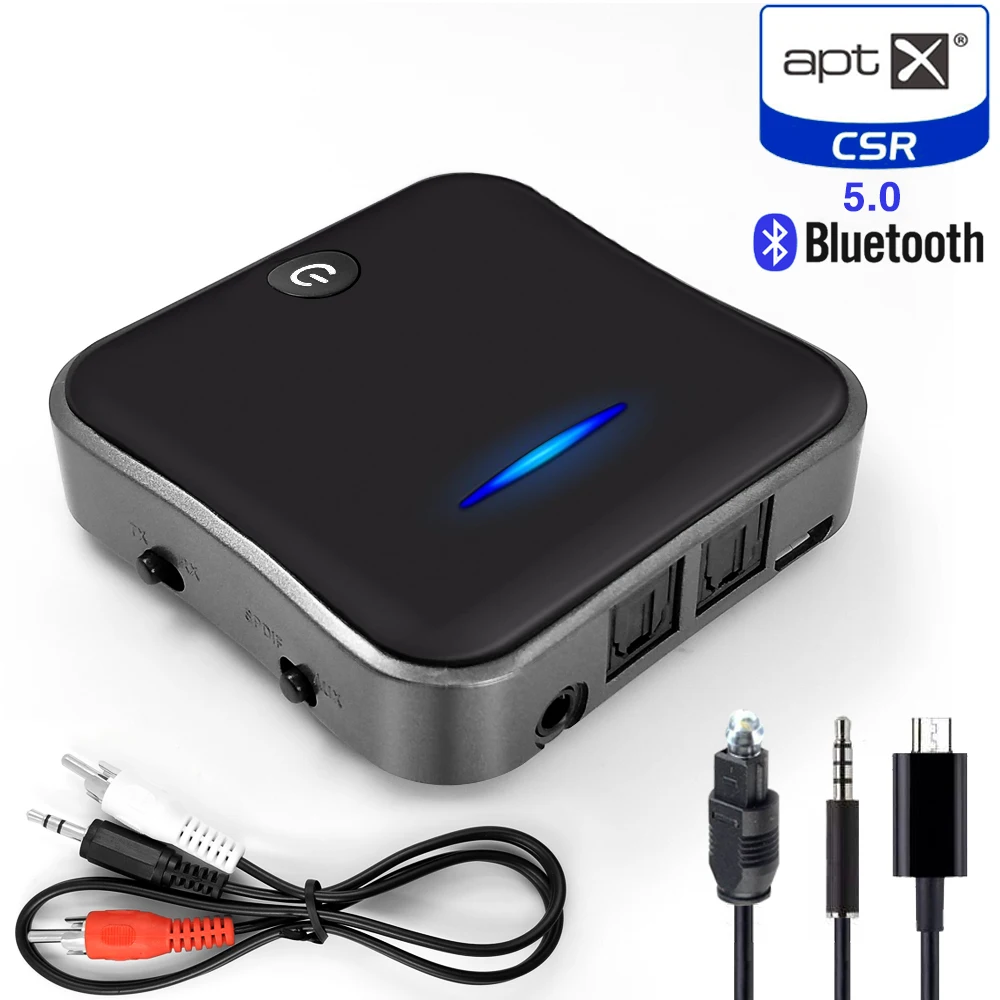
Now let’s consider what this AptX Bluetooth technology is. This is an audio codec from Qualcomm that allows you to transfer, compress, and decompress high-quality audio files via Bluetooth. So, using technology, it was possible to achieve a better sound, this is ensured by the fact that there are practically no losses at the time of conversion to digital, so the difference from the standard Bluetooth codec (SBC) is noticeably felt. . The enhanced version of AptX HD uses dynamic encoding, where most of the data is encoded losslessly, and if this is not possible, it minimizes it.

Use wireless headphones

With all the impressive advantages of modern technologies, the sound quality depends not only on the audio codec used, but also on the characteristics of the hardware (headphones, speaker). Therefore, supported devices should also be implemented at the highest level, and you shouldn’t expect pure deep sound from low-power equipment with declared support for the AptX codec.

What are the abbreviations aptX, aptX HD, and LDAC?

All of these names indicate Bluetooth codecs that differ in data transfer characteristics. They have different parameters of sample rate, audio encoding depth, and bit rate, respectively, and the sound quality will be different.

AptX

Audio codec that allows audio to be transmitted via Bluetooth in 16-bit quality at a sample rate of 48 kHz to 352 kbps. The analog signal is read 48 thousand times per second, transmitted with 16 bits, which corresponds to the parameters of the CD. It is a worthy alternative to SBC with less loss of compression and better sound, cleaner and more detailed. AptX’s transfer rates are not impressive by today’s standards.

Audio codecs


Audio codecs

Audio Codec

Codecs played at the same time, if not a key, a very important role in the development of technologies in the field of digital sound.

Audio CODECs


The rapid spread of mobile communications, Internet telephony, portable players – these are all examples of the use of codecs. It was only thanks to its invention and implementation that it was possible to transmit audio information through channels that then had a very limited bandwidth. This problem could be solved by increasing the capacity of all transmission channels, which would mean an incredible material investment associated with the remodeling and replacement of most of the elements of the existing infrastructure, or by developing an algorithm that can significantly reduce the amount of data. resulting from the analog to digital conversion and thus be able to use the existing infrastructure. The second way was much more sensible.

What are codecs?
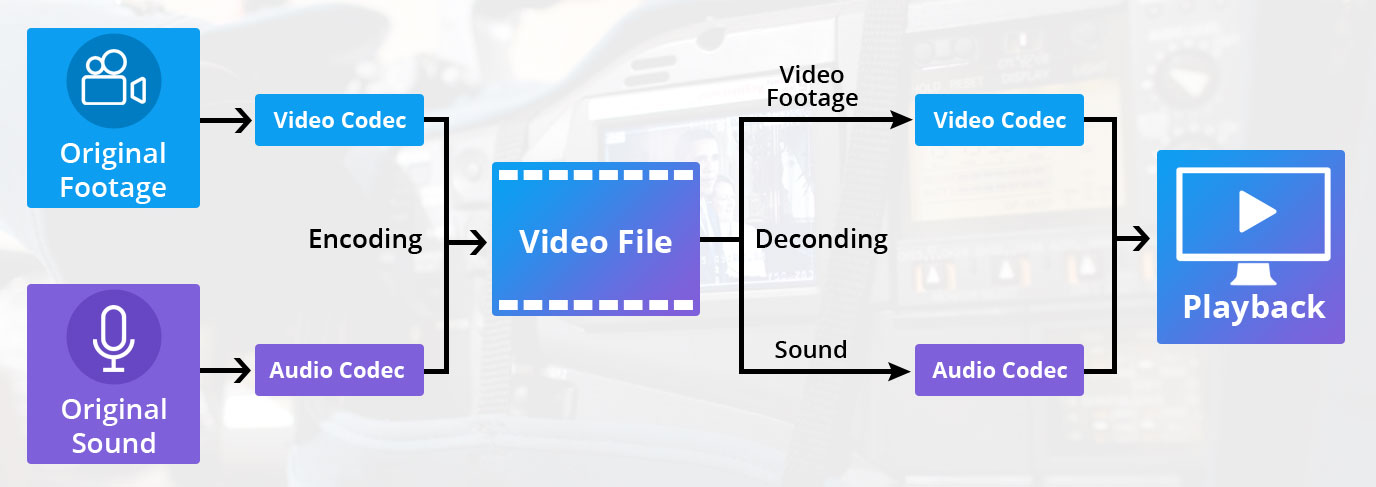
A codec is an algorithm based, as a rule, on one or another psychoacoustic model, which will be discussed below, and includes two modules: an encoder and a decoder.

The encoder encodes digital audio into a data stream, the volume of which, compared to the original volume of the raw material, is significantly lower. Depending on the codec used and the encoding parameters, it is possible to achieve an optimal balance between sound quality and the desired data volume.

However, to reproduce the sound encoded in this way, a decoder is required, whose task is to decode the digital audio stream back to the standard format (PCM).

Codecs and their families
In general, all codecs, of which there are very many at the moment, can be divided into two categories:

At a loss
As mentioned above, basically the codecs work based on one or another psychoacoustic model, which determines which audio information is not key for our brain and could be sacrificed and discarded, thus reducing the amount of data. The disadvantage of this method is that when decoding said transmission, the lost audio information cannot be recovered. The compression ratio can reach up to 90% of the original data volume, while maintaining satisfactory sound quality for most normal users. The most prominent representatives of this family are the well-known and perhaps the most common MP3 and WMA.

No loss
In this case, the encoding occurs without data loss, allowing all the information in the original audio signal to be fully recovered after the decoding process. However, the degree of data compression that can be achieved with these codecs is much lower than that of the Lossy family of codecs. In general, depending on the encoding parameters, compression of up to 60% of the original volume is possible. The most popular among the Lossless family codecs are FLAC, APE, and Apple Lossless on the Apple platform.

It should be noted that the vast majority of video formats also contain compressed video and audio. Formats like Dolby Digital, DTS and their varieties are nothing more than codecs. Without a suitable decoder, it is not possible to read the audio data. In this case, maximum white noise sounds. Therefore, you must be careful not to damage your own ears and equipment.

Encoding options
The encoding parameters determine the quality of the resulting sound and the amount of data in the resulting file. More aggressive compression will reduce the sound quality and reduce the amount of data, that is, increase the compression ratio. Depending on the algorithm used, the result, or rather the quality of your sound, can differ significantly, even when using the same encoding parameters.

One of the most important is considered to be the data flow rate per unit of time: kbps (kilobits per second, the number of kilobits per second). The higher this parameter, the less aggressive the data compression will be. As a general rule of thumb, for Lossy family codecs, optimal values ​​are 192 to 320 kbps. When lower values ​​are used, the loss of quality becomes more significant and is noticed even by ordinary users who do not have any special rights to sound quality.

Psychoacoustic codecs and models
The vast majority of audio codecs are based on psychoacoustic algorithms that utilize the limitations of the human auditory system. These principles are based on research in the field of psychoacoustics, the most significant conclusions of which include the masking effect.

MIDI and digital sound: pros and cons

MIDI and digital sound: pros and cons

Digital Audio

The WAVE format is one of many, but it is far from the only format for recording digital audio.

Digital Audio

Unlike MIDI data, digital audio data is actually sound recorded in thousands of units called samples. Digital data represents the amplitude (or volume) of a sound at discrete moments. The sound of digital data is independent of the playback device and therefore always sounds the same. But you have to pay for this with large volumes of sound files.

MIDI data is to digital data what vector graphics are to bitmaps. In other words, MIDI data depends on the audio playback devices and digital data is independent. Just as the appearance of vector graphics depends on the printer or monitor screen, the sound of MIDI files depends on the MIDI device to play these files. Similarly, a melody played on a concert piano will sound different from a normal piano. Digital data, on the other hand, is identical and independent of the reproduction system. The MIDI standard is similar in this respect to the PostScript standard and allows you to control instruments in understandable language.

Compared to digital sound, MIDI has the following advantages:

MIDI files take up less memory and the size of these files does not affect sound quality. On average, MIDI files are 200 to 1000 times smaller than digital files and therefore take up a small amount of RAM, disk space and do not require large CPU resources.

In some cases, MIDI files sound better than digital audio files. In this case, the sound source of the MIDI files must be of high quality.

You can change the length of MIDI files by changing the tempo of the sound, while maintaining the quality and volume of the sound. MIDI data can be easily edited, even at the single note level. You can manipulate small segments of a MIDI song (with millisecond precision), which is not possible with digital audio.

The main disadvantage of a MIDI file comes from its merits. Since MIDI data is not sound itself, playback will be as accurate as the device for playing the MIDI data is identical to the device used to create the original file. Even the sound of a MIDI instrument according to the General MIDI standard depends on the electronic playback device and the method used. MIDI sound is not used for voice playback.

The main advantage of digital audio over MIDI sound is that the reproduction quality of digital sound is always constant, and here MIDI sound is inferior to digital sound. There are two reasons why you should work with digital audio:

A wider selection of programs and systems that support working with digital sound.

The preparation and creation of digital sound elements does not require knowledge of music theory, which cannot be said for MIDI data.

Sound tips
Voice recording from microphone
Any book devoted to multimedia necessarily contains a section on microphone sound recording. In addition, the Sound Recorder (Phonograph) program, which is included in the standard Windows distribution, is usually used for this. Working with it is described in detail in the attached help file. It is easy to use and we will not dwell on it in detail.

The microphones come in condenser and dynamic microphones. Capacitors are more expensive, they give better sound, but your connection must be compatible with a sound card. And the vast majority of sound cards are designed for dynamic microphones.

Another important characteristic of a microphone is its directivity. The microphones are omni-directional (they have the same sensitivity to sound in all directions), unidirectional (they have the highest sensitivity to sound coming from the front), and bi-directional (more sensitive to sound coming from the front and rear). A unidirectional microphone is usually the best option, as it eliminates background noise. But it is more expensive than omni-directional microphones and is more sensitive to choppy breath sounds.

Be sure to pay attention to the impedance (impedance) of the microphone. The optimal value is around 600 ohms.

Therefore, we recommend a 600 ohm dynamic omni-directional microphone.

The benefits of digital audio

The benefits of digital audio

Digital Audio

The basics of “numbers”

DIGITAL AUDIO

Each of the multimedia devices on sale today, be it a CD player, a voice recorder or a flash memory player, uses many different types of presentation of data streams, which are then converted into sound. And even more sound formats used for professional purposes have been invented. An inexperienced buyer is forced to gather information on designations on boxes and devices from a variety of sources, often receiving incorrect information or even more confusion.

Almost all devices in the “Portable Audio” section of the ZOOM.CNews.ru catalog support multiple sound formats at the same time, and many devices that do not belong in this category are also tagged with support for playing sound files. To help our reader, we decided to create a short glossary of abbreviations and talk about the most common formats. We plan to leave it open for updates and modifications, adding new formats and describing in more detail the advantages and disadvantages of the already common or forgotten ones.

A little theory

To begin with, remember that digital sound is nothing more than a collection of numbers. The determining factor is the system by which sound as air pressure is converted into data streams and encoded for further processing and reproduction. Consequently, digital sound is usually included in computer files with various extensions, which more often (but not always) can determine their format. And the same concept of format can have, paradoxically, two meanings. First, the format may exist as a general characteristic, including both the type and the physical characteristics of the medium (disc or cassette), method of recording, principles of encoding, and protection against errors. Second, the format can only be understood as the method of encoding and compressing sound, as standard means are used for transfer, for example a computer.

Analog sound, unlike digital, is reproduced on analog devices and has several significant differences. While not a data stream, analog sound is represented as a continuous electrical signal that represents the change in sound wave. To translate it into digital format, the sound is “digitized”, that is, it is divided into certain segments, in which the numerical value of the amplitude is fixed at that moment. We will not delve into the principles of digital sound creation, but it is absolutely necessary to note that the more often a sound segment is divided and its characteristics described, the clearer and more complete the sound image itself is created.

This process generates an enormous flow of data that describes the sound, and it is clear that each digital audio format is nothing more than a compromise between the need to present the sound as loud as possible and the limitations of the memory of the computer or device. Of reproduction.

A little more theory. In most cases, the human ear perceives sound with a frequency no higher than 22,000 Hz and, to describe it fully in digital form, a sampling frequency of at least 44.1 kHz is required. Since it is absolutely impossible to determine the value of the signal at any given time, during digitization quantization occurs, that is, the replacement of the actual values ​​of the signal by approximate values. The more levels of audio quantization, the more accurately the signal level is described. As a result, each standard CD carries an audio signal with a sampling frequency of the same 44.1 kHz and a 16-bit quantization level,

Differences between analog and digital audio

Differences between analog and digital audio

Analog vs Digital

Sound information. Sound is a wave that travels through air, water, or other medium with a continuously changing intensity and frequency.

Digital vs. Analog

A person perceives sound waves (air vibrations) with the help of hearing in the form of sound of varying volume and pitch. The greater the intensity of the sound wave, the louder the sound, the higher the frequency of the wave, the higher the pitch of the sound (Fig. 1.1).

Dependence of the volume and pitch of the sound on the intensity and frequency of the sound wave.

The human ear perceives sound at a frequency of 20 vibrations per second (low sound) to 20,000 vibrations per second (high sound).

A person can perceive sound in a wide range of intensities, in which the maximum intensity is 1014 times greater than the minimum (one hundred thousand billion times). A special unit of “decibels” (dbl) is used to measure the volume of sound (Table 5.1). Decreasing or increasing the sound volume by 10 dB corresponds to a decrease or increase in sound intensity by 10 times.

Provisional discretization sound. In order for a computer to process sound, a continuous audio signal must be converted to a discrete digital form using time sampling. A continuous sound wave is divided into separate small time sections, for each section a certain value of sound intensity is set.

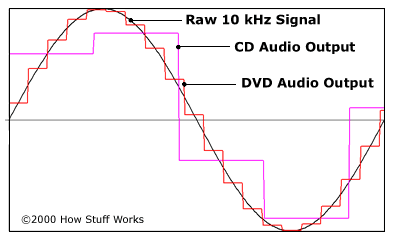
Therefore, the continuous dependence of the loudness of the sound at time A (t) is replaced by a discrete sequence of loudness levels. On the graph, this appears to replace a smooth curve with a sequence of “steps” (Fig. 1.2).

Sync Audio Sampling

Sampling frequency. A microphone connected to the sound card is used to record analog sound and convert it to digital format. The quality of the digital sound obtained depends on the number of measurements of the sound volume level per unit of time, that is, the sampling frequency. The more measurements that are made in 1 second (the higher the sampling frequency), the more accurately the “ladder” of the digital audio signal repeats the curve of the dialogue signal.

The audio sample rate is the number of sound volume measurements in one second.

The audio sample rate can vary between 8000 and 48000 sound volume measurements per second.

Audio encoding depth. Each “step” is assigned a specific value for the sound volume level. Loudness levels of sound can be viewed as a set of possible states N, for which a certain amount of information I is required, which is called audio coding depth.

Audio encoding depth is the amount of information required to encode the discrete volume levels of digital audio.

If the encoding depth is known, then the number of digital audio loudness levels can be calculated using the formula N = 2I. Let the audio encoding depth be 16 bit, then the number of sound volume levels is:

N = 2I = 216 = 65536.

During the encoding process, each sound volume level is assigned its own 16-bit binary code, the lowest sound level will correspond to the code 0000000000000000 and the highest – 1111111111111111.

The quality of digitized sound. The higher the sampling frequency and depth of the sound, the better the sound of the digitized sound. The lowest quality of digitized sound, corresponding to the quality of telephone communication, is obtained at a sampling rate of 8000 times per second, a sampling rate of 8 bits, and by recording an audio track (“mono” mode). The highest quality of digitized sound, corresponding to the quality of an audio CD, is achieved with a sampling rate of 48,000 times per second, a sampling rate of 16 bits and the recording of two audio tracks (stereo mode) .

It should be remembered that the higher the quality of the digital sound, the greater the volume of information in the audio file. You can estimate the volume of information in a digital stereo sound file with a duration of 1 second with an average sound quality (16 bits, 24,000 measurements per second). To do this, the encoding depth must be multiplied by the number of measurements in 1 second and multiplied by 2 (stereo sound):

16 bits × 24,000 × 2 = 768,000 bits = 96,000 bytes = 93.75 KB.

Sound editors. Sound editors allow you not only to record and play sound, but also to edit it. Digitized sound is presented in sound editors visually, so copying, moving, and deleting parts of the audio track can be easily performed with the mouse. Also, you can layer tracks

Audio encoding and processing.

Audio encoding and processing.

MP3 audio encoding process

Parameters that affect digital sound quality Minimum and maximum sound quality.

Audio encoding and processing

My grandfather was listening to a gramophone. My father’s youth turned to music coming from the speaker of a reel-to-reel tape recorder. The heyday and decline of cassette recorders fell upon my youth. My son is growing up in the age of digital audio. To keep up to date and give my son a good “sound”, I decided to find out what determines the quality of the digital audio signal reproduction.

I talked to my music loving friends. He did an information search on the Internet. As a result, I came to the conclusion that high-quality sound can be achieved in the digital age by choosing the right 7 basic elements of modern music centers:

the format in which the music is recorded;
player;
digital to analog converter;
amplifier;
acoustics;
cables;
food.

Below I will share my observations and conclusions on achieving high quality sound recordings in digital formats.

Lyrical digression, experts don’t need to read.

In a nutshell, I will explain where digital sound comes from. During the recording process, the microphone converts mechanical vibrations (the sound itself) into an analog electrical signal. An analog signal is, in the most general case, similar to a sinusoid that has been familiar to all of us since high school. In the age of analog sound, it was this signal that was recorded on various media and then played back.

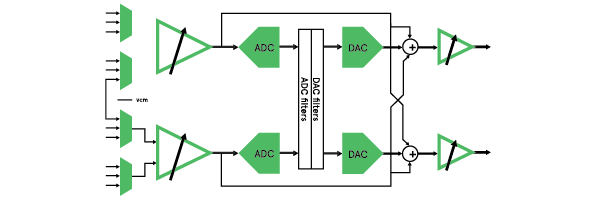
With the development of microprocessor technology, it became possible to record and store audio information in digital formats. These formats are obtained through an analog-to-digital conversion (ADC) process.

During the ADC, the analog signal (our high school sine wave) becomes a discrete one (in other words, it is cut into pieces). In the next stage, the discrete signal is quantized, that is, each resulting segment of the sinusoid is assigned a digital value. In the third step, the quantized signal is digitized, ie encoded in the form of a sequence of 0 and 1. With respect to digital sound recording, the information about the amplitude and frequency of the sound is digitized.

To record and store digital audio information, digital audio formats are used. The audio format is understood as a set of requirements for the digital representation of audio data.

When it comes to sound quality, digital formats are divided into 3 categories:

Formats without additional compression (CDDA, DSD, WAV, AIFF, etc.);
Lossless compressed formats (FLAC, WavPack, ADX, etc.);
Lossy compression formats (MP3, AAC, RealAudio, etc.).

High-quality sound is obtained when playing music saved in formats of the first and second category. In the formats of the third category, to reduce the amount of data, part of the information is deliberately excluded. For example, information about hidden frequencies.

Latent frequencies are those that are outside the range of perception of the average person: 20 Hz – 22 kHz. For audiophiles, this range is wider due to individual psychophysiological characteristics.

To complete your home audio library, you must select records saved in files with the following extensions:

* .wav, * .dff, * .dsf, * .aif, * .aiff are uncompressed sound files;
* .mp4, * .flac, * .ape, * .wma are the most common lossless compressed audio files.
From history. They say that the first experiments on the preservation of sound were carried out by the ancient Greeks. They tried to keep the sound in amphorae. It looked something like this: words were spoken into the amphora and it was quickly sealed. Unfortunately, none of those records have survived to this day.

The quality of digital sound reproduction.

The quality of digital sound reproduction.

Digital Sound Quality

Audio coding. Before converting music to another format, you must “unzip” it to WAV.

SOUND QUALITY

Sound information. Sound is a wave that travels through air, water, or other medium with a continuously changing intensity and frequency.

A person perceives sound waves (air vibrations) with the help of hearing in the form of sound of varying volume and pitch. The greater the intensity of the sound wave, the louder the sound, the higher the frequency of the wave, the higher the pitch of the sound (Fig. 1.1).

Dependence of the volume and pitch of the sound on the intensity and frequency of the sound wave.

The human ear perceives sound at a frequency of 20 vibrations per second (low sound) to 20,000 vibrations per second (high sound).

A person can perceive sound in a wide range of intensities, in which the maximum intensity is 1014 times greater than the minimum (one hundred thousand billion times). To measure the volume of sound, a special unit “decibel” (dbl) is used (Table 5.1). Decreasing or increasing the sound volume by 10 dB corresponds to a decrease or increase in sound intensity by 10 times.

The sound volume the volume of the
sound in decibels
lower limit of human ear sensitivity 0
leaf whisper 10
Conversation 60
Gudok Vehicle 90
Jet engine 120
Pain threshold 140

Provisional discretization sound. In order for a computer to process sound, a continuous audio signal must be converted to a discrete digital form using time sampling. A continuous sound wave is divided into separate small time sections, for each section a certain value of sound intensity is set.

Therefore, the continuous dependence of the loudness of the sound at time A (t) is replaced by a discrete sequence of loudness levels. On the graph, this appears to replace a smooth curve with a sequence of “steps” (Fig. 1.2).

Sync Audio Sampling

Sampling frequency. A microphone connected to the sound card is used to record analog sound and convert it to digital format. The quality of the digital sound obtained depends on the number of measurements of the sound volume level per unit of time, that is, the sampling frequency. The more measurements that are made in 1 second (the higher the sampling frequency), the more accurately the “ladder” of the digital audio signal repeats the curve of the dialogue signal.

The audio sample rate is the number of sound volume measurements in one second.

The audio sample rate can vary between 8000 and 48000 sound volume measurements per second.

Audio encoding depth. Each “step” is assigned a specific value for the sound volume level. Loudness levels of sound can be viewed as a set of possible states N, for which a certain amount of information I is required, which is called audio coding depth.

Audio encoding depth is the amount of information required to encode the discrete volume levels of digital audio.

If the encoding depth is known, then the number of digital audio loudness levels can be calculated using the formula N = 2I. Let the audio encoding depth be 16 bit, then the number of sound volume levels is:

N = 2I = 216 = 65536.

During the encoding process, each sound volume level is assigned its own 16-bit binary code, the lowest sound level will correspond to the code 0000000000000000 and the highest – 1111111111111111.