Let’s talk about “musical dynamics” and “musical loudness” Part 2


Free Download Mp4Gain
picture

Let’s talk about “musical dynamics” and “musical loudness” Part 2

Loudness

The two brief examples above are to tell you that frequency content, sound pressure, and sound duration will affect people’s perception of sound volume.
Loudness

That is why it is said that “loudness tends to human subjective perception”.

Since the volume is the subjective perception of people, how to quantify it?

To quantify “loudness”, the first thing you need to look at is the relationship between the frequency and the loudness of the human ear. There are two pictures below, you can read them carefully for reference:

Looking at the two images above, you will clearly see that the human ear and the human brain are not an organ that flattens the receiving frequency. It will not develop here. For the basis of loudness quantization, see the second image, there is a unit called “fon”. The phon unit is an attempt to quantize loudness. We take a 1kHz signal as an example, and it can be perceived at a volume of 40dB at 1kHz, so it is 40phon. Based on this, another unit is called a sone, 1 sone = 40phon. Both are units that attempt to quantify volume.

The international organization will be the ITU and the EBU…etc. The characteristics of the human ear, the psychoacoustics of the human brain, etc., all factors that affect loudness perception are considered together, and these factors are calculated through complicated mathematical calculations Define and standardize the reasonable loudness range for ” sound reproduction” only after statistically significant results have been obtained. Those interested can search: “ITU-R 1770 and ITU-R 1771”.

Should the rules be followed?

Of course continue! In fact, there is such a problem in Taiwan. Not to mention music, only the fourth channel and MOD, the sound level of each channel is different! The scariest thing is switching from the movie station to the shopping channel and often still being scared by the sudden volume of the shopping channel. Even radio shows have this kind of situation.

Here, you can go to Google again: “Volume War Loudness War”. All this is commonplace. This article is mainly to introduce the definition and specification of loudness.

Effects of loudness specifications

Although ITU, EBU, ISO, ANSI and other organizations have introduced loudness specifications, major music and video streaming platforms still have their own standards. However, the standards of the main platforms will continue to be around the specifications, and there will be no big or outside. When it comes to the audiovisual industry, it will generally affect these things:

Music streaming platforms: Records must meet loudness specifications at time of release

Video streaming platforms: Loudness specifications must be met when movies are released


Free Download Mp4Gain
picture


Mp4Gain Main Window
picture


Mp4Gain Features
picture


Free Download Mp4Gain
picture

Let’s talk about “musical dynamics” and “musical sonority”

Let’s talk about “musical dynamics” and “musical sonority”

Loudness

Where does the music we listen to come from?

Loudness

Before we talk about it, it is necessary to quickly talk about the disc creation process. In principle, it can be divided into three parts: the initial stage, the intermediate stage and the later stage.

First stage: compose, arrange

Middle term: recording, mixing

Post: post mastering, distribution, marketing

Whether a piece of music is good or not can be determined at the initial stage of the arrangement. Then there is the recording. The recording process can be finding real musicians to record the sound of real instruments, or completing the melody required by the arrangement through software instruments. Then find a singer or singers to sing… and so on. This process is called recording.

The “balance” of a song is not only achieving the balance of the melody in the arrangement, on the other hand, it is leaning on the mix to make the recorded elements a harmony in listening and frequency, it is also usually necessary to coordinate It depends on where the track goes, or what the producer wants. After all, the purpose of a song or album is to become a commercial release, and the post-production and embellishment processes that need to be done are necessary.

Usually the post-mastering process will be done last. After the entire album’s timbre direction, volume adjustment and minor flaws etc. are fixed, the final mastering will be uploaded according to the loudness specifications required by each streaming platform. .

Quantify the volume and intensity of what we hear

Sometimes people equate loudness with loudness. Actually the two are different. They are different and at the same time influence each other.

Loudness can be quantified, in simple terms, it is our most used “decibel dB”. Volume, on the other hand, tends to be subjectively perceived by people. how to say? Different 75-decibel musical signals are sent out at a time, and everyone has different feelings about its loudness and volume.

Because loudness is related to three things: frequency content, duration, and sound pressure.

We played a 1000 Hz test signal for three minutes at a sound pressure of 80 decibels. Your perception of the volume of this signal will be very different from playing it for 10 seconds or 30 seconds.

Let us take two singers as an example, one of them has a more evident timbre in the mid-high frequency band, and the other has a more evident mid-low frequency band, they sing the same song, and they sing with the same key and similar sound pressure, generally in the mid-high frequency band. The sound of the sound will feel stronger.

Loudness normalization

Loudness normalization

Loudness Normalization

When you have a lot of mp3 files, you often look for loudness normalization.

Loudness Normalization

What usually happens is that we have mp3s (although Mp4Gain can do Loudness normalization of many other audio and video formats!!) that have been created with different settings, for example different bit rates… which causes them to have a loudness different and that is annoying to the ear.

Many times we have been collecting mp3s from different sources, finding one here and another there and over time we have managed to have a good collection that is worth thinking about, but we have a problem: the loudness differs between different music or video files.

And this has generated that we desperately need to find a solution.

Mp4Gain is the result of many years of experience and is definitely the best normalizer out there, I have no doubt.

Even for very advanced users, it offers different settings to adjust exactly what you are looking for. Pewreo if you are a common user, you will not need anything, just load the song or video (you can normalize one or hundreds at the same time) and click a button, it’s that simple.

Mp3 normalize volume level software

FAQ

Normalize Audio

Mp3 normalize volume level software

Normalizing the volume level of an mp3 is quite simple using Mp4Gaion, which also allows you to normalize the volume level of other audio and even video formats.

Convert audio and video files and normalize them?

It’s perfectly possible to do it with Mp4Gain, you can normalize audio or video files in all major formats simultaneously and get any format you need.

Mp3 normalize volume level software

Audio Normalization

The normalization of volume levels is something that has existed for many years.
This arose with the need to be able to get the different songs or files to have a similar volume level.
It really wasn’t necessary in the vinyl era, for a lot of reasons.

First of all, changing from one disc to another took time, enough so that I didn’t notice if there was any difference in volume level. Unlike any playlist of mp3s or any other format, which play one song after another and if there is a noticeable difference in volume level, we perceive it immediately.

We also have the fact, which is not minor, that the quality of audio playback today is much higher.

Today any device used to play an audio file has enormous capacity in terms of sound quality. Today we handle as a common thing to talk about sample rates of 44100 or 48000 frames per second or 192 and up to 320 kilobits, etc. In other words, we are already very familiar and we have at our fingertips the possibility of choosing options that directly affect not only the volume level but also the quality.

Mp4Gain is the most powerful and modern normalizer that can not only normalize audio in many formats, but can also normalize videos or extract audio from video and convert it to mp3 or any other format you want.

The audio compressor or normalizer

Adjust volume level

Many instruments tend to be very dynamic, and when recorded can result in large note amplitudes, some very strong and some very weak. We could imagine following the volume of each of these tracks through the fader race of our console, but even with a very good automation system, this task could be very long and very complicated.
This is where the compressor or normalizer comes in. It is used to restrict the dynamics of an audio signal, making it easier to find a more stable level in the mix and to have an optimal volume level.

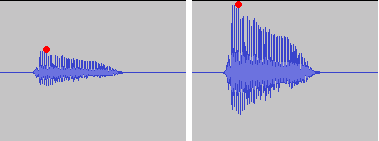
Here is the diagram of a sound wave recorded without compression and with compression:

¿Cómo ajustar un compresor?¿Cómo ajustar un compresor?

How to adjust a compressor?

As you can see, when applying compression, the dynamic range of this wave has been reduced. In the original wave, the difference between the lowest amplitude and the highest amplitude is around 15 dB. After applying compression, the dynamics are only 5 dB. What happens is that the compressor detects and compresses the loudest sounds in the wave. After compressing these louder sounds, I can raise the entire level of the wave, so that the weak and strong notes are leveled out in the rest of the mix.

Threshold :

Compressors, like all dynamic processors, including the normalizer, work by measuring the amplitude of an incoming signal relative to a reaction point that must be configured to tell the compressor when to start operating. This reaction point is called the threshold.

Consider our example of watching TV and turning the volume down when advertising. We all have our own threshold that tells us when a sound is too loud and that will force us to take the remote control to lower the volume. This volume level is our threshold. The threshold that is, in fact, the most important component of any dynamic processor.

How to adjust a compressor?

In a compressor, a signal level above the threshold will activate the compressor, while a lower signal level remains unchanged

Normalization of an audio file.

How to normalize an audio or video file.

Normalization is used to increase or decrease the level of the song as a whole, so that its maximum volume peaks assume the indicated level.

For example, if the maximum intensity points of the song are at -3 dB (therefore, well below 0, which should represent the maximum before distortion), normalizing to 0 dB means increasing the level of the entire song so that these peaks reach 0 dB.

audio level

This is the typical normalization of the peaks.

There is also RMS normalization (which takes into account not the peaks, but the actual average level of the song).

AUDIO CDs, which have good dynamic possibilities (various intensity tones, from pianissimo to fortissimo), are generally recorded so that the maximum volume points are at 0 dB.

Free image of audio levels

Normalizing your recordings in WAV can be useful to adapt them to the average level of a CD in case they are too low (because you had been careful in the level during the recording) but there is one important thing to keep in mind:

normalization of this type alters the original dynamics, that is, the reciprocal relationships between weak and strong sounds.

Although all levels are raised by the same amount, the relationship between 2 levels changes (small mathematical example:
2/5 = 0.4 ma (2 + 1) / (5 + 1) = 0.5 …

The result is that the weaker sounds, after sudden normalization, sound much louder and those that were already loud only sound a little louder … altering the dynamic relationships that had been envisioned by those who originally recorded the music and causing the sound output to lose depth.

Some types of music, generally already deficient dynamics (rock, metal, etc.) since the excursions between the minimum and maximum volume are almost never very consistent, are more “normalizable” without problems, while the genres in which there may be Large Dynamic excursions (classical music or music with passages from pianissimi to fortissimi) are more problematic.

Furthermore, it is necessary to keep in mind that if you normalize a large wav file that contains many songs (not yet divided) there can still be, even in genres with little dynamics, consistent differences, in this case between one song and another and not between different points of the same song.

So a light normalization can do and is actually used (to raise the level of the song), but it would be better to make sure you don’t need it (recording from the beginning with a good level) or at least not have too much need. and remember, however, that the dynamics are somewhat flattened.

Normalization of an mp4 or normalization of a video.

We are in the video age, it is said that 2,000 hours of video per minute are uploaded on YouTube.

HOWEVER, THERE IS NO OTHER SOFTWARE THAT IS ABLE TO NORMALIZE THE AUDIO OF THE VIDEOS !!

Mp4Gain is used by television channels throughout the world. Also by radio stations … even by some famous musicians, of whom we cannot give the name for reasons of confidence … but we are talking about musicians of global fame.

One of them is the guitarist of one of the groups that generates the most money on their world tours … or perhaps the one that generates the most money on their world tours. He uses Mp4Gain …

And so, many other celebrities are our clients. NBA players belonging to the legendary dream team, etc.

What is Normalize audio?

What is Normalize audio?

The battle of volume

For decades, but especially in recent years, music producers discovered that by being able to manipulate volume levels on the mixing console, they were able – artificially – to get people to listen to a recording as “better” with just push the recording volume up a bit, its decibels.

audio & video normalizer

Indeed, tests carried out by universities have shown that a little more volume makes the music sound “better” when listening.

Hence, in the last few decades, especially from the 80s, there has been a war to make each musical production sound louder to achieve that effect of better sound quality.

This has resulted in recordings showing extremely uneven volume levels, some sounding very loud and others sounding too low.

But today everyone wants the music to sound at high volume, to boost the volume level, to boost the volume of the song.

Even when it comes to loud music like dance music, rock, etc. trying to boost the bass, which produce an effect not only in the ear, but literally “feel” and to make people “feel” that music, the producer must be generous in the recording console and with the equalizer.

This usually results in people perceiving that their collection of musical files has uneven volume levels, that some recordings sound very loud and others sound very low in volume.

So it has become an urgent need to find an audio volume normalizer that manages to boost the music level, that manages to boost the bass and that manages to improve the sound of each music file, that makes it sound louder.

Mp4Gaines the answer. It is without a doubt the most efficient normalizer that manages to boost the volume and make it sound louder and at the same time sound at a more equal volume level.

If you are looking to improve the volume level of your audio and video files, of the main formats, not just mp3s, Mp4Gain is definitely the most powerful, modern and efficient solution.