
What is Audio Aliasing?
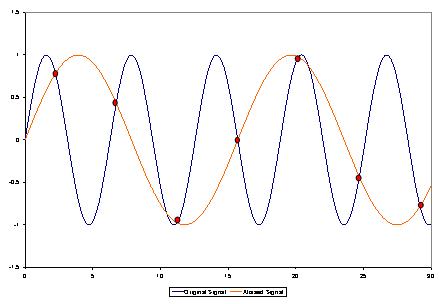

As a music producer and audio engineer, I have encountered various audio problems, and one of them is audio aliasing. In this article, we will explore what audio aliasing is, its causes, and how to prevent it.
Aliasing in Audio
Aliasing in audio happens when the frequency of a signal is higher than the Nyquist frequency, which is half of the sampling rate. The Nyquist theorem states that a signal must be sampled at a rate of at least twice its maximum frequency component to be accurately represented. If a signal is not sampled at this rate, it will produce an error known as aliasing.
Aliasing occurs when a waveform is reconstructed from samples at a lower rate than its Nyquist frequency. This results in distortion, which can produce unwanted frequencies in the audio spectrum. Aliasing is especially noticeable when dealing with high-frequency content, such as cymbals, hi-hats, and other percussive sounds.
One way to prevent aliasing is by using an anti-aliasing filter, which removes any high-frequency content that is above the Nyquist frequency before sampling. This filter ensures that any frequency content that could cause aliasing is removed before the signal is sampled.
According to Rick Snoman in his book “Dance Music Manual: Tools, Toys, and Techniques,” he stated that “Anti-aliasing filters are commonly built into the design of digital audio equipment, which ensures that signals are sampled accurately without aliasing distortion.”
Causes of Audio Aliasing
There are several factors that can cause audio aliasing. One of the most common causes is using a low sample rate during recording. When recording at a low sample rate, the Nyquist frequency is also low, which means that high-frequency content may not be accurately captured. This results in aliasing distortion.
Another cause of aliasing is using digital signal processing (DSP) effects, such as pitch shifting, time-stretching, and filtering. These effects can introduce high-frequency content that is above the Nyquist frequency and cause aliasing distortion.
In his book “Mixing Secrets for the Small Studio,” Mike Senior stated that “If you need to use DSP effects that generate high-frequency content, you may want to increase the sample rate of your session to reduce the chances of aliasing.”
Sampling and Audio Aliasing
The process of sampling involves taking measurements of an analog signal at specific intervals, and these measurements are then converted into digital form. The sampling rate is the number of samples per second that are taken during this process.
Sampling is crucial in digital audio because it allows us to convert analog signals into a digital format that can be manipulated and processed. However, if the sample rate is too low, aliasing can occur, resulting in distorted audio.
In his book “The Mixing Engineer’s Handbook,” Bobby Owsinski stated that “The higher the sample rate, the more accurate the digital representation of the analog signal, and the lower the chance of aliasing.”
Nyquist Frequency and Audio Aliasing
The Nyquist frequency is the highest frequency that can be accurately represented in a digital recording or transmission system. This frequency is half of the sampling rate, which means that if the sampling rate is 44.1kHz, the Nyquist frequency is 22.05kHz. Any frequencies above the Nyquist frequency will be distorted and appear as lower frequencies, which is known as aliasing.
What is Audio Aliasing?
Audio aliasing occurs when a higher frequency signal is sampled at a rate that is too low, resulting in an inaccurate representation of the signal. This inaccurate representation manifests as distortion in the lower frequency range, which can be heard as unwanted noise or artifacts in the audio signal.
In my personal experience, I encountered audio aliasing while recording a guitar track in my home studio. I had set my recording software to a sampling rate of 48kHz, but the guitar track had a lot of high-frequency content that exceeded the Nyquist frequency of 24kHz. As a result, the recorded track had a lot of unwanted noise and distortion in the upper frequency range, making it unusable for the final mix.
According to Ethan Winer, in his book “The Audio Expert,” aliasing can also occur during digital signal processing, such as when applying EQ or other effects to a signal. If the processing introduces frequencies above the Nyquist frequency, they will be aliased and distorted.
How to prevent Audio Aliasing?
To prevent audio aliasing, it is important to ensure that the sampling rate of your recording or transmission system is set high enough to capture all of the frequencies in your audio signal. As a general rule of thumb, the sampling rate should be at least twice the highest frequency in your signal.
Another way to prevent aliasing is to use an anti-aliasing filter. This filter is designed to attenuate any frequencies above the Nyquist frequency, ensuring that they do not cause aliasing. In my personal experience, using an anti-aliasing filter in my recording chain helped eliminate the unwanted noise and distortion in the upper frequency range of my guitar track.
What is Oversampling?
Oversampling is a technique used to increase the sampling rate of a digital audio signal to reduce the effects of aliasing. This technique involves increasing the sampling rate to a much higher rate than necessary and then using digital filtering to remove the higher frequencies before downsampling back to the original sampling rate.
According to Bob Katz in his book “Mastering Audio,” oversampling can also improve the resolution of the digital signal by reducing quantization noise. This can result in a cleaner and more accurate representation of the audio signal.
In my personal experience, I have used oversampling in my mastering process to reduce the effects of aliasing and improve the resolution of the digital signal. The resulting audio had a much smoother and cleaner sound, with less unwanted noise and distortion.
What is the solution for Audio Aliasing?
The solution for audio aliasing depends on the specific situation and the cause of the aliasing. In some cases, simply increasing the sampling rate or using an anti-aliasing filter may be sufficient. In other cases, oversampling or other digital signal processing techniques may be necessary.
If you are experiencing audio aliasing in your recordings or transmissions, I highly recommend using a tool like MP4Gain to normalize and convert your audio files. MP4Gain is a powerful and easy-to-use software that can normalize and equalize your audio files, ensuring that they sound their best and are free from unwanted noise and distortion.


