Analog to digital signal conversion


Free Download Mp4Gain
picture

Analog to digital signal conversion

Analog to digital

To convert any analog signal (sound, image) into digital format, three basic operations must be performed: sampling, quantization and encoding.

Analog to digital

Sampling
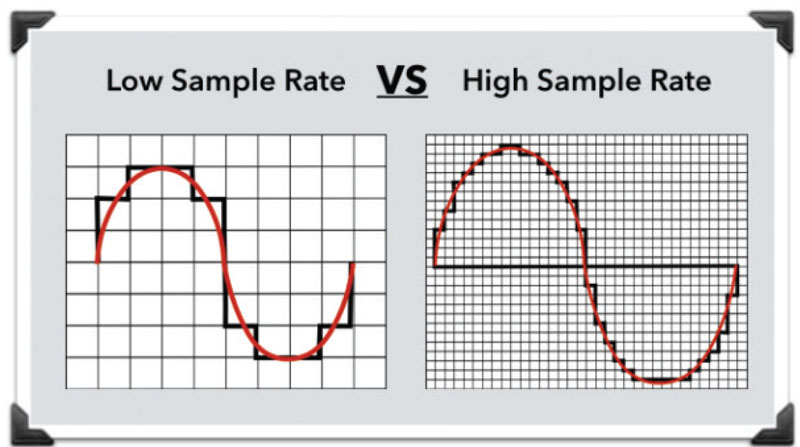
– presentation of a continuous analog signal by means of a sequence of its values ​​(samples). These samples are taken at times separated from each other by an interval called the sampling interval. The reciprocal of the interval between samples is called the sample rate. In Fig. 1 shows the original analog signal and its sampled version. The images below the timing diagrams are obtained assuming that the signals are one line television video signals, the same for the entire television screen.

Analog to digital conversion. Sampling

It is clear that the shorter the sampling interval, and therefore the higher the sampling frequency, the smaller the difference between the original signal and its sampled copy. The stepped structure of the sampled signal can be smoothed with a low-pass filter. This is how the analog signal is restored from the sampled one. But the reconstruction will be accurate only if the sampling frequency is at least 2 times the bandwidth of the original analog signal (this condition is determined by the well-known Kotelnikov theorem). If this condition is not met, the sampling is accompanied by irreversible distortions. The fact is that, as a result of sampling, additional components appear in the frequency spectrum of the signal, which lie around the harmonics of the sampling frequency in the range, equal to twice the bandwidth of the original analog signal. . If the maximum frequency in the frequency spectrum of the analog signal exceeds half the sampling frequency, then the additional components fall within the frequency band of the original analog signal. In this case, it is no longer possible to restore the original signal without distortion. The theory of sampling is covered in many books.

Analog to digital conversion. Distortion sampling

An example of sampling distortions is shown in Fig. 2. An analog signal (again, suppose it is a TV line video signal) contains a wave, the frequency of which first increases from 0.5 MHz to 2.5 MHz and then decreases to 0.5 MHz. This signal is sampled at 3 MHz. In Fig. 2 the images are shown sequentially: the original analog signal, the sampled signal, the restored analog signal after sampling. The low-pass reconstruction filter has a 1.2 MHz bandwidth. As you can see, the low-frequency components (less than 1 MHz) are restored without distortion. The 1.5 MHz wave disappears and becomes a relatively flat field. The 2.5 MHz wave after recovery became a 0.5 MHz wave (this is the difference between the 3 MHz sampling frequency and the original 2.5 MHz frequency). These image diagrams illustrate the distortion associated with an insufficiently high spatial sample rate of the image. If the subject of the television recording is an object that is moving very fast or, for example, a rotating object, then sampling distortions in the time domain may occur. An example of distortion associated with an insufficiently high sample rate (and this is the frame rate of television decay) is an image of a fast moving car on stationary wheels or, for example, slowly turning in one direction or other, the spokes of the wheel (stroboscopic effect). There is no sampling distortion when the bandwidth of the original signal is limited from above and does not exceed half the sampling frequency. associated with insufficiently high spatial sampling rate of the image. If the subject of the television recording is an object that is moving very fast or, for example, a rotating object, then sampling distortions in the time domain may occur. An example of distortion associated with an insufficiently high sample rate (and this is the frame rate of television decay) is an image of a fast moving car on stationary wheels or, for example, slowly turning in one direction or other, the spokes of the wheel (stroboscopic effect). There is no sampling distortion when the bandwidth of the original signal is limited from above and does not exceed half the sampling frequency.


Free Download Mp4Gain
picture


Mp4Gain Main Window
picture


Mp4Gain Features
picture


Free Download Mp4Gain
picture

Let’s talk about acoustics

Let’s talk about acoustics

acoustics

Have you ever wondered what happens to the front panel of a speaker when the woofer cone is pushed forward?

Acoustics

That’s right, at this point the entire panel is moving backwards, including the midrange and the tweeters mounted on it. Consequently, the sources of mid and high frequencies move away from the listener at the moments of the compression wave of the woofer along the front. Also, the movable front panel itself is a source of radiation, as you understand, not intended for this at all. And finally, the amplitude of the woofer itself is partially damped due to the opposite offset of the panel. Of course, the main harm is that the panel that bends under load is a source of radiation of various parasitic resonant frequencies.

Various means are used to combat this phenomenon and body resonances. They simply reinforce the front panel, use composite materials, multi-layer construction, elastic damping when placing the speaker. There are even more effective methods: the use of struts from the inside, the use of two independent front panels, one of which, the internal, is a carrier, a woofer is fixed on it, the external has an independent support and almost no radiates sound into space. The loudspeaker is also used to mount the loudspeaker in a special open inner box, mechanically connected only to the rear wall, while the front only has a cutout along the loudspeaker profile.

Good loudspeakers should have the most rigid and inert enclosure, and they should be solid or rigidly fixed. The high rigidity of the structure itself, while saving material, is obtained through the use of non-parallel walls, this practically completely eliminates standing waves inside the box, which generate unnecessary overtones and prolonged bass, although this it does not solve the problems of vibration the walls themselves. An inexpensive solution is spacers. Rigid or weight mounting is required due to offset of all speakers with strong woofer cone offset, especially noticeable at lower frequencies. Bill Gates has solved this problem at home by installing the speakers themselves on the wall, the so-called “wall of sound”, this is also an ergonomic solution.

The mutual influence of the LF and MF-HF channels is not only mechanical. If the amplifier does not have the lowest output impedance, then the powerful background EMF pulses arising in the LF speaker winding through the LF filter go to the AC common input terminals, and from them to the MF channel. , experiencing a time delay. Along the way and at the edge of the band division, this signal can be strong enough to degrade the sound. It uses solutions like bi-amping and bi-wiring. The first is to feed different bands with different amplifiers, each of which operates in its own frequency band, transmitting the signal to the corresponding speaker through its own cable. Advantages: total absence of mutual influence of bands, no need for passive filters between the amplifier and the loudspeaker, the ability to use more effective active filters at the crossovers up to the creation of completely mirror characteristics at the limits of the band sections, higher overall efficiency, more stable operation of the amplifier-speaker system due to narrow band. Cons: the need for two amplifiers and a crossover filter. Bi-wiring is a much less efficient solution when using a single amplifier and separate pairs of wires go to the speakers for different bands. The back-EMF signal is bypassed at the amplifier’s output terminals, first passing through one pair of wires and returning through the other to another frequency channel. It makes sense to use at least pure oxygen-free copper (b / c) as the wires for the speakers, preferably a thin single-core wire for the HF channel and relatively thick, it is already possible to have multiple cores in the LF.

The signal that has passed through the integrator circuits of the amplifier and the AC filters, as well as delayed by the more inertial moving system of the woofer, undergoes time shifts, that is, greater delays in the low frequency region compared with discharge. -frequency one. To compensate for the phase shift, the speakers of the multi-directional system can be positioned so that the tweeter is further forward of the listener. I implemented it this way: on the front panel, in which all the speakers were initially located (in the same plane), I made a hole in the form of a small mini speaker, I made an additional panel with a slot for the tweeter, it You placed it inside, attaching it to the front panel from the inside, and you already placed the speaker on it.

Sample rate, where it comes from

Sample rate, where it comes from

Sample rate

Where does the sample rate for CD-audio 44100 hertz come from?

Sample rate

The standard sample rate for CD-audio is 44100 Hertz. Where and why were these 44100s originally chosen for CD audio production?

Starting from the condition (see Nyquist-Shannon-Kotelnikov) of reproduction of the upper limit of the spectrum at 20 kHz, the sampling frequency should have been chosen above 40 kHz. But at the time of the creation of these standards and the development of CD-DA technology (the second half of the 70s of the last century), there was no generally accepted medium in which to record, edit and store digital sound. And for this, it was decided to use standard VCRs, which in those days worked in U-matic format. The digital signal was encoded by a special encoder into a black and white video pseudo-signal and recorded on a video cassette. The structure of the digital signal had to be linked to the frequency and structure of the fields of the television signal used for recording.

This decision was complicated by the fact that different video recording standards are used in Europe and the US: 525 lines at 60 Hz and 625 lines at 50 Hz, while not all lines can be used to record information. The selected frequency should fit the structure of both video signals. 44100 Hz meet this requirement.

In a 60 Hz NTSC video signal, 35 lines are not used for recording, leaving 490 active lines per frame, or 245 in the field for digital audio recording. When writing three samples to a string, the sample rate will be:

60 × 245 × 3 = 44100.

In a 50Hz PAL signal, 37 lines are not used, leaving 588 active lines per frame, or 249 per field, so the frequency will be:

50 × 249 × 3 = 44100.

Although digital sound at that time had nothing to do with the video signal, video equipment was used in the production of the CD, which determined the choice of sampling frequency.
What is the real benefit of Hi-Res Audio support?

What is the real benefit of Hi-Res Audio support?

hi res

About the Hi-Res Audio Certificate

hi res

Today, many products carry the high resolution logo, which stands for high resolution support. For sources such as portable players, sound cards, and USB headphones, this means support for sample rates above 44/48 kHz.

But if you don’t use special audiophile recordings in high resolution formats and you don’t touch on the controversial issue of audibility of frequencies above 20 kHz, is there any benefit to this support for normal use? For example, when watching YouTube videos or sound in games?

As practice shows, there is also a very notable one.

Hi-Res Audio certification is awarded to devices capable of reproducing sound at frequencies above 20 kHz. For headphones with an analog connection, this certificate is advertising tinsel, because all headphones are capable of reproducing frequencies above 20 kHz; only some models play them silently, while others are very quiet. The criteria for the threshold of this “silence” does not have a Hi-Res Audio certificate (or supposedly exists, but is not subject to disclosure). Consequently, absolutely any headset can get it.

For digital sources, the reproduction of frequencies above 20 kHz is dependent on the sample rates supported by the DAC, and consequently all devices containing a modern DAC are Hi-Res Audio certified.

The system mixer is to blame.

The fact is that in modern devices, both on a computer and on a smartphone, all sound passes through the system mixer. He is in charge of mixing all the audio streams of different programs. All separate sounds from YouTube, video player, Skype, music player and other programs need to be converted to stereo broadcast.

The mixer always runs at a specific sample rate.

All incoming audio streams are converted to the frequency at which the system mixer operates. The higher the frequency, the less distortion will go into the audible frequency range.

Where does the distortion come from when the sample rate is increased?
It’s like taking a photo of a checkerboard and zooming in slightly from 8×8 pixels to 15×15 pixels. Obviously, with multiple magnifications, you can’t just double pixels to preserve the original image. And in a multiple magnification, there will be a question, the new pixels should simply double the adjacent ones or contain an intermediate color between the original pixels.

The best option will depend on the type of image. But the higher the resolution of the final image relative to the source, the less visible the artifacts of resizing will be.

In our case, as the pixel resolution increases, each pixel will be smaller. Those. By increasing the image in pixels, we are essentially increasing the pixel density for the same visual image size.

Similarly, with an increase in sample rate, from an increase in sample rate, we do not get fundamentally new sounds, tonality measurements, or playback speed. But at the same time, by changing the sample rate, we get additional distortions in the sound. The higher the sample rate of the system mixer, the more distortion will fall in the inaudible high-frequency range.

If there is only one sound reproduction source, then the system mixer is not needed in the signal path. But for the stability of the whole system, it processes the audio stream regardless of whether the sound is reproduced by only one program or ten.

For those who want to listen to high-quality music, it makes sense to use the sound output bypassing the system mixer.

This is compatible with some Windows and Android players (and professional sound processing software). This is not possible in games, browsers, or instant messaging. For the Android operating system, the RAA project conducts separate tests for software players, identifying players with optimal settings and smartphones on which it works.

In games on low-power systems, excessively high frequency can reduce overall performance; Here it is worth making a reasonable compromise between quality and performance (if possible).

Sound enhancement at high sample rates
Quality can significantly depend on the conversion algorithm.

Sample rate and bit depth

Sample rate and bit depth

bit depth

When a signal reaches the ADC from a preamplifier, compressor, console output, synthesizer, it represents electromagnetic oscillations.

Bit depth

That is, a certain wave with a variable voltage (very small values) reaches the input of the ADC. To save a signal to a file, it must be “digitized,” that is, encoded by ones and zeros. The result is a graph of the wave on the computer screen.

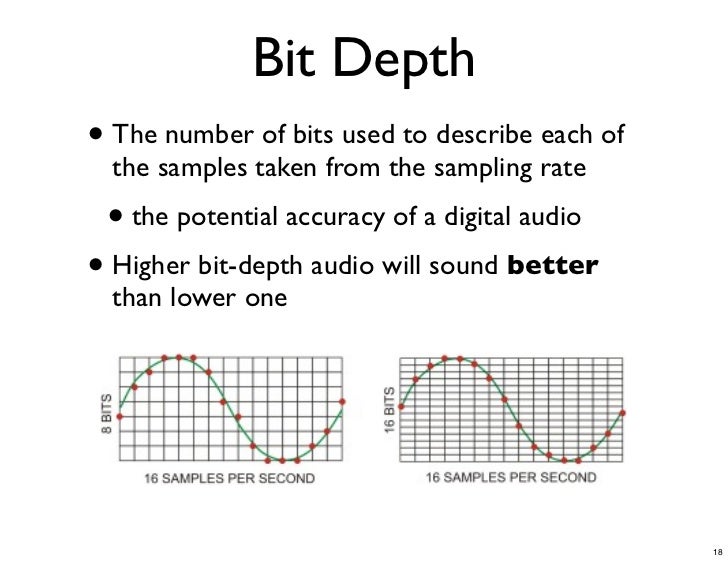
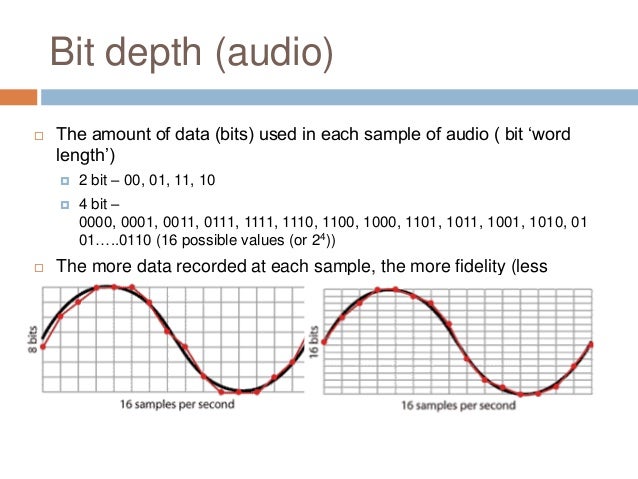
Even the best transducer has an error, because there are no intermediate values ​​between zero and one, and the wave graph will only consist of vertical and horizontal segments, with no oblique lines. The graphical representation of the wave will be influenced by the pitch (oscillation frequency), its timbre (waveform) and the volume (amplitude). A high-quality ADC must correctly transmit all these parameters to the recording system.

So the sound enters the system discreetly, that is, divided into small segments. The precision of encoding an analog signal in a digital environment depends on the size of these segments. The smaller the horizontal and vertical discrete units, the more accurate the scan will be.

Sampling rate

Splitting the wave horizontally gives us an idea of ​​the sample rate or sample rate. The more often the ADC detects changes in waveform values, the higher the sample rate. In reality, a sample is a discrete unit segment, the smallest unit of sound. The shorter it is, the higher the sample rate.

For example, a sample rate of 44.1 kHz indicates that there are 44,100 samples per second of recording. We can edit the wave, taking a segment with a duration of 1/44100 seconds as the minimum editing element. As the sample rate increases to 48 kHz, this section drops to 1/48000 of a second, allowing for more accurate impact.

Each sample is the same length as the previous one. For proper sound reproduction, the file and system sample rates must be identical. When an audio track with a different sample rate than the host (program) sample is added to the project, it must be converted.

If you play a file with a higher frequency on a lower system, it will sound slower than it should, and vice versa. Converting a signal from one frequency to another always produces distortion. To “reshape” the sound to the new sample rate, the system must divide the samples into smaller pieces and reassemble them into a single wave. Such a process can lead, at best, to simply blur the sound, at worst, to the appearance of clicks.

Of course, in the built-in speakers of a home laptop, the difference will not be noticeable. But when it comes to working with sound at a professional level, sample rate coordination is necessary.

It is not recommended to change the sample rate within the same project. A justification for higher sampling could be, for example, the need to process the file with algorithms or plugins that work better at high frequencies. Since a higher sample rate means dividing into smaller samples, the processing precision will be higher and the result will be of better quality. But it is also impossible to guarantee the effectiveness of this method: in each case the result will be individual. It is necessary to evaluate each time what is more important: the effect of processing at a higher resolution or the negative impact of the conversion.

If for some reason, after completing the job at 48 kHz, you need to convert the signal to 44.1 kHz, save the original file in case you need to re-manipulate the material (for example, for alternative mastering). Processing at a higher sample rate will produce a better effect than processing at a lower sample rate.

Bluetooth Sample Rate – What is it and why do you need it?

Bluetooth Sample Rate – What is it and why do you need it?

Bluetooth Sample Rate

What sample rate should I choose to listen to music through Bluetooth headphones?

Bluetooth Sample Rate

The sampling frequency is one of the parameters that characterize the quality of the audio data that is transmitted via Bluetooth (reproduced through wireless headphones). We will tell you in simple words what is the sampling frequency, what it affects and which one to choose.

What is the sampling rate and what does it affect?
In order for the user to listen to audio through Bluetooth headphones, the audio signal must be processed. Sampling is the process of converting an audio signal to a digital audio signal. The signals consist of samples, small segments of the audio track.

Digitizing data means taking samples of the audio signal at regular intervals. The more often it happens, the higher the sample rate. Therefore, the sample rate is the number of samples (fragments) of sound transmitted per second. The higher the frequency, the more data will be transmitted, respectively, the higher the sound quality.

Bluetooth sampling rate

What sampling frequency should I choose?
Sample rate directly affects cleanliness (free from interference and noise) and sound quality. The higher the frequency, the better. For most music applications, a 44.1 kHz sample rate is best. 48 kHz is commonly used when making music or other audio for video. A higher sample rate will have advantages for professional music and audio production, which is why it is not compatible with most smartphones and headphones.

Bluetooth sampling rate

The highest sample rates of 88.2 kHz, 96 kHz, and 192 kHz are available in music and audio production software. Its use will entail the following consequences:

When the sample rate is doubled, the size of the files also increases.
The high frequency requires more processing power from the device.
Some plug-ins and audio tools may not handle higher sample rates correctly.
Therefore, a high sample rate will ensure high quality sound when listening to audio files. 44.1 kHz is optimal for high-quality sound reproduction without interference or noise.

Sampling, sampling frequency

Sampling, sampling frequency

sampling frequency

Discretization (discretization frequency – ing.) – transcoding an analog signal into digital by reading the characteristics of the signal at a given moment and converting it into a digital data matrix (approx. 100010110).

sampling frequency

Signal sampling with a frequency of 10 Hz, graph

The sampling rate is a parameter that allows you to know the number of calls to an analog (or digital) signal in a given period of time (usually one second), to record frequencies in digital form or to convert to an analog signal.

If we rely on Kotelnikov’s theorem, then to record a lossless signal, a sample rate is required that is two or more times greater than the maximum sound frequency of the played track. That is, in theory, 44,100 Hz is sufficient for most recordings, which is more than 2 times higher than the threshold frequencies audible by humans, but this is not entirely true.

The higher the sampling frequency, the more accurately the sound will be reproduced in an analog or digital signal. However, the more conversions are made from analog to digital and vice versa, the more the accuracy and quality of the original signal recording will be lost.

The maximum sample rate for 2010 was 2,822,400 Hz and was compliant with the Super Audio CD (SACD) standard. Most multimedia centers, home theater systems have DACs (digital-to-analog converters) and ADCs (analog-to-digital converters) with a sample rate of 192,000 Hz.

To convert the signal into analog, special chips are used: DACs (digital to analog converters). To convert the signal to digital, ADCs (analog to digital converters) are used.

These microchips and chipsets have a variety of characteristics other than sample rate, such as THD, the amount of interference introduced by the transformation, the number of possible false errors, no saving a digital signal, and so on.

Digital music recording Part 4

Digital music recording Part 4

Digital music recording

Let’s take a look at the main audio file formats.

Digital music recording

Mp3 appeared in 1992. With its high compression ratio and acceptable sound quality, it has become extremely popular and has become the de facto standard for storing music files. It is in this format that music files are recorded on portable players, so popular with young people. However, since the summer of 2002, mp3 has become a payment for programmers: for the right to include support for the format in their program, a license fee of 75 cents was established for each copy. To get a new and more advanced version of mp3 Pro, one had to pay $ 1.25 for each program. Naturally, the developers and users of the programs were extremely unhappy with this idea. In particular, mp3 support was not possible on open source operating systems like all Linux clones. Feeling they had had enough, the patent owners – the Fraunhofer Institute and Thomson Multimedia – were quick to declare that they were “misunderstood”, but, as in the old joke, “although spoons were found, the residue still remained.”

The unsuccessful and inflexible policy of patent holders has led to a sharp rise in the computing world of interest in other audio encoding formats, the first of which, of course, is WMA (Windows Media Audio) , created by Microsoft. It is based on the successful Voxware Audio Codec 4 technology, originally designed for speech encoding: Voxware 4 files retained 90 percent intelligibility at 64 Kbps, twice that of the competition.

The modified Voxware codec has become the WMA brand and now allows you to record music at 64 Kbps, similar in quality to mp3 at 128 Kbps. This means that for the same sound quality, a WMA file occupies half the size of a mp3 file. Experts believe that music recorded in WMA sounds “cleaner and more alive” than in mp3.

The most interesting and serious opponent of mp3 and WMA is the OGG (Ogg Vorbis Audio) format. The project started in 1993 under the name “Squish”. In English, this word has many meanings: jam, nonsense, and whining. It’s hard to say exactly what the authors had in mind, but some candy company said Squish was their trademark. I had to urgently change the name. No doubt, to avoid coincidences, he was chosen for being picky: the word “Vorbis” was taken from Terry Pratchett’s science fiction novel, and “Ogg” is a slang word for computer gamers, meaning “there is power. , does not matter!” ”

OGG is a free and open format. Its codec supports sample rates up to 48 kHz, bit rates up to 512 Kbps, up to 255 channels, allows text and graphic information to be stored in a file along with a composition, and sound is encoded at a variable rate. Since the stereo channels are encoded together, and not separately, the music that sounds on both channels is recorded not twice, but once, which makes the file very compact, its compression is 20-50% better than the mp3 and subjective sound quality is higher … The problem with Ogg Vorbis is that the whales of the computer business do not need a strong competitor and do not include its support in popular operating systems.

AAS. The full name is MPEG-2 AAC (Advanced Audio Coding). Developed by the Fraunhofer Institute and various commercial firms. It is based on the same mp3. The AAC was originally designed to support sample rates up to 96 kHz, and the maximum number of channels was increased from 2 to 48, taking into account future multi-channel formats such as today’s Dolby Digital. Due to the use of more complex algorithms, its encoders are significantly slower than in the case of mp3s, and the players also require more processor power. The best choices for 96Kbps AAC encoders deliver quality no worse, and sometimes even better, than 128Kbps mp3.

The AAC format allows the use of steganography techniques to embed so-called watermarks in the recorded sequence: author / artist names, copyright information, etc. Subsequently, the co-authors of the format independently created several versions of it, the most famous of which is Liquid Audio.

Until recently, Liquid Audio was considered the best in terms of playback quality and could claim to be the successor to mp3, but the creator of the format, Liquid Audio Company, followed an unsuccessful policy in its implementation.

VQF is a method and format developed by the Japanese company NTT and promoted mainly by the Japanese company Yamaha under the name SoundVQ.

Digital music recording part 3

Digital music recording part 3

Digital music recording

Time masking is based on the fact that if a silent one immediately follows a loud sound, then it can be ruled out, because the change in the hearing threshold of a human ear does not happen instantly.

Digital music recording

All lossy audio encoding methods work according to the same scheme. First, the sound is divided into frames, from which the masked components are removed, after which the frames are encoded using the Hoffman method, whereby the most common code words are given the minimum duration, and the least frequent, on the contrary, the maximum. The difference between the methods lies in the way the sound is analyzed and the masked components are removed.

Lossless compression algorithms are relatively rare, although they have their own indisputable advantages. The point is, any loss spoils the sound. It is one thing if you, working at a computer, listen through plastic Chinese speakers – “Cheburashka” “And you kiss me everywhere …”, and another – when playing symphonic music on serious equipment. Furthermore, even a professional can hardly tell what exactly was missing from the sound during encoding. Vague terms such as “colorful”, “transparency”, “juiciness” … will be used.

There are many algorithms for compressing audio files and consequently the formats of these files. For example, the audio recording formats for PC games, audio players, and Internet downloads are different. The general rule of thumb is that high bit rate files have relatively high audio quality and large size, while low bit rate files are compact, but can only be called music as a courtesy.

Additionally, various audio file formats have been created for various computing platforms such as PC, Macintosh, Amiga, and others.

Digital music recording

Digital music recording

Digital music recording

In 1900, the Danish engineer W. Paulsen at the World’s Fair in Paris demonstrated a working model of a magnetic recording apparatus created as an alternative to Edison’s invention.

Digital music recording

For the first time in human history, a human voice sounded on a magnetic recording: the astonished Parisians heard the voice of the Austro-Hungarian Emperor Franz Joseph breaking the whistle. From this moment, perhaps, the true history of sound recording began, the theory of which was created in the 30s of the 20th century.

Sound is a complex analog signal. For the analysis of such signals a technique widely used in radioelectronics is used. Using the Fourier transform, a complex signal is converted into a harmonic series consisting of sinusoids with different frequencies and amplitudes. But in practice the signal we are dealing with is of course very different from the sinusoidal one.

Musicians call the first harmonic in this spectrum the fundamental tone, and harmonics with higher frequencies are called harmonics. The main tone determines the pitch and the harmonics give it a certain color, creating the timbre of a voice or musical instrument.

To study the spectra of audio signals, complex and expensive instruments are used – spectrum analyzers.

With the help of such devices, it can be established that some musical instruments, for example a violin, have a relatively uniform spectrum and some wind spectra with pronounced maxima and minima, called formants.

There are no terms that directly describe the coloring of the timbre of a human voice or of musical instruments, so it is necessary to resort to various metaphors such as “deep timbre”, “hard timbre”, “metallic” sound or even “transistor”.

Attempts to use digital information processing methods in connection with sound recording were made many times, but the first serious results were achieved in the early 1980s of the 20th century, and coincided with the rapid development of computers and the successful microminiaturization of radio. components. The use of digital sound processing techniques has opened up exciting new possibilities.

To process sound on a computer, it must first be converted to a digital, encoded format. An analog signal is encoded by devices called analog-to-digital converters (ADCs). The main method of encoding an analog signal is pulse code modulation, which consists of three operations: sampling, quantizing, and encoding.

We won’t go into coding theory now, especially since it’s quite complicated and requires higher math skills. It is important for us to understand that the quality of the digitized sound and the resulting file size depend on the sample rate and bit depth.

The sample rate is the frequency at which the characteristics of an audio signal are measured. It follows from Kotelnikov’s sampling theorem that to obtain an undistorted digital signal, the sampling frequency must be at least twice the highest frequency of the encoded signal. Therefore, when encoding an audio signal, the sample rate must be at least 40 kHz. In digital communication systems, the sampling frequency is 32 kHz, in laser CD players and consumer digital tape recorders – 44.1 kHz. In digital studio equipment, the sample rate is even higher: 48 kHz.

The bit depth of the recorded sound is the number of memory bits that are allocated to record each value of the amplitude of the sound signal at the time of its measurement. Modern sound cards use 8 or 16 bits of memory per dimension, and higher quality 32-bit cards are available. The higher the bit depth, the higher the quality of the digitized sound.

As already mentioned, the size of an audio file depends on the sample rate and bit depth of the sound. So, with a sample rate of 44 kHz and a sound depth of 16 bits, one minute of sound requires a file size of 5.3 MB, and with a sample rate of 11 kHz and 8 bits – 660 Kb.

It is clear that such a waste of disk space turned out to be unacceptable, and special algorithms and formats were created for cheaper storage of audio files.

When comparing different compression formats, the parameter “sound quality at a certain bit rate” is often used.

Bit rate is a parameter that indicates how much disk space is used to store 1 second of music. For example, a bit rate of 128 Kbps means that a three-minute song will occupy about 2.8 MB.