Sampling Frequency in Digital Audio


Free Download Mp4Gain
picture

The Role of Sampling Frequency in Digital Audio
Sampling Frequency in Digital Audio

Importance of Sampling Frequency in Digital Audio

Sampling frequency, also known as sample rate, is a crucial component of digital audio. It determines how many times per second an analog audio signal is measured and converted into a digital format. The higher the sampling frequency, the more accurately the original sound can be captured and reproduced.

As an audio engineer, I’ve had my fair share of experiences with different sampling frequencies. In my opinion, the importance of sampling frequency cannot be overstated. When working with high-quality audio, a low sampling rate can result in audible artifacts and distortion. On the other hand, using a high sampling rate can drastically improve the clarity and fidelity of the final product.

According to the book “Digital Audio Engineering” by John Watkinson, “An increase in the sampling rate produces an increase in the bandwidth and reduces the aliasing distortion.” This means that by increasing the sampling frequency, we can capture more of the original sound and reduce unwanted noise and distortion.

Digital Audio Sampling Rate

The sampling rate is measured in Hertz (Hz) and is typically represented as kHz (kilohertz). Common sampling rates for digital audio include 44.1kHz, 48kHz, and 96kHz. The standard for CD-quality audio is 44.1kHz, while higher sampling rates are often used in professional audio production.

In my experience, using a higher sampling rate can make a noticeable difference in the final sound quality. However, it’s important to note that higher sampling rates also require more storage space and processing power. For example, recording at 96kHz requires twice as much storage space as recording at 48kHz.

As stated in the book “The Art of Digital Audio” by John Watkinson, “The required storage capacity increases linearly with the sampling rate.” This means that higher sampling rates can result in larger file sizes and slower processing times. It’s important to weigh the benefits of increased audio quality against the practical limitations of storage and processing power.

Impact of Sampling Rate on Audio Quality

The impact of sampling rate on audio quality can be significant, particularly when working with high-fidelity audio. In my experience, a higher sampling rate can result in a more natural and dynamic sound.

As explained in the film “Sound City,” “If you’re going to capture music with any sort of fidelity, you have to have a high sampling rate.” This sentiment is echoed by many audio professionals, who believe that a higher sampling rate is essential for capturing the nuances and subtleties of live music.

However, it’s important to note that not all audio sources require a high sampling rate. For example, speech recordings and low-quality audio files may not benefit significantly from a higher sampling rate.

Sampling Frequency and Audio Fidelity

Audio fidelity refers to the accuracy and authenticity of a sound recording. The sampling frequency plays a critical role in achieving high audio fidelity.

As stated in the book “The Science of Sound Recording” by Jay Kadis, “The higher the sampling rate, the more accurately we can represent the waveform.” This means that a higher sampling rate can result in a more accurate and faithful reproduction of the original sound.


Free Download Mp4Gain
picture


Mp4Gain Main Window
picture


Mp4Gain Features
picture


Free Download Mp4Gain
picture

Sampling, sampling frequency

Sampling, sampling frequency

sampling frequency

Discretization (discretization frequency – ing.) – transcoding an analog signal into digital by reading the characteristics of the signal at a given moment and converting it into a digital data matrix (approx. 100010110).

sampling frequency

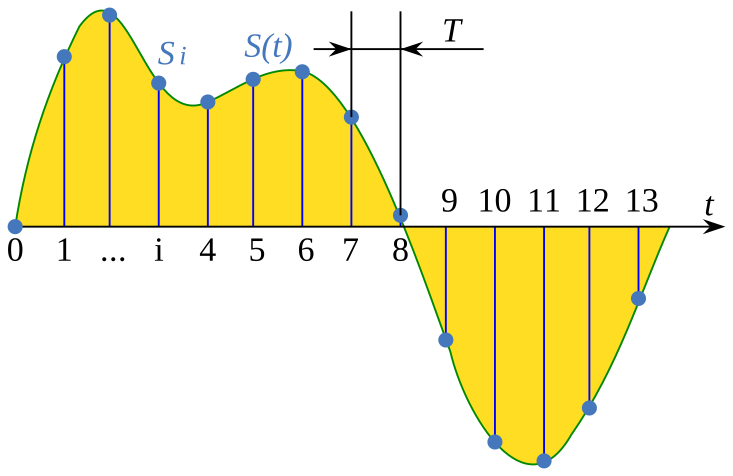
Signal sampling with a frequency of 10 Hz, graph

The sampling rate is a parameter that allows you to know the number of calls to an analog (or digital) signal in a given period of time (usually one second), to record frequencies in digital form or to convert to an analog signal.

If we rely on Kotelnikov’s theorem, then to record a lossless signal, a sample rate is required that is two or more times greater than the maximum sound frequency of the played track. That is, in theory, 44,100 Hz is sufficient for most recordings, which is more than 2 times higher than the threshold frequencies audible by humans, but this is not entirely true.

The higher the sampling frequency, the more accurately the sound will be reproduced in an analog or digital signal. However, the more conversions are made from analog to digital and vice versa, the more the accuracy and quality of the original signal recording will be lost.

The maximum sample rate for 2010 was 2,822,400 Hz and was compliant with the Super Audio CD (SACD) standard. Most multimedia centers, home theater systems have DACs (digital-to-analog converters) and ADCs (analog-to-digital converters) with a sample rate of 192,000 Hz.

To convert the signal into analog, special chips are used: DACs (digital to analog converters). To convert the signal to digital, ADCs (analog to digital converters) are used.

These microchips and chipsets have a variety of characteristics other than sample rate, such as THD, the amount of interference introduced by the transformation, the number of possible false errors, no saving a digital signal, and so on.

Sampling frequency

To convert a so-called analog audio to digital, we use a process called: sampling. Sampling is done on a converter (or sound card). The principle is to take regular snapshots, which are the measurements of the analog signal voltage, and transform them into digital data whose language is numbers (numbers).

Here is a diagram representing the samples included in the amplitude of a sound wave. The number of samples in this wave defines the sampling frequency or sampling frequency.

La frecuencia de muestreo

Sampling frequency

The sampling rate is expressed in hertz (Hz) or (kHz). The following values ​​are commonly found: 44,100 Hz, 48,000 Hz, 96,000 Hz, 192,000 Hz. The CD and the digital world standard are 44,100 Hz. This means that for every second, there are 44,100 samples. (samples) reproduced. The higher the sample rate (number of “snapshots” of the audio taken per second), the more accurate the analysis and coding of the music in digital data. The sampling rate affects the audio frequency range from the lowest to the highest pitch that can be stored.

Sampling frequency
16-bit / 44.1 kHz coding was the best quality available when the CD was released in the early 1980s, but things have changed, and we can now record and distribute music at higher bit-depth levels and sample rates. These formats have been used in studio recordings and for mastering for many years.

High-resolution audio (HRA) matches any recording format above the 16-bit / 44.1 kHz standard for CDs, and HRA recordings usually use 24-bit encoding, providing a greater dynamic range than CD and sampling rates up to 192 kHz . This is the pinnacle of HRA business records. First and foremost, it’s about getting as close as possible to the sound heard in the studio.

Which sampling rates should you choose?

In order to capture the smallest details at high frequencies, we need to try more frequently. The way it works is that a given sampling rate can accurately detect audio frequencies down to just under half its value. For example, a sample rate of 48 kHz can accurately detect audio frequencies as low as just below 24 kHz. This limit for half the sampling frequency is called the Nyquist frequency and is named after one of the engineers who developed the calculation behind the sampling principle.

La frecuencia de muestreo

The human ear can generally hear in the following spectrum: 20 Hz – 20,000 Hz. As we have just seen, for no obvious loss, the sampling rate must be at least twice as high as the maximum frequency contained in the audio when digitizing. The sampling rate must be at least 40,000 Hz for a correct result for our ears.

This is why 44 100 Hz resolution is the most widely used because it allows us to cover the spectrum up to 22 050 Hz. We even benefit from a small margin because we could have rounded up to 40,000 Hz, but it also means that if you export your music at a sampling rate higher than 44,100 Hz, your ear can’t hear the difference.

Anti alias filters

The first thing an analogue to digital converter does to analogue audio before sampling is to filter all frequencies above the Nyquist limit of the desired sampling frequency. If not filtered, all frequencies above Nyquist are injected again into the sample. This is called an alias effect.

Fortunately, almost all converters on the market today have implemented high-quality anti-aliasing filters. As a result, it seems undesirable aliasing effects are not, and all frequencies below the Nyquist recorded accurately. In most cases, as long as you use a good quality converter and a sampling rate of at least 44.1 Khz, you can record all frequencies in the area of ​​human hearing in an orderly manner. Since the analog to digital converter measures each sample, you have to assign a number to that sample, as that is what makes it digital instead of analog.

How about sound cards up to 192,000 Hz?
There are two benefits to working at a very high frequency:

The first is that the drivers for your sound card (especially professional converters) will be optimized for a given sampling rate. In general, the ASIO drivers for your drives are optimized to the maximum sample rate it offers: 96,000 Hz and 192,000 Hz in most cases. This may be surprising, but it will have less delay and more relief for the microprocessor with a higher sample rate.