Bit depth
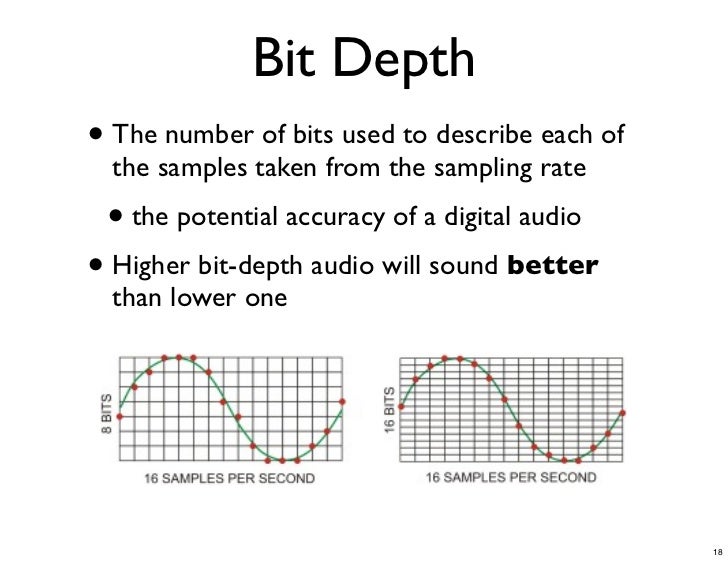
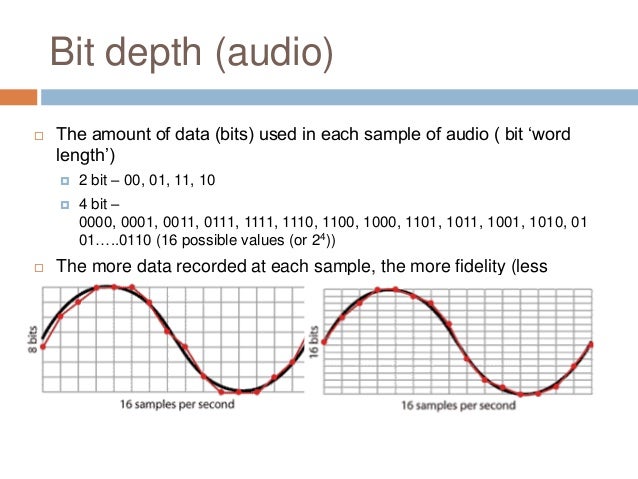
To understand bit depth (width), we first look at bits.
Short for binary digit, a bit is a separate component of a binary code, either 1 or 0.
The more bits used, the more possible combinations. For example …
As you can see from the table below, 16 combinations can be made from 4 bits.
4 bits
When used to encode information, each number is assigned a value.
As the number of bits increases, the number of possible values grows exponentially.
4 bits = 16 possible values
8 bits = 256 possible values
16 bits = 16536 possible values
24 bits = 16777215 possible values
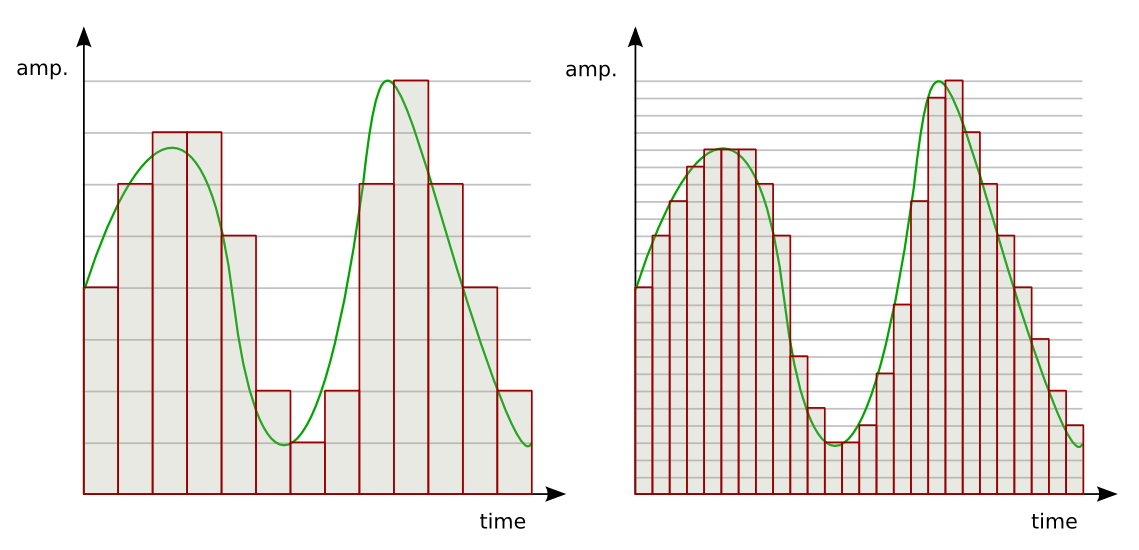
In digital audio, each value is assigned to the amplitudes of the sound wave.
The higher the bit depth, the greater the difference between loud and quiet sound … and the greater the dynamic range of the recording.
As a general rule of thumb, with each “beat”, the dynamic range increases by 6 dB.
For example :
4 bits = 24 dB
8 bits = 48 dB
16 bits = 96 dB
24 bits = 144 dB
In general, this means … more bit depth results in less noise …
Because by adding headroom, the desired signal can be recorded more clearly in relation to noise.
small and large drill depth
Further away…
5. Quantization error
It sounds amazing that there are almost 17 million values in 24-bit recordings, right?
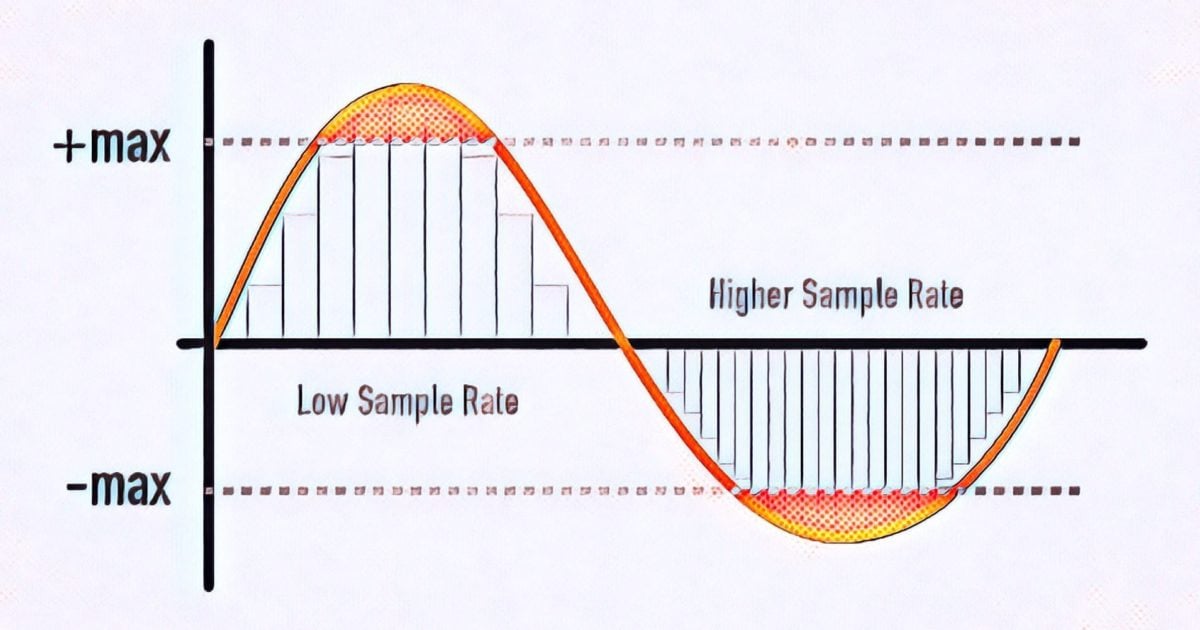
However, this is much less than the infinite number of possible values that exist in an analog signal.
In almost all samples, the true value is somewhere between the two possible values. The converter simply rounds (quantizes) them to the nearest value.
The result is a distortion known as quantization error, which occurs in two stages of the recording process:
at first, during analog to digital conversion
at the end, during mastering
During mastering, the sample rate and bit depth of the final track are often reduced when converted to the final digital format (CD, mp3, etc.).
When this happens, some information is removed and re-quantized, further distorting the sound.
To solve this problem, the following was invented …
6. Dithering
When converting a 24-bit file to a 16-bit file, dithering is used to hide most of the resulting distortion.
Adding “pseudo-random noise” to the audio signal.
Since this concept is difficult to visualize when talking about sound, it is usually explained using pictures.
It works like this:
When a color photo is converted to black and white, it is mathematically calculated which color pixel should be black and which pixel should be white.
Also how the quantization of digital audio samples is calculated.
As you can see from the illustration below, the above image looks like shit, doesn’t it?
hesitate
But thanks to dithering …
a small amount of white pixels are accidentally inserted into the black areas …
a small number of black pixels accidentally get into the white areas …
And by adding this “pseudo-random noise” to the image, the “after” image looks much better. The concept of audio dithering is similar to this.
Further away…
7. Delay time
A MAJOR FAULT of modern digital studios is the delay that builds up in the signal flow, especially in DAWs.
Taking all the calculations into account, it takes anywhere from a few milliseconds to several millisecond TENS for the audio signal to exit the system.
The 0-11 millisecond delay is so short that the average person wouldn’t even notice it.
With a delay of 11 to 22 milliseconds, you will hear an annoying slapback, a short delay that takes some getting used to.
With a delay of more than 22 milliseconds, it is almost impossible to play or sing along with the track.
In a typical digital signal chain, there are 4 stages that affect the resulting delay time:
analog to digital conversion
DAW buffering
complement delay
digital to analog conversion
A / D and D / A conversion are the 2 smallest negative effects that add a maximum of 5 milliseconds to latency.