Dynamic compression


Free Download Mp4Gain
picture

Dynamic compression

dynamic compression

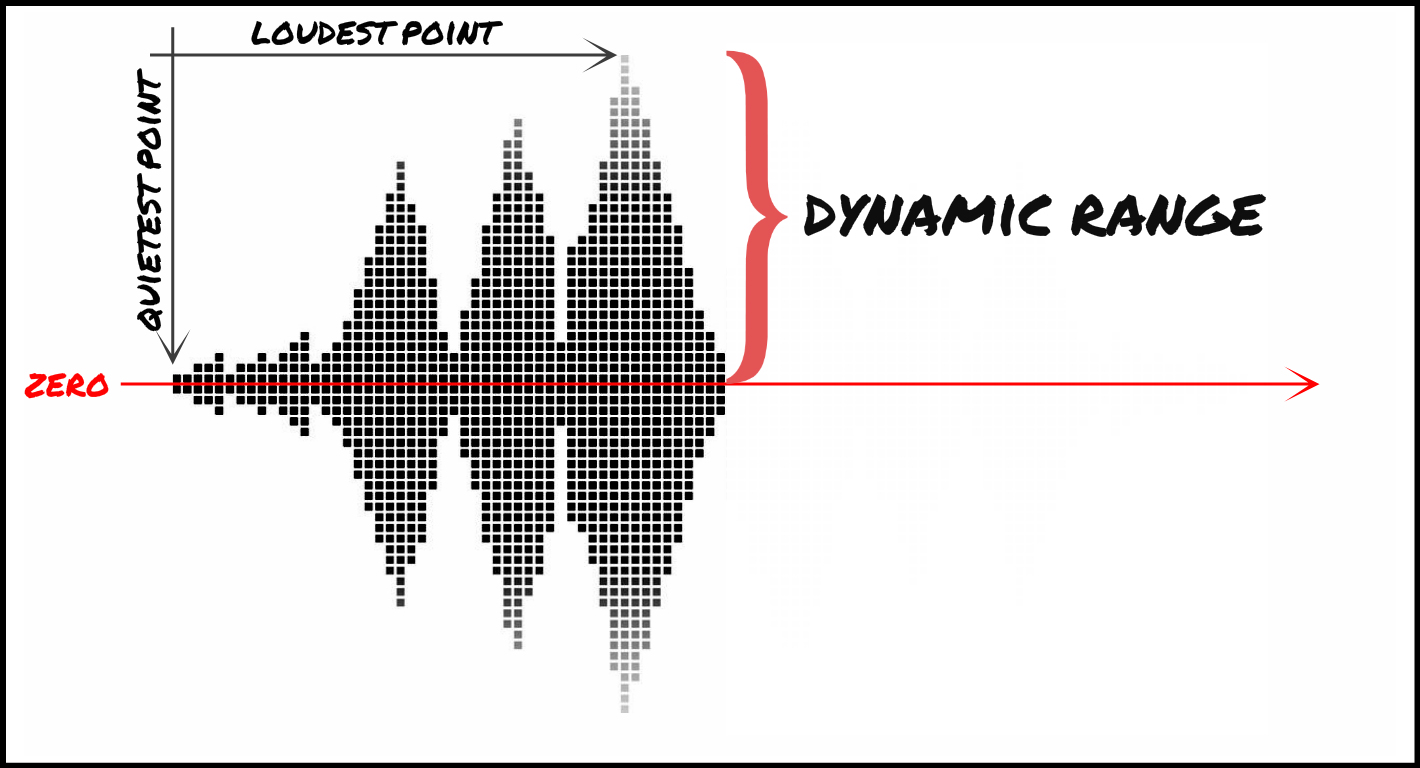
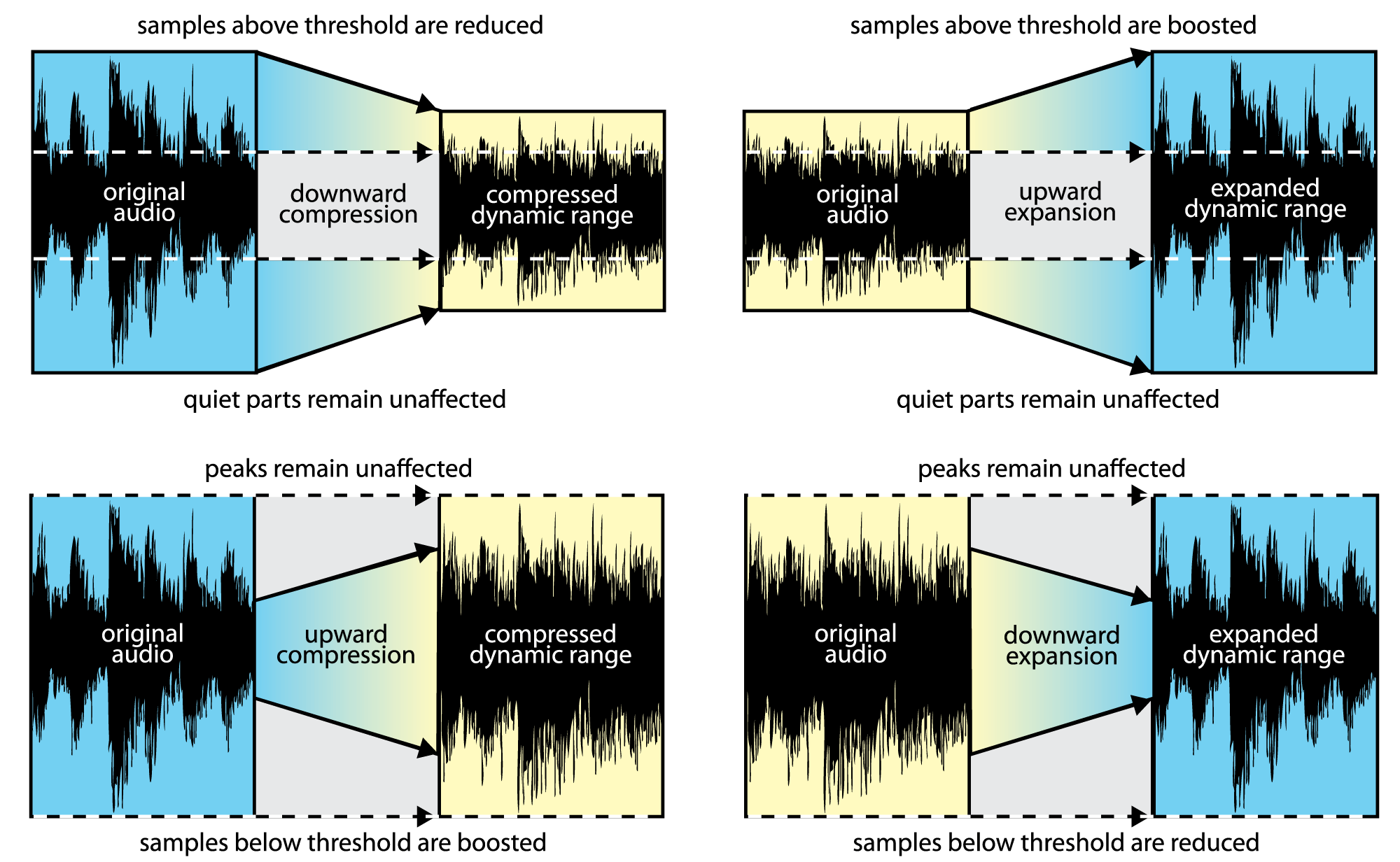
Dynamic Compression (DRC): narrowing (or expanding in the case of an expander) the dynamic range of a soundtrack. Dynamic range is the difference between the quietest and loudest sound. Sometimes the lowest sound on the soundtrack will be a little louder than the noise level, and sometimes a little lower than the loudest. The hardware devices and programs that perform dynamic compression are called compressors, distinguishing four main groups among them: the compressors themselves, limiters, expanders, and gates.

dynamic compression

Up and down compression

Creep Compression lowers the volume when it exceeds a certain threshold, leaving quieter sounds unchanged. The extreme downward compression option is the limiter. Increase compression (upward compression), conversely, increase volume if it is below a threshold value without affecting louder sounds. In this case, both types of compression reduce the dynamic range of the audio signal.

Expander and gate

If the compressor decreases the dynamic range, the expander increases it. When the signal level rises above the threshold level, the expander raises it further, thus increasing the difference between high and low sounds. These devices are often used when recording drums to separate the sounds of some drums from others.

A type of expander that is used not to amplify loud sounds, but to drown out quiet sounds that do not exceed the threshold level (for example, background noise) is called a noise gate. In such a device, as soon as the sound level falls below the threshold, the signal flow stops. Normally, the door is used to suppress noise during breaks. In some models, you can make sure that the sound does not stop abruptly when the threshold level is reached, but gradually fades away. In this case, the decay rate is set with the Decay knob.

The gate, like other types of compressors, can be frequency dependent (that is, handle certain frequency bands differently) and can operate in side chain mode (see below).

Compressor working principle

The signal entering the compressor is divided into two copies. One copy is sent to an amplifier, in which the degree of amplification is controlled by an external signal, the second copy forms this signal. It goes into a device called a side chain, where the signal is measured and based on this data, an envelope is created that describes the change in its volume.
This is how most modern compressors are organized, this is the so-called feed-forward type. In older devices (feedback type), the signal level is measured after the amplifier.

There are several analog variable gain amplification technologies, each with its own advantages and disadvantages: tube, optics with photoresistors, and transistor. When working with digital sound (in a sound editor or DAW), you can use your own mathematical algorithms or emulate the work of analog technologies.

Basic parameters of compressors
Limit
The compressor reduces the level of the audio signal if its amplitude exceeds a certain threshold value. Typically specified in decibels, a lower threshold (eg -60 dB) means that more sound will be processed than a higher threshold (eg -5 dB).

Proportion
The amount of level reduction is determined by the ratio parameter: the 4: 1 ratio means that if the input level is 4 dB higher than the threshold, the output signal level will be 1 dB higher than the threshold .
For example:
Threshold = −10 dB
Input signal = −6 dB (4 dB above threshold level)
Output signal = −9 dB (1 dB above threshold level)

It is important to note that the suppression of the signal level continues for some time after it falls below the threshold level, and this time is determined by the value of the release parameter.

Compression with a maximum ratio of ∞: 1 is called limiting. This means that any signal above the threshold level is suppressed down to the threshold level (except for a short period after a sudden increase in input volume). For more details, see Limiter below.

Attack and release
The compressor provides some control over how quickly it responds to changes in signal dynamics. The Attack parameter determines the time it takes for the compressor to reduce the gain to the level determined by the Ratio parameter.


Free Download Mp4Gain
picture


Mp4Gain Main Window
picture


Mp4Gain Features
picture


Free Download Mp4Gain
picture

Dynamic range normalizer

Dynamic range normalizer

Dynamics Processing

The audio quality of compressed formats such as MP3 or AAC is often perceived as better or at least equivalent to so-called lossless formats or audio CDs even by trained listeners. This is the conclusion reached by the TrustedReview test platform in a blind test with several people.

TrustedReview points out that this is not an experiment with strictly scientific parameters. However, what was remarkable about the results was that the self-reported hi-fi enthusiasts among the test subjects were wrong to recognize the uncompressed piece of music.

Dynamic Compression

Already sophisticated coding

“I am not surprised by this result, because we reached a similar conclusion in our internal experiments. Encoding technologies are now so sophisticated that most people no longer hear any difference even when compressing at a lower data rate,” he explains. Bernhard, MP3 expert at Fraunhofer. Grill in conversation with press release.

“It would even go so far that a properly encoded 192 kbit / s AAC sound file is the best alternative to today’s audio CD, as the 16-bit resolution of the CD can be far exceeded.” For people who are particularly sensitive to audio and want to be absolutely sure, Grill recommends a data rate of 256 kbit / s for AAC and 320 kbit / s for MP3.

The development trend goes in two directions

According to Grill, the current trend in audio encoding is bi-directional. For one thing, it’s about getting even smaller files with low-quality compromises. “This currently plays an important role, especially with streaming services over cellular networks, as bandwidths are still low despite UMTS and retrieval of large amounts of data is still expensive in most countries. “explains Grill. The most promising encoding is the HE – AAC audio codec, also known as AAC +, which is a further development of the AAC standard used by iTunes, for example.

On the other hand, the developers are also targeting the best of music listeners and want to show that with the right encoding technology, even the last noticeable differences from Audio CD can be eliminated. “Meanwhile, record labels and sound engineers have also understood how to encode for excellent sound quality. Another advantage of existing encodings, such as MP3 or AAC, is that the processes behind them are constantly being improved,” he says. Grill. MP3 encoded at 128 kbit / s sounds much better today than 15 years ago.

The term “compression” is misleading

The Fraunhofer MP3 and AAC developers find the term “compression” misleading anyway. “This should not be confused with dynamic compression, that is, the weakening of noisy passages and the elevation of soft passages, which has always been a technological necessity, especially with famous records and in FM broadcasting.” In this regard, MP3 and AAC with dynamic range up to 24 bits are even better than audio CD, which is limited to 16 bits. This restriction is not removed with a lossless copy of an audio CD.

Mp4Gain offers a dynamic range normalize, that is, the weakening of the noisy passages and the elevation of the soft passages, which is the most modern.

Much more important for good sound quality or an attractive sound image is not the medium or file format used, but the speakers used. “These are still the worst adulterers in the entire chain,” says Grill.

Loudness War

In 1973 came Raw Power, an album that punk icon Iggy Pop wanted to be the strongest in the world. But what exactly does the “strong” qualifier mean for a sound? How is this subjective sensation of acoustic power measured? How can we create it and, above all, what are the sacrifices? Why has music increased in volume in recent decades? Arm yourself with your most beautiful helmet and follow us in this report into the heart of the war for volume, a frantic race for the power of sound among producers, directors, musicians and engineers.

Loudness War

The origins of the volume war.

“How did it happen? Who is to blame? Of course, there are those who are more responsible than others and will have to account for it, but … If you are looking for a culprit, just look in a mirror. I know why Lo I did. I know you were scared. ”

The main argument of this decibel competition is taken from a psychoacoustic phenomenon: the human ear, if it is subjected to two identical pieces in all respects, will find that what is even a stronger decibel “sounds better”. The famous Fletcher-Munson curves partially explain this phenomenon: the weaker the sound, the less bass and treble are perceived. Therefore, a louder sound will not only appear linearly more powerful, but also richer “frequently”.

Loudness War

From there, to see an equivalence between “sounding louder” and “sounding better,” there is only one step, which music producers and radio directors in particular cheerfully crossed: the same tubes that loop through each other. All the Main stations, playing them higher was a way to stand out and attract new listeners. But holding them exclusively liable would be a mistake. In fact, like Iggy Pop, the artists themselves wanted to sound louder than their competitors. Sound engineers weren’t left out either: A well-known tip from mastering engineers who lacked time or inspiration was simply to assemble the mix a few decibels and go. Finally, the new millennium saw fans participate in the race, helped by the emergence of home schooling and the democratization of digital accessories.

“Too strong? Eat THIS.”

The popularization of mobile devices in the 1980s was also an important factor. Aboard the car radio and portable audio player, the radio and K7s come out of their living room and venture into the kitchen, take to the streets, take the car or plane, and rest on the beach. The sound must be more powerful in order to cover the background noise, and its dynamics (difference between the weakest and loudest sounds) is reduced to prevent the listener from doing the yo-yo with the volume button.

But frankly, basically, what would perpetual increase in noise be a problem? If the level increases, we just have to lower the knob! In fact, this oversupply would not mean any, provided it has an unlimited margin. Unfortunately, as with children, there are limits: the maximum dynamic range of a CD is 96 dB, radio levels around 60 dB, the speakers are separated above a certain sound pressure. , the consoles are saturated, not to mention our ears whose danger threshold is 90 dB, the pain threshold at 120 dB and the destruction threshold at 140 dB. How, then, to sound “stronger”, respecting the limits of the different formats and materials?

Stronger !

Here we are in the belly of the beast: how to offer a subjective sensation of greater power, without exceeding the maximum allowed sound level? And what exactly does it mean to sound “louder” when you can’t turn up the volume anymore?

Dynamic compression

Here’s the waveform for Norah Jones’ song Turn Me On: on the abscissa (horizontal), time, on the ordinate (vertical), amplitude, or volume. The peaks we see represent the loudest sounds, and the finest parts represent the weakest passages. The difference between the high amplitude signals and the others visually well marked, one does not even need to listen to the song to know that its dynamics are excellent. The mixture breathes and nuances are free to express themselves, in power as well as in softness. If we wanted to raise the level of this song in a classic way, by turning the knob or raising the faders, the amplitude of the peaks would quickly reach the maximum level, after which the signal would begin to distort. To increase the subjective level, therefore, it is necessary to decrease the difference between the peak of these peaks and the average level, then increase the overall volume – this is called dynamic compression.

Dynamic Range and Bit Depth, those great strangers

Many times we listen to songs and they seem like absolute songs and other times they seem like a waste of time. To some extent it is because of the music that is heard. But today we are going a little further. I dare say that part of the fact that we end up liking it is due to the fact that there are two concepts that have not been taken into account in production lately.

I mean the Dynamic Range.

What is it? Well, it’s just the difference between the highest possible peaks and the noise threshold. Yes, there is always a noise basis, even in the best soundproof studio. And how does that affect what you hear is a great song? Very easy, since this variation in amplitude influences the sound intensity, how the song flows, the difference between strong and weak. The specific nominal amplitude of each equipment must also be taken into account, which is called the dynamic ceiling or Headroom. Normally it stays at 120Db, since it is the limit that integrated circuits allow. What we hear from all this is the SNR, signal noise ratio, that is, the relationship between residual noise and the average signal of the subject.

If we transfer this to our tasks as musicians, it means that no frequency that we are using within our theme should be fixed, which is called average, and that too much compression is bad too, since it can crush the sound, since applying a compressor decrease dynamic differences. This also includes mixing and normalization (which we will talk about later) where some resources can help us to make our theme cover the widest dynamic range in all its frequencies. For example: If the amplitude of the mid frequencies is reduced, approximately the frequencies of 250Hz, it is possible to boost frequencies of 5KHz.

Another resource that sometimes we fail when we are playing a synthesizer, whether analog or digital, or when we are mixing is Bit Depth or Bit Resolution / Quantization.

Bit Depth is the amplitude of variations of a sound wave. Translated into Christian, the number of bits recorded per sample. This affects the previously explained concept, dynamic range, since the greater the bit depth, the greater the possibility of working with wide dynamic ranges, which is called the rule-of-thumb. Since for example, if we work with 8-bit synthesizers, which are so fashionable, we are saying that this synthesizer, the wave that sends the output, only allows to register 256 variations in the amplitude of the wave. Let’s remember that 8 bits = 2 to 8. With this I don’t mean that an 8-bit synthesizer is bad, each one does its job, but there are many cases where pears are asked from the elm, when we all know that you have to go to the pear tree. I would like to emphasize this concept especially for we use analog synthesizers, drum machines, samplers. Since the bit depth within a PCM, the digital representation of an analog sound, recreates the maximum dynamic range, which means that the sound will be more real.

So let us return to the question asked above. How does this affect my theme to sound good? Well the bit depth limits the amount of dynamic range and signal noise ratio. This means that if we cover a higher bit resolution we will be able to interact with more precision within the theme that we are composing and therefore improve the output signal of the set.

Even so, I am sorry to be this party pooper, the bit depth problem comes from the fact that nowadays we use a format that has very low and bad compression, such as MP3 or WMA. Although you export at 24 bits, it does not mean that the MP3 / WMA has a bit depth of 24 bits, since you have mastered them at 24 bits but then it has been compressed and that is where it fails. This also happens even if we copy directly to a CD, since CDs are burned at 16 bits.