Dynamic range compression


Free Download Mp4Gain
picture

Dynamic range compression
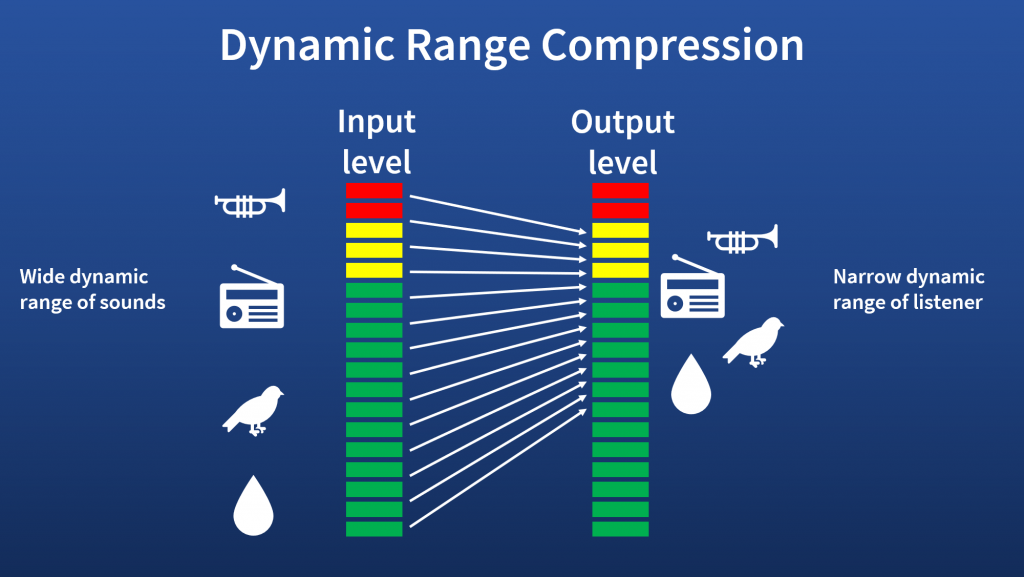
Dynamic range compression


Dynamic range compression, also known as simply “compression,” is a common technique used in audio processing to reduce the dynamic range of an audio signal. In this article, we will explore the concept of dynamic range compression, how it works, and its applications in music production and sound engineering.
Dynamic range compression

What is Dynamic Range Compression?

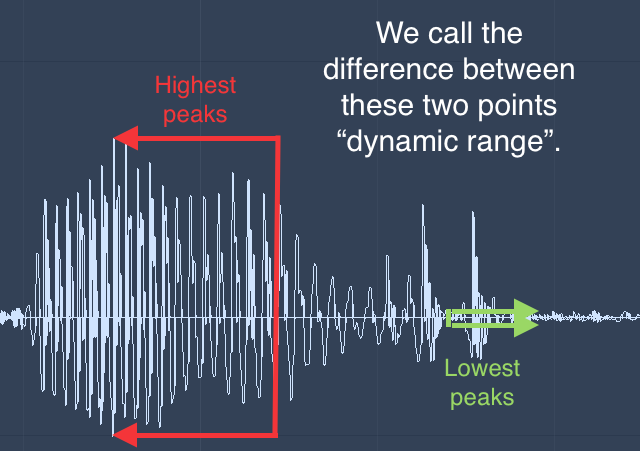
Dynamic range refers to the difference between the loudest and softest parts of an audio signal. In music production and sound engineering, it is desirable to have a wide dynamic range to create a more natural and dynamic sound. However, some musical genres, such as rock or electronic music, rely on a more consistent volume level throughout the song, which can be achieved through compression.

Dynamic range compression is a process that reduces the difference between the loudest and softest parts of an audio signal, resulting in a more consistent volume level. Compression works by lowering the volume of the loudest parts of the signal and boosting the volume of the softest parts, effectively “compressing” the dynamic range.

How Does Dynamic Range Compression Work?

Dynamic range compression works by applying a gain reduction to the audio signal when the volume exceeds a certain threshold. The threshold is set by the user and determines at what volume level the gain reduction will start to occur. Once the threshold is reached, the compressor reduces the gain of the signal by a set amount, called the ratio.

For example, if the threshold is set to -10 dB and the ratio is set to 2:1, then any part of the signal that exceeds -10 dB will be reduced in volume by half. So if a part of the signal that was originally at -8 dB is now reduced by half, it will be brought down to -11 dB.

Applications of Dynamic Range Compression

Dynamic range compression is used in a variety of applications in music production and sound engineering. Here are some of the most common applications:

Leveling the Volume of a Mix

When mixing a song, it is common for certain parts of the track to be louder than others, such as the chorus being louder than the verses. Compression can be used to level out the volume of the mix and make it more consistent.

Adding Punch to Drums and Percussion

Compression can be used to add punch and impact to drums and percussion by bringing out the attack of the sound. By setting a fast attack time and a high ratio, the compressor can reduce the volume of the sustain portion of the sound, while leaving the attack relatively untouched.

Controlling the Dynamics of Vocals

Vocals are one of the most important elements in a song, and dynamic range compression can be used to control their dynamics. By compressing the vocals, you can make them more consistent in volume, while still retaining the natural dynamics of the performance.

Managing Peaks in Audio Recordings

When recording audio, it is common for certain parts of the signal to exceed 0 dB, which can cause clipping and distortion. Compression can be used to manage these peaks and prevent clipping, allowing for a cleaner and more dynamic recording.

Conclusion

Dynamic range compression is a powerful tool for music production and sound engineering, allowing for a more consistent and controlled sound. By understanding how compression works and its various applications, you can use it to enhance your recordings and mixes. While there are many software options available for dynamic range compression, one that we recommend is MP4Gain, which provides a user-friendly interface and a variety of compression options to suit your needs.


Free Download Mp4Gain
picture


Mp4Gain Main Window
picture


Mp4Gain Features
picture


Free Download Mp4Gain
picture

Dynamic compression

Dynamic compression

dynamic compression

Dynamic Compression (DRC): narrowing (or expanding in the case of an expander) the dynamic range of a soundtrack. Dynamic range is the difference between the quietest and loudest sound. Sometimes the lowest sound on the soundtrack will be a little louder than the noise level, and sometimes a little lower than the loudest. The hardware devices and programs that perform dynamic compression are called compressors, distinguishing four main groups among them: the compressors themselves, limiters, expanders, and gates.

dynamic compression

Up and down compression

Creep Compression lowers the volume when it exceeds a certain threshold, leaving quieter sounds unchanged. The extreme downward compression option is the limiter. Increase compression (upward compression), conversely, increase volume if it is below a threshold value without affecting louder sounds. In this case, both types of compression reduce the dynamic range of the audio signal.

Expander and gate

If the compressor decreases the dynamic range, the expander increases it. When the signal level rises above the threshold level, the expander raises it further, thus increasing the difference between high and low sounds. These devices are often used when recording drums to separate the sounds of some drums from others.

A type of expander that is used not to amplify loud sounds, but to drown out quiet sounds that do not exceed the threshold level (for example, background noise) is called a noise gate. In such a device, as soon as the sound level falls below the threshold, the signal flow stops. Normally, the door is used to suppress noise during breaks. In some models, you can make sure that the sound does not stop abruptly when the threshold level is reached, but gradually fades away. In this case, the decay rate is set with the Decay knob.

The gate, like other types of compressors, can be frequency dependent (that is, handle certain frequency bands differently) and can operate in side chain mode (see below).

Compressor working principle

The signal entering the compressor is divided into two copies. One copy is sent to an amplifier, in which the degree of amplification is controlled by an external signal, the second copy forms this signal. It goes into a device called a side chain, where the signal is measured and based on this data, an envelope is created that describes the change in its volume.
This is how most modern compressors are organized, this is the so-called feed-forward type. In older devices (feedback type), the signal level is measured after the amplifier.

There are several analog variable gain amplification technologies, each with its own advantages and disadvantages: tube, optics with photoresistors, and transistor. When working with digital sound (in a sound editor or DAW), you can use your own mathematical algorithms or emulate the work of analog technologies.

Basic parameters of compressors
Limit
The compressor reduces the level of the audio signal if its amplitude exceeds a certain threshold value. Typically specified in decibels, a lower threshold (eg -60 dB) means that more sound will be processed than a higher threshold (eg -5 dB).

Proportion
The amount of level reduction is determined by the ratio parameter: the 4: 1 ratio means that if the input level is 4 dB higher than the threshold, the output signal level will be 1 dB higher than the threshold .
For example:
Threshold = −10 dB
Input signal = −6 dB (4 dB above threshold level)
Output signal = −9 dB (1 dB above threshold level)

It is important to note that the suppression of the signal level continues for some time after it falls below the threshold level, and this time is determined by the value of the release parameter.

Compression with a maximum ratio of ∞: 1 is called limiting. This means that any signal above the threshold level is suppressed down to the threshold level (except for a short period after a sudden increase in input volume). For more details, see Limiter below.

Attack and release
The compressor provides some control over how quickly it responds to changes in signal dynamics. The Attack parameter determines the time it takes for the compressor to reduce the gain to the level determined by the Ratio parameter.

Loudness War

In 1973 came Raw Power, an album that punk icon Iggy Pop wanted to be the strongest in the world. But what exactly does the “strong” qualifier mean for a sound? How is this subjective sensation of acoustic power measured? How can we create it and, above all, what are the sacrifices? Why has music increased in volume in recent decades? Arm yourself with your most beautiful helmet and follow us in this report into the heart of the war for volume, a frantic race for the power of sound among producers, directors, musicians and engineers.

Loudness War

The origins of the volume war.

“How did it happen? Who is to blame? Of course, there are those who are more responsible than others and will have to account for it, but … If you are looking for a culprit, just look in a mirror. I know why Lo I did. I know you were scared. ”

The main argument of this decibel competition is taken from a psychoacoustic phenomenon: the human ear, if it is subjected to two identical pieces in all respects, will find that what is even a stronger decibel “sounds better”. The famous Fletcher-Munson curves partially explain this phenomenon: the weaker the sound, the less bass and treble are perceived. Therefore, a louder sound will not only appear linearly more powerful, but also richer “frequently”.

Loudness War

From there, to see an equivalence between “sounding louder” and “sounding better,” there is only one step, which music producers and radio directors in particular cheerfully crossed: the same tubes that loop through each other. All the Main stations, playing them higher was a way to stand out and attract new listeners. But holding them exclusively liable would be a mistake. In fact, like Iggy Pop, the artists themselves wanted to sound louder than their competitors. Sound engineers weren’t left out either: A well-known tip from mastering engineers who lacked time or inspiration was simply to assemble the mix a few decibels and go. Finally, the new millennium saw fans participate in the race, helped by the emergence of home schooling and the democratization of digital accessories.

“Too strong? Eat THIS.”

The popularization of mobile devices in the 1980s was also an important factor. Aboard the car radio and portable audio player, the radio and K7s come out of their living room and venture into the kitchen, take to the streets, take the car or plane, and rest on the beach. The sound must be more powerful in order to cover the background noise, and its dynamics (difference between the weakest and loudest sounds) is reduced to prevent the listener from doing the yo-yo with the volume button.

But frankly, basically, what would perpetual increase in noise be a problem? If the level increases, we just have to lower the knob! In fact, this oversupply would not mean any, provided it has an unlimited margin. Unfortunately, as with children, there are limits: the maximum dynamic range of a CD is 96 dB, radio levels around 60 dB, the speakers are separated above a certain sound pressure. , the consoles are saturated, not to mention our ears whose danger threshold is 90 dB, the pain threshold at 120 dB and the destruction threshold at 140 dB. How, then, to sound “stronger”, respecting the limits of the different formats and materials?

Stronger !

Here we are in the belly of the beast: how to offer a subjective sensation of greater power, without exceeding the maximum allowed sound level? And what exactly does it mean to sound “louder” when you can’t turn up the volume anymore?

Dynamic compression

Here’s the waveform for Norah Jones’ song Turn Me On: on the abscissa (horizontal), time, on the ordinate (vertical), amplitude, or volume. The peaks we see represent the loudest sounds, and the finest parts represent the weakest passages. The difference between the high amplitude signals and the others visually well marked, one does not even need to listen to the song to know that its dynamics are excellent. The mixture breathes and nuances are free to express themselves, in power as well as in softness. If we wanted to raise the level of this song in a classic way, by turning the knob or raising the faders, the amplitude of the peaks would quickly reach the maximum level, after which the signal would begin to distort. To increase the subjective level, therefore, it is necessary to decrease the difference between the peak of these peaks and the average level, then increase the overall volume – this is called dynamic compression.