Dynamic compression

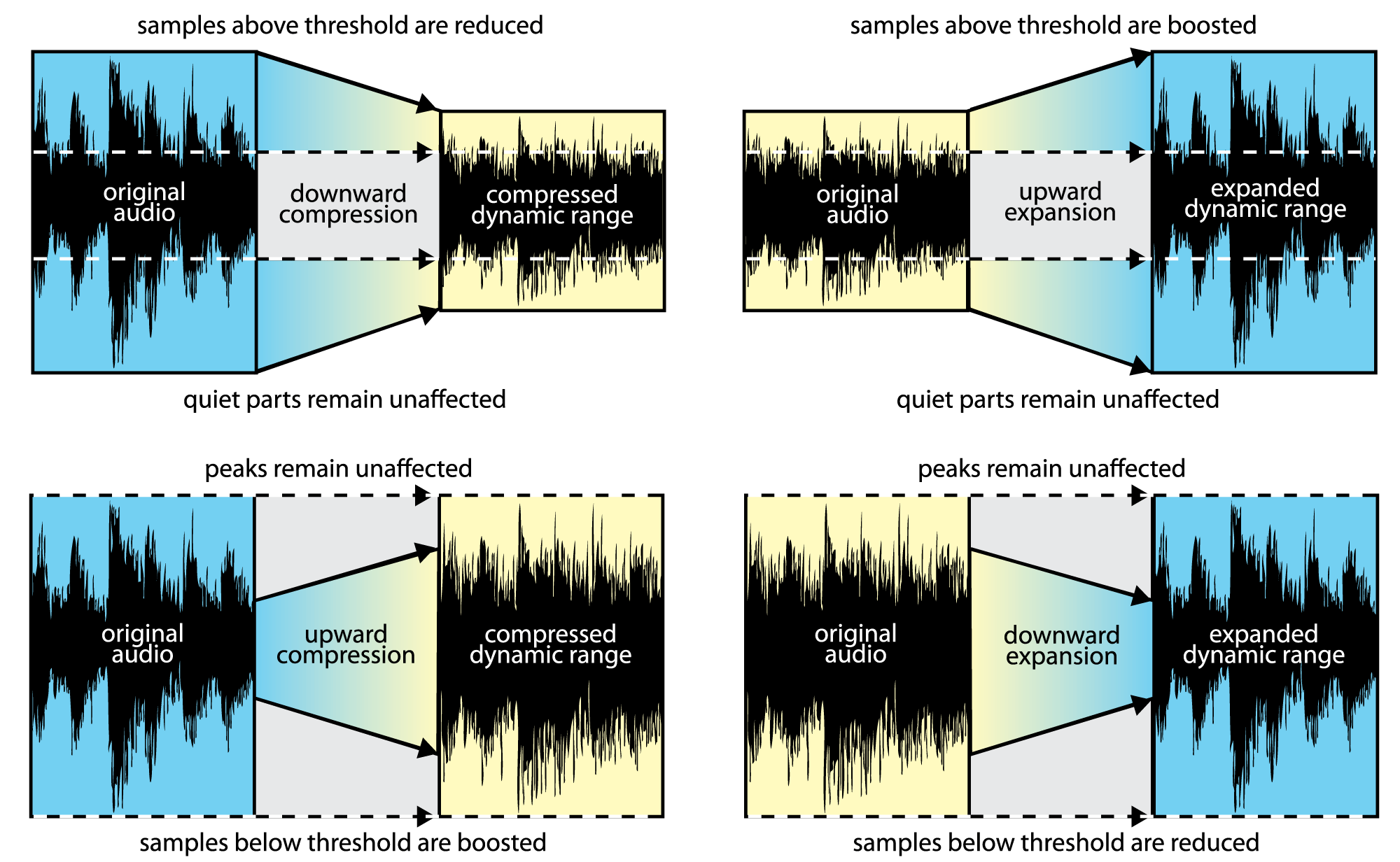
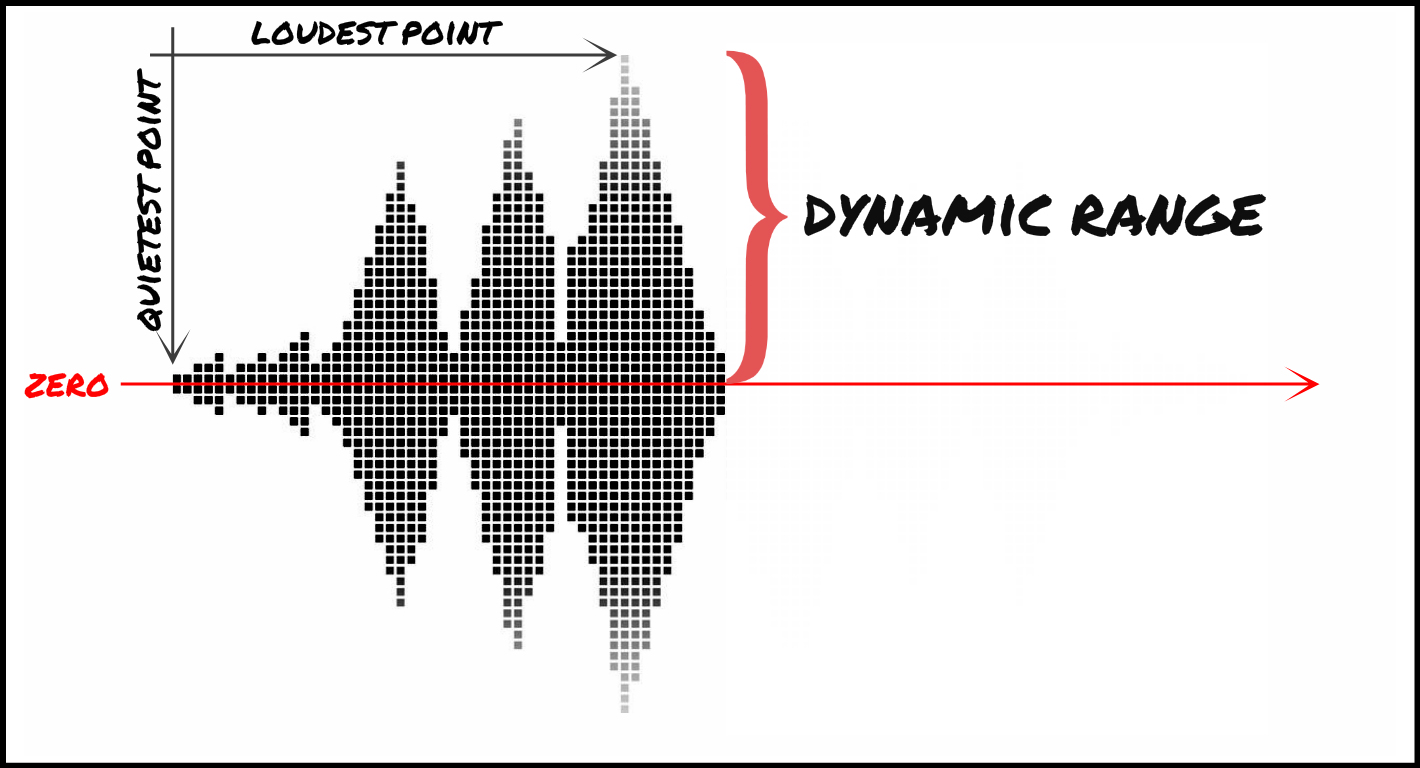
Dynamic Compression (DRC): narrowing (or expanding in the case of an expander) the dynamic range of a soundtrack. Dynamic range is the difference between the quietest and loudest sound. Sometimes the lowest sound on the soundtrack will be a little louder than the noise level, and sometimes a little lower than the loudest. The hardware devices and programs that perform dynamic compression are called compressors, distinguishing four main groups among them: the compressors themselves, limiters, expanders, and gates.

Up and down compression
Creep Compression lowers the volume when it exceeds a certain threshold, leaving quieter sounds unchanged. The extreme downward compression option is the limiter. Increase compression (upward compression), conversely, increase volume if it is below a threshold value without affecting louder sounds. In this case, both types of compression reduce the dynamic range of the audio signal.
Expander and gate
If the compressor decreases the dynamic range, the expander increases it. When the signal level rises above the threshold level, the expander raises it further, thus increasing the difference between high and low sounds. These devices are often used when recording drums to separate the sounds of some drums from others.
A type of expander that is used not to amplify loud sounds, but to drown out quiet sounds that do not exceed the threshold level (for example, background noise) is called a noise gate. In such a device, as soon as the sound level falls below the threshold, the signal flow stops. Normally, the door is used to suppress noise during breaks. In some models, you can make sure that the sound does not stop abruptly when the threshold level is reached, but gradually fades away. In this case, the decay rate is set with the Decay knob.
The gate, like other types of compressors, can be frequency dependent (that is, handle certain frequency bands differently) and can operate in side chain mode (see below).
Compressor working principle
The signal entering the compressor is divided into two copies. One copy is sent to an amplifier, in which the degree of amplification is controlled by an external signal, the second copy forms this signal. It goes into a device called a side chain, where the signal is measured and based on this data, an envelope is created that describes the change in its volume.
This is how most modern compressors are organized, this is the so-called feed-forward type. In older devices (feedback type), the signal level is measured after the amplifier.
There are several analog variable gain amplification technologies, each with its own advantages and disadvantages: tube, optics with photoresistors, and transistor. When working with digital sound (in a sound editor or DAW), you can use your own mathematical algorithms or emulate the work of analog technologies.
Basic parameters of compressors
Limit
The compressor reduces the level of the audio signal if its amplitude exceeds a certain threshold value. Typically specified in decibels, a lower threshold (eg -60 dB) means that more sound will be processed than a higher threshold (eg -5 dB).
Proportion
The amount of level reduction is determined by the ratio parameter: the 4: 1 ratio means that if the input level is 4 dB higher than the threshold, the output signal level will be 1 dB higher than the threshold .
For example:
Threshold = −10 dB
Input signal = −6 dB (4 dB above threshold level)
Output signal = −9 dB (1 dB above threshold level)
It is important to note that the suppression of the signal level continues for some time after it falls below the threshold level, and this time is determined by the value of the release parameter.
Compression with a maximum ratio of ∞: 1 is called limiting. This means that any signal above the threshold level is suppressed down to the threshold level (except for a short period after a sudden increase in input volume). For more details, see Limiter below.
Attack and release
The compressor provides some control over how quickly it responds to changes in signal dynamics. The Attack parameter determines the time it takes for the compressor to reduce the gain to the level determined by the Ratio parameter.