Sample Rate and Bit Depth: What Do They Mean for Your Sound Quality?


Free Download Mp4Gain
picture

If you’re recording music with a  digital recorder, you’ve probably come across the terms sample rate and bit depth. These are the two main factors that determine the level of detail in the sound. The sample rate determines the frequency range of your recording and the bit depth determines the dynamic range. Read on to find out which settings are the best to use for your productions.

bit depth example in colors

Bit depth example in colors

Sample rate in bit-depth

Sample rate: audio pixels

Bit Depth

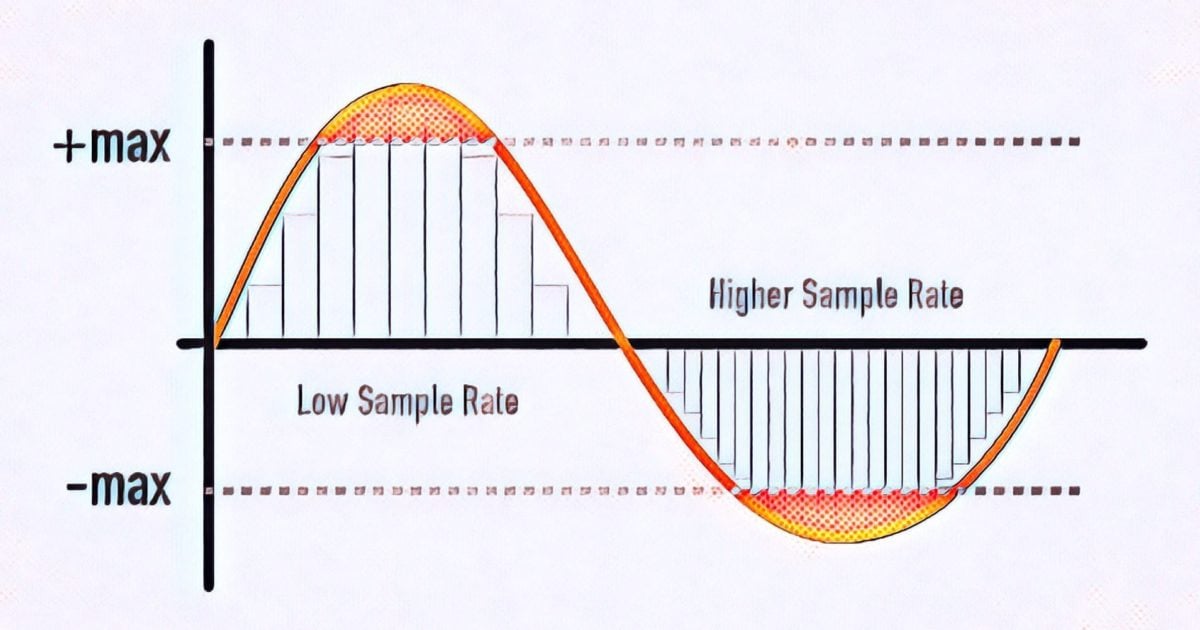
You can compare the sampling frequency of a digital signal with the number of pixels in a digital photo. As with digital photos, digital sound is divided into very small parts. With photos, those pieces are called pixels and with sound samples. The sampling frequency is expressed in kilohertz (KHz). The standard sampling frequency for CD is, for example, 44.1 kHz. That means that every second of your recording consists of 44,100 samples. Unlike photos, you will not hear any “blocks” at very low sample rates. The sound becomes mainly muffled.

Why 44.1 kHz?

In the late 1970s, Sony and Philips decided to choose 44.1 KHz as the default sample rate for their digital audio devices. That number may seem random, but there is definitely an idea behind it. The sample rate must be at least twice the highest rate you want to capture. If the sample rate is lower, the converters may misinterpret the super high frequencies. This phenomenon is called “aliasing.” Since, in theory, the human ear can detect frequencies from 20 Hz to 20 kHz, the sampling frequency should be at least 40 kHz. The additional 4.1 kHz is intended as a kind of buffer for the low-pass filter that is used to prevent aliasing above 20 kHz.

Why higher than 44.1 kHz?

Audio interfaces and DAWs often offer the ability to record at much higher sample rates, sometimes up to 192 kHz. This has several advantages. For example, the low pass filter mentioned above can be set much more gradually. Also, with the extension of time and the change of pitch, the noise will disturb you less. Keep in mind that the higher the sample rate, the larger your audio files will be. Plug-ins also require a lot more computing power from your computer at higher sample rates.

Hit my parts

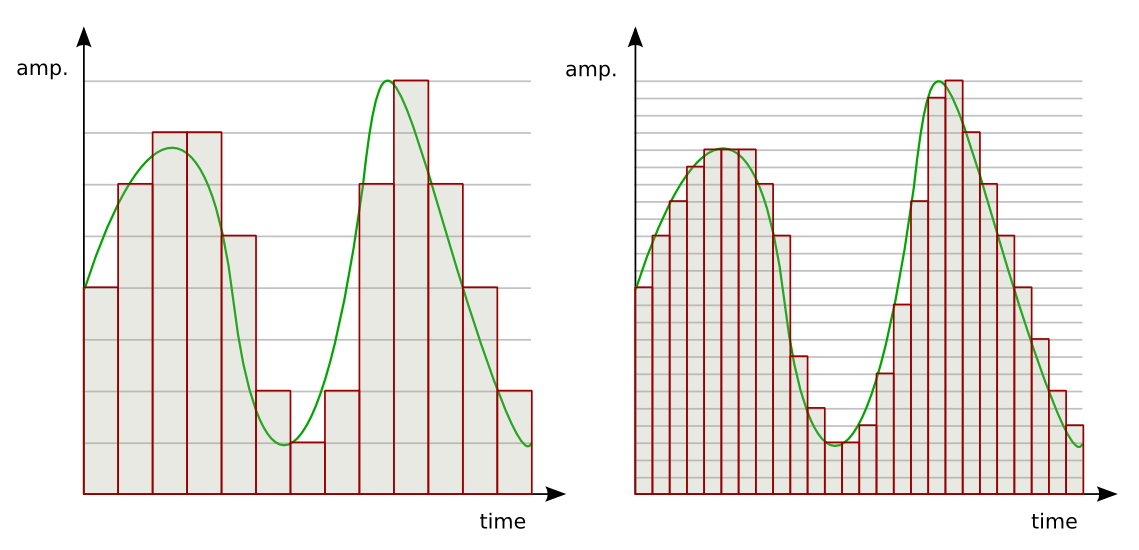
So the sample rate tells us how many pieces the recording is made of. But how many different pieces can we choose from? In other words: in how many steps do we go from the softest sample to the hardest sample? We determine this with the bit depth. With most DAW and audio interfaces, you can choose between 16-bit or 24-bit. If you make very smooth recordings at a low bit depth, you have the possibility that the softer passages will disappear in the noise and you may even get distortion.

99 problems but a little is not one

The standard bit depth for CDs is 16 bits, which gives us a dynamic range of 96 dB. That’s a considerable improvement compared to say tape (+/- 80 dB), but in the studio world, 24-bit is generally chosen. With the 144 dB that we have then in dynamic range, we hardly really have to worry about the noise that the digital medium adds to the signal. In fact, it’s better to record and mix a little too low than too high.


Free Download Mp4Gain
picture


Mp4Gain Main Window
picture


Mp4Gain Features
picture


Free Download Mp4Gain
picture

What is sample rate and bit depth

BIT DEPTH

-translated from eurpean language-

Bit Depth

As a digital music producer, you will soon come into contact with the terms Sample Rate and Bit Depth. These terms are often experienced as complicated and are also used interchangeably. Starting today, you will no longer have to make those mistakes, because you have LesinProducing and we will do our best to explain it to you as well as possible. So here we go!

Bit Depth

As a digital music producer, you work 99% of your time on your computer or laptop. In order to record and edit sounds with a computer, the sound must be translated into the digital language that a computer understands, that is, “binary codes” (with all those zeros and ones).

SAMPLE RATE

Sample Rate Image A movie is actually a complete series of images that are put together, which our brain then interprets as a moving image. This is how it works with digital audio. Digital audio is basically a series of snapshots, which our brain experiences as one continuous sound. The frequency with which snapshots of the audio are taken, we express it in “Sampling frequency”. The greater the number of snapshots taken, the more detailed the result. In the world of digital audio recording, 44.1 kHz and 48 kHz are / were the most common sample rates. “But what exactly does 44.1 kHz mean?” I heard you think!

44.1 kHz means 44,100 “snapshots” that are taken per second. At 48 kHz this is 48,000 “snapshots” per second. Today you come across sound cards that support recordings of up to 96 kHz or even 192 kHz. That’s respectively 96,000 and 192,000 “snapshots” per second.

Okay, so far, because I know you have a few questions on your mind right now. Let’s see if we can answer your questions right away:

Question 1: If my sound card supports 96kHz recording, for example, where can I configure this?
Answer: In Cubase you can set the sample rate in Project -> Project Settings. In Logic X, do this in File -> Project Settings -> Audio.

Question 2: Is the difference between 44.1 kHz and 96 kHz audible?
Answer: The difference between 44.1 kHz and 96 kHz is almost inaudible.

Question 3: If we don’t experience / hear 92 kHz as “better”, what good is it?
Answer: To answer this question, we are introducing a new term, the “Nyquist Frequency”. Simple explanation: generally people can hear frequencies from 20Hz to 20,000Hz (= 20kHz). If you want to record a 20 kHz sound source, it must have a sampling frequency of at least 40 kHz. The “Nyquist frequency” of the 40 kHz sample rate, in this case 20 kHz. In this setting, 20 kHz is the highest frequency that can be recorded with a 40 kHz sample rate. Some musical instruments are said to have a higher range than our hearing (20 kHz). According to some, it is important to record these instruments as well as possible, although these instruments contain frequencies that we do not hear directly at first, but that we can feel / experience. If you want to achieve this,

Question 4: Why not record everything at the highest possible sample rate?
Answer: One reason is that the higher the sample rate, the larger the storage space. For example, if you need 5 MB of storage space for a few seconds of audio at a sampling rate of 48 kHz, you will need no less than 4 times more storage space for the same seconds at 192 kHz, that is, 20 MB.

BIT DEPTH

When Sample Rate takes vertical “snapshots”, the bit depth is based on the resolution (sharpness of the translation). Easy said; the higher the bit depth of the “digital translation”, the sharper the “translated” result. The result is a nice smooth waveform at higher bit depth. So you can take 44,100 “snapshots” with the sample rate, but if the resolution (depth of supply) is not sharp enough, the result will not be a smooth waveform. Bit depth is also about dynamic range. With each +1 bit, a dynamic range of + 6dB is added. For example, a 16-bit bit depth has a 96 dB dynamic range, and a 24-bit has a 144 dB dynamic range. For CDs, use 16-bit and for DVDs, 24-bit.