Better audio formats


Free Download Mp4Gain
picture

You have decided to digitize the music tracks in your audio CD collection by transferring everything to your computer. You started to examine the possibility of converting it into a format that is more convenient for you.

audio formats

With a little experience in this area, however, you would like to get some advice on the subject so you can make the best decision. How do you say? Things are exactly the same and you want to know if I can help you by giving you the best audio formats? Of course yes, that’s exactly what he wanted to do.

audio formats

If you allow me a few minutes of your free time, I can actually use threads and characters to tell you which audio formats are most popular, what strengths and weaknesses they have and what purposes they may be more or less convenient for. Contact. Condition to choose those who you think are actually right for you. To complete the information and give you an even more comprehensive overview of the topic, I will also indicate at the end of the article which tools you can use to carry out various conversion processes. You will find that once you have read this manual, there is no longer any doubt about what to do.

In order to? How about putting the conversation aside and finally getting to the point? Yes? Excellent! So I suggest that you don’t waste any more time and immediately focus on the topic. Make yourself comfortable in front of your trusted computer and read everything below. I am sure you can say that you are happy and satisfied with what you have learned. As always, I hope you enjoy reading.


Free Download Mp4Gain
picture


Mp4Gain Main Window
picture


Mp4Gain Features
picture


Free Download Mp4Gain
picture

MAIN AUDIO FORMATS

MAIN AUDIO FORMATS

Even the audio formats differ in their versatility and level of compression, and even if they are not as numerous as the video formats, it is better to look at the properties to get satisfactory results according to the requirements of our work.

Microsoft Wave [Extension: WAV] It is Microsoft’s proprietary format and is certainly the most widely used. This diffusion depends on commercial aspects and the fact that it is the most supported among the competitors. It has various compressions and is a versatile and highly editable format. For this reason, it is suitable for general digital audio, both for multimedia publications (although there are certainly better formats) and for desktop video (real standard). An excellent program for processing wave files (but also other formats) is CoolEdit.

audio format

MPEG Audio (extension: MPG / MP3) MP3 stands for MPEG1 Layer3. The MPEG algorithm, the basis of MP3, emerged from the need to develop a world standard for the representation of moving images and audio. This standard was developed in 1988 for the treatment of audio and video signals and has the special feature of compressing files and reducing them by 12 times compared to their natural size.

This high-compression format is based in particular on theories of psychoacoustics: each individual has a hearing that is sensitive to frequencies from 20 Hz to 20 kHz, and in particular the man perceives sounds between 2 and 4 kHz better. In addition, some sounds mask nearby frequencies so that you cannot hear all of the sounds.

audio format

These considerations have led to the development of an algorithm that eliminates all “redundant” noise for the human ear and achieves a high level of file compression and sound quality that is comparable to the digital and can be downloaded directly to your PC.

MP3 enables good results, making small and high quality playback compatible. An established audio standard is the MPEG Layer3 version, which produces very small files of excellent quality, an excellent compromise when duplicating and creating audio files on CD. The XingMPEG encoder is an excellent software for creating MP3s.

Given the prevalence and importance of the topic on a legal level, let’s find out what it is and what benefits we can achieve by using this MPEG format.

An audio CD generally contains 60 to 78 minutes and is characterized by a quantization level of 16 bits and a sampling rate of 44.1 kHz, ie 44,100 samples per second. The quantization level describes the maximum number of intensity levels that a single sample can hold: for example 8 bits = 256 levels (28), 16 bits = 65,356 levels (216). The higher the number of levels that the signal can assume, the more precise the signal reproduction.

There is approximately 650 MB of data on a normal audio CD.

Conventionally, to reduce the size, we can work in two ways: 1) Reduce the quantization: that is, convert the samples from 16 bits to 8 bits, but lose the dynamics, quality and get a lot of noise; 2) Reduce the sampling frequency. As a result, the frequency range would decrease in the event of a loss of resolution.

The MPEG format, on the other hand, reduces the amount of information stored and therefore significantly reduces the size of the files by filtering out unimportant audio information according to the models developed on this basis. From research on the perception of the human ear, you decide which information is important and which is not . These studies have enabled us to know how our brain analyzes sounds, except irrelevant ones that are imperceptible (e.g. ultrasound).

The MPEG audio format also performs this process of removing intelligent weak signals. So if there is a strong signal, the weakest signal is not perceived.

When using a high compression rate, the MPEG encoder eliminates parts of audible information that are still of minor importance. With a slight compression rate, the difference to the uncompressed original is minimal.

Layers I, II, III can be viewed as the layers through which the MPEG format has evolved. All layers are based on the same perceptual coding scheme, the complexity of which increases for each of them. Layer II has superior quality at lower bit rates than Layer I; However, the most complex coding system currently available is Layer III,


MP4 (Extension: MP4) is an audio compression technology recently launched by Global Music Outlet (GMO) under license from AT&T Labs (January 99). As you understand, it is a further development of the MP3 format and seems to offer the ability to offer it a higher compression factor, which should even reach a factor of 16. Although the name is very similar, conceptually it has nothing to do with layer 3 and is actually in direct competition with it. Compressed MP4 files are presented as executable Win9x or WinNT files and offer the relatively encapsulated player.

Audio exchange (extension: AIF / AIFF) Format created to standardize the various audio standards between PC and Machintosh.

Microsoft NetShow (Extension: ASF) Audio extension of the format for streaming audio / video on the web.

Yamaha SoundVQ [Extension: VQF] Audio format released by Yamaha in direct competition with MP3.

Everything you need to know about audio files … compressed and uncompressed

Everything you need to know about audio files … compressed and uncompressed

Regardless of whether you’re listening to MP3 files or high-definition audio, it’s time to find out exactly which file format is best for your needs.

audio formats

As you organize your digital music collection, you may be impressed by the number of different audio file formats you have collected over the years. For this reason (and since a good review doesn’t hurt anyone) we’d like to deepen the discussion of the most common audio file formats, explain the differences and explain why you should be interested in learning more about them. Whether you’re listening to low quality MP3 files, slightly better AAC tracks, or high definition audio in FLAC or WAV, it’s time to find out exactly what you’re dealing with and which file format best suits your needs.

formats and codecs

File formats and codecs

Below is a list of all common audio file formats and the differences between them.

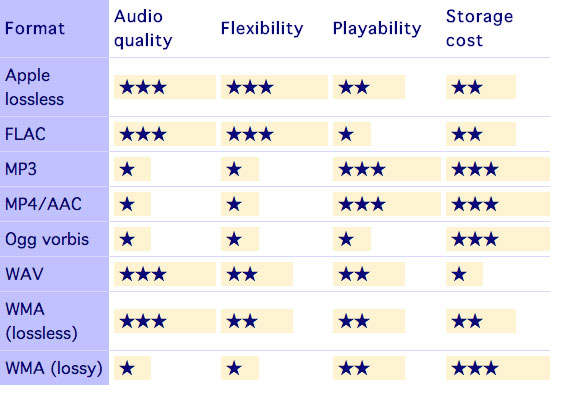
-AAC (no high resolution): Apple’s alternative to MP3. It’s a compressed audio format, but it sounds better than MP3 and is used to download music from iTunes and stream via Apple Music.

-AIFF (high resolution): Apple’s alternative to WAV, but with better metadata support. It’s an uncompressed and lossless format, but it’s not very popular.

-DSD (High Resolution) – The uncompressed single bit format for super audio CDs. It is available in the 2.8 MHz, 5.6 MHz and 11.2 MHz variants, but due to its high-quality codec it is (currently) not suitable for streaming.

-FLAC (High Resolution) – This lossless compression format supports high-resolution sampling rates, takes up about half the WAV space, and stores metadata. It is license-free and is the preferred format for downloading and storing albums in high resolution or CD quality. The disadvantage is that it is not compatible with Apple (therefore it is not compatible with iTunes).

-MP3 (not high definition): Lossy, compressed format that guarantees small file sizes, but is far from the best possible audio quality. However, it is still very convenient for storing music on smartphones and other mobile devices and is widely used.

-MQA (High Resolution) – A lossless compression format with high resolution files for more efficient transmission. It is used for high-resolution streaming from Tidal Masters and other similar services.

-OGG (not high resolution): Sometimes you can find him by his full name, Ogg Vorbis. An open source and compressed alternative to MP3 and AAC that is not limited by patents. This format is used (at 320 kbit / s) to stream Spotify.

-WAV (High Resolution) – The standard format in which all audio CDs are encoded. Excellent sound quality and no compression, which means large files (especially for high-resolution files). However, metadata (album art, artist information, and song title) are hardly supported.

-WMA Lossless – An uncompressed embodiment of Windows Media Audio, but is no longer supported by smartphones or tablets.

The 10 most common audio formats: which one to use?

The 10 most common audio formats: which one to use?

Audio files are available in all types and sizes. And although we are all familiar with MP3, what do you think of AAC, FLAC, OGG or WMA? Why are there so many audio standards? Which are important and which to ignore?

It’s actually quite easy to find that all audio formats fall into three main categories. Once you know what the categories mean, you can simply choose a format within the category that best suits your needs.

Uncompressed audio formats

Uncompressed audio consists of actual sound waves that have been captured without further processing and converted into a digital format. As a result, uncompressed audio files are usually the most accurate, but take up a lot of space, about 34MB per minute for 96-bit and 96-bit stereo.

Audio file format: PCM

PCM stands for Pulse Code Modulation, a digital representation of analog audio signals. Analog tones exist as waveforms, and in order to convert a waveform into digital bits, the tone must be sampled and recorded at certain intervals (or pulses).

This digital audio format has a “sample rate” (how often a sample is taken) and a “bit depth” (how many bits are used to represent each sample). No compression is required. The digital recording is an almost exact representation of the analog sound.

PCM is the most common audio format used on CD and DVD. There is a PCM subtype called Linear Pulse Code Modulation, in which samples are taken at linear intervals. LPCM is the most common form of PCM, so the two terms are almost interchangeable at this point.

Audio file format: WAV

WAV stands for Waveform Audio File Format (at some point also called Audio for Windows, but no longer). It is a standard developed by Microsoft and IBM in 1991.

audio formats

Many people believe that all WAV files are uncompressed audio files, but that’s not exactly true. WAV is actually a Windows container for various audio formats. This means that a WAV file may contain compressed audio, but this is rarely used.

Most WAV files contain uncompressed audio in PCM format. The WAV file is just a container for PCM encoding, so it is more suitable for use on Windows systems. However, Mac systems can generally open WAV files with ease.

Audio file format: AIFF

AIFF stands for Audio Interchange File Format. Similar to how Microsoft and IBM developed WAV for Windows, AIFF is a format developed by Apple for Mac systems in 1988.

Similar to WAV files, AIFF files can contain several types of audio formats. For example, there is a compressed version called AIFF-C and another version called Apple Loops that is used by GarageBand and Logic Audio. Both use the same AIFF extension.

Most AIFF files contain uncompressed audio in PCM format. The AIFF file is just a container for PCM encoding, making it more suitable for use on Mac systems. However, Windows systems can generally open AIFF files with ease.

Lossy compression audio formats.

Lossy compression occurs when some data is lost during the compression process. Compression is important because uncompressed audio takes up a lot of space.

In other words, lossy compression means that the sound quality and fidelity for smaller files are affected. If you are hurt, you will hear artifacts and other oddities in the audio. But if done correctly, you won’t feel the difference.

Audio file format: MP3

MP3 stands for MPEG-1 Audio Layer 3. It was released in 1993 and is becoming increasingly popular. It is the world’s most popular audio format for music files. There is a reason why we had “MP3 players” but no “OGG players”!

The main purpose of MP3 is in three ways: 1) removing all audio that is out of the normal human hearing range, and 2) reducing the quality of inaudible sounds, then 3) compressing all the other audio as efficiently as possible.

Almost every digital device in the world with audio playback can read and play MP3 files, be it PC, Mac, Android, iPhone, Smart TV or anything else. If you need a universal device, MP3 will never disappoint you.

Note: MP3 is not the same as MP4!


Audio file format: AAC

AAC stands for Advanced Audio Coding. It was developed in 1997 as the successor to MP3 and although it has become popular as a format to be used, it has never surpassed MP3 as the most popular.

The compression algorithm used by AAC is much more advanced and technical than MP3. So if you compare the same recording in MP3 and AAC format with the same bit rates, the AAC generally has better audio quality.

Although MP3 is a more popular format, AAC is still widely used today. In fact, this is the standard audio compression method used by YouTube, Android, iOS, iTunes, later Nintendo laptops, and later PlayStation.

Audio file format: OGG (Vorbis)

OGG represents nothing. In fact, it’s not even a compression format. OGG is a multimedia container that can contain all types of compression formats. However, Vorbis files are most commonly used. Therefore, these audio files are called Ogg Vorbis files.

Vorbis was first released in 2000 and is growing in popularity for two reasons: 1) it conforms to the principles of open source software and 2) it works significantly better than most other lossy compression formats (ie) this results in a smaller file size for an equivalent sound quality.

MP3 and AAC are so strong that OGG struggles to get into the spotlight – not many devices support them natively, but they do improve over time. It is currently used primarily by supporters of hardcore open source software.

Audio file format: WMA (lossy)

WMA stands for Windows Media Audio. It was first published in 1999 and has gone through several developments since then, always keeping the same name and WMA extension. It is a proprietary format created by Microsoft.

Similar to AAC and OGG, WMA should fix some of the errors in the MP3 compression method, and it turns out that WMA’s approach to compression is very similar to that of AAC and OGG. Yes, in terms of the quality of objective compression, WMA is really better than MP3.

However, since WMA is proprietary, it is not supported by many devices and platforms. In addition, it offers no real advantage over AAC or OGG. If MP3 is not good enough, it is only more practical to use one instead of WMA.

Audio formats with lossless compression.

The opposite lossy compression is lossless compression, in which the size of an audio file is reduced without loss of data between the source audio file and the compressed audio file.

The disadvantage is that lossless compressed audio files are larger than lossy compressed audio files, up to 2 times 5 times larger for the same source file.

Audio file format: FLAC

FLAC is an abbreviation for Free Lossless Audio Codec. Maybe a bit on the nose, but it has quickly become one of the most popular lossless formats since its launch in 2001.

The good news is that FLAC can compress an original source file by up to 60 percent without losing a single bit of data. What’s even better is that FLAC is a free, open source audio file format, so there are no intellectual property restrictions.

FLAC is compatible with most major programs and devices and is the primary alternative to MP3 for music. You basically get the full quality of uncompressed audio with half the file size. That is why many see FLAC as the best audio format.

Audio file format: ALAC

ALAC stands for Apple Lossless Audio Codec. It was developed and published as a proprietary format in 2004, but became open source and copyright-free in 2011. ALAC is sometimes referred to as Apple Lossless.

While ALAC is good, it is somewhat less efficient than FLAC in terms of compression. However, Apple users cannot choose between the two, as iTunes and iOS offer native support for ALAC and no support for FLAC.

Audio file format: WMA (lossless)

WMA stands for Windows Media Audio. We already discussed this in the lossy compression section, but we explained this here because there is a lossless alternative called WMA Lossless that uses the same extension. Confused, I know.

Compared to FLAC and ALAC, WMA Lossless is the worst compression efficiency, but not much. Since it is a proprietary format, it is not suitable for open source software enthusiasts, but is natively supported on Windows and Mac systems.

The most used audio formats

The most used audio formats

audio formats

As you can imagine, when we talk about digital formats in the field of sound, the range is wide. When choosing the one that best suits our needs, we need to think about several questions. To do this, the first thing to do is to know the most used audio formats.

We start by clarifying the concepts of bit depth and sample rate, which are essential for understanding how audio formats work. These are two measurements that indicate the quality of a digital audio file.

When we read the specifications for audio formats and find, for example, 32 bit / 192 kHz and 24 bit / 96 kHz, these figures refer to “bit depth” and “sampling frequency”, respectively. They tell us the amount of information transmitted by the different formats and the quality of the sound. The more times a device reads samples, the higher the quality.

audio format

Audio formats

-MP3: These files weigh very little for any device to read. The downside is that the quality of compression is sacrificed.
online CPA sound postproduction course

-WAV (Waveform Audio File Format): These are higher resolution files than MP3, an audio track which is coded with what is called Pulse Code Modulation (PCM). Analog audio tracks are encoded and converted to digital so that they can have sample rates and bit depth.

-AIFF (Audio Interchange File Format): it is very similar to WAV and also uses PCM to encode analog audio tracks and present them in digital format. Indeed, AIFF and WAV files are more or less interchangeable.
In short, when we talk about a file in WAV or AIFF audio format, we are talking about a good quality piece of sound.

Most important audio formats

Most important audio formats

MP3

MPEG Audio Layer III
-Compressed digital format with loss.
-Its compression size: 11 to 1
-Compresses the audio using a lossy algorithm to obtain a smaller size, decoding the signal, allowing less bits to be consumed, which translates into less weight and less quality.
-Extension: .MP3
-Good compatibility. Can be played on almost all audio players
-Easily distributable online
-Better quality-space ratio
-Loss of the original sound, implies a decrease in quality throughout the format
-Supports two channels
-Distortion in frequency bands where the brightness and sparkle (5000hz-20000hz) are located.
-Increase in the bass and subwoofer frequencies (250hz – 40hz) due to the dynamic compression of the sound that causes a different equalization from the original recording.
-present patterns between tracks

AAC

Advanced Audio Coding
– Lossy compressed digital format
-It is an audio compression system developed by the Fraunhoffer Institute, AT&T, Sony and Dolby Laboratories.
– It is an audio broadband coding algorithm with higher performance than MP3.
-Extension: .m4a, .m4b, .m4p, .m4v, .m4r, .3gp, .mp4, .aac
-Play files from the hard disk of a computer with a quality that can be similar to the CD using significantly less space than an mp3.
-This system increases the quality of the mp3.
-Loss of original sound
-Subject to patent

WAV

Waveform audio format
-Uncompressed digital format.
– Windows own format
– Used to store sounds on PC, supports mono and stereo files at various resolutions and sampling rates
– Extension is .wav
-High sound quality
-Provides faithful listening to the audio
-It works in Windows applications and in common equipment with a CD player.

– Includes support for almost all current audio codecs
– Compatible to convert into various formats by means of the appropriate software.Example switching from Wav to Mp3
-It takes up a lot of disk space
-Poor quality-space ratio
-Difficult to distribute online due to the weight of the file
-Allows to capture in the same file up to 6 hours

FLAC

Free Lossless Audio Codec
– Lossless compressed format

-Extension: .flac
-Higher quality in high fidelity equipment
-Information is continuous between separate tracks
-It does not delete information from the original content
-It is an open source format.
-Code and decode quickly
-It takes up a lot of disk space
-It is not supported by all portable players

AIFF

Audio Interchange File Format
-Uncompressed format without loss.
– Format typical of native applications of Mac OS X for example iTunes
-Extension: .aiff or .aif.
-High sound quality
-Requires large storage space

OGG VORBIS

-Compressed format loss
– Stream-oriented container, which means that
can be written and read in one step, making it suitable
for streaming on the internet.
– Free software version to MP3 and AAC.
– Intended to allow maximum encoder flexibility
Extension: .ogg
-It is free, open and not patented
-Similar to MP3
-Good value for space
-Improved same-size MP3 quality.
-It is not supported by all players
-Loss of original sound

WMA

Windows Media Audio
– Lossy audio compression format, although there is a more recent lossless development
-Windows version to compress audio
-Extension: .wma
-Ideal for real-time streaming
-Reduce size of large files
– Inclusion of support in Windows Media Player
-Lower quality
-It takes space
Real Audio
-Media player with various functions and Internet connection tools
Example: listening to music and watching videos hosted on the Internet (streaming), and creating and playing extensive playlists.

– Ideal for live streaming over the network due to its streming ability
– the coding allows adapting it to the user’s reception capacity depending on their internet connection speed.
-Can be used in different operating systems (Windows, Linux, Mac OS)
– Ability to transfer files to other multimedia devices
-Reduction in file sizes

-Incompatibility with some browsers
-High RAM consumption

APE

– Lossless compressed format
-Extension: .ape
-Save space
-High quality
-Better file compression rate
-It is not compatible with most players.
-Slow to compress and decompress files

What audio formats are there? All you need to know


FLAC, WAV, AIFF, DSD … these are just some of the initials that you can find when you are looking for a digital format. They are also accompanied by technical data such as sample rates and bit depth. So many terms can leave you more misplaced than a chicken at a dance. And it is that unless you are an expert in digital sound, the process to choose the audio format that best suits your needs can be a mess. But if they explain it to you, the topic is relatively simple. That is why at Culturasonora we have prepared a complete guide for you on the different audio formats most used. This will prevent any acronym from taking you on the dark side.

What are Bit Depth and Sample Rate?

These two concepts are basic. To understand how audio formats work you need to know what Bit Depth and Sample Rate are. These are two measures that indicate the quality of a digital audio file. We are going to try to summarize it so that you keep the general idea

samplerate

When you read the specifications of the audio formats you come across a couple of figures. For example: 32-bit / 192kHz or 24-bit / 96kHz. These numbers indicate the bit depth and the sample rate. These references tell us how much information the different formats transmit and the quality of the sound. For example, the audio we hear on a regular CD, or on a Spotify stream, is 16bit / 44.1kHz. Samples are always measured in Hertz (or hertz) and bit depth in Bits.

Softwares or hardwares usually do not work with a continuous flow of information, but usually use pieces, samples or samples to effectively manage the data that is transmitted. The sample rate is the number of samples per second that are obtained from a recording. The higher the number of times a device plays samples, the higher the sound quality. Each of these extracts or samples has a certain amount of information, which is the bit depth, or bit depth.

So that you understand it better we are going to make a somewhat beastly analogy, which is not entirely true, but that will help you get the sense of all this. Which is what interests us. If you control a bit of photography and image you will get it right away: the sample rate would be something similar to the frames or frames per second of a video, and the bit rate would be similar to the pixels of a photograph. The higher the bit depth number, the more information each sample will have. The more pixels an image has, the higher resolution each frame of a video will have. The more frames per second a movie has, the better definition. In short: the higher the number of the Bit Depth and the Sample Rate, the higher the quality of the audio file. Heard cooking?

Audio formats: MP3 vs WAV vs AIFF

What is the MP3 format?

If you’re interested in getting some audio fidelity and decent sound from your files, you’ll want to avoid this format. Why? Because basically an MP3 is a file that sacrifices audio quality to minimize size. They weigh very little for any device to read. The negative? Compressing these files provides poor, almost lifeless sound. Today, hardly anyone uses this format seriously. Even its creators recently ended the license by declaring it dead. But surely from time to time you come across a zombie file with this format.

What is WAV format?

WAVs (Waveform Audio File Format) are just as common but better for anyone who wants a decent audio format. They are higher resolution files than MP3s. A WAV is an audio piece that is encoded with something known as Pulse Code Modulation (PCM), a medium that encodes analog audio pieces and converts them to digital so they can have the Sample rate and Bit Depth of the that we have already talked about previously.

What is the AIFF format?

The AIFF (Audio Interchange File Format) audio format is very similar to WAV in that it also uses PCM to encode analog audio pieces and present them in digital format. This format was born as a response from Apple to Microsoft’s WAV, and at the beginning it could only work on MAC computers. Currently AIFF and WAV are more or less interchangeable.
In summary…
To close this topic, we will tell you that if you have a file in WAV or AIFF audio formats, you will hear a piece of sound of good quality. Normally these formats are used in files that we reproduce through our services, such as the iTunes music library. We will not see them in online streaming services, which tend to use special types of files.

Audio Formats: Know all that exist

Audio Formats: Know all that exist

There are several kinds or types of audio formats, you probably know the most common ones such as mp3, mp4, wav, etc. In this article you will know which are the most important apart from those mentioned above and how they differ from each other.

What is an audio format?

An audio format is a multimedia container where data is stored in an audio file. Each of these has its own characteristics and capabilities in terms of reproduction, they also have a sample rate (bit rate) and a specific bit depth (bit depth) that are closely related to the quality of each format.

Let’s talk about the sample rate and the bit depth
These two terms refer to the way it is stored and how an audio file is played. For this, what is sought is to digitally re-interpret the analog signal of a recording. As they have a type of continuous analog wave signal and instead the digital language used by computers is given by shorter and more concrete actions (1 and 0) executed at high speed, that continuous analog wave must be described in more values Small and concrete.

To achieve this conversion, small fragments of a specific size of the analog signal are taken, each sample (sample) contains the necessary information so that by putting all the “pieces” together and reproducing them in the same order and at the same speed in which they were captured, as a result a reliable digital interpretation of analog recording.

The frequency at which each of these samples is reproduced is what is called “sampling rate” or “sample rate” and the digital data in bits contained in each sample is called “bit depth” or “bit depth ”.

How is an audio format different from a codec?
The difference between these two is that while a codec as its name says is responsible for encoding and decoding all the information in an audio file, the format gives us the idea of ​​how this audio information is stored, what is its bit depth, its sample rate, etc.

Types of audio formats

Among the types of audio formats there is a large amount and we will separate them into 4 groups or families to understand a little better the characteristics and potential they have:

1.Compressed audio format

The uncompressed formats allow several sample rate combinations in a flexible way and seek to preserve all the details of the analog recording even the details inaudible to our ears.

The main ones are:

WAV

Owned by IBM and Microsoft, the Wave Audio File Format was developed by these two previous ones to store sounds on the PC or computer. It is relatively similar to the Mac AIFF and a variant of the RIFF or Resource Interchange File Format which is a file format for the exchange of resources.

AIFF

The Audio Interchange File Format was co-developed by Apple Inc. to store sound data on personal computers. The AIFF is used professionally for audio applications along with SDII and WAV because it is a compression-free format and fast signal processing

AU

This format was formerly common on internet pages. At first it was encoded in 8-bit data with a sample rate of 8000 Hz, uploading in the newer files to a 32-bit encoding.

2. Compressed audio format without loss or lossless
Because the uncompressed formats encode both the sound of a recording and the silences, a few seconds of sound from an audio file will weigh the same as the same seconds of silence. The type of lossless format compresses the file so that silence does not take up almost anything in size.

Between them we have:

Shorten

The SHN format is used for lossless compression of CD quality audio files, it is similar to formats such as RAR or ZIP with the difference that it is optimized for compression of audio data.

WMA Lossless

The WMA or Windows Media Audio format is a compressed audio format which has 4 codecs of which the WMA Lossless codec allows the compression of an audio file without loss of definition.

Within the codecs for this type of audio we have:
TTA

The True Audio Codec Compresses audio in 8, 16, or 24 lossless bits that are stored in WAV format files, which is done while maintaining good operating speed.

ATRAC

Although the first version of the ATRAC codec (Adaptive Transform Acoustic Coding) was developed as a lost audio encoder, currently the most recent version of this codec (ATRAC3) in addition to doubling the compression capacity of the first version is capable of encoding the An audio file with very few losses.

DIGITAL AUDIO FORMATS

DIGITAL AUDIO FORMATS

Currently, thanks to digital audio formats, we can store and listen to our music on numerous devices, such as mobile phones, tablets, computers and music players.


What are digital audio formats?

Digital audio formats are basically containers. And the differences between them are fundamentally in:

Whether or not they are compressed.
If they are compressed, in the quality of compression.
The type of labeling they can support.
Digital audio formats

MP3

It is the best known, popular and most used. They are known by their extension “.mp3”.

It was developed by Moving Picture Experts Group, to be part of the well-known MPEG-1 and MPEG-2 standards.

Its fundamental characteristic lies in the fact that the technology behind it compresses the sound sequence, resulting in a really small file, which normally occupies half of the original file. To achieve this, it is necessary to lose certain sounds, which supposedly cannot be heard by the human ear.

Audio formats

WAV

Developed by the companies Microsoft and IBM, this format, whose name comes from the acronym WAVE (Waveform Aujdio File Format), is currently one of the audio formats that have no compression in the data, so they have excellent quality.

They are known for their “.wav” extension.

On the other hand, this format has the particularity that it includes support for almost all current audio codecs. This makes the WAV one of the most used formats in the field of professional sound, since the sound is captured with parameters of 44100 Hz and at 16 bits, the same quality can be obtained as on a CD.

On the contrary, one of the disadvantages of this format is that it has a limitation in recording, since it can only capture a maximum of 6.6 hours at maximum quality in the same file.

Audio formats

AIFF

The AIFF (Audio Interchange File Format) format is very similar to WAV. It was born as an answer from Apple to the Microsoft WAV, being initially only compatible with MAC computers. Currently it can also be used on Windows.

Due to its characteristics, AIFF, together with FLAC and WAV, are usually the most used formats in the professional field of audio.

Wma

The WMA (Windows Media Audio) format is a format of music files created by Microsoft.

One of its main features is that those files that have been compressed in WMA format occupy less space than MP3s, which also means reducing their quality. Therefore, it is a lossy audio compression format.

OGG

OGG audio formats are compressed audio files, which means that they have a size that allows them to be transmitted via WIFI, but at the same time avoid the damage that is usually generated in the compression process.

For example, Spotify uses these OGG formats.

Audio formats

OPUS

Opus is a new codec that use the Ogg container. It was developed by the same creators of FLAC, with the help of Mozilla and Skype.

This new format stands out for its low latency, being ideal for online audio transmissions.

FLAC

When we talk about the FLAC (Free Lossless Audio Codec) format, we are referring to an audio compression free codec without loss of quality.

Emerged within the community responsible for the OGG project, FLAC has become one of the strongest competitors of the WAV format, due to its advantages in terms of its sound quality.

Its objective is to reduce the size of the original file, eliminating data that are usually known as “waste”, without causing loss of quality.

This is the format used by the Tidal platform, the best service for high quality audio transmissions.

Audio formats

A THE C

The Alac (Apple Lossless Audio Codec) format is basically Apple’s alternative to FLAC. It is the format used by Itunes and for Apple Music broadcasts.

The most used audio formats

As you can imagine, when we talk about digital formats in the field of sound, the range is wide. When choosing the one that best suits our needs we have to think about several issues. To do this, the first thing is to know the most used audio formats.

CPA Online sound postproduction course We begin by clarifying the concepts of Bit Depth and the Sample Rate, fundamental to understand how audio formats work. These are two measures that indicate the quality of a digital audio file.

When we read the specifications of the audio formats and we find, for example, 32-bit / 192kHz and 24-bit / 96kHz, these figures refer to the “bit depth” and the “sample rate” respectively. They tell us how much information the different formats transmit and the sound quality. The higher the number of times a device plays the samples, the higher the quality.

Audio formats

MP3: these files weigh very little for any device to read. The negative part is that the quality of the compression pro is sacrificed.
CPA Online sound postproduction course

WAV (Waveform Audio File Format): are higher resolution files than MP3s, a piece of audio that is encoded with what is known as Pulse Code Modulation (PCM). The analog audio pieces are encoded and converted into digital so that they can have the Sample rate and the Bit Depth.
AIFF (Audio Interchange File Format): It is very similar to WAV and also uses the PCM to encode analog audio parts and present them in digital format. In fact, the AIFF and WAV files are more or less interchangeable.
In short, when we talk about a file in WAV or AIFF audio format we talk about a piece of sound of good quality.