Audio compression formats


Free Download Mp4Gain
picture

Audio compression formats
Audio Compression Formats

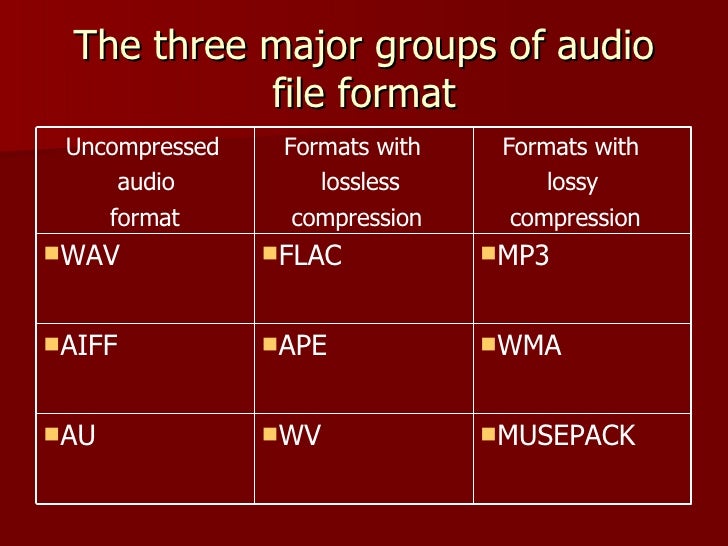
Now there are many audio compression formats that were originally developed for a computer, but later migrated to home appliances. Some of them are outdated and practically unused, some have appeared recently and have not had time to occupy their niche yet. Here I will focus only on the lossy compression formats that allow you to achieve the highest degree of compression of the audio data. What does “lossy compression” mean? Only after encoding from a .wav file to a compressed format, and then re-encoding from a compressed format to a .wav file, the original file and the final file will be different. Maybe not for the better.

audio compression formats

The compressed audio format means that there is practically no change in sound quality, despite the decrease in file size by several times. How do you manage to achieve such a result? The science of psychoacoustics answers this. The human brain is designed in such a way that we do not notice the whisper of books in the background of a conversation, although on a computer, with close listening, we can track this sound. So it turns out that it looks like it is, but it looks like it isn’t …

The combination of conventional data compression methods and the knowledge of what information is perceived by our brain and what is not, allows you to achieve a music compression ratio of up to 10 times with an acceptable sound quality. Below I have provided a brief overview of the most common and well-known music file compression formats that could be used to create a home music collection.

MP3
MPEG 1 Layer III (less often MPEG 2 Layer III), also sometimes called by people as incompetent MPEG 3 (this format does not exist), has been for many years the only association with the phrase “computer music” for many users. Developed in the late 1980s, the format, which allowed music to be compressed up to 10 times without a catastrophic loss of quality, quickly took root in home computers.

The optimal compression bit rate is approximately 192 Kb / s. Although everyone’s ears are different: someone distinguishes distortions better, someone worse. A decent minimum is 128 Kb / s. It is possible to use a variable bit rate. That is, at the moment when the range of sound frequencies is small, the bit rate decreases, and when many things sound at the same time, then, on the contrary, it increases. A constant bit rate greater than 320 Kb / s is often excessive and causes a loss of space. Also, the MP3 file includes a specific area header Id3 tag. Contains basic information about the file. There are 2 different versions of this tag. The second, consequently, is more extensive, but nothing revolutionary has been added. The sound quality of an MP3 file can vary greatly depending on the selected encoder and player.

MPEGplus / Musepack (MP + / MPC / MPP)
This encoder is similar in principle to MPEG Layer II (MP2), but uses a more advanced algorithm. Unlike most modern codecs, the goal of the creators of Musepack was not at all to achieve the highest possible quality at low bit rates. The format is best displayed at medium and high bit rates (typical file bit rate is usually in the 160-180 Kb / s range). A superb psychoacoustic model that uses VBR encoding for excellent sound quality. As a result, the codec performs better than most of its competitors at similar bit rates. The quality of the files obtained when compressed in MPC significantly exceeds the quality of similar MP3 files. One of the serious shortcomings of the current version of Musepack is the limitation of the file format: 44 kHz, 16 bit, stereo, which makes it inapplicable, for example, to compress audio tracks for DVD movies. If MP3 compatibility is not too important to you and you want the highest quality from the final file, choosing Musepack may be the ideal solution. Using this format is a real alternative to using lossless compression to encode music from CDs for those who are already disappointed with the possibilities of the MP3 format. and it is desirable that the quality of the final file is as high as possible, choosing Musepack may be the ideal solution. Using this format is a real alternative to using lossless compression to encode music from CDs for those who are already disappointed with the possibilities of the MP3 format. and it is desirable that the quality of the final file is as high as possible, choosing Musepack may be the ideal solution.


Free Download Mp4Gain
picture


Mp4Gain Main Window
picture


Mp4Gain Features
picture


Free Download Mp4Gain
picture

Overview in the jungle of audio formats

Overview in the jungle of audio formats

Audio Formats

Size does not necessarily matter, especially with compressed audio files. The deciding factor here is the algorithm that is used during encoding. Meanwhile, there are quite a few, but not all of them harmonize with iTunes, iPod & Co. We provide an overview of supported formats and introduce the general working method of audio compression.

Audio File Formats

Since Philips introduced the audio CD in 1982, digitally stored music has been ubiquitous. However, since then, the number of digital data formats available has become so great that it is very easy to lose sight of things. There are basically compressed and uncompressed formats. The uncompressed WAV and AIFF formats are mainly used in audio media production due to their file size and high quality of the audio signal, and still on good old audio CDs.

Compression and reduction

Formats like Apple Lossless manage to reduce the amount of data without reducing the quality of the signal. This lossless encoder procedure is called data compression. However, you still have to live with relatively large files. This can quickly lead to difficulties, especially when gaming on mobile devices, as the battery drains very quickly. On a fourth-generation iPod, AAC-compressed music could only be played for three and a half hours in the test. However, when highly compressed audio books were used, it was more than ten hours. The other lossy processes accept a loss of quality in exchange for the advantage of a small file size. Here, the original quality of the music signal cannot be restored during playback. These compression processes make use of certain properties of human hearing to reduce data: the brain simply masks sound signals that are considerably quieter than other sounds that are perceived at the same time. Another effect that has been exploited is that there must be a minimal difference in the frequency of the tones to be able to distinguish them and to be able to perceive them consciously. Here there is also the possibility of saving. The encoder just skips everything within the specified bit rate that the brain would also leave out in its opinion. If the bit rate is set too low in relation to the complexity of the audio signal, you will inevitably notice signal interference, so-called artifacts, during decompression, that is, you will notice that the original has been compressed.

Bit rates for everyone and everything
Lossy encoders, unlike lossless encoders, can compress source material with different bit rates. The results are qualitatively very different. As a general rule, the average listener can no longer distinguish what is heard from the original signal of a bit rate of 160 kbps for MP3 and 128 kbps for AAC. However, this only applies to music; audiobooks, for example, can be compressed much more without incurring excessive losses. Bit rates of 96 kbps are sufficient for good results. Modern versions of encoders, including iTunes, can also compress the audio signal with a variable bit rate (VBR). The complexity of the source material is checked. If a passage is not very elaborately designed, the encoder automatically regulates the bit rate and saves space for more complicated parts. There it increases the bit rate again to improve the result. The option in iTunes to select the encoder settings and the encoder itself can be found in iTunes -> Settings -> Advanced -> Import. From encoder to bit rate to variable bit rate, you can choose the one that best suits your needs and needs from many options.

AIFF
This data format is not compressed and corresponds to the original data on an audio CD. Therefore, a large file size is expected. A music CD usually contains 80 minutes of music with a size of 700 MB. Therefore, this format is a bit difficult to handle. AIFF isn’t doing itself a favor, especially on mobile music players, as the battery capacity drains very quickly.

Wav
In principle, what has been said above also applies to WAV files, the two formats are very similar. This format is also usually uncompressed, but there are also variants with compression.

MP3
The MP3 data format, strictly speaking the MPEG1 Audio Layer 3 standard, was one of the first to achieve high data compression and therefore a reduced file size. In times of Internet connections via modem, it quickly found widespread use. Today’s encoders come with a variety of possible VBR and bit rates, so there is something for every purpose.

Lossless apple
This can be used to create files that have no signal loss compared to the original when played back. However, the files are quite large and the bit rate is usually over 900 kbps. Therefore, this format is less suitable for mobile devices due to the shorter battery life.

AAC and protected AAC
This encoder is a further development of MP3 and generally works better than MP3 encoders. Protected AAC files have rights management (music files purchased from the iTunes Music Store are in this format).

Audible
Audiobooks purchased from Audible.com come in a file format that is a variation of AAC. The files have the extension .m4b. This file format supports bookmarks so you can continue listening to an audiobook where you last left it.

Windows Media Audio on Mac
Since Windows Media Player no longer exists for the Mac operating system, the Flip4Mac company has been offering a QuickTime component that allows you to open Windows Media files directly in QuickTime Player. However, digital rights management files cannot be played. WMA files offered by some internet music stores (eg Musicload.de) cannot be played with this solution. iTunes is also not supported. You can find an installer for the component on our brochure CD under Software -> Mac -> WMA Components 2.2.0.49R.dmg.

OGG Vorbis Audio
The OGG format, which is free of software patents, can be added to iTunes at a later date. The required QuickTime components can be found under Software -> Win -> OGG_xiph-qt-win32-0.1.5.exe or Software -> Mac -> OGG_xiph-qt-0.1.8.dmg on our brochure CD. After installation with the supplied installation program in the respective operating system, both QuickTime and iTunes can play OGG files. However, all iPod and iPhone models still cannot play OGG.

An overview of the main audio formats that can be found on your computer

Codec for mp3, mpc, flac, mono, ogg vorbis and more.

For convenience, audio formats can be divided into unprofitable (unprofitable) and unprofitable (or unprofitable without losing quality).

The idea of ​​loss formats (most common among ordinary users) stems from the idea that the human ear misunderstands all the sounds that are in a standard WAV file at 44,100 samples per second.

In this way (as in the JPG format of the images) we will drop the high frequencies, which are thought to be less different from our hearing. The more these frequencies are reduced, the more space is allocated to our track (for example, 3 MB instead of 6 MB for a few minutes of song or much more) … but it also degrades the quality of the result, as the cut frequencies are no longer so “inaudible”.

Converting to WAV from lossy formats does not provide any benefit (unless you have to process the track and save it several times, in which case the quality loss will be limited to the first step); There are also programs that are able to bring some of these high frequencies back into our tracks, such as Steinberg Clean Plus or others (such as the first versions of Easy CD Creator or other, even more professional ones), but by doing the job properly , more than No they can do a lot.

Unbearable (lossy) formats try to reduce the space occupied by the track without touching the sound; the degree of compression will be much less than the loss, but there will be no loss of quality. If it is converted back to WAV (possibly processed), the sound will be identical to the previous one.

wav

To listen to audio tracks in various formats, we recommend using audio players that can support different formats, such as AIMP and Foobar2000.

Lost audio formats (lossy quality)

WMA (.wma): Windows Media audio format, compressed and very similar to mp3. Microsoft audio compression format. Files compressed in this format are approximately 20% smaller than MP3 files

MP3 (.mp3) is briefly suitable for the MPEG 1 III layer and identifies audio files that use this algorithm. This is a standard that removes inaudible sounds from the human ear. This way the 128 kbps mp3 track takes up 1/11 of its space in .wav or audio CD format.
Some rate 128-bit bits as “CD quality”; In fact, the frequencies that are reduced to save hard disk space are not so “inaudible”. 192 The results are starting to get good and at only 320 kbps we can talk about the quality of CDs … Until a few years ago the quality of mp3 was considered high, but now with the advent of more modern sound cards, 24 bits: we continue to use mp3 compared to other formats like like ogg or mpc, more for its diffusion and compatibility than the quality of the result. A 600 MB album in wav format will take up about 50 MB in 128 mp3 format.

To convert an audio track to mp3, it’s a good idea to use the Lame mp3 codec (free) in all the best conversion programs (download).

AAC audio format

AAC (.aac and .mp4): A lossy format that delivers high quality (currently the highest among lossy formats), at least one step higher than mp3. A feature of this format is the ability to protect DRM from being freely copied from one platform to another (unless applications are used to protect it).

AC3 (ac3). This is the audio format used by DVDs. We usually find it at 384 kbps (and 6 channels), but it is also possible that you only have it at 2 channels and lower speeds. One of the free programs that supports it (and allows, for example, to reduce the bit rate) is BeLight (Besweet).

OGG VORBIS (.ogg) is a great open source codec. It is able to give better results than mp3, especially at low bit rates (higher quality, less space), which is less than 128 kbps (download). It is compatible with virtually all audio players (both software and audio).

MusePack (.mpc): Very large output format, especially at high bit rates (more than 192 kbps and above). The results are much better than mp3: just listen to one 192 kbps mp3 encoded track and one mpc track at the same bit rate to immediately feel the difference (in some cases without words …). Many people considered this to be the best lossy audio format, at least until mp4 was released. It is compatible with WinAmp through plug-ins and, on average, with more advanced players such as Foobar 2000.

Digital audio formats

Digital audio formats

Below is a non-exhaustive list of the most widely used digital audio formats.

AIFF – Audio Exchange File Format

Apple uses a standard audio format. This can be considered the wav equivalent of a mac environment. Audio data is organized according to PCM encoding and is not compressed. There is also a condensed option defined as AIFF-C or AIFC.

AAC – Advanced Audio Encoding

This format is based on MPEG2 and MPEG4 lossy compression standards. It was created as a successor to the mp3 format, which uses a slightly better algorithm. This allows you to get slightly better quality for the same speed.

ALAC – Apple Lossless Audio Codec

This is Apple’s lossless audio format. Also called ALE (Apple Lossless Encoder).

ATRAC (.mp3) – acoustic coding of adaptive transformation

Old Sony audio format with ATRAC compression. Files always have a .mp3 extension, but you need the ATRAC3 driver to open them. MiniDisc was a commercial advertising product that took advantage of this type of format. The codec was later improved by subsequent enhancements such as ATRAC3 (1999), ATRAC3plus (2002), and ATRAC Advanced Lossless (2006).

AS

This is the standard audio format used by Sun, Unix, and Java operating systems. Data encoding can be PCM (uncompressed) or compressed with μ-law, a-law G729 codecs. The Au audio format was introduced by Sun Microsystems. It was a format used on NeXT systems and early websites. Initially, the file did not have a header (the original data from the file) because the encoding was unique: 8 bits with µ-law compression and a sampling rate of 8000 Hz. The latest version of this format contains a header consisting of six blocks. 32 bits, an optional block of information, and finally audio data.

flac

FLAC is a free lossless audio codec

It is an audio codec with lossy compression (without losing information). Data compression can reach 50-60% without losing quality.

M4P

It is a patented version of the MP4 AAC format with a DRM (Digital Rights Management) system developed by Apple to download music from the iTunes Music Store.

MPEG-4 Part 14 or MP4 (formerly ISO / IEC 14496-14: 2003) is a storage medium for multimedia data. It is mainly used to store audio / video data, but can also be used to store other types of data, such as still images and subtitles. Like all modern formats, this format allows data to be sent over the Internet in real time: this feature is implemented by adding a data path for transmission control. The only extension for files that use this codec is .mp4.

mp3

MP3 – MPEG layer III audio recording

It is currently the most widely used audio format. The MPEG-1 or MPEG-2 III audio layer, commonly referred to as MP3, is a patented lossy format. It is used for digital music use at the user (non-professional) level.

OGG

It is an open source container that supports a variety of formats, the best known being the Vorbis audio format. This format offers MP3-like audio compression, but is less common. The big difference with mp3 is the absolute free format. In terms of performance, with the same parameters, Vorbis is slightly more efficient than MP3.

The Ogg cache can handle multiple independent streams at the same time: audio, video, text (such as subtitles), and additional data (metadata).

RA and RM

This is a format developed by Real Audio to transmit audio over the Internet. The .Ra format allows you to store all the audio files you want to transfer in one file. The codec enables transmission from very low quality to high accuracy.

RAW

A RAW file can contain any type of data, but in reality it is mainly used for PCM-encoded (uncompressed) audio data. Thus, unlike the uncompressed audio format (wav, aiff), a flat file does not contain headers with information about the data itself (usually the header contains information about: sampling rate, quantitative bits, channels, type of markup used for the ideas). A typical file extension for this type is: .raw, .pcm, without the extension.

Vox

This audio format uses Dialogic ADPCM (Adaptive Differential Pulse Code Modulation). This performs 4. compression. Vox files are similar to wave files, except that they do not have a header, so you need to specify frequency information.

Better audio formats

You have decided to digitize the music tracks in your audio CD collection by transferring everything to your computer. You started to examine the possibility of converting it into a format that is more convenient for you.

audio formats

With a little experience in this area, however, you would like to get some advice on the subject so you can make the best decision. How do you say? Things are exactly the same and you want to know if I can help you by giving you the best audio formats? Of course yes, that’s exactly what he wanted to do.

audio formats

If you allow me a few minutes of your free time, I can actually use threads and characters to tell you which audio formats are most popular, what strengths and weaknesses they have and what purposes they may be more or less convenient for. Contact. Condition to choose those who you think are actually right for you. To complete the information and give you an even more comprehensive overview of the topic, I will also indicate at the end of the article which tools you can use to carry out various conversion processes. You will find that once you have read this manual, there is no longer any doubt about what to do.

In order to? How about putting the conversation aside and finally getting to the point? Yes? Excellent! So I suggest that you don’t waste any more time and immediately focus on the topic. Make yourself comfortable in front of your trusted computer and read everything below. I am sure you can say that you are happy and satisfied with what you have learned. As always, I hope you enjoy reading.

MAIN AUDIO FORMATS

MAIN AUDIO FORMATS

Even the audio formats differ in their versatility and level of compression, and even if they are not as numerous as the video formats, it is better to look at the properties to get satisfactory results according to the requirements of our work.

Microsoft Wave [Extension: WAV] It is Microsoft’s proprietary format and is certainly the most widely used. This diffusion depends on commercial aspects and the fact that it is the most supported among the competitors. It has various compressions and is a versatile and highly editable format. For this reason, it is suitable for general digital audio, both for multimedia publications (although there are certainly better formats) and for desktop video (real standard). An excellent program for processing wave files (but also other formats) is CoolEdit.

audio format

MPEG Audio (extension: MPG / MP3) MP3 stands for MPEG1 Layer3. The MPEG algorithm, the basis of MP3, emerged from the need to develop a world standard for the representation of moving images and audio. This standard was developed in 1988 for the treatment of audio and video signals and has the special feature of compressing files and reducing them by 12 times compared to their natural size.

This high-compression format is based in particular on theories of psychoacoustics: each individual has a hearing that is sensitive to frequencies from 20 Hz to 20 kHz, and in particular the man perceives sounds between 2 and 4 kHz better. In addition, some sounds mask nearby frequencies so that you cannot hear all of the sounds.

audio format

These considerations have led to the development of an algorithm that eliminates all “redundant” noise for the human ear and achieves a high level of file compression and sound quality that is comparable to the digital and can be downloaded directly to your PC.

MP3 enables good results, making small and high quality playback compatible. An established audio standard is the MPEG Layer3 version, which produces very small files of excellent quality, an excellent compromise when duplicating and creating audio files on CD. The XingMPEG encoder is an excellent software for creating MP3s.

Given the prevalence and importance of the topic on a legal level, let’s find out what it is and what benefits we can achieve by using this MPEG format.

An audio CD generally contains 60 to 78 minutes and is characterized by a quantization level of 16 bits and a sampling rate of 44.1 kHz, ie 44,100 samples per second. The quantization level describes the maximum number of intensity levels that a single sample can hold: for example 8 bits = 256 levels (28), 16 bits = 65,356 levels (216). The higher the number of levels that the signal can assume, the more precise the signal reproduction.

There is approximately 650 MB of data on a normal audio CD.

Conventionally, to reduce the size, we can work in two ways: 1) Reduce the quantization: that is, convert the samples from 16 bits to 8 bits, but lose the dynamics, quality and get a lot of noise; 2) Reduce the sampling frequency. As a result, the frequency range would decrease in the event of a loss of resolution.

The MPEG format, on the other hand, reduces the amount of information stored and therefore significantly reduces the size of the files by filtering out unimportant audio information according to the models developed on this basis. From research on the perception of the human ear, you decide which information is important and which is not . These studies have enabled us to know how our brain analyzes sounds, except irrelevant ones that are imperceptible (e.g. ultrasound).

The MPEG audio format also performs this process of removing intelligent weak signals. So if there is a strong signal, the weakest signal is not perceived.

When using a high compression rate, the MPEG encoder eliminates parts of audible information that are still of minor importance. With a slight compression rate, the difference to the uncompressed original is minimal.

Layers I, II, III can be viewed as the layers through which the MPEG format has evolved. All layers are based on the same perceptual coding scheme, the complexity of which increases for each of them. Layer II has superior quality at lower bit rates than Layer I; However, the most complex coding system currently available is Layer III,


MP4 (Extension: MP4) is an audio compression technology recently launched by Global Music Outlet (GMO) under license from AT&T Labs (January 99). As you understand, it is a further development of the MP3 format and seems to offer the ability to offer it a higher compression factor, which should even reach a factor of 16. Although the name is very similar, conceptually it has nothing to do with layer 3 and is actually in direct competition with it. Compressed MP4 files are presented as executable Win9x or WinNT files and offer the relatively encapsulated player.

Audio exchange (extension: AIF / AIFF) Format created to standardize the various audio standards between PC and Machintosh.

Microsoft NetShow (Extension: ASF) Audio extension of the format for streaming audio / video on the web.

Yamaha SoundVQ [Extension: VQF] Audio format released by Yamaha in direct competition with MP3.

Everything you need to know about audio files … compressed and uncompressed

Everything you need to know about audio files … compressed and uncompressed

Regardless of whether you’re listening to MP3 files or high-definition audio, it’s time to find out exactly which file format is best for your needs.

audio formats

As you organize your digital music collection, you may be impressed by the number of different audio file formats you have collected over the years. For this reason (and since a good review doesn’t hurt anyone) we’d like to deepen the discussion of the most common audio file formats, explain the differences and explain why you should be interested in learning more about them. Whether you’re listening to low quality MP3 files, slightly better AAC tracks, or high definition audio in FLAC or WAV, it’s time to find out exactly what you’re dealing with and which file format best suits your needs.

formats and codecs

File formats and codecs

Below is a list of all common audio file formats and the differences between them.

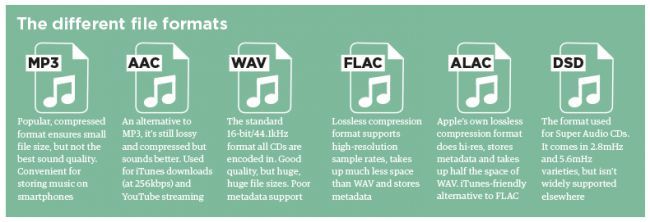
-AAC (no high resolution): Apple’s alternative to MP3. It’s a compressed audio format, but it sounds better than MP3 and is used to download music from iTunes and stream via Apple Music.

-AIFF (high resolution): Apple’s alternative to WAV, but with better metadata support. It’s an uncompressed and lossless format, but it’s not very popular.

-DSD (High Resolution) – The uncompressed single bit format for super audio CDs. It is available in the 2.8 MHz, 5.6 MHz and 11.2 MHz variants, but due to its high-quality codec it is (currently) not suitable for streaming.

-FLAC (High Resolution) – This lossless compression format supports high-resolution sampling rates, takes up about half the WAV space, and stores metadata. It is license-free and is the preferred format for downloading and storing albums in high resolution or CD quality. The disadvantage is that it is not compatible with Apple (therefore it is not compatible with iTunes).

-MP3 (not high definition): Lossy, compressed format that guarantees small file sizes, but is far from the best possible audio quality. However, it is still very convenient for storing music on smartphones and other mobile devices and is widely used.

-MQA (High Resolution) – A lossless compression format with high resolution files for more efficient transmission. It is used for high-resolution streaming from Tidal Masters and other similar services.

-OGG (not high resolution): Sometimes you can find him by his full name, Ogg Vorbis. An open source and compressed alternative to MP3 and AAC that is not limited by patents. This format is used (at 320 kbit / s) to stream Spotify.

-WAV (High Resolution) – The standard format in which all audio CDs are encoded. Excellent sound quality and no compression, which means large files (especially for high-resolution files). However, metadata (album art, artist information, and song title) are hardly supported.

-WMA Lossless – An uncompressed embodiment of Windows Media Audio, but is no longer supported by smartphones or tablets.

The 10 most common audio formats: which one to use?

The 10 most common audio formats: which one to use?

Audio files are available in all types and sizes. And although we are all familiar with MP3, what do you think of AAC, FLAC, OGG or WMA? Why are there so many audio standards? Which are important and which to ignore?

It’s actually quite easy to find that all audio formats fall into three main categories. Once you know what the categories mean, you can simply choose a format within the category that best suits your needs.

Uncompressed audio formats

Uncompressed audio consists of actual sound waves that have been captured without further processing and converted into a digital format. As a result, uncompressed audio files are usually the most accurate, but take up a lot of space, about 34MB per minute for 96-bit and 96-bit stereo.

Audio file format: PCM

PCM stands for Pulse Code Modulation, a digital representation of analog audio signals. Analog tones exist as waveforms, and in order to convert a waveform into digital bits, the tone must be sampled and recorded at certain intervals (or pulses).

This digital audio format has a “sample rate” (how often a sample is taken) and a “bit depth” (how many bits are used to represent each sample). No compression is required. The digital recording is an almost exact representation of the analog sound.

PCM is the most common audio format used on CD and DVD. There is a PCM subtype called Linear Pulse Code Modulation, in which samples are taken at linear intervals. LPCM is the most common form of PCM, so the two terms are almost interchangeable at this point.

Audio file format: WAV

WAV stands for Waveform Audio File Format (at some point also called Audio for Windows, but no longer). It is a standard developed by Microsoft and IBM in 1991.

audio formats

Many people believe that all WAV files are uncompressed audio files, but that’s not exactly true. WAV is actually a Windows container for various audio formats. This means that a WAV file may contain compressed audio, but this is rarely used.

Most WAV files contain uncompressed audio in PCM format. The WAV file is just a container for PCM encoding, so it is more suitable for use on Windows systems. However, Mac systems can generally open WAV files with ease.

Audio file format: AIFF

AIFF stands for Audio Interchange File Format. Similar to how Microsoft and IBM developed WAV for Windows, AIFF is a format developed by Apple for Mac systems in 1988.

Similar to WAV files, AIFF files can contain several types of audio formats. For example, there is a compressed version called AIFF-C and another version called Apple Loops that is used by GarageBand and Logic Audio. Both use the same AIFF extension.

Most AIFF files contain uncompressed audio in PCM format. The AIFF file is just a container for PCM encoding, making it more suitable for use on Mac systems. However, Windows systems can generally open AIFF files with ease.

Lossy compression audio formats.

Lossy compression occurs when some data is lost during the compression process. Compression is important because uncompressed audio takes up a lot of space.

In other words, lossy compression means that the sound quality and fidelity for smaller files are affected. If you are hurt, you will hear artifacts and other oddities in the audio. But if done correctly, you won’t feel the difference.

Audio file format: MP3

MP3 stands for MPEG-1 Audio Layer 3. It was released in 1993 and is becoming increasingly popular. It is the world’s most popular audio format for music files. There is a reason why we had “MP3 players” but no “OGG players”!

The main purpose of MP3 is in three ways: 1) removing all audio that is out of the normal human hearing range, and 2) reducing the quality of inaudible sounds, then 3) compressing all the other audio as efficiently as possible.

Almost every digital device in the world with audio playback can read and play MP3 files, be it PC, Mac, Android, iPhone, Smart TV or anything else. If you need a universal device, MP3 will never disappoint you.

Note: MP3 is not the same as MP4!


Audio file format: AAC

AAC stands for Advanced Audio Coding. It was developed in 1997 as the successor to MP3 and although it has become popular as a format to be used, it has never surpassed MP3 as the most popular.

The compression algorithm used by AAC is much more advanced and technical than MP3. So if you compare the same recording in MP3 and AAC format with the same bit rates, the AAC generally has better audio quality.

Although MP3 is a more popular format, AAC is still widely used today. In fact, this is the standard audio compression method used by YouTube, Android, iOS, iTunes, later Nintendo laptops, and later PlayStation.

Audio file format: OGG (Vorbis)

OGG represents nothing. In fact, it’s not even a compression format. OGG is a multimedia container that can contain all types of compression formats. However, Vorbis files are most commonly used. Therefore, these audio files are called Ogg Vorbis files.

Vorbis was first released in 2000 and is growing in popularity for two reasons: 1) it conforms to the principles of open source software and 2) it works significantly better than most other lossy compression formats (ie) this results in a smaller file size for an equivalent sound quality.

MP3 and AAC are so strong that OGG struggles to get into the spotlight – not many devices support them natively, but they do improve over time. It is currently used primarily by supporters of hardcore open source software.

Audio file format: WMA (lossy)

WMA stands for Windows Media Audio. It was first published in 1999 and has gone through several developments since then, always keeping the same name and WMA extension. It is a proprietary format created by Microsoft.

Similar to AAC and OGG, WMA should fix some of the errors in the MP3 compression method, and it turns out that WMA’s approach to compression is very similar to that of AAC and OGG. Yes, in terms of the quality of objective compression, WMA is really better than MP3.

However, since WMA is proprietary, it is not supported by many devices and platforms. In addition, it offers no real advantage over AAC or OGG. If MP3 is not good enough, it is only more practical to use one instead of WMA.

Audio formats with lossless compression.

The opposite lossy compression is lossless compression, in which the size of an audio file is reduced without loss of data between the source audio file and the compressed audio file.

The disadvantage is that lossless compressed audio files are larger than lossy compressed audio files, up to 2 times 5 times larger for the same source file.

Audio file format: FLAC

FLAC is an abbreviation for Free Lossless Audio Codec. Maybe a bit on the nose, but it has quickly become one of the most popular lossless formats since its launch in 2001.

The good news is that FLAC can compress an original source file by up to 60 percent without losing a single bit of data. What’s even better is that FLAC is a free, open source audio file format, so there are no intellectual property restrictions.

FLAC is compatible with most major programs and devices and is the primary alternative to MP3 for music. You basically get the full quality of uncompressed audio with half the file size. That is why many see FLAC as the best audio format.

Audio file format: ALAC

ALAC stands for Apple Lossless Audio Codec. It was developed and published as a proprietary format in 2004, but became open source and copyright-free in 2011. ALAC is sometimes referred to as Apple Lossless.

While ALAC is good, it is somewhat less efficient than FLAC in terms of compression. However, Apple users cannot choose between the two, as iTunes and iOS offer native support for ALAC and no support for FLAC.

Audio file format: WMA (lossless)

WMA stands for Windows Media Audio. We already discussed this in the lossy compression section, but we explained this here because there is a lossless alternative called WMA Lossless that uses the same extension. Confused, I know.

Compared to FLAC and ALAC, WMA Lossless is the worst compression efficiency, but not much. Since it is a proprietary format, it is not suitable for open source software enthusiasts, but is natively supported on Windows and Mac systems.

The most used audio formats

The most used audio formats

audio formats

As you can imagine, when we talk about digital formats in the field of sound, the range is wide. When choosing the one that best suits our needs, we need to think about several questions. To do this, the first thing to do is to know the most used audio formats.

We start by clarifying the concepts of bit depth and sample rate, which are essential for understanding how audio formats work. These are two measurements that indicate the quality of a digital audio file.

When we read the specifications for audio formats and find, for example, 32 bit / 192 kHz and 24 bit / 96 kHz, these figures refer to “bit depth” and “sampling frequency”, respectively. They tell us the amount of information transmitted by the different formats and the quality of the sound. The more times a device reads samples, the higher the quality.

audio format

Audio formats

-MP3: These files weigh very little for any device to read. The downside is that the quality of compression is sacrificed.
online CPA sound postproduction course

-WAV (Waveform Audio File Format): These are higher resolution files than MP3, an audio track which is coded with what is called Pulse Code Modulation (PCM). Analog audio tracks are encoded and converted to digital so that they can have sample rates and bit depth.

-AIFF (Audio Interchange File Format): it is very similar to WAV and also uses PCM to encode analog audio tracks and present them in digital format. Indeed, AIFF and WAV files are more or less interchangeable.
In short, when we talk about a file in WAV or AIFF audio format, we are talking about a good quality piece of sound.