Overview in the jungle of audio formats


Free Download Mp4Gain
picture

Overview in the jungle of audio formats
Audio Formats

Size does not necessarily matter, especially with compressed audio files. The deciding factor here is the algorithm that is used during encoding. Meanwhile, there are quite a few, but not all of them harmonize with iTunes, iPod & Co. We provide an overview of supported formats and introduce the general working method of audio compression.

Audio File Formats

Since Philips introduced the audio CD in 1982, digitally stored music has been ubiquitous. However, since then, the number of digital data formats available has become so great that it is very easy to lose sight of things. There are basically compressed and uncompressed formats. The uncompressed WAV and AIFF formats are mainly used in audio media production due to their file size and high quality of the audio signal, and still on good old audio CDs.

Compression and reduction

Formats like Apple Lossless manage to reduce the amount of data without reducing the quality of the signal. This lossless encoder procedure is called data compression. However, you still have to live with relatively large files. This can quickly lead to difficulties, especially when gaming on mobile devices, as the battery drains very quickly. On a fourth-generation iPod, AAC-compressed music could only be played for three and a half hours in the test. However, when highly compressed audio books were used, it was more than ten hours. The other lossy processes accept a loss of quality in exchange for the advantage of a small file size. Here, the original quality of the music signal cannot be restored during playback. These compression processes make use of certain properties of human hearing to reduce data: the brain simply masks sound signals that are considerably quieter than other sounds that are perceived at the same time. Another effect that has been exploited is that there must be a minimal difference in the frequency of the tones to be able to distinguish them and to be able to perceive them consciously. Here there is also the possibility of saving. The encoder just skips everything within the specified bit rate that the brain would also leave out in its opinion. If the bit rate is set too low in relation to the complexity of the audio signal, you will inevitably notice signal interference, so-called artifacts, during decompression, that is, you will notice that the original has been compressed.

Bit rates for everyone and everything
Lossy encoders, unlike lossless encoders, can compress source material with different bit rates. The results are qualitatively very different. As a general rule, the average listener can no longer distinguish what is heard from the original signal of a bit rate of 160 kbps for MP3 and 128 kbps for AAC. However, this only applies to music; audiobooks, for example, can be compressed much more without incurring excessive losses. Bit rates of 96 kbps are sufficient for good results. Modern versions of encoders, including iTunes, can also compress the audio signal with a variable bit rate (VBR). The complexity of the source material is checked. If a passage is not very elaborately designed, the encoder automatically regulates the bit rate and saves space for more complicated parts. There it increases the bit rate again to improve the result. The option in iTunes to select the encoder settings and the encoder itself can be found in iTunes -> Settings -> Advanced -> Import. From encoder to bit rate to variable bit rate, you can choose the one that best suits your needs and needs from many options.

AIFF
This data format is not compressed and corresponds to the original data on an audio CD. Therefore, a large file size is expected. A music CD usually contains 80 minutes of music with a size of 700 MB. Therefore, this format is a bit difficult to handle. AIFF isn’t doing itself a favor, especially on mobile music players, as the battery capacity drains very quickly.

Wav
In principle, what has been said above also applies to WAV files, the two formats are very similar. This format is also usually uncompressed, but there are also variants with compression.

MP3
The MP3 data format, strictly speaking the MPEG1 Audio Layer 3 standard, was one of the first to achieve high data compression and therefore a reduced file size. In times of Internet connections via modem, it quickly found widespread use. Today’s encoders come with a variety of possible VBR and bit rates, so there is something for every purpose.

Lossless apple
This can be used to create files that have no signal loss compared to the original when played back. However, the files are quite large and the bit rate is usually over 900 kbps. Therefore, this format is less suitable for mobile devices due to the shorter battery life.

AAC and protected AAC
This encoder is a further development of MP3 and generally works better than MP3 encoders. Protected AAC files have rights management (music files purchased from the iTunes Music Store are in this format).

Audible
Audiobooks purchased from Audible.com come in a file format that is a variation of AAC. The files have the extension .m4b. This file format supports bookmarks so you can continue listening to an audiobook where you last left it.

Windows Media Audio on Mac
Since Windows Media Player no longer exists for the Mac operating system, the Flip4Mac company has been offering a QuickTime component that allows you to open Windows Media files directly in QuickTime Player. However, digital rights management files cannot be played. WMA files offered by some internet music stores (eg Musicload.de) cannot be played with this solution. iTunes is also not supported. You can find an installer for the component on our brochure CD under Software -> Mac -> WMA Components 2.2.0.49R.dmg.

OGG Vorbis Audio
The OGG format, which is free of software patents, can be added to iTunes at a later date. The required QuickTime components can be found under Software -> Win -> OGG_xiph-qt-win32-0.1.5.exe or Software -> Mac -> OGG_xiph-qt-0.1.8.dmg on our brochure CD. After installation with the supplied installation program in the respective operating system, both QuickTime and iTunes can play OGG files. However, all iPod and iPhone models still cannot play OGG.


Free Download Mp4Gain
picture


Mp4Gain Main Window
picture


Mp4Gain Features
picture


Free Download Mp4Gain
picture

DIGITAL AUDIO FORMATS

DIGITAL AUDIO FORMATS

Currently, thanks to digital audio formats, we can store and listen to our music on numerous devices, such as mobile phones, tablets, computers and music players.


What are digital audio formats?

Digital audio formats are basically containers. And the differences between them are fundamentally in:

Whether or not they are compressed.
If they are compressed, in the quality of compression.
The type of labeling they can support.
Digital audio formats

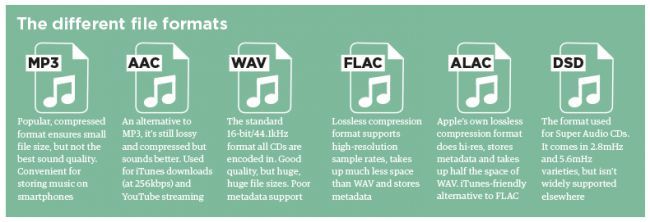
MP3

It is the best known, popular and most used. They are known by their extension “.mp3”.

It was developed by Moving Picture Experts Group, to be part of the well-known MPEG-1 and MPEG-2 standards.

Its fundamental characteristic lies in the fact that the technology behind it compresses the sound sequence, resulting in a really small file, which normally occupies half of the original file. To achieve this, it is necessary to lose certain sounds, which supposedly cannot be heard by the human ear.

Audio formats

WAV

Developed by the companies Microsoft and IBM, this format, whose name comes from the acronym WAVE (Waveform Aujdio File Format), is currently one of the audio formats that have no compression in the data, so they have excellent quality.

They are known for their “.wav” extension.

On the other hand, this format has the particularity that it includes support for almost all current audio codecs. This makes the WAV one of the most used formats in the field of professional sound, since the sound is captured with parameters of 44100 Hz and at 16 bits, the same quality can be obtained as on a CD.

On the contrary, one of the disadvantages of this format is that it has a limitation in recording, since it can only capture a maximum of 6.6 hours at maximum quality in the same file.

Audio formats

AIFF

The AIFF (Audio Interchange File Format) format is very similar to WAV. It was born as an answer from Apple to the Microsoft WAV, being initially only compatible with MAC computers. Currently it can also be used on Windows.

Due to its characteristics, AIFF, together with FLAC and WAV, are usually the most used formats in the professional field of audio.

Wma

The WMA (Windows Media Audio) format is a format of music files created by Microsoft.

One of its main features is that those files that have been compressed in WMA format occupy less space than MP3s, which also means reducing their quality. Therefore, it is a lossy audio compression format.

OGG

OGG audio formats are compressed audio files, which means that they have a size that allows them to be transmitted via WIFI, but at the same time avoid the damage that is usually generated in the compression process.

For example, Spotify uses these OGG formats.

Audio formats

OPUS

Opus is a new codec that use the Ogg container. It was developed by the same creators of FLAC, with the help of Mozilla and Skype.

This new format stands out for its low latency, being ideal for online audio transmissions.

FLAC

When we talk about the FLAC (Free Lossless Audio Codec) format, we are referring to an audio compression free codec without loss of quality.

Emerged within the community responsible for the OGG project, FLAC has become one of the strongest competitors of the WAV format, due to its advantages in terms of its sound quality.

Its objective is to reduce the size of the original file, eliminating data that are usually known as “waste”, without causing loss of quality.

This is the format used by the Tidal platform, the best service for high quality audio transmissions.

Audio formats

A THE C

The Alac (Apple Lossless Audio Codec) format is basically Apple’s alternative to FLAC. It is the format used by Itunes and for Apple Music broadcasts.

The most used audio formats

As you can imagine, when we talk about digital formats in the field of sound, the range is wide. When choosing the one that best suits our needs we have to think about several issues. To do this, the first thing is to know the most used audio formats.

CPA Online sound postproduction course We begin by clarifying the concepts of Bit Depth and the Sample Rate, fundamental to understand how audio formats work. These are two measures that indicate the quality of a digital audio file.

When we read the specifications of the audio formats and we find, for example, 32-bit / 192kHz and 24-bit / 96kHz, these figures refer to the “bit depth” and the “sample rate” respectively. They tell us how much information the different formats transmit and the sound quality. The higher the number of times a device plays the samples, the higher the quality.

Audio formats

MP3: these files weigh very little for any device to read. The negative part is that the quality of the compression pro is sacrificed.
CPA Online sound postproduction course

WAV (Waveform Audio File Format): are higher resolution files than MP3s, a piece of audio that is encoded with what is known as Pulse Code Modulation (PCM). The analog audio pieces are encoded and converted into digital so that they can have the Sample rate and the Bit Depth.
AIFF (Audio Interchange File Format): It is very similar to WAV and also uses the PCM to encode analog audio parts and present them in digital format. In fact, the AIFF and WAV files are more or less interchangeable.
In short, when we talk about a file in WAV or AIFF audio format we talk about a piece of sound of good quality.

Most popular audio formats

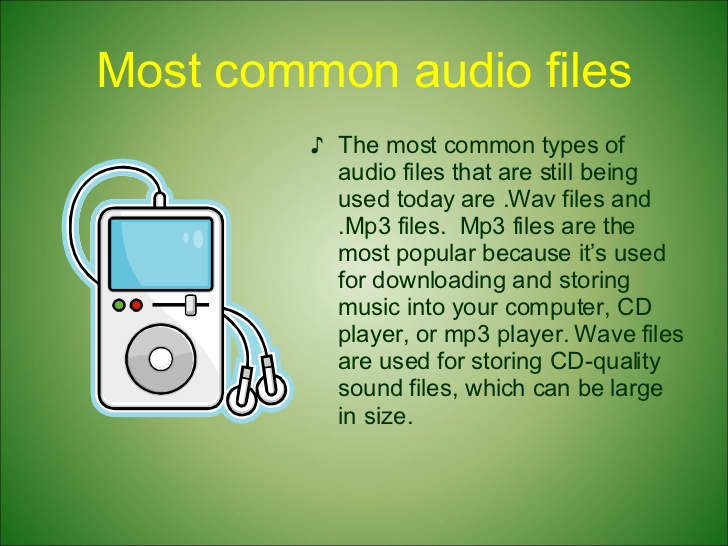
There is a huge amount of audio formats. The most common are formats such as MP3 (MPEG-2 Audio Layer III) and WAV. Usually, the type of format corresponds to the file extension (the letters of the file name after the period, for example .mp3, .wav, .ogg, .wma).

audio formats

A codec is an algorithm for encoding and compressing data in an audio format. Some file types are assigned a specific codec. For example, the MP3 format always uses the MPEG Layer-3 codec, while the MP4 format can use a range of different codecs.

Many times, the notions of codec and format are used as interchangeable. Especially when a format always uses a single codec. However, it is necessary to understand the difference between a format and a codec. In simple terms, a format can be compared to a container in which a sound or a video signal that uses a particular codec can be stored.

Some formats, such as MP4 or FLV, can store both audio and video sequences.

mp3 format

If you don’t know what program you should use to open one format or another audio, we recommend that you use our audio converter. It is compatible with almost all existing formats.

Depending on the type of compression, two types of codecs can be distinguished:

Lossless Codecs

This group of formats records and compresses a sound in such a way that it allows the preservation of its exact original quality when decoded.

The most common lossless coding formats are:

FLAC (Free Lossless Audio Codec – Audio codec, lossless and free),
APE (Monkey’s Audio – Mono Audio),
ALAC (Apple Lossless Audio Codec – Audio codec, lossless Apple).

Loss Codecs

When compressed with loss, a sound undergoes some modification. For example, compression cuts the sound frequencies that are inaudible to the human ear. When decoded, the file will be different from the original in terms of the information stored in it, but it sounds almost the same.

Some of the most common lossy formats are:

MP3
Wma
OGG
AAC

WAV is one of the first audio formats. It is mainly used to store uncompressed audio tracks (PCM) that are identical to audio CDs in terms of quality. On average, a minute of WAV format sound requires about 10 megabytes of memory. CDs are usually digitized in WAV format and then can be converted to MP3 with an audio converter.

MP3 (MPEG Layer-3) is the most widespread sound format in the world. MP3, like many of the other lossy formats, compresses the file size by reducing sounds inaudible to the human ear. Currently, MP3 is not the best format in terms of file size for sound quality, but since it is the most widespread and compatible with most devices, many people prefer to save their files in this format.

WMA (Windows Media Audio) is a format owned by Microsoft Corporation. It was initially introduced as the substitute for the MP3 format, with the highest compression characteristics. However, this fact has been compromised by some independent tests. In addition, the WMA format is compatible with data protection through DRM.

OGG is an open format that supports audio coding by several codecs. The Vorbis codec is the most commonly used in OGG. The quality of compression can be compared to the MP3 format, but it is less widespread in terms of compatibility with various audio players and devices.

AAC is a patented audio format system that has higher capabilities (number of channels, frequency of discretion) compared to the MP3 format. Usually, it achieves better sound quality with the same file size. AAC is currently one of the loss-coding algorithms that offers the highest quality. A file encoded with this format can have the following extensions: .aac, .mp4, .m4a, .m4b, .m4p, .m4r.

FLAC is a common lossless format. It does not modify the audio sequence and the sound encoded with this format is identical to the original. It is frequently used to reproduce sound in high-end audio systems. Its playback compatibility on devices and players is limited, therefore, if desired, it often becomes other formats before listening to it on a player.