How many KB is the best sound quality for mp3?


Free Download Mp4Gain
picture

How many KB is the best sound quality for mp3?

Mp3 Quality
Mp3 Quality

Four Factors That Determine MP3 Sound Quality

Mp3 Quality
Mp3 Quality

Today’s mp3 market can be described as a hundred flowers in bloom, and the competition between the major manufacturers is splendid. In order to take the lead and gain the most market share, various manufacturers, especially those with strength, have their own unique tricks. In terms of appearance, mpio’s fl200 has won the award with its mini round cake design. unique pendant. The latest mp3 title, Truly’s mp379, also created the trend of big screen mp3, and Samsung also released its sports mp3 concept, which is absolutely stunning in the market. Some small manufacturers have also adopted imitation methods, making the market of all kinds of mp3 like a sky full of countless stars. Simple repeat, record and fm functions can also meet the needs of the market. Line-in, features, e-book reading, gaming, and colorful backlights are slowly creeping into the new mp3 design. However, the author believes that no matter how cool it looks and how perfect its functions are, the mp3 is used to enjoy music in the final analysis. An mp3 without good sound quality is at least not a qualified mp3. If you just go for looks and function (actually, we rarely use some functions), and ignore its sound quality performance, you will feel a bit like buying a scorpion.
A decoder chip inherent in mp3
The decoder chip used by the Mp3 itself is the key to its sound quality. The sound quality displayed by high quality decoder chips is unmatched by those of the poorest. Friends who have listened to the famous iriver series of mp3s will know that its sound quality characteristics are very obvious, the bass is strong and powerful, the vocals are restored to truth, the high-frequency field is wide, and the increase is enough, which is very pleasing to the ears. This series mp3 adopts Philips SAA7750, the most advanced decoder chip in the market, and its quality and performance are excellent. The major Korean manufacturer MPIPO (Dewei Technology) also uses this decoder chip. The reputation and market feedback of these two mp3 sound quality brands are very good, and they are highly praised by the industry and outside the industry. It proves that mp3 sound quality is better than md’s ace gun. Due to the relatively high cost of the chip and the control chip, it is rarely used except for some brands. The cost is high, and the price is of course expensive. This is also the threshold that restricts many mp3 lovers from enjoying the beautiful sound quality.


Free Download Mp4Gain
picture


Mp4Gain Main Window
picture


Mp4Gain Features
picture


Free Download Mp4Gain
picture

What is the difference between 128k and 320k music?

What is the difference between 128k and 320k music?

audio bitrate
audio bitrate


Some time ago, a colleague came across a very troubled client. The mess was said to have been caused by the client asking him to provide song files larger than 100MB-200MB in size.

bit depth
bit depth

And my colleagues don’t know much about audio formats, so they started endlessly fumbling about FLAC, WAV and audio size. In the end, the colleague did not clearly explain to the customer what was going on.

After that, other things happened that made me feel that in the music industry there are too many practitioners around me who have an extremely poor understanding of music and even lack some basic knowledge related to music. I don’t even have the idea to understand, which makes me very sad. It seems that music has only one merchandise attribute, and our practitioners only need to organize the shelves, encode various merchandise, and use the big data of users’ purchase records to recommend merchandise to users, no matter why to users. they like this. features that these products have, and provide users with various services with cold data.

Therefore, I think it is necessary to write something. I don’t expect practitioners to become people who really love music. I just hope that even if you still think of “her” as a commodity, you can first figure out what you’re selling. and what is..

PS: The content of the first lesson is about media files. Since the relevant content involves a lot of technical issues, it seems a bit boring, but if you read it carefully, you will find that it is actually very easy to understand, but this basic knowledge can be very helpful.Improve your skill well. Also expect more interesting content about records, musical styles, etc. which I will post soon.

【text】

Bit Rate, Sample Rate, Lossless, MP3, FLAC, APE, 320kb, 192kb, 128kb, 44.1khz, CBR, VBR. Does this bunch of various names make you both familiar and unknown?

The higher the bitrate, the better the sound quality. Lossless music is the highest sound quality, right? So, let’s start with the sound collection.

【Audio composition】

Nowadays, when we talk about audio, everything is digital audio. Digital audio consists of three parts: sample rate, sample precision, and number of sound channels.

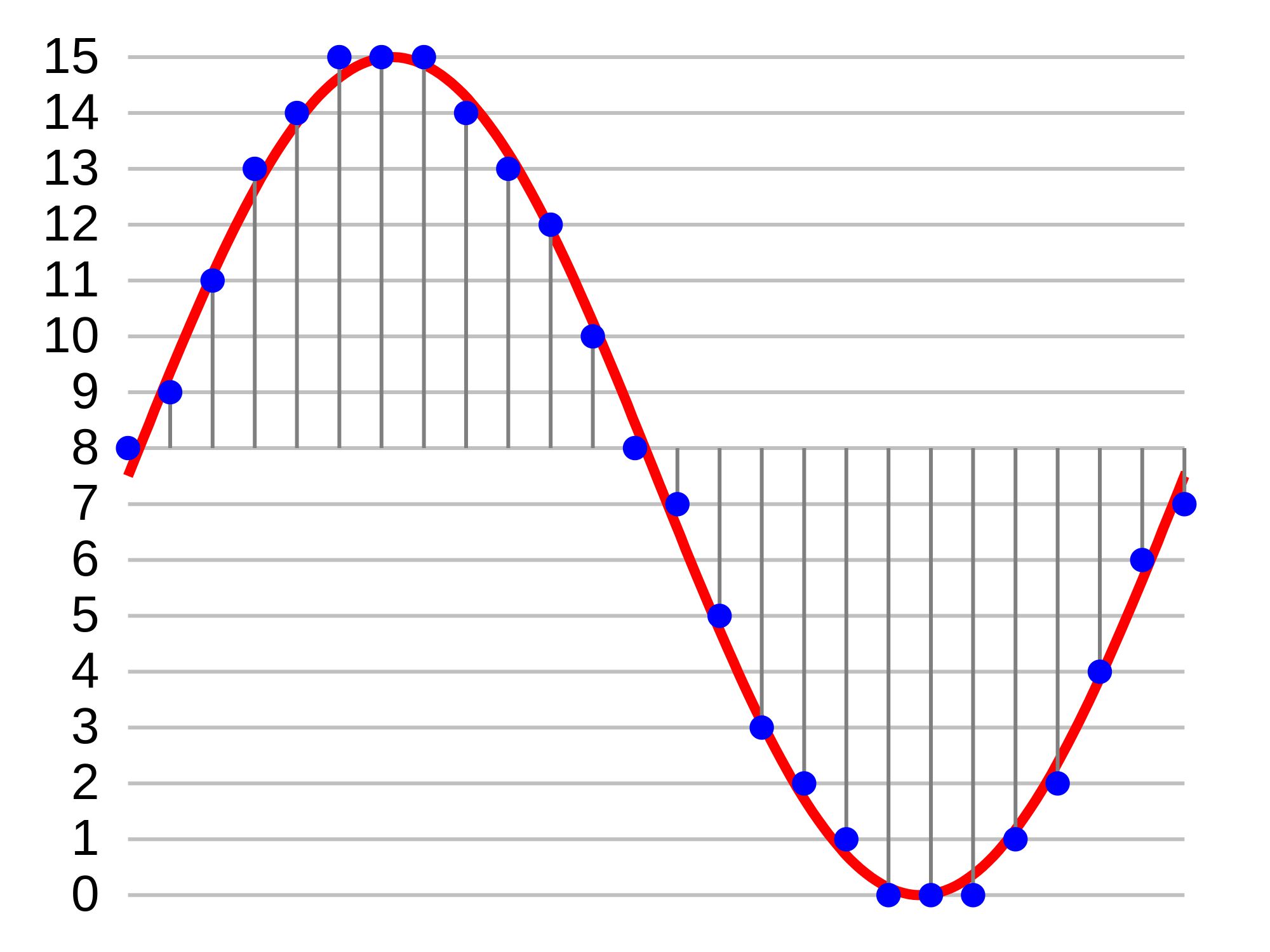
Sample Rate: Both the sample rate, which refers to the number of samples per second when recording the sound, expressed in Hertz (Hz).

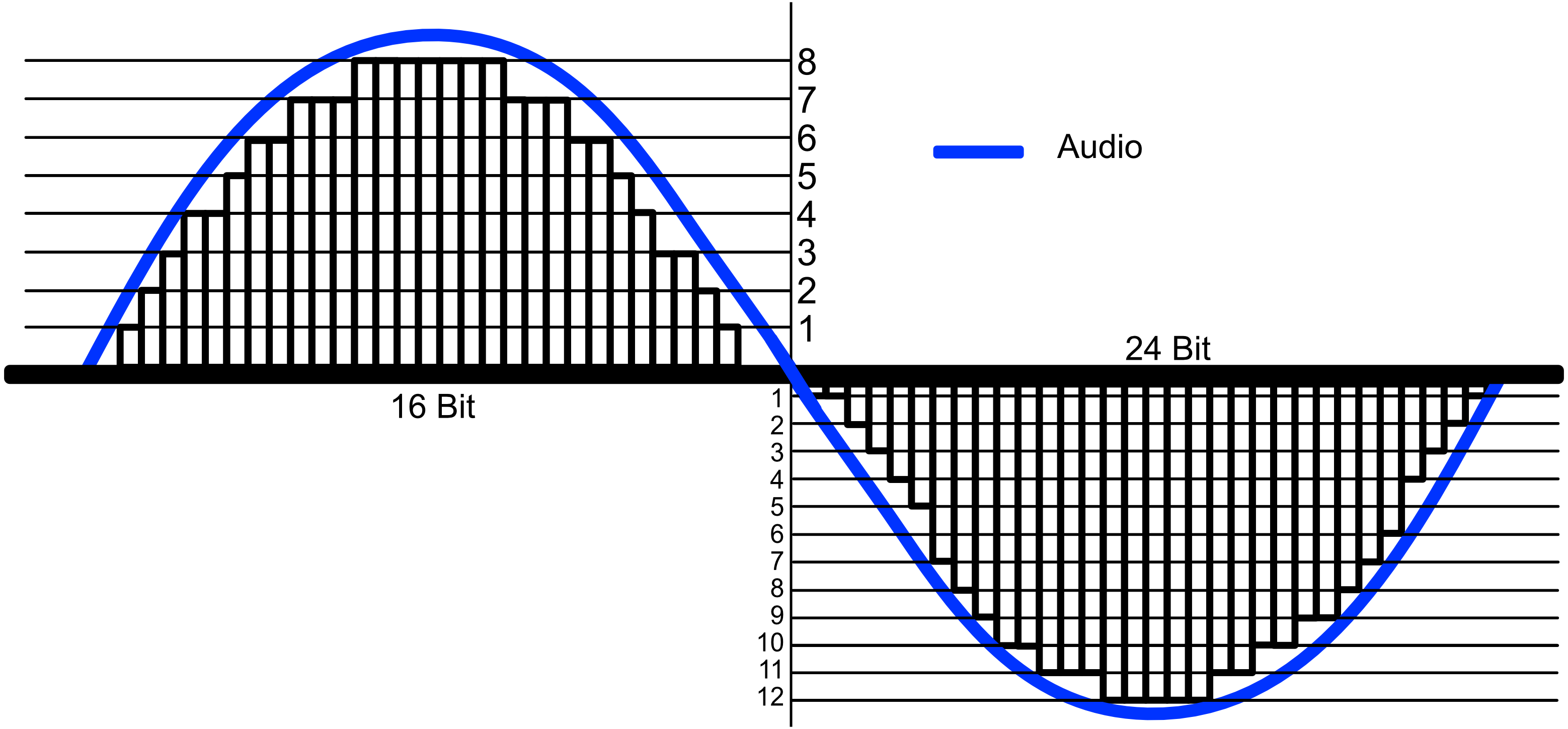
Sampling Precision: Refers to the dynamic range of the recorded sound, measured in bits (Bit).

What is the recording bitrate (the appropriate mp3 bitrate range)

What is the recording bitrate (the appropriate mp3 bitrate range)

MP3 Bitrate
MP3 Bitrate

All music on the web is digital, so what does the “bitrate” or “kbps” you see when previewing or downloading mean? What is bit rate?

MP3 Bitrate
MP3 Bitrate

In its simplest terms, bitrate represents the amount of data a file produces per second.

For example, you might see something like “320 kbps.” Literally, that means 320 kilobits per second, or the amount of data that is produced.

How does bitrate affect music?
Common audio file formats are MP3, OGG Vorbis, or AAC, which can be called lossy compression, while others are lossless compression, such as FLAC or WAV, which basically retain all the audio information.

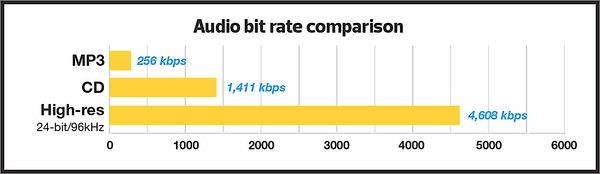
320k is the highest bitrate encoding of mp3, and the sound quality is generally considered to be the closest to CD format. If you listen to popular music, you can see that there is more music encoded in 196k. From the point of view of listening, the difference between 320k encoding and uncompressed encoding is negligible, but in theory, the bit rate of a common CD is 1411k, which is 4.5 times the bit rate highest of MP3.

There is a direct relationship between bit rate and sound quality, but reasonable compression does not degrade listening.

Since MP3s are lossy files, meaning some of the audio is lost due to compression, why don’t the ears seem to change the sound? This involves psychoacoustics, a fringe discipline that studies the relationship between sound and the hearing it provokes. Psychoacoustics refers to “the way the human brain interprets sound.” Compressed audio is the use of powerful algorithms to convert audio messages that we cannot hear. remote.

So even though the bitrate of a lossy file like MP3 is much lower than that of a lossless file, it doesn’t sound like that. Even with just 320kbps MP3, the listening experience is not 4.5 times worse than music on CD.

Of course, the compression is not unlimited, when the bit rate drops below 128kbps, the sound quality will be degraded, and the lower it is, the more obvious it will be. On the contrary, the higher the bitrate, the higher the quality of the music.

Mp3 ape flac What is the difference between the three music formats?

Mp3 ape flac What is the difference between the three music formats?

When we often download songs, we want to download some of the best sound quality, and we are also confused about which sound quality is the best.

If you ask the friends around you, they will definitely all say that you want to download lossless files, but how good is the sound quality of lossless files?

First of all, the first impression is that the volume of lossless files is obviously different from normal MP3 files. Normally, the size of normal MP3 music file is only 2-5M, but the volume of lossless APE files of the same version is about 30M, a difference of 10M times more.

In the case of the same playback time, why is there such a big volume difference?

Here to talk about a term – bitrate It is a data factor that determines whether the quality of a song file is good or bad, bitrate refers to the number of bits transmitted per second (bit). The unit is bps (bits per second). The higher the bit rate, the higher the data transmission speed. The bit rate in sound refers to the amount of binary data per unit of time after converting an analog sound signal (a signal with sound properties such as amplitude and frequency) into a digital sound signal (i.e., a binary signal such as 010101 stored on a computer’s hard drive) is an indirect measure of audio quality. The principle of bit rate (bit rate) in video is the same as in sound, which refers to the amount of binary data per unit of time after the analog signal is converted to a digital signal.

Bitrate Property for Lossless Files

Bitrate Properties for High Quality MP3

The bit rate of MP3 files with ordinary sound quality is generally 128 kbps, the bit rate of high-quality MP3 files is generally 320 kbps, and the bit rate of lossless files is generally 960 kbps. kbps or even more. The difference in bit rate can be understood as the vibration frequency of the sound decoded by the decoder at the same time. The higher the bit rate, the higher the vibration frequency and the better the corresponding sound. Good timbre means that the restoration of sound details is relatively complete, that is, the sound quality is good. However, this is also the reason for the large size of the lossless files.

Keyframes for moving images

Keyframes for moving images

Bitrate vs Resolution

In a moving image, things move or change significantly in a short time. Therefore, inserting keyframes at short intervals improves the reproducibility of small movements.

Bitrate

There is also the advantage that the search is smoother for images with many keyframes. The reason is that the search is based on keyframes, so the more keyframes you have, the easier it is to stop at the target scene. If the position where the search stops is not a keyframe but a difference information frame, the information is fetched to a nearby keyframe, but that time is short.
However, if you increase the number of keyframes too much, the keyframe bit rate will be taken over and the overall video quality will deteriorate, so be careful.
For moving images, the keyframe is approximately once every 3 seconds.

■ Keyframes for images with little movement

Since there is little difference information in a video with little motion, you won’t notice much difference in change even if there are few keyframes. However, if you insert keyframes for too long, search may not work properly and playback may take a long time to start. This is the opposite of the case where there are many keyframes, and if the rewind position is far from the keyframes, it will take time to read.
For those with little movement, the guideline for keyframes is approximately once every 6 to 8 seconds.

So far, “What is the encoding mechanism? Five points to consider for encoding HD video [Part 1]”, “Understanding the appropriate bit rate for the resolution you want to distribute”, motion oriented or image quality I explained three points how to change the “frame rate” and “how to insert keyframes” depending on whether it is important. In [Part 2], we will explain “the advantages and disadvantages of bitrate setting (CBR / VBR), proper usage” and “correct aspect ratio and interlaced processing”.

Learn a suitable bit rate guideline for resolution

Learn a suitable bit rate guideline for resolution

video bitrate

This is because the amount of data allocated per pixel is reduced, resulting in poor image quality.

Video Bitrate or Resolution

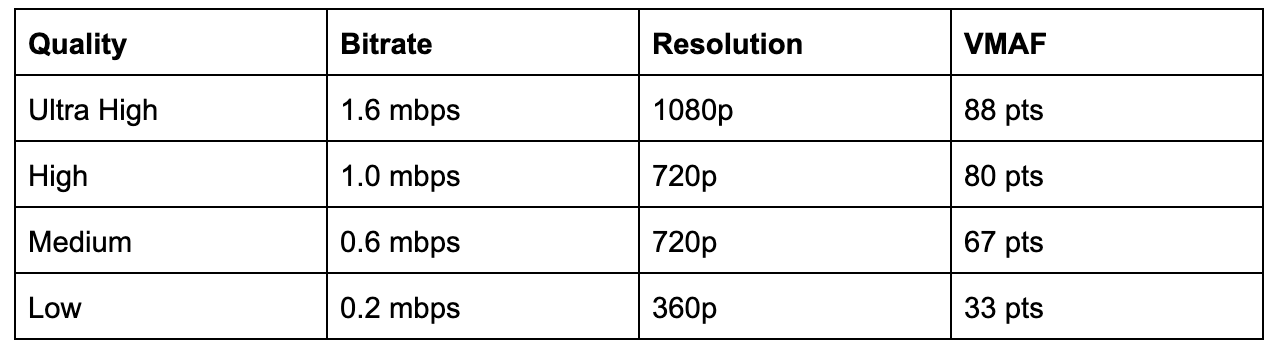
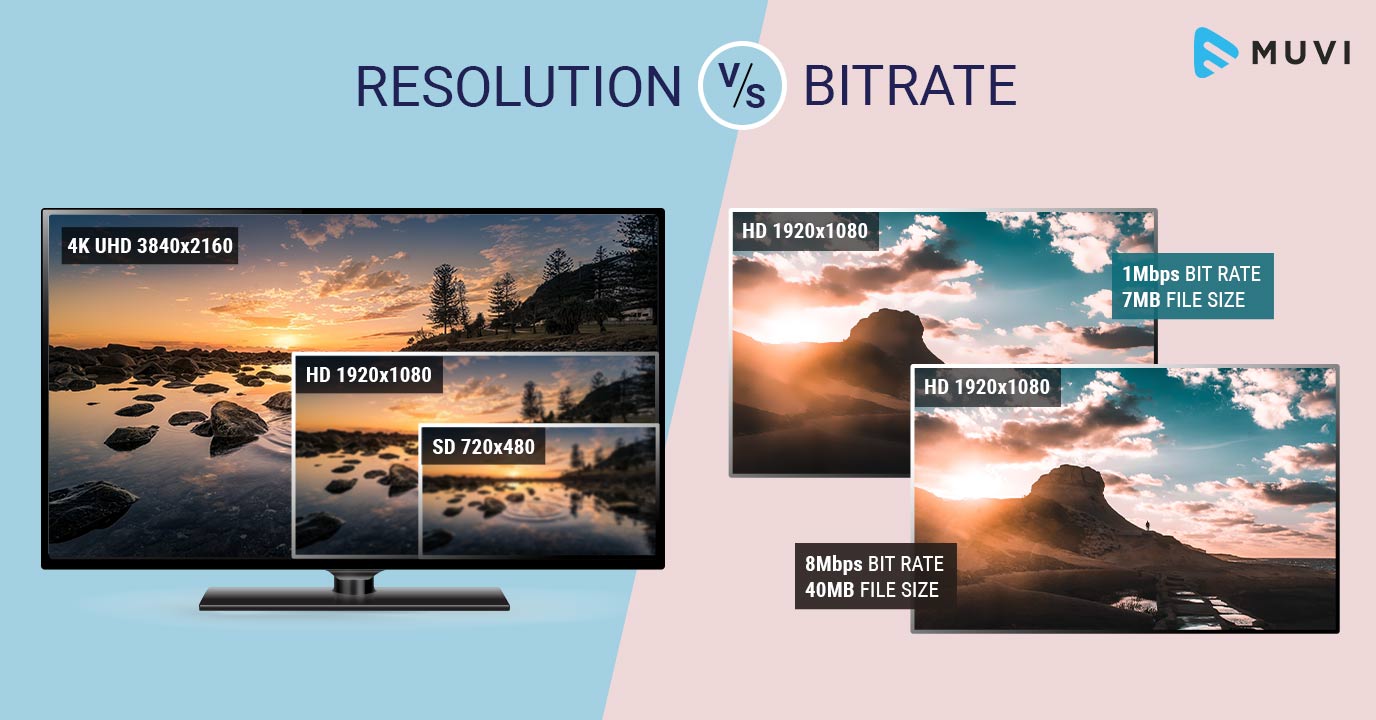
The same phenomenon can be said of the videos. Bit rate is the amount of data allocated per second and affects the image quality of the video. If you want to display a video on a large screen, such as full screen display on a computer or TV monitor, you need a sufficient bit rate according to the resolution. On the other hand, when displayed at a small resolution, the roughness is not as noticeable even if the bit rate is reduced. On the contrary, even if you encode at a high bit rate, you will not notice the difference in image quality, and in many cases the file size will only increase.

Below is a list of the appropriate resolutions and bit rates commonly used for Internet video distribution.

<< Estimated resolution and suitable bitrate >>
* Figures are based on 30 fps assumption and based on our opinions as of June 2021.
* The appropriate bit rate may vary slightly depending on the video content.

resolution Video with little movement Video with a lot of movement
SD (720 x 480 px) 500 kps-1 Mbps 1 Mbps-2 Mbps
HD (1280 x 720 px) 2.4 Mbps-4.5 Mbps 4.5 Mbps-9 Mbps
Full HD (1920 x 1080px) 4.5 Mbps-9 Mbps 9 Mbps-18 Mbps
4K (4096 x 2160 px) 25 Mbps-35 Mbps 35 Mbps ~ 70 Mbps
However, in the case of moving images, the image quality at the time of encoding will differ depending on whether the video material has a lot of movement or the video material has little movement, even if the bit rate is the same. Therefore, it is necessary to thoroughly judge and encode not only the bit rate, but also the frame rate and keyframe settings, which will be explained later, according to the video material. I hope you understand that “there is a relationship between resolution and proper bit rate” as a determining factor for high definition.

Point 2: Increase the frame rate if motion is important and lower the frame rate if image quality is important.
The frame rate (number of frames) is set at 29.97 fps for televisions and 24 fps for movies, while the frame rate is freely configurable for Internet video encoding. A video is a collection of continuous images (frames) like a flip book. The more frames per second, the smoother the movement.

In video encoding, the bit rate per second is fixed, so if you increase the frame rate, the number of images in the flip book will increase and the movement will be smoother, but the amount of data allocated per frame will decrease, so the image quality will be better to fall.
On the other hand, if you reduce the number of frames, the number of images in the flip book will decrease and the smoothness of the movement will be a little slower, but the image quality will improve because a large amount of data will be allocated to each frame.

If you want to emphasize the smoothness of motion in a video with a lot of motion, increase the frame rate (video demo 1). On the other hand, if the video has little movement, it is not necessary to increase the number of frames as much (depending on the degree), so it is effective to lower the frame rate and give priority to improving the image quality (Video Demo 2 ).

Point 3: insert “keyframes” at short intervals for moving images
A keyframe is a frame that exists as a single still image (an image that is not compressed between frames) and is the starting point for difference information. Depending on the encoder settings, the keyframes are inserted when there is a scene change and the difference information is inserted at regular intervals, such as XX frames and once every XX seconds.

What is the encryption mechanism? 5 Points to Consider for HD Video Encoding [Part 1]

What is the encryption mechanism? 5 Points to Consider for HD Video Encoding [Part 1]

sample rate

Encode

Sample Rate

The image quality of Internet videos is almost proportional to the bit rate. However, if the bit rate increases unnecessarily, the file size will increase. “Keep bit rate low”, “Reduce file size” and “Reduce load time” are linked, and there is nothing to say if you can encode in high definition while keeping the bit rate low.
Also, at the beginning, I wrote that “image quality is almost proportional to bit rate”, but I think some of you may have experienced that “I increased the bit rate and encoded, but I am not satisfied with the quality of the image. “So, this time, I will explain five points that are often used to do high definition video encoding.

” Table of Contents ”

Encoding Mechanism
Point 1: learn a suitable bit rate guideline for resolution
Point 2: Increase the frame rate if motion is important and lower the frame rate if image quality is important.
Point 3: insert “keyframes” at short intervals for moving images
* You can read the second part (Point 4, Point 5) here.

Encoding Mechanism
First, I will briefly explain the encoding mechanism.
An image is a collection of continuous images (frames), and by changing this in a short time like a flip book, it appears that you are visually moving. Japanese television images are 29.97 frames per second (short for 29.97 fps / frame per second) and most movies and animations have a standard of 24 fps. Since a large number of frames are required for video, the amount of data is also huge. Therefore, data compression is indispensable for distributing videos on the Internet.

When coding

“Prediction in frame” that compresses data within a frame
“Prediction between frames” that compresses data into consecutive frames
Information is reduced and data is compressed within the range that does not affect the visual sense.

■ What is in-frame prediction?
There are various methodologies for data compression, so I will skip the details here, but the basic idea of ​​within-frame prediction is to divide a frame into small blocks called cells and the colors adjacent to each other in the block. they are the same or similar, they are compressed together.
For example, if there is information “blue blue blue blue blue blue blue blue blue blue red red yellow yellow yellow” in the divided block, the amount of data can be reduced by combining this with “blue 11, red 2, yellow 3”. It’s an image.

An example of data compression in in-frame prediction (image)

■ What is cross-frame prediction?
However, in the case of video with a time axis, the number of frames is large, so there is a limit to the overall weight reduction based solely on the prediction within the frame. On the other hand, in the prediction between frames, based on the idea that “the contents are similar before and after the consecutive frames”, the cells that do not change from the previous frame reduce the amount of data by reusing information and the cells that change It becomes data as difference information.

Prediction between frames (image)

From here, I’ll explain five specific code points.

What format do you choose when copying? AIFF, ALAC, AAC … Check the sound quality of each one by “appearance” Part 2

What format do you choose when copying? AIFF, ALAC, AAC … Check the sound quality of each one by “appearance” Part 2

Sample Rate

The “lossless compression” method, to which Apple Lossless and FLAC belong, is a method that can completely restore the original audio data during playback, at the cost of a low compression rate.

Sample Rate

The file size is large, but the sound quality is equivalent to that of a CD. The bit rate fluctuates automatically according to the content of the audio data, and the compression rate is not constant accordingly.

AIFF and WAV are “uncompressed” methods. Extract the original audio data and create a file as is. It does not compress, so it has a lot of capacity, but the sound quality is perfect.

Let’s take a closer look at the table.

■ Don’t say it again … Considering the playback environment, the format selection criteria for copying are as follows: As

You can see from the “Compression rate” and “Sound quality” items in the table, both are highly rated. It has around “AAC / 256kbps” and “MP3 / 192kbps”, which is a Rossy format with a higher bit rate. While ensuring good sound quality, the file size can also be reduced. It also has an excellent balance with the capacity of the integrated SSD / HDD of PC, iOS devices, smartphones, etc.

The default setting for iTunes is AAC / 256kbps, and the specifications for music files sold on the iTunes Store are the same. You can tell that the current standard is around here. In terms of playback compatibility, AAC and MP3 are widespread, and no matter which one you choose, you don’t have to worry about the playback environment.

On the other hand, it is the lossless format that Apple Lossless and FLAC belong to that can reduce the file size to some extent while maintaining the best sound quality equivalent to that of a CD. If you want to give the highest priority to sound quality from an audio point of view, I would like to select this. It will be a bit difficult to balance it with the capacity of SSD / HDD, smartphone, etc. from the PC, but if it can be erased, it is convenient to use this format.

For example, if you don’t have that many CDs, creating a library in a lossless format will not put too much pressure on your PC’s SSD / HDD and you will be able to sync all the songs on your iOS device. Alternatively, you can deal with this by coming up with sync settings for iOS devices, etc. (I’ll explain later). If so, it is better to have a lossless format that can maintain the best sound quality, and there are few errors in the long run.

Just keep in mind that Apple Lossless and FLAC are a bit difficult to choose in terms of the playback environment. Until now, iTunes and iOS devices do not support FLAC, and many other devices and software do not support Apple Lossless. As of June 2012, at the time of writing, many network players only support FLAC. However, with Apple Lossless opening font in October 2011, support for the same format is expanding, so I’d like to keep an eye out for this trend as well.

AIFF and WAV are uncompressed formats. Of course, the sound quality remains the same as that of a CD. However, the data capacity is not compressed at all. In other words, the uncompressed format “has the same sound quality as the lossless format and has a larger file size than the lossless format.” In that sense, there is no reason to choose it unless you are particular about it.

Well finally the highlight of this era. Let’s review the “appearance” of “what is the actual deterioration in sound quality for each compression format?”

What format do you choose when copying? AIFF, ALAC, AAC … Check the sound quality of each by “appearance”

What format do you choose when copying? AIFF, ALAC, AAC … Check the sound quality of each by “appearance”

Bit Rate

Music files are the mainstream of Imadoki’s audio playback sources.

bitrate

Except when purchased from an online distribution, the sound quality of the music files used here is largely related to the work of reading audio data from a CD to a PC, the so-called “ripping” setting. This time I would like to review that part in a little more detail.

The first half of this article describes the basics of the extraction format for those who want to know what sound quality to choose when extracting. Perhaps this first half is common information to many file and web readers.

However, the highlights are beyond that. “Really Terrifying Audio Compression” … So, in the second half of the article, “How much does the compressed file actually deteriorate the sound?” And “How much does the sound quality change depending on the bit rate value?” you will check with (→ Visually check the sound quality of AIFF, ALAC, AAC!). I would like you to stay with us until the end.

■ Don’t say it’s time to change … First, let’s review the basics

The scheme of the options for copying is “compression format (file format)” and “bit rate”. These two determine the sound quality and file size, which is another important factor.

“Compressed format (file format)” refers to formats such as AAC, MP3, Apple Lossless, and FLAC. This selection determines the sound quality, file size, and playback environment.

The “bit rate” is the amount of data allocated per second of audio. The higher the value (kbps), the higher the sound quality, but the larger the file size.

In the case of iTunes, call this screen “Load Settings” from the environment settings and configure the extraction.

Please refer to the following table based on that. We have summarized the characteristics of typical compression formats and bit rate settings.

The item “Sample Bitrate Settings” in the table is quoted from the default settings provided in iTunes (* iTunes does not support FLAC)

First of all, pay attention to the second item from the left of the table. Compression formats can be broadly classified into “lossy compression”, “lossless compression” and “uncompressed”.

The “lossy compression” method, to which AAC and MP3 belong, achieves a high compression rate = a significant reduction in file capacity by reducing some of the data when compressing audio data. In contrast, the original audio data cannot be fully restored during playback and deterioration in sound quality is inevitable. The degree of deterioration in sound quality changes depending on the bit rate setting. The lower the value of the bit rate, the greater the deterioration in sound quality and, conversely, the higher the value of the bit rate, the more mitigated.

How does the bit rate affect the quality of the music?
How does the bit rate affect the quality of the music?

Audio Bitrate Quality

Does the bit rate affect the quality of the music?

There is a lot of talk these days that we have lost real music with the advent of compressed audio formats like MP3, AAC and the like. Is it really so? Will lossless music save music? Can an inexperienced listener tell the difference between MP3 and FLAC music? Let’s take a look at this problem.
Audio Bitrate

What is Bitrate?

You’ve probably heard the term “bitrate” before and you probably have a basic idea of ​​what it means, but it might be a good idea to familiarize yourself with its official definition so you know how it all works.

Bit rate is the number of bits or the amount of data that is processed over a period of time. In audio, this generally means kilobits per second. For example, the music you buy from iTunes is 256 kilobytes per second, which means that every second of the song contains 256 kilobytes of data.

The higher the bit rate of the track, the more space it will take up on your computer. Audio CDs typically take up quite a bit of space, so it has become common practice to compress these files so that you can burn more music to your hard drive (or iPod, Dropbox or whatever). This is where the “lossy” and “lossy” formats conflict.

Lossless and Lossy formats: what’s the difference?

When we say lossless, we mean that we haven’t really changed the original file. That is, we copy a track from the CD to our hard drive, but we do not compress it to the point of losing data. Essentially the same as the original CD track.

However, most of the time, you will probably extract your music in Lossy format. That is, you took a CD, copied it to your hard drive, and compressed the tracks so they don’t take up a lot of space. A typical MP3 or AAC album is probably about 100MB. The same album in a lossless format like FLAC or ALAC (aka Apple Lossless) will be around 300MB, so it has become common practice to use lossy formats for faster downloads and more hard drive savings. .

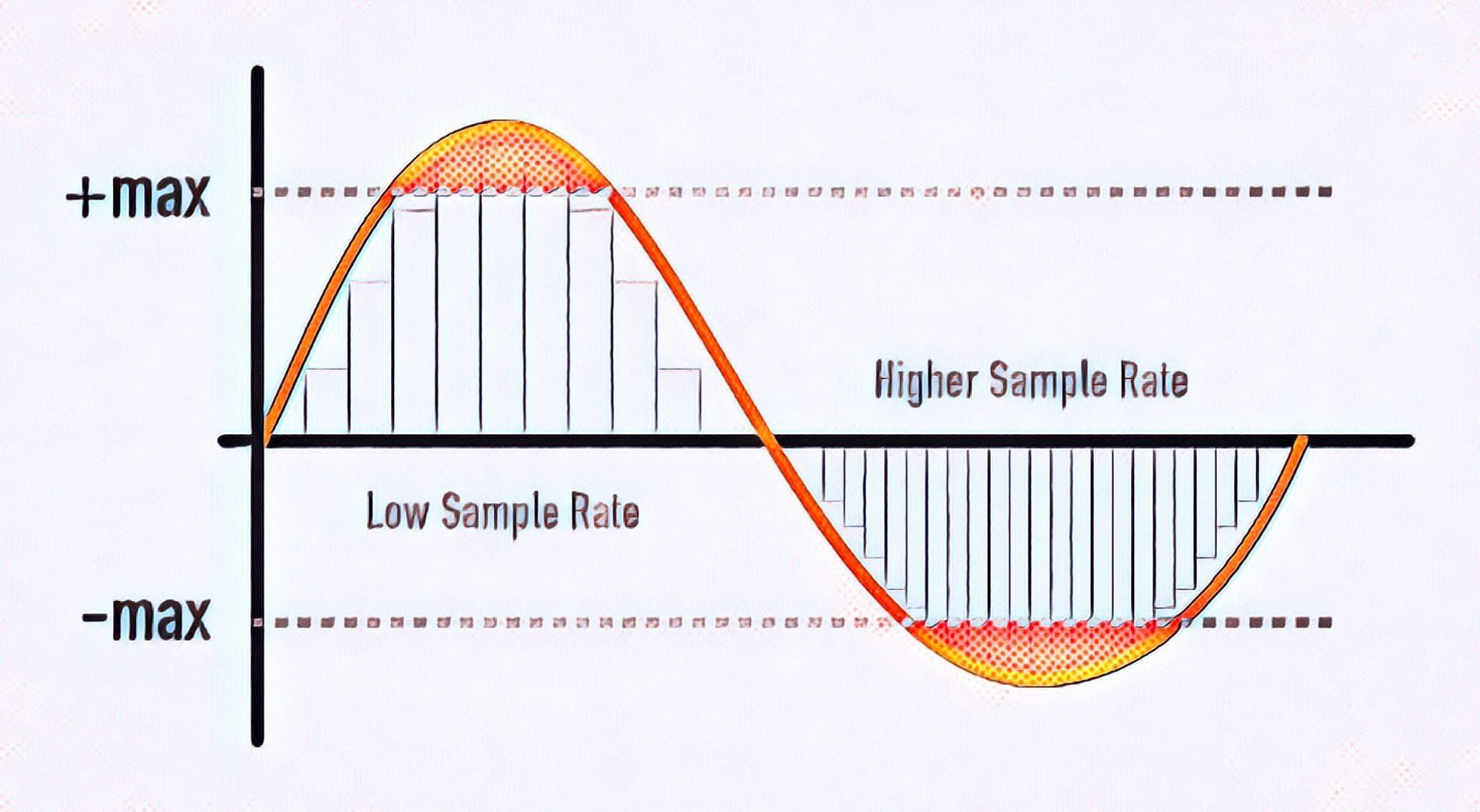
The problem is that when you compress a file to save space, you are removing chunks of data. Just like when you take a high quality image and compress it to JPEG, your computer grabs the raw data and “tricks” certain parts of the image into being basically the same, but with some loss of clarity and quality.

An example of how the JPEG graphics compression algorithm works
Remember that you are saving hard drive space by compressing music in lossy formats, which can make a big difference for an iPhone with 32GB of storage, but is only a trade-off in terms of size / quality.

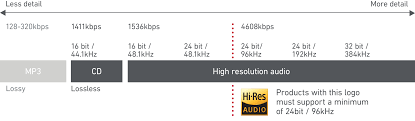
There are different levels of compression: 128 Kbps, for example, takes up very little space, but it will also have a lower quality of playback than a larger 320 Kbps file, which in turn is of lower quality than the 1,411 reference file Kbps. From. 1,411 kbps is an audio CD level quality, which is more than sufficient in most cases.

The problem is not how much the music is compressed, but what equipment you listen to it on.

Does bit rate really matter?

As memory gets cheaper every year, listening to sound at a higher bit rate, or even lossless formats, is starting to become more and more popular. But is it worth the time, effort, and storage space on your phone or computer?

I don’t like answering questions this way, but sadly the answer is: it depends.

Part of the equation is the hardware you use. If you are using a good quality pair of headphones or speakers, you are used to wide frequency and dynamic range. As such, you are more likely to notice the downsides that come with compressing music into lower bitrate files. You may notice that low-quality MP3 files lack a certain level of detail; Subtle backing tracks may be harder to hear, the highs and lows won’t be as dynamic, or you may hear distortion in the lead vocal. In these cases, you may want a higher bit rate track.

However, if you’re listening to your music with a cheap pair of headphones on your iPod, you probably won’t notice the difference between a 128Kbps file and a 320Kbps file, let alone 1,411Kbps lossless music. Remember when you I showed the image a few paragraphs above and noticed that you probably had to look at it to see the flaws? Your headphones are like a truncated version of the image: they will make these imperfections difficult to perceive, as they are not physically capable of reproducing the music for you the way you want them to.

The other part of the equation is, of course, your own ears. It can be very difficult for some people to distinguish between two different bit rates for the simple reason: they listen to little music. Listening skills, like any other, develop with practice. If you listen to your favorite music often and a lot, your hearing becomes more accurate and begins to pick up small details and midtones. But until then, doesn’t it really matter what bitrate you use?

So what format and bit rate should you choose yourself? Is 320 Kbps enough for you or do you definitely need Lossless format?

The point is that it is difficult to hear the difference between a lossless file and a 320Kbps MP3 file. To hear the difference, you need serious high-quality equipment, good hearing, and some kind of music (for example, classical or jazz). .

For the vast majority of people, 320 Kbps is more than enough to listen to.

What else should you consider?

Music recorded in the Lossless format can be useful. Lossless files are more reliable in the future, in the sense that you can always compress them to Lossy format when you need to, but you can’t do the opposite and restore original CD quality from MP3 file. This, again, is one of the fundamental problems of online music stores: if you have created a huge music library on iTunes and one day you decide that you need more bitrate, you will have to buy it again, but this time only in CD format . …

Whenever I can, I always buy or copy music in Lossless format for backup.

I understand that audiophiles are like a needle under your nails. Like I said, it all depends on you, your audition and the equipment you have.

Compare two tracks recorded in Lossless and Lossy formats. Try a few different audio formats, listen to them for a while and see if it makes a difference for you or not.