Differences between digital audio formats (MP3, AAC, FLAC, WAV files, etc.)


Free Download Mp4Gain
picture

Differences between digital audio formats (MP3, AAC, FLAC, WAV files, etc.)

What are the main digital audio formats and what are the differences between WAV, MP3, AAC, FLAC and others?

audio file formats

Differences in audio files To discover all types of digital audio formats, you must first understand briefly and synthetically what digital audio means and how it was created.

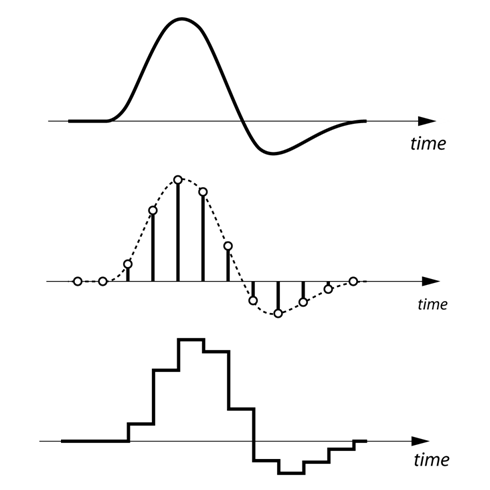
It all starts with Pulse Code Modulation (PCM), the basis for digital audio, which was founded in 1937 and is characterized by two properties: sampling rate for measuring the waveform amplitude and bit depth for measuring possible digital values.

If the sound is continuous in the real world, this is not the case in the digital world.

To understand the difference, you can think of digital videos that consist of still images that change quickly and give the impression of continuous motion.

It is the same for audio and the amplitude of the sound waves in a digital format is not fluid, but changes according to certain criteria at predefined intervals.

Since I am not an audio technician or physicist to do simple things and understand what digital audio is, I have found a very explanatory analogy that I am trying to explain here.

The analog audio source can be thought of as the water flowing from an open tap and the amplitude of the audio waveform as the water temperature.

Sampling can be viewed as the frequency with which the finger is immersed in the flowing water per second

The more the finger is immersed in it, the more continuous the temperature changes become.

audio formats

If you put your finger in the running water 44,100 times per second, it’s almost like holding your finger still all the time.

This is the idea behind the sampling rate.

In terms of bit depth, we should think that we’re using a thermometer instead of the finger.

If the water temperature is higher than that of the surrounding area, we will say that it is hot, otherwise it will be cold if it is below it.

Instead of only 2 options, we could mark 16 possible values ​​for measuring the water temperature.

The bit depth can be viewed as the number of values ​​with which the thermometer is to be used to measure the temperature. The more they are, the more accurate information is obtained.

Without losing ourselves technically, we are now seeing the most important digital audio file formats and their differences.

1) WAV and AIFF are lossless (i.e. uncompressed) PCM-based audio container formats with some minor changes in data storage.

.WAV or Wave is the standard format when you take a CD out of your computer (CD ripping).

A WAV and an AIFF can be converted into each other without changing the quality.

These audio formats are suitable for a stereo system (2 channels), they are sampled at 44.1 kHz (or 44100 times per second) with 16 bits (“CD quality”) and the files are approximately 10 MB per minute.

2) Lossless formats: FLAC (Free Lossless Audio Codec), ALAC (Apple Lossless Audio Codec) and APE

These formats compress audio using algorithms.

The difference between compressed files and FLAC files is that FLAC is specifically designed for audio and therefore has better compression rates without data loss.

As a rule, a .FLAC takes up half of the storage space of a WAV in megabytes and maintains the “CD quality”.

A FLAC can be converted to WAV without loss of quality and is the preferred format for those who want to listen to music with the best quality and great speakers.

3) Loss formats: MP3, AAC, WMA, Vorbis

.MP3 and .AAC files are the most common formats when you need to store music on a computer or phone and need to share or download music on the network and the Internet.

MP3 is a highly compressed “lossy” format that sacrifices a certain amount of audio quality for a significant gain in file size.

An MP3 has a size of approximately 1 MB per minute.

The difference to lossless formats is that if you convert the file to a less compressed format like WAV, the quality sacrificed during compression will not be restored.

The various lossy formats use different data storage algorithms, so they vary the size of the files with the same quality. For lossy formats such as MP3, the audio quality is measured using the bit rate value, which is generally specified in “192 kbit / s” or “192 kbit / s”.

The higher the bit rate, the more detailed the sound becomes.


Free Download Mp4Gain
picture


Mp4Gain Main Window
picture


Mp4Gain Features
picture


Free Download Mp4Gain
picture

Lossy and Lossy Digital Audio Formats: Audio Codec Guide

Lossy and Lossy Digital Audio Formats: Audio Codec Guide

In recent years, the way we listen to music has changed a lot, also thanks to the Internet, which has allowed a great diffusion of digital audio files. In a short time we went from vinyl to CD, to online music transmitted in high resolution.

losselless

An analog sound to be handled by a computer must become digital. To maintain the exact fidelity of the original audio, you must write a lot of information, thus producing heavy files that take up a lot of disk space. Hence the need to reduce the size of the audio file to save space on various storage media, such as hard drives, but also to take better advantage of the available bandwidth for transferring and listening to files.

Digital audio formats

Every day we use multimedia content such as YouTube, online radio or music streaming services, with a quality that is sometimes enough, other times excellent. This is because the files are the result of a data compression process through the use of codecs.

audio file formats

What is an audio codec?

A codec is an algorithm for encoding and decoding the audio (but also video) data stream.
It is used both to compress a file and to convert, for example, an analog to digital file. The difference in digital audio formats lies in the type of compression that determines their quality and, consequently, their size according to the type of codec used.

Types of digital audio formats.

Audio formats can be of three types:

-Loss (with data loss)
-No loss (no data loss)
-Uncompressed

Lossy digital audio formats

Lossy audio formats are compressed files with lost data and information. They allow you to significantly reduce the size of the original file, even up to 90%. The sound quality is lower than the CD-Audio standard because the compression algorithm “cuts” certain frequencies that the human ear has more difficulty perceiving and, therefore, are less relevant, generally the highest (more than 16 -17,000 Hz).

The Lossy audio format is widely used for listening to digital audio, such as streaming (Spotify, Deezer, Apple Music, etc.). Depending on the type of codec used, compression can vary significantly, as does the quality of the listening. The most popular and popular format is MP3 and WMA.

MP3

The most famous and well-known digital audio format. In its entirety, Motion Picture Expert Group-1/2 Audio Layer, 3, developed by MPEG, offers good compression and discrete audio quality, in particular with a bit rate of 192 kbit / s and 320 kbit / s. Although still widely used, better compression algorithms can be found.

OGG Vorbis

The open source format without lossy audio compression offers an excellent alternative to MP3. With the same perceived quality, it allows for greater compression. The high frequencies (above 16 kHz) are wider and wider, offering greater spatiality of sound. Also used in computer games, it is also often used for audio streaming. Spotify music, for example, uses the Ogg Vorbis digital audio format from 96 kbit / s to 320 kbit / s in addition to the AAC codec.

WMA

Windows Media Audio is Microsoft’s proprietary digital audio format. Encrypted WMA offers excellent compression and good audio quality at high bit rates, but at the same time little compatibility. Precisely for this feature it is now little used. WMA consists of four different codecs: WMA codec, lossless WMA (lossless), WMA Pro, or WMA Voice.

AAC

The Advanced Audio Coding Format (AAC) is part of the MPEG consortium and was born as MP3’s successor. It became famous thanks to Apple that uses it with iTunes, but also thanks to several radios (DABè) that use it to transmit audio. It is the excellent quality and good compression digital audio format used by YouTube, iPhone, Android smartphones and many other devices such as Nintendo and Playstation. The AAC supports 48 audio channels with sampling up to 96 kHz and uses constant bit rate (CBR – Constant Bit Rate) or variable (VBR – Variable Bit Rate) compression encoding. AAC is one of the best lossy codecs, the encoding speed is not among the best.

MPC

Musepack (or MPC) together with AAC vies for the podium as the best lossy digital audio format. The quality is very high, thanks to the VBR encoding that guarantees a good distribution of the bit rate. The peculiarity of this codec, in terms of AAC, is the clarity of the sound, which is very wide and spacious. Good encoding speed, it is ideal for those looking for quality while keeping a small audio file size.

ATTRAC

ATRAC (Adaptive Transform Acoustic Coding) is a lossy audio compression algorithm developed by Sony. Born for MiniDisc (MD) whose production ended in 2013, this codec has not been very successful and is no longer used today.

mP3Pro

Derived from MP3, its peculiarity lies in the fact that it maintains the same quality as an MP3 at 128 kbps but with lower bit rates, from 64 kbps to a maximum of 96 kbps. Compression of the higher frequencies, a painful note from lossy files, occurs through the Spectral Band Replication (SBR) algorithm. The result is space savings at lower bit rates, but also less dynamic and unclear sound.

Dolby Digital

Dolby Digital is a multi-channel audio encoding system, used primarily in DVD, film, and digital television. Contrary to what one might think, it is a lossy audio format, therefore compressed with loss of information. Known as Dolby Digitale 5.1, it works with a minimum bit rate of 96 kbit / s up to a maximum of 640 kbit / s. On DVD, it maintains an average of 192 kbit / s in stereo audio and up to 448 kbit / s in 5.1 signals

Lossless digital audio formats

Lossless audio formats are compressed but lossless files. They maintain the original audio quality, without degrading its characteristics in any way, while managing to compress certain information up to 40-50%. The most popular and widely used Lossless Codec format is the FLAC (Free Lossless Audio Codec) file. Apple has produced its own lossless format called ALAC (Apple’s Lossless Audio Codec) that iTunes uses.

Lossless files offer the quality of a CD (reported as standard), but to maintain fidelity, the dimensions will be larger and take up more disk space than Lossy, but still half the original file.

FLAC

FLAC (Free Lossless Audio Codec) is a codec released under a free software license with lossless data compression. Extended and compatible with most audio devices, the FLAC codec compresses data from a minimum of 30% to 50%, compared to the original file, while maintaining the perceived quality unchanged.
A Flac file can be 8, 16, or 24-bit deep and has a sample rate of up to 192 kHz (Flac Hi-Res).
Various music audio streaming services like Deezer Music, QoBuz, Tidal offer high quality music equal to or higher than the CD standard using this format.

Lossless wma

WMA Lossless is the lossless version of Microsoft’s WMA Lossy codec. It offers good and fast compression. Although it is proprietary, it can also be played by VLC Media Player, WinaAmp, RealPlayer and others.

A THE C

ALAC (Apple Lossless Audio Codec), also known as ALE (Apple Lossless Encoder) is an audio codec developed by Apple in 2004. In 2011, the source code was made available under an open source license. Primarily used by iTunes, other online music services have also used it in recent years. Excellent audio quality and fast decoding, but slightly less compression than FLAC files.

Advantages and disadvantages of the main digital audio formats

Advantages and disadvantages of the main digital audio formats

CDA:

Advantage
· It is the most standard digital format of all.
· Contains Digitized Stereo Music
· Play all audio spectrum
WAV (AIFF):

Advantage:
· It can contain other resolutions or even be monophonic.
· It can be considered a lot to record voices.

Disadvantages:
· It is considered insufficient for music.
· The most common are 16-bit and 44.1kHz.
· 8 bit 22kHz monophonic WAVs were only capable of reproducing this resolution.

MP3:

Advantage:
· It is adaptable for most devices.
· It is very accessible.

Disadvantages:
· You can force to pay for the use of codecs.
· Contains too many losses, making them clearly insufficient for the quality of MP3 players.
· Adds obvious losses in the stereo image, permanently missing the highest frequencies.
· It is one of the worst in audio quality.
· The higher the resolution, the more the MP3 will occupy.
· It also affects the definition and timbre of the instruments.
· It also removes certain sounds that move at the same frequencies as another louder sound.
· Add excessive modifications to the original music.

WMA:

Advantage:
· Improve MP3 quality.
· There does not seem to be an advantage to using a proprietary format having free alternatives.
· All Windows and many MP3 players support it natively.

Disadvantages:
· Over the years it may become obsolete or discontinued by Microsoft.
· Add artifacts and losses similar to MP3, although lighter.

OGG (Vorbis):

Advantage:
· It would be the equivalent of MP3 and WMA but free and free.
· The code of the codecs is open.
· It is available to the community, which can continue to improve it.
· It has excellent compression rates.
· Quality superior to that of WMA and much superior to MP3.
· Sounds better than a 192 Kbps MP3
· Adds a certain artificial brightness at high frequencies, the losses produced by psychoacoustic theory being much lower.

ATRAC3:

Advantage:
· ATRAC3 plus in an improved ATRAC format.
· Cuts at certain frequencies are auditively seen in secondary and treble instruments.

M4A / MP4 / ACC:

Advantage:
· Contains ACC audio.
· They are capable of playing video.
· The quality of the AAC is much higher than that of the MP3.
· Adds some distortion in the mid frequencies and digital artifacts in secondary instruments.

MPC (musepack):

Advantage:
· It is free and free.
· Excellent sound quality.
· It offers the best quality of all and the losses are practically negligible.

Disadvantages:
· It is one of the most modern and sophisticated formats with loss.
· The resulting files are larger.
· Codecs are not intended for low bitrates.

RA (Real Audio):

Advantage:
· Compress to limits to be able to transmit audio streaming through slow 56 Kbps modems

Disadvantages:
· Requires installation of Real Audio player.
· Slow, heavy and full of advertising.

APE (Monkey Audio):

Advantage:
· It is a lossless format.
· We compress but when unzipping we get the same files intact.
· Contains the full disk wave.

Disadvantages:
· It is a proprietary format.
· It has a discreet support on the platforms.
· Slow decompression.

FLAC:

Advantage:
· It is a free lossless audio format.
· The quality is equal to that of the APE.
· We use less processor.
· It is multichannel (accepts all streaming).
· Avoid annoying shorts.
· It is very compatible.

What are digital audio formats

What are digital audio formats

Digital audio formats are basically containers. And the differences between them are fundamentally in:

Whether or not they are compressed.

If they are compressed, in the quality of compression.

The type of labeling they can support.
Digital audio formats

MP3

It is the best known, popular and most widely used. They are known by their “.mp3” extension.

It was developed by Moving Picture Experts Group, so that it was part of the well-known MPEG-1 and MPEG-2 standards.

Its fundamental characteristic resides in the fact that the technology behind it performs a compression of the sound sequence, resulting in a really small file, which normally occupies half of the original file. To achieve this, the loss of certain sounds is necessary, which supposedly cannot be heard by the human ear.

Audio formats

WAV

Developed by the Microsoft and IBM companies, this format, whose name comes from the acronym WAVE (Waveform Aujdio File Format), is currently one of the audio formats that do not have compression in the data, therefore they present an excellent quality.

They are known by their “.wav” extension.

On the other hand, this format has the peculiarity that it includes support for almost all current audio codecs. This makes WAV one of the most widely used formats in the field of professional sound, since the sound is captured with parameters of 44100 Hz and at 16 bits, the same quality can be obtained as on a CD.

On the contrary, one of the disadvantages of this format is that it has a limitation in recording, since it can only capture a maximum of 6.6 hours in the same file at maximum quality.

Audio formats

AIFF

The AIFF (Audio Interchange File Format) format is very similar to WAV. It was born as an answer from Apple to Microsoft’s WAV, being initially only compatible with MAC computers. Currently it can also be used in Windows.

Due to its characteristics, AIFF, together with FLAC and WAV, are usually the most widely used formats in the professional field of audio.

WMA

The WMA (Windows Media Audio) format is a music file format created by Microsoft.

One of its main characteristics is that those files that have been compressed in WMA format take up less space than MP3 files, which also implies a reduction in their quality. Therefore, it is a lossy audio compression format.

OGG

OGG audio formats are compressed audio files, which means that they have a size that allows them to be transmitted via WIFI, but at the same time they avoid the damages that are usually generated in the compression process.

For example, Spotify uses these OGG formats.

Audio formats

FLAC

When we talk about the FLAC (Free Lossless Audio Codec) format, we are referring to a codec free of audio compression and without loss of quality.

Emerged within the community responsible for the OGG project, FLAC has become one of the WAV format’s strongest competitors, due to its advantages in terms of sound quality.

Its objective is to reduce the size of the original file, eliminating data that is usually known as “waste”, without causing loss of quality.

This is the format used by the Tidal platform, the best high quality audio streaming service.

What is the difference between the different audio formats, and which should I choose?

What is the difference between the different audio formats, and which should I choose?

Lossless formats: WAV, AIFF, FLAC, Apple Lossless and others

In summary, there are two types of sound quality: lossless and lossy. Lossless music preserves the sound quality of the original source – in most cases, CD – intact, on the other hand, lossy music compresses the file to save space (in exchange for decreasing quality). Lossless formats include the following formats:

WAV and AIFF: Both are uncompressed formats, making them exact copies of the original sound source. The two formats are essentially the same quality; they simply store the data differently. AIFF was created by Apple – you will see it often in its products – but WAV is much more universal. However, since they are not compressed, they take up too much unnecessary space. Unless you are editing sound, we do not need to use this format.

FLAC: Free Lossless Audio Codec (FLAC). It is the most used lossless codec, it is a good option if we want to store our music without losing quality. Unlike WAV and AIFF, it uses compression, taking up less space. However, it is still a lossless format, which means that the sound quality is the same as the original source, so it is better for listening than WAV and AIFF. It is also free and free software, which is useful if you like to take a look at how it works.

-Lossless Apple (Apple Lossless): Also known as ALAC, it is similar to FLAC. It uses compression, although it is made by Apple. Its compression is not as efficient as that of FLAC, so the files will be slightly larger, but it is compatible with iTunes and iOS (FLAC not). Therefore, if you use iTunes or iOS as the main software for listening to music, you should choose this format.

APE: It is a very high lossless compression file, which means you will save more space. The quality is the same as FLAC, ALAC and other lossless files, but it is not compatible with most players. On the other hand, it makes the processor work more to decode because it is so compressed. Generally, I would not recommend using this format unless you are very concerned about space and have a compatible player.

Lossy formats: MP3, AAC, OGG and more

For day to day, we are more likely to use lossy formats. They save significantly more space, and if they have a high enough bitrate, it will be very difficult to distinguish the quality of the original source. The most commonly used formats are shown below:

MP3: MPEG Audio Layer III, or MP3 for short, is the most common lossy format. So much so that it has become synonymous with music downloads on the internet. It is not the most efficient f-format of all, but it is certainly the most compatible, making this the first choice of lossy sounds.

AAC: Advanced Audio Coding, also known as AAC, is similar to MP3, although slightly more efficient. Which means that the files take up less space and with the same sound quality as MP3. And, with Apple’s iTunes making it so popular, it’s as compatible as MP3.

Ogg Vorbis: The Vorbis format, often known as Ogg Vorbis due to the use of the Ogg container, is the free software version to MP3 and

AAC. Its main attraction is that it is not restricted by patents, but that does not affect you as a user – in fact, despite being open it is of similar quality, and much less popular than MP3 and AAC, so not all players support it. . I do not recommend it unless you are interested in being open source.

WMA: Windows Media Audio. Microsoft’s proprietary format, similar to MP3 or AAC. It really doesn’t offer any advantage over other formats, and it’s not very well supported.

So which one should you use?

Now that we have seen the differences between each format, which one should we use for our music? In general, we recommend using MP3 or AAC. They are compatible with most players, and the quality of both is very similar to that of the original source if encoded with a high bitrate. Unless you have specific needs, MP3 and AAc are the most recommended options.

However, there is something to be said for storing music in lossless formats like FLAC. Although we probably won’t notice higher quality, it is good for storing music if you plan to convert it to other formats later – as converting from one lossy format to another. Lossy (eg from AAC to MP3) will produce lower quality files.

Digital audio: a simple but deep explanation about digital audio. Part 1

Sound is a phenomenon that implies a propagation of waves generally produced by a vibratory movement of a body. The propagation of sound implies a transport of energy without carrying out a transport of matter.

digital audio

As the sound is produced by a wave movement when applying the Fourier transform we can express it by a sum of sinusoidal curves that correspond to pure tones that can be characterized by the magnitudes of any wave such as:

-Period It is the time elapsed between two equivalent points of a wave.
– Wavelength It is the real distance a wave travels from its highest point to the next equivalent point.
-Frequency It is the magnitude that measures the number of repetitions in a space of time.
-Amplitude It is the distance between the furthest point of the wave with the equilibrium point.

These magnitudes give the sound a series of characteristics such as:

-Duration: Determines the length or short of the sound due to the time, measured in seconds, it occupies.
-Intensity: Determines the high or low sound due to what we know in relative terms as volume, which is measured in decibels (it is a logarithmic scale).
-Timbre: Determines the proper nuance of each instrument or sound source due to the different harmonics that compose it.
– Hue: Determines the acute or serious sound due to the frequency it has. The frequency is measured in hertz (Hz).

If we carefully consider it, we will see that the initial concept of Mp3Gain was intensity, which is measured in decibels and represents the loudness we perceive.

digital audio

Digital audio

Digital audio is the digital coding of an electrical signal that represents any sound wave. This electrical signal is picked up for example by a microphone, which takes the sound whose nature is analog and transforms it into electricity that still has the same type of analog nature, then through the necessary hardware and software it can be transformed into binary information, turning Something continuous in discreet. This process involves two tasks: sampling and digital quantification of the electrical signal.

Within the digital audio there are different types of formats to represent the audio:

-PCM: They contain all the information received from the analog to digital converter, without any omission of data. This makes the type of formats that have the best quality in the digital world. WAV is an example of this type of format in question.

-Compressed: It is similar to the previous one, but specific compression techniques are used in which “non-essential” information can be lost to reduce the size of the final file. They usually have good quality in relation to the weight of the file, but as noted above, information is lost, so those with sufficiently developed / trained ears might perceive that there is something strange in a song for example. On the one hand we have formats such as MP3 and OGG that compress with loss, compared to FLAC that compresses without loss. Obviously between one format and the other there is a notable difference in the size of the final file.

-Descriptive: They are used primarily to make music and contain mainly a description of what would be the “score” of the song. With this description, the algorithm, which reproduces the song, can take a sound source with samples of the instruments that the composition needs, to synthesize the final sound based on the indications of the “score”. Examples of this format are MIDI and tracker formats (MOD, XM, IT, etc.). The difference between MIDI and tracker formats is that the latter bring built-in sound sources into the file, so the final file weighs more than using MIDI. However, with MIDI we will need to obtain a sound source on our own or use the one that brings the default sound card (which is not usually too good).