What is lossless sound quality Part 2


Free Download Mp4Gain
picture

What is lossless sound quality Part 2
lossless audio

The principle of these audio compression methods is to preserve places that are easily heard by the human ear as much as possible.
 

Music Lossless


In conventional fixed bit rate (CBR) mode, the audible data in the audio is removed and is easier for the human ear to hear. The more information that is withheld, the less information that is withheld when the part is inaudible. As the complexity of the sound increases, the degree of deterioration in sound quality becomes more apparent. For example, when listening to pure voice Performances and performances combined with background music, pure compressed music for vocals, sounds less degraded than the original file.

As for the lossless sound quality offered by the current streaming platform, there are many formats, but in fact, strictly speaking, these formats, including flac and ALAC, belong to lossless compression (non-destructive data compression) in place of lossless sound quality in a strict sense. The performance is almost the same as WAVE, but the file size is small, the decoding speed is fast, and at the same time, it can be used in streaming services. Therefore, it is also the representative format of lossless sound quality entering the era of non-optical disc media, and it is also the current music streaming service.

In addition, Tidal’s MQA is a more controversial format, because although MQA is general lossless audio reduction, it focuses on making high quality music files higher than CD quality so that they are similar to files. CD-quality flac. original high-quality sound format, but the point of controversy is whether the higher compression ratio can maintain the same real listening experience as the original high-quality sound quality has been controversial, and MQA requires a specific device to perform the hardware decoding. many devices are still only able to do MQA decoding through software.

The photo mentions オーディオ Association が, ハイレゾ対応 machine に, めた processing power, including ハイレゾオーディオ definition, digital audio, high-resolution audio, Japan オーディオ Association, sound quality

▲Today’s so-called High-Resolution Audio generally refers to sound quality above CD, but to be certified, the device must support 24-bit, 96kHz format processing capability.

However, since MP3 and AAC are previously planned destructive music compression formats, their purpose is to compress CD-level sound quality into smaller files, so most of the encoding specifications are presented in one presentation. 16-bit 44.1 kHz or 16-bit 48 kHz CD-level audio, but MQA is a format with a reduced file size that blocks high-quality sound. Basically, the MQA format will be equivalent to PCM 24-bit or top music.

In fact, with that said, current music file formats that don’t emphasize high-quality streaming services, whether presented in MP3 or AAC, are called lossy-compressed music, while high-quality, lossless streaming quality is compressed without loss. music. As for the music heard by traditional vehicles like vinyl and CD, it is called lossless music. In theory, non-destructively compressed lossless music and lossless music should have the same sound quality.

Does lossless sound quality have to be good? Does compressed sound have to be bad?
The photo mentions Browse, Coming Soon, New Single, and Apple. Related, contains media, streaming, apple, eddie library, media

▲ Although Apple Music has released lossless sound quality, its marketing focus is on spatial audio

When the Japanese audio industry started promoting high-quality music, many people jumped up and said that high-quality sound was useless. When Apple Music launched the premium sound format, its executives also said that he was one of the people who couldn’t tell the difference, noting that Apple launched the premium sound service to serve one of those hundred people. ; Before we talk about high-quality sound, let’s go back and talk about the current state of digital music on today’s playback devices. .


Free Download Mp4Gain
picture


Mp4Gain Main Window
picture


Mp4Gain Features
picture


Free Download Mp4Gain
picture

What is lossless sound quality

What is lossless sound quality

lossless

There is no comparison, no harm, if lossless sound quality and high sound quality are necessary, and what differences in hearing can Bit-Perfect bring without going through SRC

lossless & lossless audio

mp3

CD

KKBOX

flac

spotify

high resolution

dolby atmos

Apple

apple music

CAA

360 reality audio

SRC

spatial audio

Bit-Perfect

Although lossless sound quality and high-quality streaming services have been on the market for a while, as have true wireless earphones, Apple isn’t the first to make waves in the market, with Apple’s launch of so-called high-fidelity compressed sound quality. in Apple Music, in fact, after the lossless compression commonly known in Taiwan’s audio industry, lossless sound quality and high sound quality have instantly become a hot topic discussed by many people, but if the benefits of lossless sound quality are really obvious, the author will spend some space from the theoretical concept to the practical level. The differences are briefly described, but the following arguments focus on being easy to understand, so some of the descriptions are not entirely accurate.

What is lossless sound quality? What is the sound quality of the music we usually listen to?
The photo mentions * Introduction to KKBOX sound quality (including format), release year, sound quality, including digital, KKBox, streaming, Hi-Res Audio and Hi-Fi

▲ Both AAC and MP3 are destructive compression, while FLAC and ALAC are lossless compression

Before we go into the details, let’s talk about what is called lossless sound quality; From the author’s concept and cognition, the so-called lossless sound quality is a relative word rather than an absolute word. The main source is the relative word born due to the emergence of the MP3 music compression format. ; After the music industry entered the digital format, digital music files were generally recorded through PCM encoding, and WAVE files were generally used on CDs. The time and space situation of MP3 was Due to the fact that the capacity of the hard disk was generally not large at that time, in order to be limited in the limited space, a large amount of music data is stored in the storage space and you may need to compress the files. .

The reason why MP3 cannot be called a lossless format is because its essence is to compress the original WAVE file with a limited bit rate by combining concepts such as the psychology of sound. In bitrate compression mode, compared to the original WAVE file, the bitrate is at least 1:4 to 12:1. The higher the bitrate, the greater the amount of information retained. For example, AAC format also uses similar audio psychology for compression, but the efficiency is better than MP3. Therefore, the lossless sound quality of most streaming platforms today is mostly AAC as the mainstream.

Photo mentions KKBOX, FLAC format, 16bit/48kHz, related to KKBox, including kkbox Hi-Res, Hi-Res Audio, KKBox, Streaming Media, Hi-Fi

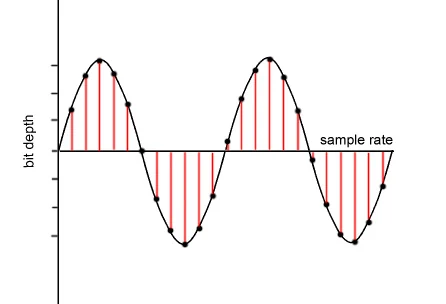
▲ Although the waveform of digital music in PCM format will appear jagged, but as the sampling rate increases, it will be closer to the analog arc curve

5 reasons to choose lossless audio: Flac, WAV, AIFF

MP3 versus FLAC

There are several formats you can choose from when you want to rip your CDs. MP3 is the most popular format, while FLAC (Free Lossless Audio Codec) is a lesser known alternative. The main difference between the two is the way they compress the audio information. Mp3 is a lossy format in which parts of the audio information are people probably won’t hear it, it gets thrown away. On the other hand, as the name suggests, FLAC is lossless, which means that it would keep all the information about the audio and nothing would be thrown away.

LossLess Audio

The biggest consequence of the lossy / lossless difference is the magnitude of the corresponding size. While both are significantly smaller than uncompressed audio, MP3 files will likely be about 20% larger than their equivalent FLAC files. is very important on portable devices where space is often a big issue. FLAC advantage nothing is lost no matter how many times you compress and unzip the file. With MP3, the sound quality would deteriorate due to the way the algorithm works.

LossLess Audio

The small MP3 file size is also one of the main factors why it has become so popular. It was the codec of choice when the first SSD music players appeared; dubbed as MP3 players. Even today, MP3 is still very popular and almost all devices that can play digital music can recognize and play MP3 files. With FLAC, the number of devices capable of playing FLAC files is very small. The ability to play FLAC files can often only be seen on high-end devices, where the sound quality can really be appreciated.

Another aspect in which the two formats differ is royalties. Although MP3 is widely used, few know that it is a proprietary format and that royalties are required to use this format. However, people don’t have to worry because it is the device manufacturer who pays the royalties for using the MP3 format. FLAC is royalty-free software that anyone can use without paying for it. The author intended it to be free from the start.

Resume:

1. MP3 is a lossy encoding algorithm while FLAC is a lossless encoding algorithm

2 is. MP3 files are probably 20% the size of the same FLAC-encoded file

3. MP3 has a broader hardware support compared to FLAC

4. MP3 is a proprietary format, while FLAC is not copyrighted.

FLAC, WAV, MP3, DSD, ALAC … What audio format should I use?

You probably know the famous MP3 audio format. There’s even a good chance that you only use it on a daily basis. But did you know that it is possible to take your music to the next level thanks to other audio formats? If the terms FLAC, DSD, sample rate, or even lossless don’t mean anything to you, then you’ve come to the right place. Designed specifically for newbies, this guide tells you everything you need to know about the basics of digital audio.

soundwave

FLAC, DSD, ALAC … Listening to a debate between audiophiles can seem difficult when you do not know this universe and the many acronyms that refer to it. But if you try the adventure, you will not regret it. Say goodbye to your boring and lifeless MP3s and hello to quality music. Trust us, your ears will thank you!

Sample Rate and Bit Depth: The Basics of Digital Music

Before knocking you out (we promise we won’t hit too hard) with barbaric acronyms in every way, let’s first focus on two essential notions of modern audio, namely sampling rate and bit depth. These two elements give an idea of ​​the recording precision of a song.

but depth

As you know, computers run on bits, which are sets of 0 and 1. During a passage in the studio, music produced by an artist must be digitized, therefore transformed into 0 and 1 in order to be recorded on CD or transmitted to through transmission services. This is where the sampling rate and bit depth come into play.

Take the example of a CD. Our beloved empanadas are recorded in 16-bit / 44.1 kHz. The 44.1 kHz sampling rate means that the music produced by our musician is analyzed 44,100 times per second by studio recording devices. As for the bit depth, it gives an indication of the number of information recorded during this same period. The greater the depth, the more information will be encoded at the end.

However, CD quality is not the best in the world, even if it far exceeds MP3. Thus, we find 24-bit / 192 kHz recordings. The DSD goes even further with a frequency that rises to several MHz. But for simplicity, just remember that the higher the values ​​described above, the more accurate the recording will be in your sound reproduction.

Lossy formats: MP3, AAC, OGG

In general, there are two types of formats in the audio world: lossy, lossy in English, and lossy, or lossless. If you want the best audio quality, stay away from compressed formats.

The best known of all is MP3. True dinosaur in the audio world, this type of file was developed at a time when the capacities of our hard drives were determined in MB and not in TB. Therefore, we had to compress the recordings as much as possible, even if that meant putting quality aside.

It is true that MP3 encoded music weighs only a few megabytes. But the applied algorithm is very aggressive, it simply cuts the frequencies considered inaudible by the human ear. In fact, MP3 loses many audible parts. To get an idea, click the link below, you will hear these famous truncated parts. The pieces seem flat, devoid of life. Listening can even become unpleasant after several tens of minutes. Suffice it to say that, apart from its small size, MP3 is no longer really interesting in our time if we are looking for quality music.

To make things better, Apple, meanwhile, released another audio format, AAC, for advanced audio encoding. This is also a lossy format which therefore loses details during data compression. However, the algorithm used is more efficient, cutting fewer important frequencies, at least on paper. In absolute terms, the difference from MP3 is not necessarily stark and the debate has been raging for years in the audiophile environment to find out if the AAC format is really better than MP3.

Finally, there is also the OGG Vorbis, another lossy compressed format. Like AAC, it is supposed to work better than MP3. This is the type of file Spotify uses. Her interest is to enable efficient transmission while reducing quality. However, the songs encoded in this format are not fabulous. The ideal is really to become lossless.

Some of the most popular digital audio formats.

Main audio formats without loss of quality.


WAVE (.wav) – This is the most common uncompressed audio file format. When you rip audio from a music CD on your computer, this will be the format you get. It takes up a lot of space (1411 KB of information per second on 4400 Hz / 16 bits of stereo music), but reproduces the sounds in a quiet way. In terms of quality and amount of information, it resembles the AIFF (.aif) format, which is mainly part of the Mac world. Suitable for audio files and those that record music.

FLAC (.flac) – Free Lossless Audio Codec: It is an open source codec that is often used to store music CDs on the computer without loss of quality. While .wav offers uncompressed audio, .flacs are called “lossless c compressed”. However, compression is minimal and the vast majority of people do not notice differences between a Wave file and a FLAC file. However, they take up less space than WAV files. This is possible because they use a variable amount of compression as needed. This means that, in the case of very complex and rich music parts, it uses encodings that are equal to WAV files (1411 Kb / s data). However, in the case of the “simpler” parts, the number of bits used to represent them will be smaller. It is suitable for demanding ears who also want to save some space on their hard drives.

APE Monkey’s Audio is one of the most powerful and popular lossless multimedia compression algorithms for audio files.
The lossless format, that is without data loss, ensures that the original sound quality is maintained in smaller files than compressed sample formats (such as WAV).
The format used is “.ape”, Monkey’s Audio allows compression of a WAVin mono source and also the opposite procedure, ie mono decoding for other formats such as WAV or MP3

ALAC Apple Lossless Audio Codec: Similar to FLAC, which always uses maximum compression. The quality is good on average, but the format is not as effective as FLAC in terms of weight. Not all players support it, so if your life is not exclusively dedicated to Apple and its products, it’s not a recommended format. Other important but less popular lossless audio formats are Monkey’s Audio (.ape) and OptimFROG (.ofr).

AIFF Audio Interchange File Format is a standard file format used to store audio recordings on a personal computer. The format was developed by the Apple computer based on Electronic Arts electronic exchange format and is often used on Apple Macintosh systems, which is why it is also called Apple Interchange File Format.
The audio data in the AIFF file is not compressed, so the file tends to be much larger than other formats, both lost and lost, such as ALE or MP3. One minute sound records approx. 10 MB of data, this is because it is a format created for sharing, although it is also used for editing.
However, there are compressed formats, called AIFFC (AIFF compressed), that can reduce the file size by a third (AIFF3) or a sixth (AIFF6), but this results in a great loss of quality, so there is virtually no use.

The most important sound quality formats in loss quality.

MP3 (.mp3) or MPEG-1 or MPEG-2 Audio Layer III – is the best known compressed audio standard. It was the forerunner of the category (it was published as an international standard in 1998) and is still the most widely used. Minifying a WAV file to MP3 makes it up to 90% easier for MB. The quality varies depending on the bit rate, ranging from 32 to 320 Kbit information for every second of music. The default is 128 Kb / s. At 320 the performance is pretty good.

AAC (.aac) – Advanced audio coding. It’s an Apple standard that iTunes uses by default when importing music. It works like MP3, and with the same bit rate, it takes the same space. The difference is in the way compression is handled. In simple words, “music” sums up another way. According to many people it sounds better than MP3. Especially suitable for those who use iPhone and iPod to listen to music.

WMA (.wma) – This is a proprietary format from Microsoft and is considered Redmund’s response to MP3. Its incompatibility with the iPod makes it very uncomfortable. Incidentally, although most players support MP3, WMA does not. Basically, unless your music world starts and ends with Windows Media Player, it’s a generally discouraged format. It is not compatible with Mac and iTunes.


OGG VORBIS: It is an open source or free format, which means that it does not require any license to be implemented in an audio player (the details are irrelevant for us users). The quality is comparable to MP3, perhaps a little higher. A noble and well-made creation, but not widespread enough to justify its massive use. In light of all this, therefore, recording music in WAV and broadcasting it in MP3 or AAC is the most reasonable option. In this way, you will have quality when you need it and the guarantee of usability of music wherever you are.

Audio formats

Audio formats

Compression

Compressions are systems for reducing the file size by using different types of algorithms and / or encodings.

compressed audio

There are two types of compression: lossless (compression), which compresses the file without deleting information. Decompression can therefore exactly return the original and lossy (lossy) compression, eliminating redundant parts that are considered irrelevant or irrelevant and the decompression does not return to the original.
It is clear that the first system preserves the integrity of the original, but less compressed, while the second implies a loss of quality, but compresses much more, in proportion to the degree of loss one is willing to accept. Let’s look at a few examples.

Lossless compression

Lossless compression is based on reducing the redundancy typical of human production.

human perception
For example, in a book dedicated to experimental music, the phrase “experimental music” is repeated many times with 19 characters. At this point, simply replace it with a symbol that is normally not included in the text, e.g. ‘# 1 #’ to reduce a term from 19 characters to one of 3 and store 16 characters for each occurrence. Actually we have to say “for every occurrence after the first”, because in order to unpack the text, we also have to create an index of the substitutions in which it is written in this case
# 1 # = “experimental music”.
Obviously, many other words or phrases are repeated several times in the book, and each of them can be replaced by a symbol such as # 2 #, # 3 #, …, # n #, where n is a progressive number, which ultimately makes significant savings.
The Lempel-Ziv (LZ) algorithm uses a similar system, the derivatives of which underlie many modern lossless compression programs, including the well-known ZIP.
In fact, the ancestor of many lossless encoders is the so-called Huffman coding. It is a redundancy elimination system that was developed in 1952 by the researcher of the same name, then an MIT student. His algorithm solves the problem of encoding a series of strings (string = any character set) as compactly as possible, taking into account the frequency with which strings occur: the most common is assigned the shortest symbol in to maximize compression. Here is a good example dealing with Huffman coding issues.

Another type of lossless compression, which is always based on reducing redundancy, is the so-called Run Length Encoding (RLE), which works in a very simple way. Suppose we have the following string of 20 characters
ABBBBBBBBBCDEEEEFGGG

By applying the RLE it will
A 9BCD * * * 4EF 3G

for a total of 13 characters with a saving of 35%.
In practice, a code consisting of the character and the number of repetitions was inserted instead of the repeated characters. The asterisk indicates that the following is the number of repetitions and is not part of the chain (this is of course the basic principle; the details of the coding may vary).
Of course, this system is not productive with text, but it is the case with images where long stripes of the same color are fairly common.

Lossy compression

Lossy compression is based on the elimination of the information components that are considered to be more or less irrelevant depending on the compression level required. At low compression levels, only the really irrelevant details are removed, while at higher levels, the sensitive details are also removed.
An example that is not audio is the encoding of JPEG images, in which nuances are eliminated by assigning neighboring pixel groups the same color if their difference is less than a value that is proportional to the degree of compression. On this page you can see the effect of the size reduction and the corresponding loss of quality when increasing the compression levels.

Further information on compression on Wikipedia (free, community-created encyclopedia) can be found here in English. Wikipedia also exists in Italian, but the content is smaller.
First class compressed audio formats
Lossless (lossless)
These formats work similarly to zip. You compress the content without removing anything. At the time of listening, it is necessary to perform a decompression and to return to the original in one of the linear formats already shown.
Since it is lossless compression, the comparison between these codecs is not made in

Digital Music: A Quick Guide to Having the Best Lossless Files

Digital Music: A Quick Guide to Having the Best Lossless Files

Digital Music

Surely changing our music from one side to the other, from an analog format to a digital one or even music already stored in digital format on a compact disc towards one for use on mobile devices, would result in a loss of sound quality that would exceed convenience and comfort.

This has been the main vision of people who care about sound quality, since the concept of digital music files was born. A reference generated by the common use of highly compressed lossy formats such as MP3.

wHowever, it is an opinion that simply “cannot take any more water.” Yes, popular formats like MP3 and AAC sacrifice some quality to keep file sizes small, but the emergence of lossless digital audio formats that are capable of preserving every piece of information from a CD recording means that a ripped file It may sound indistinguishable from the original.

You may still be wondering why you should spend precious time ripping up your CD collection. It’s all about convenience: a lossless digital music collection saves shelf space, is easy to move and to back up; for larger collections, it also makes locating individual songs and albums much easier and faster. You can also access a digital music library from multiple sources simultaneously, for example, from multiple network music players located in different rooms in your home.

Additionally, thanks to higher quality file acquisitions with popular streaming and download sites like B&W Society of Sound, higher quality music files can now be accessed as part of a subscription-based model without taking up space valuable on shelves – or even the attic – with physical means.

On the hardware side, storage devices like NAS and external hard drives offer huge amounts of space at ever lower prices. And with increasingly better and less expensive, widely available high-quality DACs, computers now offer excellent reproduction and can be easily connected to your existing hi-fi system, either wired or wireless.

When streaming or ripping discs, the file format option may seem complicated by too many options. This is what we think of the main formats that can be the salvation of true audio enthusiasts:

FLAC

Free Lossless Audio Codec is a popular choice for many audiophiles. Like MP3 and AAC, FLAC is compressed to keep file sizes relatively small, but unlike those formats, it is lossless and therefore – in theory – indistinguishable from the quality of a CD. In theory. Audio from CD converted to FLAC will typically shrink about 50 percent from its original size; a typical three-minute song on a CD will take up 30-40MB of space, while a ripped FLAC version of that song results in 15-20MB.

FLAC supports metadata (artist and song information can be embedded in the file and artwork can be referenced by the file) and will be played on a wide variety of software and hardware. Crucially for many, it is currently not compatible with Apple products like iTunes or the iPhone.

However, there are downsides to FLAC from an audiophile perspective and a lot of that comes during encoding and decompressing the file for playback. Because FLAC is unzipped on the fly, the sound quality is highly dependent on the software you are using to do that. Therefore, although it is theoretically lossless, there are still barriers to overcome when listening to the music contained in FLAC.

Apple Lossless

As you might guess from the name, Apple Lossless Audio Codec (or ALAC) was developed by Apple and works with company products like iTunes, iPod and iPhone (as well as supported by a number of other computers and players on software); If you are an avid user of the Apple team, it will be very attractive to you. However, like FLAC, this format is compressed, and files ripped from a CD are typically around 40-60 percent of their original size. Furthermore, ALAC suffers from the same decoding problems as FLAC.

AIFF

AIFF is a lossless format, but also without compression. While this means that it takes up as much space as the source file when ripping from a CD, it also avoids any compression issues, making it the ideal file for people who are concerned about sound quality.