Codecs: The Building Blocks of Digital Media


Free Download Mp4Gain
picture

Codecs: The Building Blocks of Digital Media
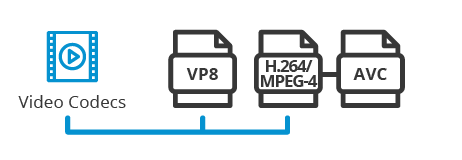
codecs
codecs
Codecs
Codecs

Codecs are the building blocks of digital media. They are software or hardware that encode and decode digital data streams. This means that they can take a raw digital signal, such as a video or audio recording, and compress it into a smaller file size, or they can take a compressed file and expand it back into its original form.

Codecs are essential for the transmission, storage, and playback of digital media. They are used in a wide variety of applications, including streaming video, video conferencing, and digital broadcasting.

How Codecs Work

Codecs work by using a variety of techniques to reduce the size of digital data streams. These techniques include:

Entropy coding: This technique takes advantage of the fact that some parts of a digital signal are more likely to occur than others. By assigning shorter codes to the more likely parts of the signal, entropy coding can significantly reduce the size of the file.
Transform coding: This technique breaks the digital signal down into smaller components, and then compresses each component individually. This can be more efficient than entropy coding, but it is also more complex.
Prediction: This technique uses the past values of a signal to predict future values. By predicting future values, the codec can reduce the amount of data that needs to be stored.
**

Types of Codecs

There are two main types of codecs: lossy and lossless. Lossy codecs reduce the size of a digital data stream by discarding some of the data. This can result in a loss of quality, but it also allows for much smaller file sizes. Lossless codecs do not discard any data, so they do not suffer from any loss of quality. However, they also produce larger file sizes.

Some of the most common lossy codecs include:

MPEG-1: This codec is used for a variety of applications, including video CDs and digital television.
MPEG-2: This codec is used for DVD-Video and high-definition television.
H.264: This codec is the most widely used codec for streaming video and online video.
Some of the most common lossless codecs include:

FLAC: This codec is used for lossless audio compression.
WAV: This codec is a lossless audio format that is used by many professional audio applications.
ALAC: This codec is a lossless audio format that is used by Apple’s iTunes and iPod products.
**

Conclusion

Codecs are essential for the transmission, storage, and playback of digital media. They are used in a wide variety of applications, and they have made it possible to enjoy digital media on a variety of devices.

Final Words about Codecs

Codecs are a complex topic, but they are essential for understanding how digital media works. By understanding how codecs work, you can make better decisions about the quality and size of your digital media files.

I hope this article has given you a better understanding of codecs.


Free Download Mp4Gain
picture


Mp4Gain Main Window
picture


Mp4Gain Features
picture


Free Download Mp4Gain
picture

Best Bluetooth Audio Codec

In recent years, the disappearance of 3.5 mm ports from smartphones is causing wireless audio to gain a lot of strength. And among all wireless technologies, Bluetooth stands out strongly.

aptX, aptX HD, SBC o ACC

With the latest versions of Bluetooth, the connectivity between the devices is very stable. The technology already works. So manufacturers are starting to put more emphasis on streaming audio quality by focusing on improving codecs that compress audio files and stream them wirelessly from source to audio device.

 Bluetooth Audio Codec

Basic concepts

Bitrate or bit rate (kbps): usually measured in kbps or Mbps. It is the amount of data that is transmitted per second through the Bluetooth connection.
Sampling frequency (kHz): is the number of data per second in an audio file. We have to bear in mind that we need two data to accurately capture a frequency, which is why refresh rates around 40 kHz (44.1 kHz or 48 kHz) are very common, which is twice the frequency range of the human ear.
Bit Depth (-bit): Represents the number of bits saved for each audio sample. Higher bit depth records a signal more accurately. The quality of CDs is 16-bit, but high-resolution files are typically 24-bit.
If we didn’t compress the files, the bitrate could be calculated by multiplying the sample rate by the bit depth.
Best audio codecs for Bluetooth
Codecs are encoding and decoding algorithms that compress audio into manageable data packets for more efficient transmission.

The efficiency of the codec will determine the speed at which the audio data is sent and also the resulting audio quality.

One very important thing to keep in mind is that, to use a certain codec, both the audio source and receiver must be compatible with it.

This means that, even if my headphones are aptX, if my mobile doesn’t support the aptX codec, the connection between the two can never be aptX. The Bluetooth protocol will negotiate the connection and choose the next best codec. If there are none in between (AAC, for example), the final connection will end up using the SBC codec (which is universal).
Next, we are going to see the most used audio codecs in Bluetooth connections:

To read later …

► The 7 Best Turntables of 2020: Buying, Setting Up and More
► The 8 best Bluetooth and TWS headphones of 2020: cheap, sports, gaming …
► The 7 Best Bluetooth Speakers of 2020 – We Tried Them All!
SBC (low-complexity SubBand Codec)
sbc
The SBC codec was developed by the SIG (Special Interest Group), the organization responsible for developing Bluetooth technology, for the A2DP (Advanced Audio Distribution Profile) audio profile. This codec is one of the minimum requirements that any Bluetooth audio device must be able to use in order to connect to a wireless source. This means that all Bluetooth audio devices have to be capable of working with this codec as a minimum. ref

The SBC was created in 1993 and requires very little computing power. The downside is that the compression efficiency is not very good, so even at its maximum bitrate of 328 kbps, it does not achieve remarkable sound quality either. Also, the sound is quite delayed.

AAC (Advanced Audio Coding)
aac
The AAC codec was developed by several companies (AT&T, Fraunhofer Institute, Dolby Laboratories, Sony Corporation and Nokia) and was announced internationally by the MPEG group (Moving Pictures Experts Group) in April 1997. Besides being a codec used by the protocol Bluetooth, AAC is also one of the most popular codecs on the internet thanks to being used extensively by Apple and YouTube.

The AAC is characterized by having a much higher audio quality for the same bit rate as the SBC codec, however the latency is usually even worse. Ref

aptX, aptX LL, aptX HD, and aptX Adaptive
aptx
AptX (audio data reduction technology) is a codec designed in the 80s of the last century and used in the cinema and on the radio. The codec was later acquired by the company CSR (Cambridge Silicon Radio) which in turn was bought in August 2015 by Qualcomm.ref

The codec is characterized by offering better sound quality, but it requires more processing power. Its typical compression ratio is 4: 1.

Currently, the codec has three variations (aptX Low Latency, aptX HD, aptX Adaptive) that reduce latency or improve your audio quality.

aptX LL (Low Latency): has latencies close to 30 ms. For comparison, the SBC codec has typical latencies of 170 ms. So it is almost 6 times faster.