Audio Codec Converter


Free Download Mp4Gain
picture

Audio Codec Converter: An Essential Tool for Any Audiophile
Audio Codec Converter

If you’re a music enthusiast, you know how important it is to have your music in the best quality possible. However, not all devices and media players support the same audio formats, which can be frustrating. This is where an audio codec converter comes in handy. In this article, we’ll explore what an audio codec converter is, how it works, and its benefits for any audiophile.

What is an Audio Codec Converter?

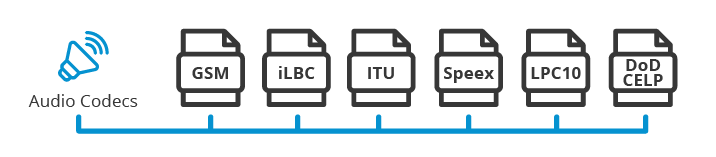
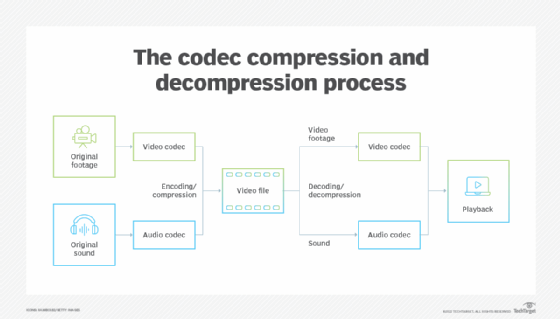
An audio codec converter is a software application that enables you to convert your audio files from one format to another. Audio codecs are algorithms that compress and decompress audio data, allowing it to be stored and transmitted efficiently. Different devices and media players use different codecs to support different audio formats. For instance, an MP3 player might only support the MP3 format, while a CD player might support WAV and AIFF formats.

With an audio codec converter, you can easily convert your audio files from one format to another, making them compatible with your desired device or media player. This tool can also help you compress your files to save space or improve their quality by changing the bitrate, sample rate, and other parameters.

How Does an Audio Codec Converter Work?

Most audio codec converters operate by decoding the original audio file and then encoding it into the desired format. The software uses a codec library that contains all the codecs needed to decode and encode various audio formats. The converter then applies the necessary compression algorithms to reduce the file size or improve the quality, depending on the user’s preferences.

Some audio codec converters also support batch conversion, which allows you to convert multiple files at once. This feature is especially useful when you have a large music collection that you want to convert to a new format or compress to save storage space.

Benefits of an Audio Codec Converter

Here are some of the benefits of using an audio codec converter:

  • Compatibility: An audio codec converter enables you to play your music on any device or media player that supports different formats.
  • Quality: You can improve the quality of your music by converting it to a higher bitrate or changing other parameters.
  • Compression: You can compress your files to save storage space on your device or media player without compromising the quality.
  • Organization: You can easily organize your music collection by converting all your files to a single format.

Frequently Asked Questions (FAQs)

What are the most common audio codecs?

The most common audio codecs are MP3, AAC, WAV, and FLAC. MP3 is the most widely used codec for music, while AAC is used by Apple devices. WAV is a lossless codec that is often used for professional audio recordings, while FLAC is a lossless codec that provides higher quality than MP3 or AAC.

Can I convert DRM-protected audio files using an audio codec converter?

No, most audio codec converters cannot convert DRM-protected files due to copyright laws. However, there are some software applications that can remove DRM protection, allowing you to convert the files to your desired format.

Do I need a special software to play my converted audio files?

Most devices and media players support the most common audio formats, so you shouldn’t need any special software to play your converted files. However, some specialized formats may require specific software or codecs. For instance, if you want to play high-resolution audio files, you might need a media player that supports FLAC or DSD formats.

Is an audio codec converter difficult to use?

No, most audio codec converters are designed to be user-friendly and intuitive. You don’t need any technical knowledge to use them. Simply select the files you want to convert, choose the output format and parameters, and start the conversion process. The software will guide you through the process and provide you with feedback on the progress.

Conclusion

An audio codec converter is an essential tool for any music lover who wants to enjoy their music in different formats and on different devices. It enables you to convert your audio files easily and quickly, improving their quality and compatibility. With the right audio codec converter, you can organize your music collection, save storage space, and enjoy your favorite tunes in the best quality possible.


Free Download Mp4Gain
picture


Mp4Gain Main Window
picture


Mp4Gain Features
picture


Free Download Mp4Gain
picture

Audio Codec Comparison: A Comprehensive Guide for Audio Geeks

Audio Codec Comparison: A Comprehensive Guide for Audio Geeks

Audio Codec Comparison

Introduction

Audio codecs play a significant role in digital audio technology, as they are responsible for compressing and decompressing digital audio files. The use of audio codecs is essential to reduce the file size of audio files, making them easier to store, share, and transfer over the internet.

However, with the numerous audio codecs available in the market, it can be challenging to choose the right one for your needs. In this article, we will provide a comprehensive guide on the most popular audio codecs available today, their features, and their pros and cons.

What is an Audio Codec?

An audio codec is a software program or algorithm that compresses and decompresses digital audio data. The term codec stands for coder-decoder, and it is responsible for reducing the file size of digital audio files by removing redundant and irrelevant information from the file while retaining the original sound quality as much as possible.

Without an audio codec, digital audio files would be too large to store or transfer over the internet, which would be impractical. Therefore, audio codecs are essential for digital audio technology to function effectively.

Types of Audio Codecs

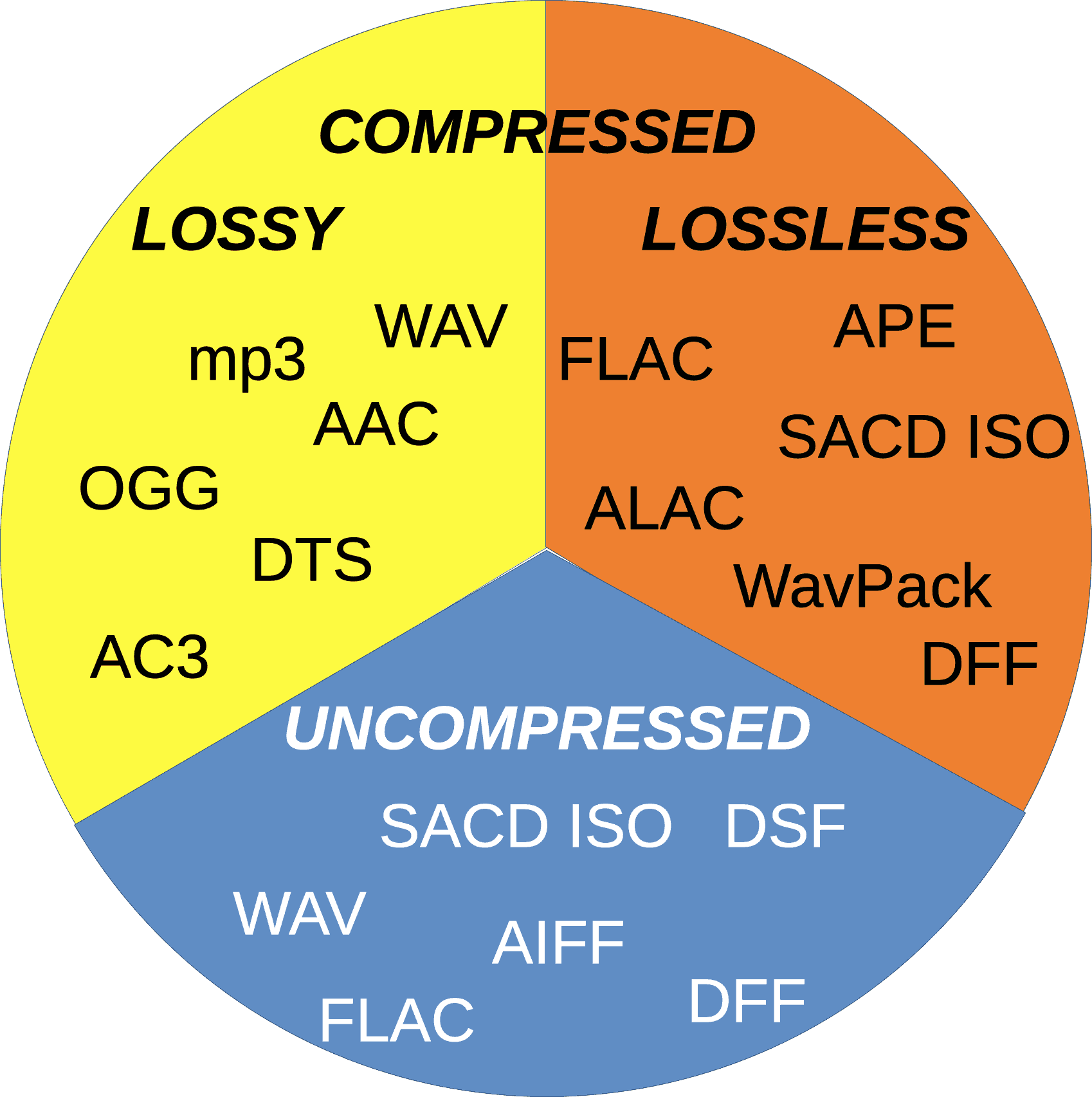
  • Lossy Audio Codecs

    Lossy audio codecs are designed to reduce the file size of digital audio files by discarding information that is considered irrelevant or redundant for human hearing. Lossy codecs achieve compression by applying psychoacoustic models that analyze the human auditory system’s limitations and remove sounds that are inaudible or less audible to the human ear. The most popular lossy audio codecs are:

    • MP3
    • AAC
    • OGG
    • WMA
  • Lossless Audio Codecs

    Lossless audio codecs compress digital audio files without discarding any information. Lossless codecs achieve compression by using sophisticated algorithms that analyze and encode the original audio data without affecting its quality. Lossless codecs are preferred for archiving or storing audio files that require the highest possible sound quality. The most popular lossless audio codecs are:

    • FLAC
    • ALAC
    • WAV
    • AIFF

Popular Audio Codecs

MP3

MP3 is the most popular audio codec in the world, and it has been around since the 1990s. MP3 stands for MPEG Audio Layer III, and it is a lossy audio codec that compresses digital audio files by removing sounds that are less audible to the human ear. MP3 is compatible with almost all audio players and devices and is widely used for music streaming, downloading, and sharing over the internet.

The main advantage of MP3 is its small file size, which makes it easy to store and transfer over the internet. However, MP3’s main drawback is its reduced sound quality, especially for audio files that contain a wide range of frequencies or dynamic range. MP3 files are prone to audio artifacts, such as compression artifacts, and they can sound flat or distorted compared to the original audio file.

AAC

AAC stands for Advanced Audio Coding, and it is a lossy audio codec that is widely used for music streaming and downloading. AAC is the default audio codec for Apple devices and is used by popular streaming services such as Spotify, Tidal, and YouTube. AAC is also used for high-definition digital television and radio broadcasting, as well as in various video formats such as MP4 and M4V.

FLAC

FLAC stands for Free Lossless Audio Codec, and as the name suggests, it is a lossless audio codec. FLAC is designed to compress audio files without losing any data or quality. It is an open-source codec that can be used on any platform and supports metadata, tagging, and album cover art. FLAC is a popular codec for archiving audio files and for audiophiles who want to preserve the original quality of their music. However, because FLAC files are larger than compressed audio files, they are less suitable for streaming and downloading over the internet.

ALAC

ALAC stands for Apple Lossless Audio Codec, and it is a lossless audio codec that is similar to FLAC. ALAC is the default audio codec for Apple devices and is supported by iTunes and other Apple software. Like FLAC, ALAC is designed to compress audio files without losing any data or quality. However, because ALAC is only supported by Apple devices and software, it is less widely used than FLAC.

Opus

Opus is a relatively new audio codec that was standardized by the Internet Engineering Task Force (IETF) in 2012. Opus is a versatile codec that can be used for a wide range of audio applications, including music streaming, voice chat, and video conferencing. It is designed to provide high-quality audio at low bitrates and can adapt to changing network conditions. Opus is an open-source codec that is supported by most modern web browsers and operating systems.

DSD

DSD stands for Direct Stream Digital, and it is a high-resolution audio codec that is used for digital recordings of analog audio sources. DSD uses a 1-bit sampling method that is different from traditional PCM-based codecs. DSD recordings have a high sampling rate and a wide frequency response, which allows them to capture more of the original sound than other codecs. DSD is used primarily by audiophiles and is supported by high-end audio equipment and software.

Conclusion

Choosing the right audio codec depends on your specific needs and preferences. If you want to compress your audio files for streaming or downloading, then lossy codecs such as MP3 or AAC are a good choice. If you want to preserve the original quality of your music, then lossless codecs such as FLAC or ALAC are a better option. Opus is a versatile codec that can be used for a wide range of audio applications, and DSD is a high-resolution codec that is ideal for audiophiles. Ultimately, the choice of codec depends on your personal preferences and the specific requirements of your project or application.

One tool that can be useful for managing and adjusting audio files is MP4Gain. MP4Gain is a software that allows you to normalize and adjust the volume of MP3, MP4, FLAC, and other audio files. It can be used to ensure that all of your audio files have the same volume level, which can be particularly useful for creating playlists or for streaming audio files. MP4Gain is available for Windows and it is a simple and effective tool for managing your audio files.

Best Bluetooth Audio Codec

In recent years, the disappearance of 3.5 mm ports from smartphones is causing wireless audio to gain a lot of strength. And among all wireless technologies, Bluetooth stands out strongly.

aptX, aptX HD, SBC o ACC

With the latest versions of Bluetooth, the connectivity between the devices is very stable. The technology already works. So manufacturers are starting to put more emphasis on streaming audio quality by focusing on improving codecs that compress audio files and stream them wirelessly from source to audio device.

 Bluetooth Audio Codec

Basic concepts

Bitrate or bit rate (kbps): usually measured in kbps or Mbps. It is the amount of data that is transmitted per second through the Bluetooth connection.
Sampling frequency (kHz): is the number of data per second in an audio file. We have to bear in mind that we need two data to accurately capture a frequency, which is why refresh rates around 40 kHz (44.1 kHz or 48 kHz) are very common, which is twice the frequency range of the human ear.
Bit Depth (-bit): Represents the number of bits saved for each audio sample. Higher bit depth records a signal more accurately. The quality of CDs is 16-bit, but high-resolution files are typically 24-bit.
If we didn’t compress the files, the bitrate could be calculated by multiplying the sample rate by the bit depth.
Best audio codecs for Bluetooth
Codecs are encoding and decoding algorithms that compress audio into manageable data packets for more efficient transmission.

The efficiency of the codec will determine the speed at which the audio data is sent and also the resulting audio quality.

One very important thing to keep in mind is that, to use a certain codec, both the audio source and receiver must be compatible with it.

This means that, even if my headphones are aptX, if my mobile doesn’t support the aptX codec, the connection between the two can never be aptX. The Bluetooth protocol will negotiate the connection and choose the next best codec. If there are none in between (AAC, for example), the final connection will end up using the SBC codec (which is universal).
Next, we are going to see the most used audio codecs in Bluetooth connections:

To read later …

â–º The 7 Best Turntables of 2020: Buying, Setting Up and More
â–º The 8 best Bluetooth and TWS headphones of 2020: cheap, sports, gaming …
â–º The 7 Best Bluetooth Speakers of 2020 – We Tried Them All!
SBC (low-complexity SubBand Codec)
sbc
The SBC codec was developed by the SIG (Special Interest Group), the organization responsible for developing Bluetooth technology, for the A2DP (Advanced Audio Distribution Profile) audio profile. This codec is one of the minimum requirements that any Bluetooth audio device must be able to use in order to connect to a wireless source. This means that all Bluetooth audio devices have to be capable of working with this codec as a minimum. ref

The SBC was created in 1993 and requires very little computing power. The downside is that the compression efficiency is not very good, so even at its maximum bitrate of 328 kbps, it does not achieve remarkable sound quality either. Also, the sound is quite delayed.

AAC (Advanced Audio Coding)
aac
The AAC codec was developed by several companies (AT&T, Fraunhofer Institute, Dolby Laboratories, Sony Corporation and Nokia) and was announced internationally by the MPEG group (Moving Pictures Experts Group) in April 1997. Besides being a codec used by the protocol Bluetooth, AAC is also one of the most popular codecs on the internet thanks to being used extensively by Apple and YouTube.

The AAC is characterized by having a much higher audio quality for the same bit rate as the SBC codec, however the latency is usually even worse. Ref

aptX, aptX LL, aptX HD, and aptX Adaptive
aptx
AptX (audio data reduction technology) is a codec designed in the 80s of the last century and used in the cinema and on the radio. The codec was later acquired by the company CSR (Cambridge Silicon Radio) which in turn was bought in August 2015 by Qualcomm.ref

The codec is characterized by offering better sound quality, but it requires more processing power. Its typical compression ratio is 4: 1.

Currently, the codec has three variations (aptX Low Latency, aptX HD, aptX Adaptive) that reduce latency or improve your audio quality.

aptX LL (Low Latency): has latencies close to 30 ms. For comparison, the SBC codec has typical latencies of 170 ms. So it is almost 6 times faster.

What is the best bluetooth codec?

Bluetooth audio is gaining a lot of followers today. The disappearance of the mini-jack ports for headphones on some smartphones, such as the iPhone, has led to audio companies producing high quality wireless devices. Among bluetooth audio technology, the Qualcomm aptX code is in a privileged place.

codec bluetooth

Bluetooth codecs What is a Bluetooth codec?

The word codec, when we talk about wireless audio, means the software’s method for encoding a stream of audio information that is sent wirelessly between two devices. In other words, it is the process by which zeros and ones, of binary digital data, acquire format. It serves to transmit stereo audio through a source device, such as a telephone, a computer, television etc …, to a receiver, such as wireless speakers or headphones.
Different codecs send the audio information using different formats, they can also introduce their own compression technologies to maintain a balance between the sound quality and the information package of the audio files. Compression may sound like something negative for lovers of high quality audio, but it is necessary if we are going to send heavy files wirelessly.

bluetooth codec

This means that the variants between the bluetooth codecs are compatible with different audio devices, in addition to providing different connection and sound qualities. All bluetooth devices support the standardized SBC (Low Complexity Subband Coding) codec, but SBC implementations have varied in quality throughout the history of this technology. To offer greater consistency to users of bluetooth products, several companies have developed their own bluetooth codecs, and then offer the license to other producing houses. AAC is one of these formats, the successor of MP3, used by Apple and others. Sony has its LDAC codec and Qualcomm offers aptX.
bluetooth codecs

AptX, SBC and AAC codecs, which one is the best?

The codecs are coding algorithms that compress audio to handle sound packets and thus achieve fast wireless transmission. The effectiveness of the codec determines the quality of the audio information that will be sent. The SBC code is the standard algorithm for most bluetooth devices. However, this codec has a relatively high latency and can be somewhat noisy. The three main codecs, which most users will encounter, are SBC, AAC and aptX:

SBC

It is the code found in most wireless devices and with which all bluetooth headphones have the A2DP (Advance Distribution Profile) profile. It is capable of transmitting up to 328kbps with sample rates of 44.1 Khz. It provides very decent quality audio and does not require much processing. However, audio may be inconsistent in some situations. This is notable especially when using cheap bluetooth transmitters.

AAC

Similar to SBC but provides better sound quality. This codec is very popular thanks to the Apple iTunes platform. As against, we must mention that it is not very comfortable to find it in headphones.
aptX

Ideal for demanding audio applications as it encodes audio more efficiently and accepts more information than the SBC. It has additional variations, such as aptX (LL) and aptX (HD), which dramatically reduce latency in the wireless connection and improve sound quality. However, it is somewhat limiting because both the transmitter and the receiver must have the aptX capability for this codec to work.
Since from Culturasonora we do not have a reliable means to measure the AAC and LDAC formats wirelessly, we have compared the SBC and aptX codes using them with Plantronics Backbeat Pro 2 headphones:


AptX and SBC sound quality

We perceive that the standard SBC codec works well for most audio applications. It is not particularly loud, although in the signal-to-noise ratio, the aptX has a greater range of optimal loudness. The audio differences are subtle with respect to aptX, but they can be notable for expert and critical ears. The resulting measurements, however, both for the frequency response and for the harmonic distortion, are very similar between the aptX and SBS codecs.

Bluetooth codec latency

Latency, or delay in wireless sound reproduction, is the aspect where the aptX codec separates. The SBS connection has about 100 ms of delay, which is notable when watching videos and can ruin certain gaming experiences. On the other hand. CSR developed the low-latency aptX code to fix these connection problems. The aptX improves the performance of the SBC, but it is the aptX-LL that has a greater impact on the results. The aptX-LL codec was excellent when we tested it by watching some movies and using some games. This makes the BackbeatPro2 and other headphones that have this technology, ideal options for these activities.
Based on our tests, we have noticed that codecs have a greater impact on latency than on sound quality. The aptX codec has subtle improvements in sound quality, but the differences are less noticeable than the improved speed at the time of audio playback via bluetooth.

AptX codec, why should we use it?

The SBC codec is configured to work with small bitrates, such as 200kbps, which does not offer the best sound quality. In theory, the SBC codec can operate with bitrates of up to 345 kbps, and the introduction of A2DP audio profiles allows wireless transfers of audio formats such as MPEG and ATRAC. However, support for these formats is optional and varies between headphones or wireless speakers.

The aptX codec, on the other hand, offers a better signal-to-noise radio in important frequency ranges, as well as better performance when it comes to delays in the Bluetooth connection. This codec exists, in part, to provide guaranteed quality audio in all products compatible with this format. AptX audio transfers are made with a 352 kbps / 16-bit 44.1 kHz bitrate. This means a 4: 1 compression compared to lossless files, and includes enough information to wirelessly carry files equivalent to the best MP3 formats. In terms of smartphones, the aptX standard codec is found in a large number of devices as well as the improved aptX HD, which has appeared on new wireless devices.

Another interesting aspect of the aptX codec is that it uses a technique called ADPCM (Adaptive Differential Pulse-Code Modulation). Essentially, it divides the audio frequency spectrum into four bands, each with its own bit depth and signal to noise ratio. In addition, this technology is superior to SBC when sending audio that has already been compressed via Bluetooth, such as MP3 audio files. The aptX codec has, as we said, a better signal to noise ratio than the SBC, about 5kHz more capacity, so we can better perceive the fine details of voices and instruments when we listen via an aptX codec, if our material Source has a good quality.

The Qualcomm codec also has a faster conversion speed than the algorithms used by the SBC and can transfer audio packets more efficiently. This means that it handles lower latency, an important factor for wireless audio when watching movies or playing with our favorite consoles. Qualcomm’s low latency technology handles a delay in the 40 ms region, although this may increase to about 150 ms in older codecs. The SBC is measured with a delay of 100 ms and can increase to 150 ms. The AD2P varies between 40 and 150 ms, depending on the conversion requirements.