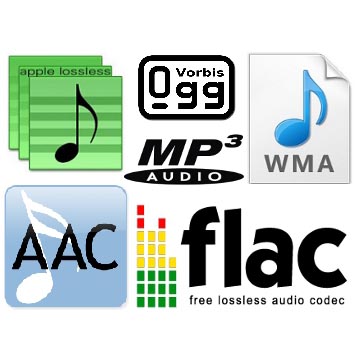
Audio formats


Free Download Mp4Gain
picture

Before going through the different audio formats to identify the best ones for you, it seems right to try to make you understand what digital audio is. In short, it is nothing more than a representation of real sounds through a chain of zeros and ones. The more there is in a file, the closer the digital sound will be to what it represents.

Audio Formats

Better audio formats

It all started with Pulse-Code Modulation (PCM), created in 1937 and characterized by two properties: the sampling frequency to measure the amplitude of the waveform and the bit depth to measure possible digital values. It is basically the faithful conversion of analog audio into a digital file in which no compression is done. The result is a very large audio file, which takes up a lot of space.
Audio Formats

To remedy this, therefore, more or less compressed audio formats have been created that, depending on their characteristics, are divided into two different types: Lossless formats, that is, when the information contained in the final file is identical to that contained in the source file and therefore there is no loss of quality, and lossy formats, for which the information contained in the final file is less than that contained in the source file with the consequent loss of quality but in benefit of the space of necessary storage. For more details, continue reading, below you will find the different audio formats belonging to the categories in question indicated and explained.

Lossless (WAV, AIFF, FLAC and ALAC)

As I told you a few lines above, Lossless audio formats are those that are not compressed or that, despite being subjected to this type of treatment, the final quality remains practically unchanged with respect to the original audio. The main formats that belong to this category are the following: WAV, AIFF, FLACC, ALAC and APE. Let’s see its characteristics in detail.

WAV – An acronym for WAVEform audio file format, is a standard that was developed by Microsoft and IBM in 1991. It is the most popular category of apparent audio file format. It is not compressed and is essentially what you get when you rip audio from a music CD with your computer. It takes up a lot of space (1,411 kilobits of information per second of stereo music at 44,100 Hz / 16 bits), but it reproduces sounds faithfully. In terms of quality and quantity of information, it is similar to the AIFF format, which you will find explained below.
AIFF – Short for Audio Interchange File Format, it belongs mainly to the Mac world, it was developed by Apple based on the Electronic Arts Interchange File Format and is particularly suitable for audiophiles and music recorders. It basically has the same characteristics as the WAV format mentioned above, so it is not compressed, so it takes up a lot of space (1,411 Kilobits of information per second of stereo music at 44,100 Hz / 16 bits) and is capable of reproducing sounds with a lot of fidelity.

FLAC: is the abbreviation for Free Lossless Audio Codec. It is an open source codec that is often used to store music CDs on the computer without loss of quality and is compatible with most programs and devices. Compared to the formats that I have already told you about, it has a minimal degree of compression, but most people cannot perceive significant differences compared to a WAV or AIFF file.
ALAC – Short for Apple Lossless Audio Codec, is essentially Apple’s worldwide counterpart to the earlier FLAC format. The quality is good on average but the format is not as efficient as the FLAC in terms of weight. Then keep in mind the fact that not all gamers support it, so unless you have uniquely and exclusively Apple devices, it may not be the best solution to opt for.

Other important but less common audio formats that always belong to the Lossless calorie are Monkey’s Audio (APE) and OptimFROG (OFR). Its characteristics are more or less similar to those of the FLAC and ALAC formats.

Lossy (MP3, AAC, WMA, and Ogg Vorbis)

Now let’s move on to the audio formats belonging to the Lossy category, that is, those always subjected to compression that take up very little space but “sacrifice” a certain degree of audio quality. The main formats in this category are: MP3, AAC, WMA, and Ogg Vorbis. For more information, keep reading, you will find more details about it below.

MP3: in Full Moving Picture Expert Group-1/2 Audio Layer 3, also known as MPEG-1 Audio Layer III or MPEG-2 Audio Layer III.


Free Download Mp4Gain
picture


Mp4Gain Main Window
picture


Mp4Gain Features
picture


Free Download Mp4Gain
picture

What audio formats exist? All you need to know.

FLAC, WAV, AIFF, DSD … these are just some of the acronyms you can find when looking for a digital format. They are also accompanied by technical data such as sample rates and bit depth. So many terms can leave you more misplaced than a chicken in a dance. And unless you are an expert in digital sound, the process to choose the audio format that best suits your needs can be a mess. But if they explain it to you, the subject is relatively simple. That is why in Culturasonora we have prepared a complete guide on the different audio formats used.

Audio formats: OGG vs Opus vs FLAC vs ALAC

Nowadays a lot of the music that is heard sounds through online platforms. It is worth talking about the audio formats used by services such as Spotify, Tidal, or Apple Music.
What is the OGG format?
OGG audio formats are like supercharged MP3s. They are compressed audio files, which means that they have a size that allows transmission via WiFi, but at the same time they avoid damage that is usually generated in the compression process. Spotify uses these OGG formats. Depending on how much you want to pay for this service you can listen to them through this portal with different sample rates: from 96 kbps, to Premium 320 kbps files. The audio quality provided by Spotify for Premium users is quite good.
What is the Opus format?
Opus is a new codec that uses the Ogg container. It was developed by the same creators of FLAC, with the help of Mozilla and Skype. It can handle up to 510 kbps and 48 kHz. This new format stands out for its low latency, so it is ideal for online audio streams. Its average latency of 22.5 ms is well below other codecs. It is versatile, open and more and more platforms are adopting it.
What is the FLAC format?
With FLAC audio codecs the sound quality increases with respect to the OGG. They are Lossless, or lossless, audio formats that perform a great trick: they compress file sizes up to 60% without losing quality. In addition, they allow the transmission of sample rates of up to 1,411 kbps, which is much higher than any other audio format. This is the format used by the Tidal platform, the best service for high quality audio transmissions.
What is the ALAC format?
Finally we have the ALAC (Apple Lossless Audio Codec). This format is basically Apple’s alternative to FLAC. It is the format used by Itunes and for Apple Music broadcasts.

What is the difference between the different audio formats, and which one should I choose?

There are two types of sound quality: lossless and lossless. Lossless music preserves the sound quality of the original source – in most cases, CD – intact, on the other hand, lossy music compresses the file to save space (in exchange for decreasing quality). The following formats are included in lossless formats:

loseless formats

Formats WITHOUT loss of quality:

WAV and AIFF: Both are uncompressed formats, which are exact copies of the original sound source. The two formats have essentially the same quality; They simply store the data differently. AIFF was created by Apple – you’ll see it often in its products – but WAV is much more universal. However, since they are not compressed, they take up too much unnecessary space. Unless you’re editing sound, we don’t need to use this format.

FLAC: Free lossless sound codec – Free Lossless Audio Codec (FLAC). It is the most used lossless codec, it is a good option if we seek to store our music without losing quality. Unlike WAV and AIFF, it uses compression, taking up less space. However, it is still a lossless format, which means that the sound quality is the same as the original source, so it is better to listen to than WAV and AIFF. It is also free and free software, which is useful if you like to take a look at how it works.

Apple lossless (Apple Lossless): Also known as ALAC, it is similar to FLAC. Use compression, although it is made by Apple. Its compression is not as efficient as that of FLAC, so the files will be a bit larger, but it is compatible with iTunes and iOS (FLAC not). Therefore, if you use iTunes or iOS as the main software for listening to music, you should choose this format.

APE: It is a file of very high compression without losses, which means that you will save more space. The quality is the same as FLAC, ALAC and other lossless files, but it is not compatible with most players. On the other hand, it makes the processor work harder to decode when it is so compressed. Generally, I would not recommend using this format unless you are very concerned about space and have a compatible player.

Formats with losses: MP3, AAC, OGG and more

MP3: MPEG Audio Layer III, or MP3 for short, is the most common lossy format. So much that it has become synonymous with music downloads on the internet. It is not the most efficient format of all, but it is undoubtedly the most compatible, making this the first option to choose between lost sounds.

AAC: Advanced Audio Coding, also known as AAC, is similar to MP3, although a bit more efficient. Which means that the files take up less space and with the same sound quality as MP3. And, with Apple’s iTunes making it so popular, it’s as compatible as MP3.

Ogg Vorbis: The Vorbis format, often known as Ogg Vorbis due to the use of the Ogg container, is the free software version to MP3 and AAC. Its main attraction is that it is not restricted by patents, but that does not affect you as a user – in fact, despite being open it is of similar quality, and much less popular than MP3 and AAC, so not all players support it . I do not recommend it unless you are interested in the fact of being open source.

WMA: Windows Media Audio. The proprietary format of Microsoft, similar to MP3 or AAC. It really offers no advantage over the other formats, and is not very well supported.

So which audio format should you use?

Now that we have seen the differences between each format, which one should we use for our music? In general, we recommend using MP3 or AAC. They are compatible with most players, and the quality of both is very similar to that of the original source if it is encoded with a high bit rate. Unless you have specific needs, MP3 and AAc are the most recommended options.

However, there is something to say to store music in lossless formats such as FLAC. Although we probably don’t notice a higher quality, it is good to store music if you plan to convert it to other formats later – since converting from one format with losses to another Lossy (eg, from AAC to MP3) will produce lower quality files. In that case we recommend FLAC. In addition, we can choose the lossless format we want, since converting between formats without losses does not degrade the quality of the file.

As a final conclusion, we can say that one should not become obsessed with the subject. We just have to be sure to choose something widely compatible, not convert between two formats with losses, and enjoy music.

An advantage is that Mp4Gain works with all these fromatos (and more) and you can convert from one to another, without problems or loss of quality, on the contrary, with tools like the Equalizer, you can improve the sound to your liking.