Unraveling the Secrets of H.264 Compression


Free Download Mp4Gain
picture

Unraveling the Secrets of H.264 Compression

H.264 Compression
H.264 Compression
H.264 Compression
H.264 Compression

H.264 Compression Explained

As a video enthusiast, I have always been fascinated by the technology behind video compression. H.264 is one of the most widely used video compression standards, and for good reason. It offers excellent video quality at low bitrates, making it ideal for streaming and other bandwidth-limited applications.
One of the key features of H.264 compression is its ability to divide video frames into smaller blocks, which are then compressed individually. This allows for more efficient compression and better video quality. As the book “Video Compression for Flash, Apple Devices and HTML5” explains, “H.264 is a block-oriented compression scheme, which means that it divides each frame into small blocks of pixels and then compresses each block separately.”
In my experience, understanding the basics of H.264 compression is essential for anyone working with video. Whether you’re a content creator, a streaming service provider, or just a video enthusiast, knowing how H.264 compression works can help you optimize your video quality and reduce bandwidth usage.

H.264 Compression Techniques

There are many different techniques used in H.264 compression, each designed to optimize video quality and reduce file size. One of the most important techniques is motion estimation, which involves analyzing the movement of objects in a video frame and using that information to compress the video more efficiently.
Another important technique is entropy coding, which is used to compress the data generated by the motion estimation process. As the book “H.264 and MPEG-4 Video Compression” explains, “Entropy coding is a technique that takes advantage of the statistical properties of the data to compress it more efficiently.”
In my experience, understanding these techniques and how they work together is essential for optimizing video quality and reducing file size. By using the right combination of techniques, you can achieve excellent video quality while minimizing bandwidth usage.

H.264 Compression Performance

One of the key advantages of H.264 compression is its excellent performance. As the book “H.264 and MPEG-4 Video Compression” explains, “H.264 provides better video quality at lower bitrates than previous video compression standards.”
In my experience, this performance advantage is particularly important for streaming and other bandwidth-limited applications. By using H.264 compression, you can deliver high-quality video to your viewers without overloading your network or causing buffering issues.
Overall, understanding the secrets of H.264 compression is essential for anyone working with video. By mastering the techniques and technologies behind H.264 compression, you can optimize your video quality, reduce bandwidth usage, and deliver an excellent viewing experience to your audience.
Final words:
In conclusion, H.264 compression is a powerful technology that offers excellent video quality at low bitrates. By understanding the techniques and technologies behind H.264 compression, you can optimize your video quality and reduce bandwidth usage, making it ideal for streaming and other bandwidth-limited applications. And if you’re looking for a powerful tool to help you normalize and convert your audio and video files, be sure to check out mp4gain.



Free Download Mp4Gain
picture


Mp4Gain Main Window
picture


Mp4Gain Features
picture


Free Download Mp4Gain
picture

Video Compression Methods

Video Compression Methods

Video Compression
Video Compression
Video Compression
Video Compression


Introduction to Video Compression

Video compression is the process of reducing the size of digital video files without sacrificing quality. Compression is necessary for efficient storage and transmission of video over networks or on physical media. The compression process involves removing redundant and non-essential information from the video stream, while retaining as much perceptual quality as possible. There are several video compression methods available, each with its own strengths and weaknesses.

Lossy Compression

Lossy compression is the most common method of video compression. It works by discarding information that is deemed less important, based on visual perception. The discarded information cannot be recovered, which is why this method is called “lossy”. The amount of compression can be adjusted by varying the amount of information that is discarded. Popular lossy video compression codecs include H.264, MPEG-4, and VP9.

Lossless Compression

Lossless compression, on the other hand, retains all of the original information, but compresses it in a way that can be reconstructed exactly. This method is typically used for archival or master copies, where quality cannot be sacrificed. However, lossless compression does not achieve the same degree of compression as lossy methods. Examples of lossless video compression codecs include Apple ProRes and Avid DNxHD.

Hybrid Compression

Hybrid compression methods combine elements of both lossy and lossless compression. These methods use lossy compression on parts of the video that are less important, and lossless compression on parts that are more important. The result is a balance between quality and compression efficiency. One example of a hybrid compression codec is the JPEG2000 format.

Variable Bit Rate (VBR) vs. Constant Bit Rate (CBR)

Video compression can be further classified as either variable bit rate (VBR) or constant bit rate (CBR). In VBR, the bit rate varies depending on the complexity of the video content. This allows for higher quality in complex scenes, while still maintaining a reasonable file size. CBR, on the other hand, maintains a constant bit rate throughout the entire video stream. This results in predictable file sizes, but can lead to lower quality in complex scenes.

Compression Settings

The effectiveness of video compression is highly dependent on the settings used during compression. Key settings include the bitrate, resolution, frame rate, and codec. Higher bitrates and resolutions result in higher quality, but also larger file sizes. The codec used can also have a significant impact on the quality and compression efficiency. Experimenting with different settings can help achieve the desired balance between quality and file size.

Conclusion

Video compression is a necessary part of modern video production and distribution. There are several compression methods available, each with its own advantages and disadvantages. Choosing the right compression method and settings requires a balance between quality and file size.

FAQ

1. What is the difference between lossy and lossless compression?

Lossy compression discards information that is deemed less important, while lossless compression retains all of the original information. Lossy compression achieves higher compression ratios, but at the expense of quality.

2. What are some common video compression codecs?

Some common video compression codecs include H.264, MPEG-4, VP9, Apple ProRes, and Avid DNxHD.

3. What is hybrid compression?

Hybrid compression methods combine elements of both lossy and lossless compression. These methods use lossy compression on parts of the video that are less important, and lossless

Comparison of video encoding with H.264 and H.265 codec

Comparison of video encoding with H.264 and H.265 codec

H.265 VS H.264

I would like to draw the attention of readers to the fact that I will carry out my story about the H.265 codec only from the point of view of how it can be used to create video movies, regardless of use in other areas. , for example, in video surveillance – everything is completely different there. I will start with the technical definition of the H.264 and H.265 codecs.

H.264 vs H.265

H.264 codec: scientifically it is called MPEG-4 part 10 or AVC (Advanced Video Coding). It appeared in 2003, but in everyday life they began to use it far from immediate, approximately since people began to buy high-definition video cameras. In my opinion today it is the only codec you want to compress video, it just has no competitors. Except, of course, 265.

H.265 or HEVC codec (High Efficiency Video Coding – High Efficiency Video Coding). Frame formats up to 8K (UHDTV) with a resolution of 8192 × 4320 pixels are supported. Manufacturers officially announced this codec in 2012. It was first used in IP broadcast systems. Then when 4K and 8K formats appeared and started to be widely used, for which H.264 was no longer ideal, the fifth one was useful there too.

But Н.265 is not a new product, it is, in fact, an improved 264. Initially, the creators were tasked with halving the bitrate with the same quality. If this task had been completed, then it would be possible, using H.265, to have a computer with half the power, or to receive the final file twice as easy, with the same quality. But this is only in theory.

You probably know that not all pixels in the image are affected during encoding; The image is divided into blocks according to the content. And the main difference between these two codecs is that they form these blocks differently. In other words, they divide the image into a different number of fragments. H.265 includes more pixels in each block, that is, the image is divided into fewer parts.

The first thought that occurs to a normal person is what he is like, because this will only make the quality worse! After all, if there was only one pixel in each block, which was compressed with individual parameters, then the image would be much better. This, of course, is true, but the reality is that, unfortunately, in our time the concept of quality for manufacturers of something fades into the background.

Based on information received from other operators, it can be assumed that when encoding the 4K format with a low bit rate, the advantage of H.265 is more noticeable than when using the Full HD format. But I don’t work with a low bit rate, high quality is important to me.

H.264 or H.265. What is better?

Everyone knows that the higher the quality you want to achieve, the more time and effort it takes. The same goes for encoding. If we assume that H.265 encodes better, it means that more time will be spent on encoding compared to H.264. But 30 times is excessive! I’m sure at 100 percent motion picture, it’s almost impossible to tell the difference that can be seen in the freeze frame, but then why complicate things using the 265? Although, here everyone decides for themselves what is more important to him: code as soon as possible and get a finished product, or wait longer, but evaluate a higher result.

The exact encoding time depends on how you record the video, how many small details there are, movement, what frame size, what is the power of your computer. Based on my observations, when encoding H.265, the computer uses much more resources, but the process itself is more adapted for multi-core processors, that is, the computer runs more smoothly.

I also tried encoding H.265 in maximum quality Full HD video, 50 frames per second for about 10 minutes. And when Media Encoder, which in principle encodes faster than Premier, reported that encoding would take more than 300 hours, I realized that it would take almost two weeks not to turn off the computer, and this is for 10 minutes. And my computer is quite powerful. When encoding 265 with a quality profile of “good”, the elapsed time is the same as the 264 setting in the image, but the difference is so insignificant that there is no point in uploading these screenshots.

The H.265 codec was created a long time ago and the question arises why it is not as popular as the developers planned. To the best of my knowledge, I can assume that firstly there is no such clearly visible advantage in video editing, and secondly, the development of using H.265 is hampered by the fact that you have to pay for its use in all devices where it is present.

The perfect video compression

We all like to enjoy great image quality in the videos and movies we watch on the computer, especially if you make your own compressed copies of DVD movies. I have always relied on the popular DivX but, now that there are other types of compression such as Xvid and some as modern as the H.264, it would be worth comparing to discover which one offers the best quality in the smallest size.


For the test I have chosen the movie Transformers, released in November 2007 and directed by Michael Bay, with Shia Labeouf and Megan Fox as protagonists. It is an action movie with a variety of scenes: static in great detail, with movement, explosions, lots of color … ideal for testing. The DVD boasts a very high image quality, as evidenced by the editors of a well-known magazine.

codecs

Choice of codecs, bitrates and encoders

To carry out the test, you have to choose different “compression methods”, each of them to several different “qualities” and using one or several programs that allow to compress in this way.
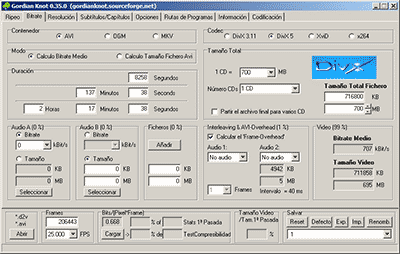
Things have changed a lot since in 2000 I compressed my first movie in DivX 3.11 format. It took me a whole day looking for information on the Internet on how to do it and my computer at that time (an AMD K6 II of 400Mhz) took all night to compress it in only 650 MB. Since then I have been using all versions of DivX, from 3.11 to the current 6. But the Xvid codec sounds more and more and there are excellent comments from the newest H.264, so the question is on the table: what is The best way to compress to achieve sublime image quality? Well, for this you have to discover which is the best codec and use it at the optimal bitrate with the ideal encoder. But what about that “codec”, “bitrate” and “encoder”?

Codec, the type of compression

The “compression method” is what in the video world is called “codec”, which is the acronym for COmpresor-DECompresor, a program capable of compressing and decompressing the image in a certain way. It is something similar to what photography programs incorporate to allow them to read and write files in JPEG format, for example. The type of compression that incorporates the DVD is called MPEG-2 and is already considered somewhat old, being surpassed by the MPEG-4 standard, more modern and efficient.
The problem is that there are many types of MPEG-4 and it is not clear which one is the best.

On the one hand there is DivX (a variant of the MPEG-4 type called ASP; see official page), which is tremendously popular and more and more DVD lounge players admit it. The decompressor (necessary to watch the videos) is free, but the compressor (to generate them) is paid.

There is also Xvid, (which is the same type as DivX; official page) a competitor of DivX (its name is the same, but vice versa) although completely free.

codec

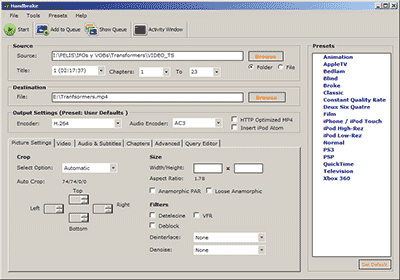
And finally, the very modern H.264, of the MPEG-4 AVC type, a prodigy of compression according to experts. Well, to find out which one is better, I have compared the generic MPEG-4 with these three contenders. There are several codecs to use this type of compression, but the most popular is the x264, mostly because it is free, which is what I used.

The versions that I have used for this comparison are the following: DivX Pro v6.8.2, Xvid v1.2 and x264 revision 808.

Bitrate, the amount of compression

Already with each of them, you can select the “quality” image, similar to how you choose the quality between 0 and 12 when saving a JPEG file from Photoshop. The difference is that in the world of video this is known as bitrate, which is nothing more than the bit stream per second of video, and is measured in bits per second and their multiples. Since video is a succession of frames formed of pixels (ultimately bits), this parameter measures the flow of information per second; at higher flow, higher quality and vice versa. In our case, I will use measures in “kbps” (“Kb / s” would also work), that is, kilobits per second (be careful, don’t confuse it with KB / s, which would be kiloBytes per second, an 8 times larger unit).
In order not to make the mistake of falling short, I have chosen 7 different bitrates, starting from an intermediate one. Taking the original DVD image, with a 720×304 pixel size frame