Digital video, video [DV – Digit Video, video]

Digital video, video [DV – Digit Video, video]

Video compress!

1. The term used in relation to the systems and tools to create, store, transform, transmit and / or receive (including reproduction) of moving images using computer technology. Digital video is characterized by the following basic parameters: frame rate [frame rate] (measured by the number of interchangeable image frames on the screen per second), screen resolution [spatial resolution] (measured by the number of pixels in an image frame), color depth or color resolution [color resolution] (measured by the number of transmitted color tones), and image quality [image quality] – a complex indicator, including the above. One type of digital video is computer animation.

Video Compression

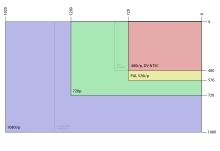
2. Video presentation format used for recording and data exchange between digital video cameras, VCR and PC. Also called DV editing [DV-the format]. For DV transmission, the IEEE-1394 standard (FireWire or i.LINK) is used. Provides 5: 1 video signal compression ratio, 3.6MB / s signal transmission rate, video frame resolution for PAL – 720×576 and NTSC – 720×480, support for recording and reproduce sound in 4 channels with a sampling frequency of 32 kHz and a bit depth of 12 (or in 2 channels with a sampling frequency of 48 kHz and a bit depth of 16 bits). See [556] for more details.

DV Type-1 (Digital Video Type-1): A variant of the DV format presentation (see above), incompatible with Video for Windows and compatible only with later versions of DirectShow. A file in this format has video and audio components of the recording, which are interleaved (stereo, 48 kHz, 16-bit). This format is the recommended format for processing DV video on a PC [556].
DV Type-2 (Digital Video Type-2) – The original (legacy) version of the DV format on a PC, backward compatible with Video for Windows – Programs running on Video for Windows can only read one file Type -2. In this case, to save data in it, you need to use a special codec. Compared to Type -1, it is more expensive to decode and mix [556].
S-Video is an image format in which chroma and luminance are separated into two separate signals, resulting in higher image quality (see also “stereo video” above).
Component Video [Component Video]: Color video transmitted using three separate channels using one of the color separation models: RGB, YiQ, or YUV.

Intel DVI (Intel Digital Video Interface), Intel Real-time Video – DVI is a hardware / software suite that includes a DVI chipset, an executable software interface, data compression and decompression schemes, and data file formats. DVI format was created in 1984 in Princeton, New Jersey by employees of the USA company the RCA Corporation. Then it changed ownership and from 1988 became the property of Intel Corp., which supports its development. Currently, DVI is a multimedia format for storing audio and video data. Its main features: Supports 16 million colors; it has a maximum resolution of 256×240 pixels; uses its own compression machine and JPEG (5: 4 motion picture compression ratio); it also provides still image storage and compression (lossy and lossless); has a specification on CD-ROM. Audio compression is done using ADPCM and PCM 8. For more information, see [584].

RIFF (Resource, Interchange, File, Format) – “File Format Resource Sharing” from Microsoft is a complex multimedia format used for Windows * *, Windows NT, and OS / 2 operating systems. Its purpose: to adapt various types of data for multimedia programs. The type of data contained in the RIFF file is indicated by the extension: embedded audiovisual data – * .avi; audio data (“wave”) – * .wav; raster data – * .rdi; MIDI data – * .rmi; lots of other RIFF- * .bnd files … Since there are many different multimedia files under the general name RIFF, each of them is processed taking into account the type of data it contains. For example, a RIFF file that contains audiovisual data is often referred to and treated as an AVI file in general and not as a RIFF file. RIFF files are often mistakenly believed to be similar to TIFF (Tag Image File Format) files. Although these formats use the same storage concept, they are incompatible. For more details, see [584].

QT (QuickTime), QTM (QuickTime Movie Resourse Format)

The perfect video compression

We all like to enjoy great image quality in the videos and movies we watch on the computer, especially if you make your own compressed copies of DVD movies. I have always relied on the popular DivX but, now that there are other types of compression such as Xvid and some as modern as the H.264, it would be worth comparing to discover which one offers the best quality in the smallest size.


For the test I have chosen the movie Transformers, released in November 2007 and directed by Michael Bay, with Shia Labeouf and Megan Fox as protagonists. It is an action movie with a variety of scenes: static in great detail, with movement, explosions, lots of color … ideal for testing. The DVD boasts a very high image quality, as evidenced by the editors of a well-known magazine.

codecs

Choice of codecs, bitrates and encoders

To carry out the test, you have to choose different “compression methods”, each of them to several different “qualities” and using one or several programs that allow to compress in this way.
Things have changed a lot since in 2000 I compressed my first movie in DivX 3.11 format. It took me a whole day looking for information on the Internet on how to do it and my computer at that time (an AMD K6 II of 400Mhz) took all night to compress it in only 650 MB. Since then I have been using all versions of DivX, from 3.11 to the current 6. But the Xvid codec sounds more and more and there are excellent comments from the newest H.264, so the question is on the table: what is The best way to compress to achieve sublime image quality? Well, for this you have to discover which is the best codec and use it at the optimal bitrate with the ideal encoder. But what about that “codec”, “bitrate” and “encoder”?

Codec, the type of compression

The “compression method” is what in the video world is called “codec”, which is the acronym for COmpresor-DECompresor, a program capable of compressing and decompressing the image in a certain way. It is something similar to what photography programs incorporate to allow them to read and write files in JPEG format, for example. The type of compression that incorporates the DVD is called MPEG-2 and is already considered somewhat old, being surpassed by the MPEG-4 standard, more modern and efficient.
The problem is that there are many types of MPEG-4 and it is not clear which one is the best.

On the one hand there is DivX (a variant of the MPEG-4 type called ASP; see official page), which is tremendously popular and more and more DVD lounge players admit it. The decompressor (necessary to watch the videos) is free, but the compressor (to generate them) is paid.

There is also Xvid, (which is the same type as DivX; official page) a competitor of DivX (its name is the same, but vice versa) although completely free.

codec

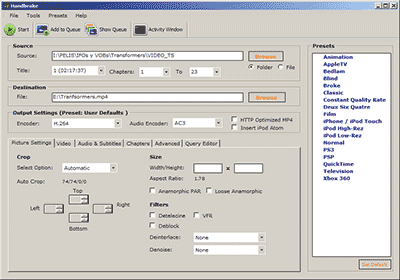
And finally, the very modern H.264, of the MPEG-4 AVC type, a prodigy of compression according to experts. Well, to find out which one is better, I have compared the generic MPEG-4 with these three contenders. There are several codecs to use this type of compression, but the most popular is the x264, mostly because it is free, which is what I used.

The versions that I have used for this comparison are the following: DivX Pro v6.8.2, Xvid v1.2 and x264 revision 808.

Bitrate, the amount of compression

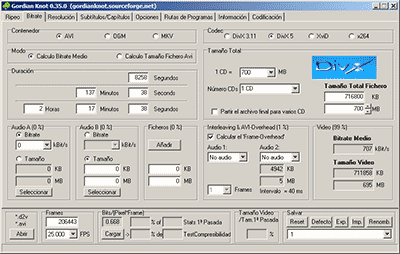
Already with each of them, you can select the “quality” image, similar to how you choose the quality between 0 and 12 when saving a JPEG file from Photoshop. The difference is that in the world of video this is known as bitrate, which is nothing more than the bit stream per second of video, and is measured in bits per second and their multiples. Since video is a succession of frames formed of pixels (ultimately bits), this parameter measures the flow of information per second; at higher flow, higher quality and vice versa. In our case, I will use measures in “kbps” (“Kb / s” would also work), that is, kilobits per second (be careful, don’t confuse it with KB / s, which would be kiloBytes per second, an 8 times larger unit).
In order not to make the mistake of falling short, I have chosen 7 different bitrates, starting from an intermediate one. Taking the original DVD image, with a 720×304 pixel size frame