Video Compression Methods


Free Download Mp4Gain
picture

Video Compression Methods
Video Compression
Video Compression
Video Compression
Video Compression


Introduction to Video Compression

Video compression is the process of reducing the size of digital video files without sacrificing quality. Compression is necessary for efficient storage and transmission of video over networks or on physical media. The compression process involves removing redundant and non-essential information from the video stream, while retaining as much perceptual quality as possible. There are several video compression methods available, each with its own strengths and weaknesses.

Lossy Compression

Lossy compression is the most common method of video compression. It works by discarding information that is deemed less important, based on visual perception. The discarded information cannot be recovered, which is why this method is called “lossy”. The amount of compression can be adjusted by varying the amount of information that is discarded. Popular lossy video compression codecs include H.264, MPEG-4, and VP9.

Lossless Compression

Lossless compression, on the other hand, retains all of the original information, but compresses it in a way that can be reconstructed exactly. This method is typically used for archival or master copies, where quality cannot be sacrificed. However, lossless compression does not achieve the same degree of compression as lossy methods. Examples of lossless video compression codecs include Apple ProRes and Avid DNxHD.

Hybrid Compression

Hybrid compression methods combine elements of both lossy and lossless compression. These methods use lossy compression on parts of the video that are less important, and lossless compression on parts that are more important. The result is a balance between quality and compression efficiency. One example of a hybrid compression codec is the JPEG2000 format.

Variable Bit Rate (VBR) vs. Constant Bit Rate (CBR)

Video compression can be further classified as either variable bit rate (VBR) or constant bit rate (CBR). In VBR, the bit rate varies depending on the complexity of the video content. This allows for higher quality in complex scenes, while still maintaining a reasonable file size. CBR, on the other hand, maintains a constant bit rate throughout the entire video stream. This results in predictable file sizes, but can lead to lower quality in complex scenes.

Compression Settings

The effectiveness of video compression is highly dependent on the settings used during compression. Key settings include the bitrate, resolution, frame rate, and codec. Higher bitrates and resolutions result in higher quality, but also larger file sizes. The codec used can also have a significant impact on the quality and compression efficiency. Experimenting with different settings can help achieve the desired balance between quality and file size.

Conclusion

Video compression is a necessary part of modern video production and distribution. There are several compression methods available, each with its own advantages and disadvantages. Choosing the right compression method and settings requires a balance between quality and file size.

FAQ

1. What is the difference between lossy and lossless compression?

Lossy compression discards information that is deemed less important, while lossless compression retains all of the original information. Lossy compression achieves higher compression ratios, but at the expense of quality.

2. What are some common video compression codecs?

Some common video compression codecs include H.264, MPEG-4, VP9, Apple ProRes, and Avid DNxHD.

3. What is hybrid compression?

Hybrid compression methods combine elements of both lossy and lossless compression. These methods use lossy compression on parts of the video that are less important, and lossless


Free Download Mp4Gain
picture


Mp4Gain Main Window
picture


Mp4Gain Features
picture


Free Download Mp4Gain
picture

Digital video, its advantages

Digital video, its advantages

DIGITAL VIDEO

Digital technologies provide undeniable advantages over analog technologies.

Digital Video

The digitized signal can store all the information stored in analog form. Modern digital data transmission, recording and storage technologies practically do not distort the signal.

One of the indisputable advantages of digital technologies is the ability to apply a powerful mathematical apparatus to compress video and audio information into a digitized signal. Unlike “analog”, “digital” can be reproduced at any time with 100% repeatability. Consequently, the digitized signal opens up convenient post-processing, analysis, and simulation options.

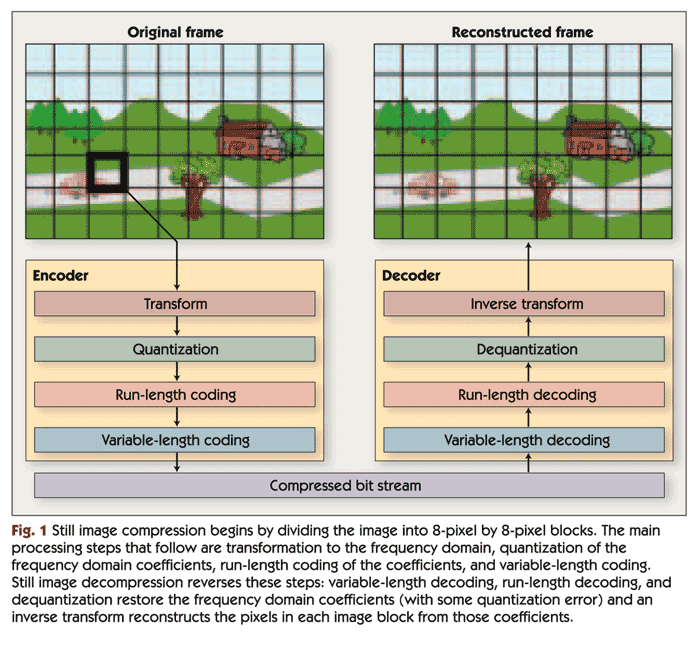
The main video compression methods come down to compressing data within a single frame and optimizing the transfer of changes between frames. Even when looking at a still image, you can see that it contains a lot of information of the same type and duplicate information. For example, the background intensity is usually a constant value; many separate areas of the image, occupying significant frame sizes, also have the same digital signal level. Naturally, it makes no sense to transmit all this information without compression. With the use of specialized video compression techniques, smoothly changing frame by frame, it is possible to further reduce the resulting density of information transmission over the network.

Unlike universal archivers (such as WinRar or WinZip), video compression can occur with some loss, the amount of which depends on the selected codec. Modern compression algorithms use extensive logical analysis of the video to extract duplicate fragments between frames and reduce the size of the final file. During playback, the compressed information is “stretched” and then displayed to the user. On a low-powered computer, it can take a long time to decompress images compressed with some codecs.

Digital video compression technologies
There are many digital video compression technologies. Some of the compressors considered use more than one compression technology, but a combination of them. For example, both Indeo 3.2 and Cinepak use vector quantization. The international standards MPEG-1, MPEG-2, MPEG-4, H.261 and H.263 use a combined BDKP technology and motion compensation. Some modern algorithms use Discrete Wavelet Transform (DWT) technology. Other technologies include fractal image compression.

Lossless compression

Image compression can be performed without quality loss only if there was no data loss during the compression process. As a result, the image obtained after decompression will match exactly (bit by bit) the original. Examples of such compression are GIF for static graphics and GIF89a for video.

Lossy compression

Compression can be lossy if information is lost during the compression process. However, from the point of view of human perception, lossy compression should be considered only that compression in which it is possible to distinguish with the naked eye the result of compression from the original. Thus, despite the fact that two images, the original and the result of compression with one or the other compressor, may not coincide little by little, however, the difference between them may be completely imperceptible. Examples include the JPEG algorithm for compressing static graphics and the M-JPEG algorithm for compressing video.

Lossless compression from a perceptual perspective

Being formally lossy compression, a compression scheme can at the same time appear to be lossless in terms of human perception. Most lossy compression technologies have the so-called Compression Quality Factor (QF), which characterizes the perceived quality side and ranges from 0 to 100.

About video compression

About video compression

Video Compression

As the days go by, the demands for video quality are constantly increasing.

Video Compression

At the same time, channel width and media capacity could not keep up with this growth if video compression algorithms were not improved.
Next, we will talk about some of the basics of video compression. Some of them are somewhat outdated or described too simply, but at the same time they give a minimal idea of ​​how everything works.

Video Streaming Features

Most everyone knows that any video is a collection of still images that will replace each other over time. In what follows, we will call this ordered set video stream. They are different, so it is extremely useful to do a little classification here:
Pixel format. The pixel does not give us more information than its color. However, color perception is highly subjective and great efforts have been made to create color rendering and rendering systems that are acceptable to most people. So the color that we see in the real world is quite complex in terms of the frequency spectrum of light, which makes it extremely difficult to transmit it in digital form and display it even more. However, it was observed that the three points of the spectrum can quite accurately bring the displayed color closer to the present in the metric of color perception by an ordinary person. These three points are red, green, and blue. That is, due to its linear combination, we can cover most of the spectrum of visible colors. Therefore, the simplest way to represent a pixel is: RGB24, where exactly 8 bits of information are allocated for the Red, Green and Blue components. And so we can transfer 256 gradations of each color and a total of 16,777,216 of all kinds of shades. But in practice, during storage, this color representation is practically not used, not only because we spend up to 3 bytes per pixel, but also for other reasons, but more on that later (on YV12).
Frame size. We already grab and encode all the pixels in the video stream and receive a lot of data, but it is inconvenient to work with. In the beginning, everything is very simple, the frame is characterized by: width, height, size of the visible part and format (more on that later). Here the numbers will probably be familiar to many: 640×480, 720×480, 720×576, 1280×720, 1920×1080. Why? Yes, because they appear in different standards, for example most European DVDs have a resolution of 720×576. No, of course you can make a 417×503 video, but I don’t think there is anything good in that.

Frame format. Even knowing the size of the frame, we cannot represent the pixel array in a more convenient way without knowing how to “pack” the frame. In the simplest case, there is nothing complicated: we take a row of pixels and write the bits of each encoded pixel in a row, and so on line by line. That is, we write as many lines as we are tall by as many pixels as we are wide and all in a row, in order. This is called progressive. But maybe you tried to watch TV shows on a computer without the proper settings and saw the “comb effect”, this is when the same object is in different positions relative to the odd and even lines. You can argue for a long time about the desirability of interlaced (interlaced) scanning, but the truth is that it has remained a relic of the past of traditional television (those who are interested in reading about the kinescope device). I will not talk now about methods to remove (deinterlace) this unpleasant effect. This is where the magic designations come from: 576i, 720p, 1080i, 1080p, where the number of lines (frame height) and the type of scan are indicated.
Frame rate. Some of the standard values: 23.976, 24, 25 and 29.97 frames per second. For example, 25 fps is used on European television, 29.97 on American television, and 24 fps is used in movies. But where did the “strangers” 23.976 and 29.97 come from? Let me tell you a secret: 23.976 = 24 / 1.001, and 29.97 = 30 / 1.001, that is, the 1.001 divisor is included in the American NTSC broadcast standard. Consequently, when the movie is shown, there will be a very slight slowdown, which will not be noticeable to the viewer, but if it is a musical concert, then the speed of the show is so critical that it is better to occasionally skip frames and again the viewer will not notice anything.

Video compression, how it works

Video compression, how it works

Video Compression

Video – This is essentially a three dimensional pixel color matrix. Two measurements indicate the vertical and horizontal resolution of the frame, and the third dimension, this time. Frame – is an array of pixels, visible camera at this moment of time, or just an image. Video is also possible so-called half images (see: Interlace Scan System).

Video Compression

Compression might be impossible, if I would each frame was unique and the pixel placement was completely random, but it’s not so. Therefore, you can compress, in – first, the image itself – for example, the sky blue photo without sun will actually be reduced to the outline dotted description and a gradient fill. In – Second, you can compress a similar neighboring frames. Ultimately, the algorithms for image and video compression are similar, if you consider video as a three-dimensional image with time as the third coordinate.

Lossless compression
In addition to lossy video compression, it can also be compressed and lossless. This means that when the decompression result will be a precision (bit bits) that matches the original’s. However, when lossless compression is impossible to achieve high compression ratios in real (not artificial) video. For this reason, almost all commonly used videos are lossy compressed (by that number on consumer digital video discs, video sharing, on satellite broadcast). On the web – sites for small clips without sound sometimes use simple GIF and APNG formats.

Compress technology and video compensation motion
One of the most powerful technologies, which allows to increase the degree of compression, this compensation movement. When any modern video compression system later frames in the sequence uses the similarity of regions in the previous frames to increase the degree of compression. However, since – for any traffic – any objects in the frame (or the camera itself), the use of adjacent frame similarity was incomplete. Motion compensation technology allows you to find similar sites, even if they move from the previous frame.

The current state of affairs

РЕКЛАМА
Cm. See also: HTML5 video
At the end of 2011 the year almost all algorithms compress the video (for example, the standards, adopted by the ITU – T and ISO) using a discrete cosine transform (DCT) or its modification to eliminate spatial redundancy. Other methods, such as a fractal compression and discrete wavelet- transform, have also been the subject of investigation, but are now generally used only for compression of still images.

The use of most compression methods (such as the discrete cosine transform and wavelet – conversion) also involves the use of the quantization process. Quantization can be like scalar, so and vector, so there are less, most compression schemes in practice use scalar quantization for its simplicity.

Television
Modern digital television broadcasting is available precisely thanks to video compression. The television station can transmit not only high definition video (HDTV), but also it and several channels on one physical channel (6 MHz).

Although most of today’s video content is broadcast with the use of the MPEG – 2 video compression standard, the no less new and more efficient standards for video compression already used in broadcasting – for example, H . 264 and VC – 1.