Which is better, FLAC or MP3? ? Are there pros and cons?
Mp3 vs AAC
FLAC is lossless compression format, with higher quality and higher volume, not suitable for playing in MP3, some MP3 don’t support it at all.
Mp3 vs AAC
For example, I have a 5 minute song in FLAC Format, 40M, but even if the mp3 format is 320kps, it may only be around 10M, and most online MP3 music is 128KPS, 192KPS MP3 has lossy compression , small size, but only missing data that is not sensitive to humans. There is no big difference in sound quality between the two. It is recommended to use the FLAC format on the computer, and use the MP3 format on the mobile phone and MP3. Now there are not many FLAC resources.
Of course, it’s FLAC. FLAC is similar to MP3, but it is lossless compression, which means that the audio is compressed in FLAC without losing any information. This compression is similar to Zip, but FLAC will give you a higher compression ratio, because FLAC is a compression method specially designed for the characteristics of audio, and you can use the player to play FLAC compressed files like you normally play MP3 files (there are already there are many FLAC-compatible car players and home audio equipment, and you can find links to these equipment manufacturers on the FLAC website).
FLAC is free and is supported by most operating systems, including Windows, Unix kernel-based systems (Linux, *BSD, Solaris, OS X, IRIX), BeOS, OS/2, Amiga. And FLAC provides build system in autotools, MSVC, Watcom C, Project Builder development tools.
Mp4Gain can convert both formats, also do FLAC NORMALIZER and MP3 NORMALIZER.
Since AAC is better than MP3 and the size is similar, why is AAC audio format not popular on the Internet?
MP3 vs AAC
Have patents limited the growth of AAC?
MP3 vs AAC
As an upgraded version of the MP3 format, the enhanced sound quality of AAC does not have substantial performance on most audio playback terminals (such as mobile phone speakers, mobile phone compatible headphones, Ai speakers, Bluetooth speakers, etc. .). Also, AAC involves many patents, but only proprietary rights.
The cost of this aspect is no small expense for music publishers and platforms. Therefore, many publishers and merchants choose not to use the AAC format, limiting AAC from the source. Diffusion and popularization, so the AAC audio format is relatively unknown to our public users.
That is to say, for one thing the performance is not noticeable on much of the playback equipment available. Not on any computer, phone, tablet, etc. the difference in audio quality is noticeable when buying an AAC and an Mp3.
On the other hand, expensive patents have to be paid, even though they may not make a difference in the ears of the customers, and to this we must add that mp3 is known all over the world.
Mp4Gain can convert mp3->aac and vice versa and normalize both audio formats.
I believe that many friends will find the audio format of aac when listening to songs.
AAC audio format
At this time, some friends asked, what kind of audio format is the aac format? Compared to mp3, which sound quality is better? To answer your questions, Xiao Bian went to study it personally, and now I will bring you the specific introduction of the aac format and the comparison with mp3. Come and have a look.
What audio format is aac?
The details are as follows:
AAC (Advanced Audio Coding), Chinese name: Advanced Audio Coding. It appeared in 1997, based on MPEG-2 audio coding technology. Co-developed by Fraunhofer IIS, Dolby Laboratories, AT&T, Sony and other companies to replace the MP3 format.
AAC is a file compression format designed for sound data. Unlike MP3, it uses a new encoding algorithm, which is more efficient and has a higher “price ratio”. Using the AAC format may make people feel that the sound quality is not significantly reduced and that it is more compact. Apple iPod, Nokia mobile phone supports audio files in AAC format.
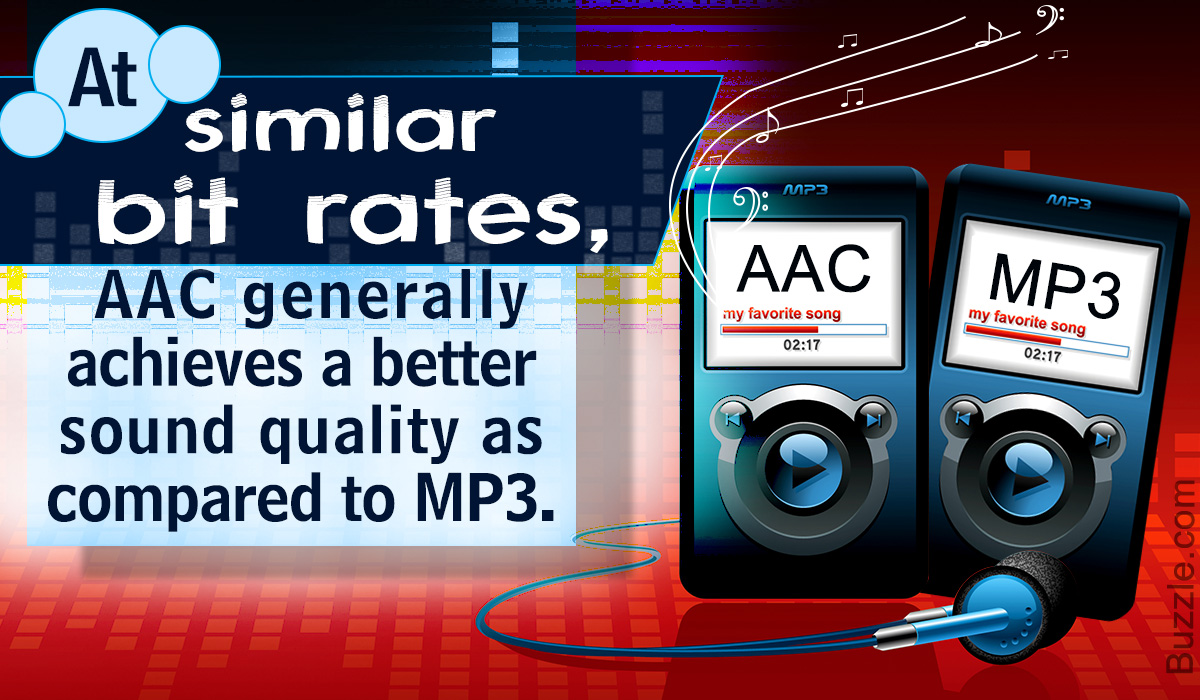
Advantages: Compared to mp3, AAC format has better sound quality and smaller file size.
Disadvantages: AAC is a lossy compression format and there is an “essential” gap in sound quality compared to popular lossless formats like APE and FLAC. In addition, USB3.0 with faster transmission speed and large-capacity MP3 above 16G are accelerating the popularization, which also makes the “small” halo in the AAC head no longer exist.
Characteristic:
1. Improved compression ratio: You can get higher sound quality with smaller file size.
2. Support multi-channel: It can provide up to 48 full-range channels.
3. Higher resolution: sampling rate up to 96KHz.
4. Improved decoding efficiency: fewer resources are occupied by decoding and playback.
which sound is better aac or mp3
1.ACC has better sound quality than MP3
Compared to mp3, AAC format has better sound quality and smaller file size. Unlike MP3, it uses a new encoding algorithm, which is more efficient and has a higher “price ratio”. Using the AAC format can make the sound quality appear lower, without significant degradation;
The mp3 is encoded at a lower bitrate, so encoder errors are more noticeable and sound like echoes.
2.ACC is more algorithmic and advanced than MP3
The algorithm adopted by AAC is different from that of MP3. AAC improves encoding efficiency by combining other features. AAC’s audio algorithm far surpasses some previous compression algorithms (such as MP3, etc.) in terms of compression capabilities;
It also supports up to 48 tracks, 15 low-frequency tracks, more sample rates and bit rates, multi-language support, and higher decoding efficiency. It is called a 48-channel soundtrack, with a sample rate of 96khz and a data rate of 320kbps, providing the equivalent of ITU-R broadcasts for 5.1-channel music programs.
3.ACC is more advanced than MP3
The AAC format appeared in 1997, based on MPEG-2 audio coding technology. Fraunhofer II, Dolby Laboratories;
MP3 was invented and standardized in 1991 by a group of engineers at the Fraunhofer-Gesellschaft research organization in Erlangen, Germany.
AAC is short for Advanced Audio Coding, which appeared in 1997 and was originally an audio coding technology based on MPEG-2. Co-developed by Fraunhofer IIS, Dolby Laboratories, AT&T, Sony and other companies to replace the MP3 format. In 2000, the MPEG-4 standard was introduced, and AAC reintegrated other technologies (PS, SBR). To distinguish it from the traditional MPEG-2 AAC, AAC with SBR or PS features is also called MPEG-4 AAC.
AAC is a new generation of lossy audio compression technology. It derives three main encodings, LC-AAC, HE-AAC, and HE-AACv2 through some additional encoding technologies (such as PS, SBR, etc.). LC-AAC is the Compared to traditional AAC, in relative terms, it is mainly used for medium and high code rate (>= 80 Kbps), HE-AAC (equivalent to AAC+SBR) is mainly used for medium and low code (<= 80 Kbps), and the recently released HE-AACv2 (equivalent to AAC+SBR+PS) is mainly used for low bit rates (<=48 Kbps); in fact, most encoders are set to <=48 Kbps to automatically enable PS technology, and >48 Kbps does not add PS, which is equivalent to ordinary HE-AAC.
2. Brief description of AAC specification
AAC has a total of 9 specifications to meet the needs of different occasions:
MPEG-2 AAC LC Low Complexity Specification (Low Complexity): Relatively simple, no gain control, but improved
Encoding efficiency, you can find a balance point in the encoding efficiency of medium bit rate and sound quality
Main Main Specification MPEG-2 AAC
Scalable sample rate MPEG-2 AAC SSR
MPEG-4 AAC LC Low Complexity Specification (Low Complexity) —— the current mobile phone is more common in the MP4 file
The audio part of the file includes the audio file of this specification
Main Main Specification MPEG-4 AAC —— It contains all the functions except gain control, and its sound quality is the best
Scalable sample rate MPEG-4 AAC SSR
MPEG-4 AAC LTP Long Term Prediction
Low Delay Specification MPEG-4 AAC LD (Low Delay)
MPEG-4 AAC HE (High Efficiency) High Efficiency Specification—-This specification is suitable for low bit rate encoding, with
Nero ACC encoder support
Currently the most used are LC and HE (suitable for low bit rates). The popular Nero AAC encoding program only supports the three specifications of LC, HE and HEv 2. For AAC audio encoded, the specifications are displayed in LC. HE is actually AAC(LC)+SBR technology, HEv2 is AAC(LC)+SBR+PS technology;
Hev1 and HEv2 are simply represented by this diagram:
(AAC in the figure refers to the original AAC-LC)
HE: “High Efficiency.” HE-AAC v1 (also known as AACPlusV1, SBR) implements AAC(LC)+SBR technology by means of a wrapper. SBR actually stands for Spectral Band Replication. Briefly describe, the main spectrum of music is concentrated in the low-frequency band, and the high-frequency band has a small but important amplitude, which determines the sound quality. If the whole frequency band is encoded, if it is to protect the high frequency, the low frequency band will be encoded too precisely and the file will be huge; if the main low-frequency component is preserved and the high-frequency component is lost, the sound quality will be lost. SBR cuts the frequency spectrum, the low frequency is encoded separately to save the main components, and the high frequency is amplified and encoded separately to save the sound quality. It is “built-in”, and the sound quality is also preserved in the case of reducing the file size, which perfectly resolves this contradiction.
AAC audio coding format, the full name is “Advanced Audio Codec”.
This state-of-the-art, advanced encoding standard was jointly developed by Fraunhofer IIS (former MP3 standards maker), Dolby, AT&T, Sony, Apple, and other industry giants. AAC audio coding technology was formulated as early as 1997. At that time, it was used as one of the MPEG2-AAC audio coding specifications in MPEG-2. Later, it was used in MPEG-4 in 2000 (ISO 14496-3 Audio), so now it changed to the MPEG-4 AAC standard, that is, AAC has become one of the main members of the MPEG4 family, which is the audio coding system in the third part of MPEG4. AAC provides up to 48 channels of full-range audio. Among them, AAC audio coding is divided into nine specifications in different fields: MPEG-2 AAC main MPEG-2 AAC LC (low complexity) MPEG-2 AAC ××× (scalable sampling rate) MPEG-4 AAC main MPEG -4 AAC LC (Low Complexity) MPEG-4 AAC ××× (Scalable Sample Rate) MPEG-4 AAC LTP (Long Term Prediction) MPEG-4 AAC LD (Low Delay) MPEG-4 AAC HE (High Efficiency) AACPlusV1/V2( 3GPP ) Among them, the first three estimates are difficult to apply, and among the last six, LC and HE are the most used, so these two are mainly introduced:
MPEG-4 AAC LC (Low Complexity) is the most widely used specification, we call it “low complexity specification”, we call it “LC-AAC” for short, this specification can strike a balance in terms of coding efficiency and sound quality . at the half bit rate point. The so-called average bit rate refers to the bit rate between 96 kbps and 192 kbps. So if you want to use the LC-AAC specification, please try to control the bitrate within the range mentioned above. In this range, LC-AAC can completely beat MP3 with the highest quality LAME slow encoding mode at the same bit rate. In my opinion, whether it is a Walkman or streaming music over the Internet, it is recommended to use the LC-AAC 128kbps-192kbps encoding specification. MPEG-4 AAC HE (High Efficiency) AACPlusV1/V2(3GPP), we call it “High Efficiency Specification”, we call it “HE-AAC” or “AACPlus” for short, this specification is suitable for low bit rate encoding bits, because this specification also incorporates the type of SBR technology in Mp3Pro. When you need to encode audio files between 32 kbps and 96 kbps, it is recommended to prefer the “HE-AAC” encoding specification. With this spec, you can easily kill Microsoft formats like WMA9 and WMAPro within this range at the same bitrate. If you’re a fan of audio novels or radio dramas, consider the He-AAC specification, which can provide crystal-clear vocal dialogue even at a very low bitrate.
So if you need to encode AAC at relatively high bit rates (192kbps-384kbps or more), how should you choose? If your bit rate does not exceed 256kbps (eg: 192kbps-256kbps), “LC-AAC” can also be applied. If you really need a higher bit rate, choose the Main encoding (main specification). At high bit rate, AAC can also easily beat the very popular Lame MP3, even 320kbps CBR MP3 is not Mian-AAC’s opponent at all. Even many people believe that the LC-AAC medium bit rate, 192kbps CBR has reached the sound quality of 320 CBR Lame MP3. Of course, only the MPC format can compete with high-bitrate AAC, but the MPC format is too versatile. Having said that, there is no need to use high bitrate AAC, and Main-AAC will have problems in some general purpose or ××× players, because the sound quality of LC-AAC mentioned above is good enough, and the versatility is good. If you are an audiophile, just use lossless, like FLAC etc.
I know that the lossless sound source is of the highest quality, but the file size is too large.
I want to hear it in the smallest possible size with the best possible sound quality!
I think there are many such people. I am the same.
This time, I would like to roughly examine the differences between mp3 and AAC.
I don’t know because it’s a bit of a snob for a hobbyist.
Table of Contents
Effect
Frequency analysis
Let’s listen and compare
conclusion
Effect
Since this is a compressed sound source, casual listening is an important premise.
First, let’s abandon the stereotype that “AAC is better.”
Looking at the net, there are people who write that “AAC is better because it came out later” or “AAC is better because it is an improved version of mp3”, but the compression efficiency is good and the sound you can really hear I don’t think always be the same to improve.
This study then only confirms the “objectively understandable difference” for each format and does not determine the superiority or inferiority of sound quality.
Personally, assuming 320 kbps, even if it is a compressed sound source, be it mp3 or AAC, the audible range is perfectly suppressed, so I think the sound you hear is the same, and I only listen casually. I don’t even have to hear the slightest difference.
Honestly, 128 kbps is fine for portable use (although the audible range changes significantly compared to 320 kbps), but if you’re looking for a premium music experience with home audio, you should use a compressed sound source first. use time.
Frequency analysis
There are many other people who do the same, but I’ll check it out myself.
Note that the vertical and horizontal widths differ for each graphic.
All encoding to mp3 / AAC is done with iTunes.
First, I prepared a FLAC sound source sample. The genre is rock.
The characteristics of 4608 kbps bit rate / 96 kHz sampling rate / 24 bit bit depth of
frequency are as follows. This is the original way.
Generally, the human audible range is said to be around 20Hz to 20kHz *, but with FLAC, you can see that information is also included in the ultra-high range above 20kHz.
* Actually, it seems that most people have a hard time distinguishing between 15 kHz and higher.
Then AAC / 320 kbps
* Sampling frequency 44.1 kHz / Bit depth 16 bit
What is the AAC format? How to Easily Convert MP4 Video to AAC
Q1: “I want to extract audio data from .mp4 video, but I am wondering what output format to use, MP3 or AAC, can you tell me the difference between MP3 and AAC?”
Q2: “I am looking for a tool that can convert video files to music format. There are many files that I want to convert, and if possible, please show me a tool that can quickly convert or batch convert. I would be happy if I could
There are times when it is enough to enjoy music, not as a video. For example, when you watch the music video of your favorite singer, you want to enjoy the singing voice itself instead of the video.
Also, if you turn the video into music, you can easily listen to music even with your smartphone in your pocket, and the file size will be small.
However, to convert video files to music format, you need tools that can edit media files, but today there are not so many tools that have fast conversion speed on the Internet.
This time, I will explain the difference between AAC and MP3.
What is AAC
AAC (Advanced Audio Coding) is one of the technologies for compressing audio data and is a container format for storing audio data, which was developed in 1997 as a successor to MP3.
It is mainly used as a standard format for Apple products such as iPod and iPhone, and it is not compatible with Windows compatible software, making it difficult to play and edit on those devices.
Also, there are MPEG-2 AAC and MPEG-4 AAC in the AAC format, but the latest MPEG-4 AAC is often used.
The unique features of AAC are that it supports sample rates up to 96 kHz, supports up to 48 channels, and has a fairly high data compression efficiency.
Here I will talk a bit about the difference between MPEG-2 AAC and MPEG-4 AAC.
MPEG (Moving Picture Experts Group) is a group that establishes the standards used when compressing multimedia data such as video, audio, and text. Both MPEG-2 AAC and MPEG-4 AAC are audio data compression methods specified by MPEG.
MPEG-2 AAC A popular format for digital terrestrial broadcasting, it is considerably inferior to MPEG-4 in terms of compression efficiency.
It is a widely used music standard in portable devices such as MPEG-4 AAC digital audio players and digital cameras. The compression efficiency is significantly improved from 2, and the compressed music file size is also smaller.
Difference between AAC and MP3
In this part, I will explain the difference between “AAC” and “MP3”, which are often compared to each other.
Either also “lossy compression in the form of” as it is not returned based on sound quality. When compressing the sound source at once it is a “lossy compression” characteristic.
By the way, in addition to “lossy compression”, there are “lossy compression (representative: FLAC, ALAC)” and “uncompressed (representative: AIFF, AAC)” as music compression formats.
Both AAC and MP3 can compress the sound source data to about 1/10 of the original size with some deterioration in sound quality, but in terms of compression ratio, AAC is about 1.4 times higher than MP3. This means that AAC compressed files are smaller in size than MP3 files.
Therefore, for the same file size, AAC has higher sound quality than MP3, while for the same sound quality, AAC file is smaller than MP3.
However, from a bit rate point of view, if it is 128 kbps or less, AAC is by far the highest sound quality, but if it exceeds 198 kbps, MP3 will have a higher sound quality. .
PS: Bitrate is a numerical value that indicates how much audio data is packed during compression. The higher the number, the less audio data will be deleted and the higher the sound quality, but the larger the compressed file size.
AAC vs AC3 is a common comparison in the realm of audio codecs, with both formats vying for dominance in digital audio compression. Advanced Audio Codec (AAC) is renowned for its superior sound quality and efficient compression, making it the preferred choice for various applications like online streaming, mobile devices, and digital radio. It has gained popularity due to its ability to deliver high-quality audio at lower bit rates, resulting in smaller file sizes while maintaining impressive sound fidelity. On the other hand, AC3, also known as Dolby Digital, has long been used in home theater systems and DVDs. While it may not match AAC in terms of compression efficiency, AC3 offers compatibility with a wide range of devices and audio systems, making it a reliable option for surround sound setups and media distribution.
The debate over AAC vs AC3
The debate over AAC vs AC3 often centers on audio quality and device support. AAC boasts better audio quality at similar bit rates compared to AC3, making it ideal for audiophiles and those seeking a more immersive listening experience. Its widespread support across platforms like iOS, Android, and major media players ensures seamless playback on various devices. Additionally, AAC’s integration in popular streaming services further solidifies its position as the go-to choice for digital content distribution. Conversely, AC3 remains prevalent in the entertainment industry, particularly for DVDs, Blu-rays, and older home theater systems. Its legacy support and compatibility with a vast array of multimedia players ensure that AC3-encoded content remains accessible and relevant.
Choosing between AAC and AC3
When choosing between AAC and AC3, several factors come into play, depending on the intended application. For creators and content distributors looking to deliver high-quality audio over bandwidth-constrained networks, AAC emerges as the frontrunner. Its efficient compression and exceptional sound reproduction make it a top pick for streaming platforms and online media consumption. Conversely, AC3 finds favor in scenarios where backward compatibility and compatibility with legacy systems are critical, such as DVD and Blu-ray distribution. Ultimately, the decision between AAC and AC3 hinges on the specific requirements of the project, the target audience, and the ecosystem of devices where the audio content will be played, making it essential for content creators to carefully evaluate their needs before settling on the ideal audio codec.
How to convert to AAC / AC3
“What is the difference between AC3 and AAC? I want to compress PCM and convert it to AAC / AC3 to save free space, but I don’t know which is better. AAC is more efficient and sound quality than AC3. I heard that it is OK. For example, I’m compressing from the same source, but which is better compared to a 256 kbit AAC file or a 384 kbit AC3 file? ”
Many people would like to ask. When I want to extract audio files from video files or Blu-ray / DVD, I don’t know which one to choose, AC3 or AAC. In this article, we will explain the difference between AAC and AAC, compare the advantages and disadvantages of each, and how to convert DVD to AC3 / AAC.
AC3, also known as Dolby Digital (audio code number 3), is an audio format developed by Dolby Laboratories, Inc. Originally, AC3 was widely used in 5.1 channels and is similar to Dolby Pro Logic. AC3 is often used for 384 kbps and 448 kbps DVD or laser discs. It is also used in 640 kbps movies.
AAC, also known as advanced audio coding, is an irreversible audio format standardized as part of the MPEG-4 specification. Developed as a successor to MPEG Layer III (MP3). AAC can transfer any bit rate from AC3 and compress data better, but it is considerably more complex than AC3. However, AAC excels with an output of 400 Kbps on 5.1 channels and 180 Kbps on dual channels.
aac-vs-ac3
Besides Movie / DVD / Blu-Ray projects, I rarely use AC3. The AC3 Dolby Digital format is mainly used for videos only. Generally, you cannot encode or decode without the use of specially licensed software or hardware.
In general, AC3 appears to be an irreversible format, but not all encoded AC3 files are irreversible. It can be encoded in lossless AC3 format. Of course, this is better than using the irreversible AAC format.
When asked which codec produces the best sound, assuming AAC or AC3 is used to encode the audio at similar bit rates, the results may be similar. However, the AAC can be a bit better. The main reason is that AAC appeared a few years after AC3, and is recognized as an excellent codec in many respects compared to MP3 (very similar to AC3).
Part 2: Advantages and disadvantages of AC3 and AAC
What are the advantages and disadvantages of AC3 and AAC? The following detailed comparison table will explain it clearly and easily.
merit demerit
CAA
1. As part of the ISO standardized MPEG-4 specification, AAC supports multiple sample rates (8000-96000 Hz), bit depth, and multi-channel (up to 48 channels).
2. Various implementations are available, such as free and high-quality implementations. Therefore, anyone can implement it.
3. AAC audio files are compatible with more devices and players.
4. AAC audio files create small digital audio files.
AAC comes in a variety of formats, including AAC LC, AAC HE, and AAC PS. Therefore, it is not possible to play valid AAC files with multiple players (LC compatible only).
AC3
1. AC3 only supports full-range channels, but the sound quality is much better. It can also be backward compatible.
2. AC3 has now become the industry standard for DTV and DVD media, so almost all the latest DVD movies come with a DVD soundtrack program.
3. For high quality audio, AC3 is widely used for HDTV, DVD and Blu-ray.
Supports up to 5.1 channel audio CDs.
Dolby digital is limited to a maximum of 448 kbps.
AAC is the default audio format for iPhone, iPod, iPad, Nintendo DSi / 3DS, iTunes, DivX Plus web player, and PS3. It is also compatible with PS Vita, Wii (Photo Channel Update), Sony Walkman MP3 series and later Sony Ericsson. And mobile phones based on Nokia, Android, BlackBerry and webOS. Most car audio manufacturers also use AAC.
AC3 (Dolby Digital) is widely used in broadcasting HDTVs, DVDs, Blu-ray discs, and game consoles.
As part of the standardized MPEG-4 specification, AAC Codex creates small digital audio files, so you can store audio files in less space while maintaining high-quality sound.
Like MP3, AAC is a lossy music storage format. As in the case of the MP3 format, AAC encoding algorithms cut the highest and lowest frequencies, and also actively use the characteristics of a person’s hearing to remove information about sounds that a person cannot easily distinguish when listening to music. . As a result of compression, AAC files do not sound identical to CD-quality files, but in general the algorithms compress the music efficiently enough that most people overlook the fact that it has been deleted. resulting sound information.
Like MP3, the quality of an AAC file is measured by its bit rate. Common AAC bit rates include 128 kbps, 192 kbps, and 256 kbps.
Without going into technical details, here are the reasons why AAC files sound better than MP3s:
AAC encoding uses samples with a wider frequency coverage from 8 to 96 kHz; mp3 encoding uses samples with coverage from 16 to 48 kHz
Up to 48 channels can be encoded, while MP3 encodes 2 channels in MPEG-1 mode and up to 5.1 channels in MPEG-2 mode
Arbitrary bit rates and variable frame lengths are used
Higher algorithm efficiency and simpler filter banks (instead of hybrid MP3 encoding, AAC uses pure MDCT method)
Greater precision is provided when encoding AAC sound using smaller sample sizes, which are equal to 128 or 120 units, while 192 units are used for mp3 encoding. In this case, the smaller sample size allows you to code more precisely, since the original sound wave is an analog signal, and for a more accurate description, it needs to be measured as often as possible. Therefore, a smaller sample size is better because it allows you to more accurately describe the analog nature of a sound wave in digital form.
Sound frequencies above 16 kHz are processed more efficiently. Let me remind you that in mp3 format these frequencies are simply erased
More progressive algorithms are used in stereo binding mode. Let me remind you that stereo stitching allows you not to store both channels separately, as in CD-quality recording. The common signal for both channels is stored and only the difference between the channels is stored separately from each other.
Additional modules were added to improve compression efficiency: TNS, Inverse Prediction, PNS and others
Back to content
How AAC works with iTunes
Apple adopted AAC as its primary audio format. All songs stored in iTunes Store and all songs streamed or downloaded from Apple Music are encoded in AAC format. All AAC files in the Apple ecosystem are encoded at 256 kbps.
The Advanced Audio Coding audio format, or AAC for short, offers very good sound quality even at low bit rates. While you need a bit rate of at least 192 kbit / s for CD quality with MP3, you can achieve the same quality with AAC from a bit rate of at least 128 kbit / s. As a result, AAC files are much smaller than MP3 files and are often used, for example, when streaming music or Internet radio.
AAC became known especially through iTunes. The music player developed by Apple preferably uses this format. One reason for this is that copy protection can be built into AAC, preventing uncontrolled transfer of music files.
Better than MP3
As with MP3, the AAC format removes sounds that are not perceptible to humans and therefore unnecessary. This applies both to inaudible frequency ranges and to redundant tones that arise, for example, by overlapping. Therefore, a low data rate does not necessarily mean a deterioration of the sound. A decisive advantage over MP3: AAC files have the same quality and a significantly smaller file size than MP3 files.
AAC has other advantages as well. AAC supports up to 48 channels, while MP3 only supports six. Also, the scanning range is significantly wider with AAC. It ranges from 8 to 96 kHz. AAC achieves good sound quality starting at 94 kbit / s. Bit rates of 192 kbit / s or 224 kbit / s correspond to almost lossless CD quality. By the way, AAC files mainly use the .mp4 file extension and are used by Apple iTunes, Quicktime, mobile phones, car radios, Nintendo and Playstation, among others. AAC is also used for Internet radio.
Compress AAC
If you want to compress a file according to AAC, you can use various software programs, so-called encoders, for this. Both free and paid software are available on the market, and there are few programs that work really well. Some examples are Nero or Liquifier.
Where does the AAC come from?
AAC was developed at the Fraunhofer Institute, with other companies such as Sony and Nokia also involved. The goal was to develop a standardized audio format that offered very good sound quality in the smallest possible size. AAC is a further development of the MPEG-2 standard. Later more AAC profiles were developed under MPEG4. If you want to use AAC commercially, you have to pay for a license, which is why most encoders are paid.
AAC comes with different profiles
AAC has different profiles that can be selected for compression. Typically the LC profile is used, which is suitable for medium to high data rates. Other profiles are the HE profile, the SSR profile and the LD profile. Due to the different profiles, in some players it may happen that data such as the artist or the title is not displayed correctly because the existing profile is not supported correctly.