What is a good bitrate guide for mp3 files?


Free Download Mp4Gain
picture

What is a good bitrate guide for mp3 files?

Mp3 Bit Rate
Mp3 Bit Rate

(a good bitrate guideline for mp3 files?)
Mp3 Bit Rate
Mp3 Bit Rate

MP3 files are compressed audio files created from audio formats such as wave (.wav). Wave files replicate analog recordings and digital sound files at the expense of large file size, while MP3 files sacrifice some quality for a smaller footprint. There are several factors that mitigate the quality sacrifice during the conversion process. With the correct bitrate and settings, MP3 files can provide very high quality results, making them very close to the original wave files when played on portable audio players.

An mp3 player.

The balance between file size and quality is somewhat subjective. For audiophiles, any difference is noticeable. Others may simply not be able to tell the difference between a high quality MP3 file and a raw wave source. In many cases, the nuances of the sound environment will only become clearer when played through a high-quality stereo system.

MP3s are compressed digital music files that sacrifice quality for file size.
MP3 files are primarily targeted at portable audio players. In this field, high-quality MP3 files are played with incredible sound due to their small file size. With the limited memory of portable players, it makes sense that one would want MP3 files to be as small as possible while maintaining the highest possible quality.

For this, one of the most important factors when creating MP3 files is the bit rate. In general, the more bits per second that are preserved from the original file, the higher the quality of the MP3 and the larger the file size. Lower bit rates reduce size and quality. The idea is to use the bitrate for maximum realism without saving unnecessary data, which just creates larger files with no noticeable difference to the ear.

For voice recordings such as lectures or language lessons saved to waveforms, a bit rate of 32 kilobits per second (kbps) is acceptable, although 64 kbps may offer better quality, depending on the source. At 32 kbps, the sound may sound “flat”, but that’s understandable. A 64 kbps MP3 file created from a voice recording should sound nearly identical to the original.

Desaturated acoustic music with simple arrangements should work fine at 192kbps bitrate. You can choose 256 kbps if the music will be played on a high quality device. Music that falls into this category includes folk, boy band songs, easy listening, and folk music. There are also works by many classic artists such as James Taylor, Linda Longstadt, Jonny Mitchell, and Simon Garfunkel.



Free Download Mp4Gain
picture


Mp4Gain Main Window
picture


Mp4Gain Features
picture


Free Download Mp4Gain
picture

Audio Intro Part 3

Audio Intro Part 3

Audio Intro
Audio Intro

WAV

Audio Intro
Audio Intro

structure
file header
The WAV format follows the RIFF Resource Interchange File Format, so the WAV format is actually a three-layer relationship, which is simplified here. Its file header format is as follows:

Address Carving type content
00H-03H 4 character * 4 RIFF resource file exchange flag
04H-07H 4 unsigned int The number of bytes from the next address to the end of the file.
08H-0BH 4 character * 4 WAV file WAVE logo
0CH-0FH 4 character * 4 fmt wave file flag, the last digit is 0x20 space
10H-13H 4 unsigned int The size of the subchunk file header. For the WAV subfragment, the value is 0x10.
14H-15H 2 short unsigned Format type, when the value is 1, it means the data is linear PCM encoding
16H-17H 2 short unsigned number of channels
18H-1BH 4 int unsigned Sampling rate
1CH-1FH 4 int unsigned Wave file bytes per second = sample rate Bit depth PCM / 8 channels
20H-21H 2 short unsigned DATA data block unit length = number of channels * PCM bit depth / 8
22H-23H 2 short unsigned Bit depth PCM
24H-27H 4 character * 4 data stamp data
28H-2BH 4 unsigned int Total length of data part (bytes)
struct WAVHeader
{ char RIFF[ 4 ]; ///Resource file exchange flag RIFF unsigned LEN; ///Number of bytes from the next address to the end of the file char WAV[ 4 ]; ///WAV file flag WAVE char FMT [ 4 ]; ///Wave fmt file pointer, last digit is 0x20 space unsigned SubchunkSize; ///The size of the sub-chunk file header, for WAV this sub-chunk, the value is 0x10 DATATYPE short unsigned; / //Format type, when the value is 1, it means the data is unsigned linear PCM encoding short CH ; ///Number of unsigned channels F; ///Unsigned sample rate BYTERATE; ///Number of bytes per second of wave file = sample rate*PCM bit depth/8*Number of unsigned channels

short DATAUNITLEN; ///DATA block unit length=channel number*Bit depth PCM/8 unsigned short BITDEPTH; ///Bit depth character PCM DATA[ 4 ]; ///Data flag data unsigned DATALEN ; ///Data partial total length (bytes) };

data organization
After the file header is the data part of the WAV file. Its data organization is: the left channel value of the first sample point, the right channel value of the first sample point, …, the left channel value of the last sample point, the right channel value of the last sample point value. Each value has a bit depth of bits.

Generate a simple wav
First complete the Wav header.

WAVHeader getHeader ( int number )
{
WAV Header res; memcpy (res.RIFF, “RIFF” , sizeof (res.RIFF)); memcpy (res.WAV, “WAVE” , sizeof (res.WAV)); memcpy (res.FMT, “fmt ” , size of ( res.FMT )); res.SubchunkSize= 0x10 ; res.DATATYPE= 1 ; res.CH= 2 ; res.F=F; res.BITDEPTH=DEPTH; res.BYTERATE=res.F*res.BITDEPTH/ 8 *res.CH; res.DATAUNITLEN=res.CH*res.BITDEPTH/ 8 ; memcpy(res.DATA, “data”


, size of ( res.DATA ));
res.DATALEN=num*res.DATAUNITLEN;
res.LEN=res.DATALEN+ 44 -8 ; returnres; }

First, define the key name – frequency comparison table.

const double keyf[]=
{ 27.5 , 29.1352 , 30.8677 , 32.7032 , 34.6478 , 36.7081 , 38.8909 , 41.2034 , 43.6535 , 46.2493 , 48.9994 , 51.9131 , 55 , 58.2705 , 61.7354 , 65.4064 , 69.2957 , 73.4162 , 77.7817 , 82.4069 , 87.3071 , 92.4986 , 97.9989 ,

103.826 , 110 , 116.541 , 123.471 , 130.813 , 138.591 , 146.832 , 155.563 , 164.814 , 174.614 , 184.997 , 195.998 , 207.652 , 220 , 233.082 , 246.942 , 261.626 , 277.183 , 293.665 , 311.127 , 329.628 , 349.228 , 369.994 , 391.995 , 415.305 , 440

, 466.164 , 493.883 , 523.251 , 554.365 , 587.33 , 622.254 , 659.255 , 698.456 , 739.989 , 783.991 , 830.609 , 880 , 932.328 , 987.767 , 1046.5 , 1108.73 , 1174.66 , 1244.51 , 1318.51 , 1396.91 , 1479.98 , 1567.98 , 1661.22 , 1760 , 1864.66 ,

1975.53 , 2093 , 2217.46 , 2349.32 , 2489.02 , 2637.02 , 2793.83 , 2959.96 , 3135.96 , 3322.44 , 3729.31 , 3951.07 , 4186.01 } ___ { “A-0” , “A#0” , “B- 0” , “C-1” , “C#1” , “D-1” , “D#1” , “E-1” , “F-1”, “F#1”


, “G-1” , “G#1” , “A-1” , “A#1” , “B-1” , “C-2” , “C#2” , “D-2″ , ” D#2″ , “E-2” , “F-2” , “F#2” , “G-2” , “G#2” , “A-2” , “A#2” , “B- 2” , “C-3” , “C#3” , “D-3” , “D#3” , “E-3” , “F-3” , “F#3” , “G-3” , “sun#3” ,

Audio Intro Part 2

Audio Intro Part 2

Audio Intro
Audio Intro


A wav is 44100 Hz 16-bit stereo or 22050 Hz 8-bit mono, what does that mean? stereo/mono refers to dual/mono.

Audio Intro
Audio Intro


For monophonic sound files, the sample data is an eight-bit short integer (short int 00H-FFH); for two-channel stereo sound files, each sample data is a 16-bit integer (int) and the upper eight bits (left channel) and lower eight bits (right channel) represent the two channels, respectively.

Sound is a mechanical wave, produced by the vibration of an object, and requires a medium to propagate. So, in essence, a sound is a waveform on an axis over time.

Sound has three elements: pitch, volume, and timbre:

Pitch is determined by the frequency of the sound wave, the higher the frequency, the higher the pitch.
The volume is determined by the amplitude of the sound wave, the larger the amplitude, the louder the sound.
The timbre is determined by the “shape” of the waveform (sounds like square, triangle, and sawtooth are called impulse waves and sound individual).
An audio file is a file obtained by converting an analog signal to a digital signal. In general, there are five important parameters: encoding method, number of channels, sampling rate, bit depth, and bit rate.

Encoding: how this format organizes binary data and how it is compressed.
Number of channels: mono, dual or 5.1 channels, etc.
Sampling rate: The number of samples per second.
Bit Depth: The number of binary bits used to store the y value of the sample point.
Bitrate – The desired number of bits per second for the file.
We know that there is no compression in the WAV format, so its encoding method is to directly write all the sampled points to the file in order.

WAV file size (B) = number of channels * sample rate (Hz) * bit depth (bit) / 8 + file header size (B, it’s 44B)

Implementation
When you open an mp3 or wav file with a text editor, you see numbers like this:

4944 3303 0000 0000 3d48 5459 4552 0000
0006 0000 0032 3031 3800 5444 4154 0000
0006 0000 0032 3230 3300 5449 4d45 0000
0006 0000 0031 3430 3600 5052 4956 0000
168e 0000 584d 5000 3c3f 7870 6163 6b65
7420 6265 6769 6e3d 22ef bbbf 2220 6964
3d22 5735 4D30 4D70 4365 6869 487A 7265
537A 4E54 637A 6B63 3964 223F 3E0A 3A78
6D70 6D65 7461 2078 6D6C 6E78 3D22
6F62 653A 6574 612F
5249 4646 2e3d 0e05 5741 5645 666d 7420
1200 0000 0300 0200 44ac 0000 2062 0500
0800 2000 0000 6461 7461 a026 0e05 8089
00bc 00e8 f0bb c09e 8dbc 00c2 87bc 80f1
d3bc 8063 ccbc c030 fcbc 8012 f4bc 20bb
13bd e051 0fbd c0b0 2dbd 6079 28bd 4012
46bd 6032 40bd c0e3 5dbd 6040 57bd c015
7cbd e035 74bd b058 8dbd 50e2 88bd f0a7 9dbd e0dd 98bd 70d3 acbd e0a9 a7bd
d043 b8bd b0da b2bd
00e3 c4bd 605c bfbd

This one above is the mp3/wav format of the same song. What is the difference between them?

Audio intro

Audio intro

Audio intro
Audio intro

An mp3 is 320kbps, 44100hz, what does this mean?

Audio intro
Audio intro

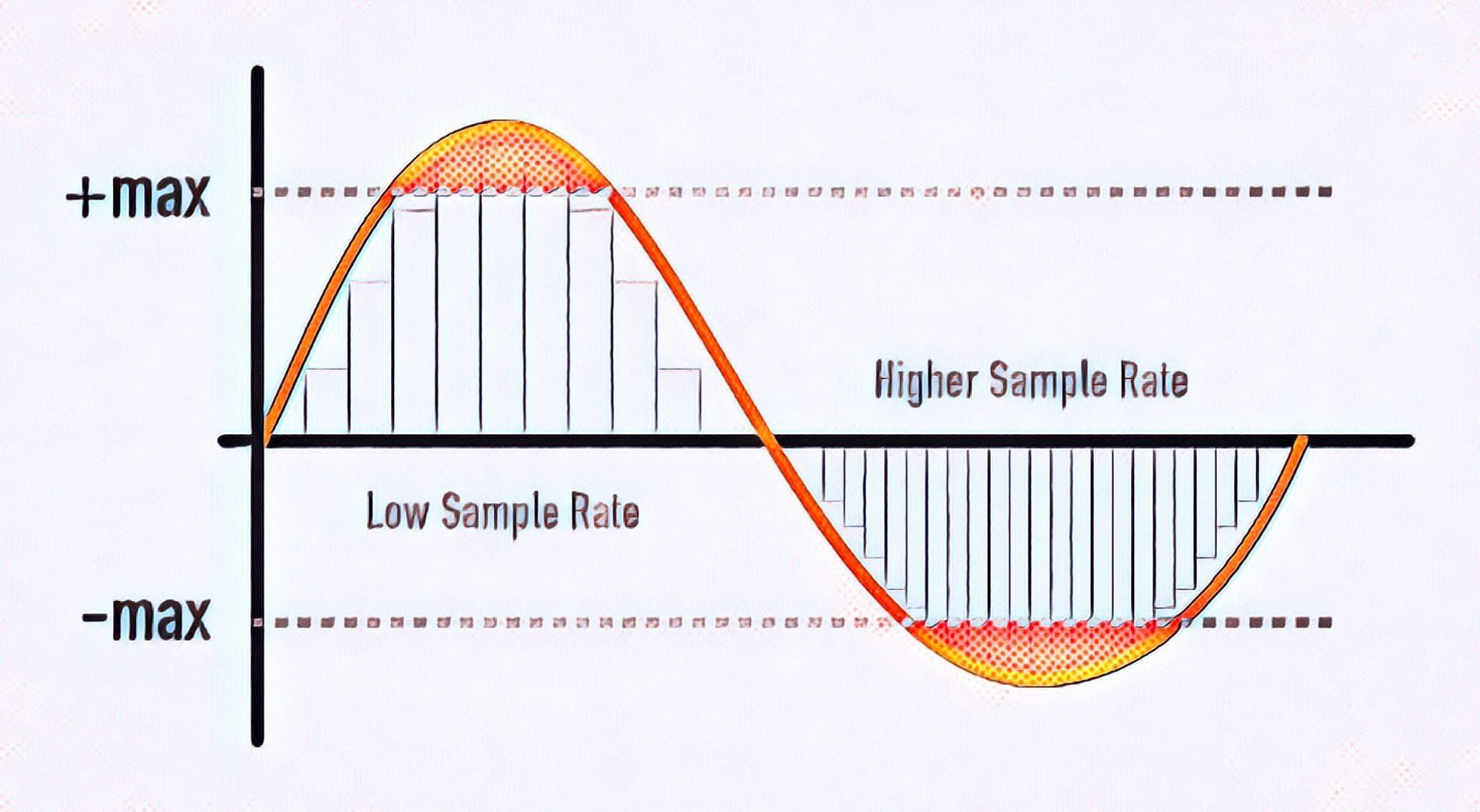
44100Hz represents the sample rate of the signal. The so-called sampling consists of obtaining the value y of the sound wave at the current moment every unit of time. Sampling is the process of discretizing continuous data (converting an analog signal to a digital signal).
image source

The sampling method mentioned above is called PCM (Pulse Code Modulation). According to the Nyquist-Shannon sampling law, the sampling rate must be at least twice the highest target frequency. The hearing range of the human ear is about 20Hz-20,000Hz (if you’re curious how loud you can hear, you can click here to test your ears), although recording software often has a 48,000 option Hz, but we can safely conclude: 44100Hz can meet almost all our needs, higher is just a waste of your memory and CPU. More than 48,000 samples are meaningless to the human ear, which is similar to 24 frames per second on a movie. 44100Hz happens to be the standard sample rate for almost all music released. In fact, for vocals and many instruments, high-frequency sounds are noise, so high sample rates can sometimes worsen sound quality (which is why we need to adjust the equalizer).

320 kbps represents your bitrate/bitrate, which is shorthand for kilobits per second, which represents the size of the data used to describe sound. In CD (uncompressed audio file), the bit rate is 1411.2kbps, and the mp3 sound quality to achieve CD quality should be higher than 128kbps/44100Hz (128kbps can be said to be the most common bit rate). Generally, a higher number means better quality. The quality depends on many factors (such as the encoding algorithm). Many times we don’t need too high bitrate: our device can play mp3 and CD without difference (sound/sound card is normal).

What is bit rate? Knowledge of the MP3 audio format. Part 2

What is bit rate? Knowledge of the MP3 audio format. Part 2

bit rate
bit rate

Bitrate is a benchmark indicator of the efficiency of digital music compression.

bit rate.
bit rate

The bit rate represents the number of bits bps (bit per second, bits per second) transmitted per unit of time (1 second). We usually use kbps (in simple terms, it is per second) clock 1000 bits) as the unit. The bit rate of digital music on CD is 1411.2 kbps (ie recording 1 second of CD music requires 1411.2 × 1024 bits of data). The higher the bit rate of the music file, the more data (Bit) must be processed in a unit of time (1 second), and the better the sound quality of the music file. However, when the bit rate is high, the file size increases, which will occupy a large amount of storage capacity. 8 to 320 kbps.

1. WMA (Windows Media Audio, Windows Media Audio)

As a Microsoft media compression method, it is a part of the technology that only compresses audio data in Windows Media Technologies. The sound quality is similar to MP3 and can be compressed with half the technology of MP3. It has the copyrighted Windows Media Rights Manager and can be played by installing it in WMP (Windows Media Player, Windows Media Player). Due to the strong influence of Microsoft and Windows, as well as major copyright reasons, the major American record companies, EMI and BMG, officially confirmed that they use the WMA method developed and produced by Microsoft. It is believed that this advanced method will become even more popular in the future.

2. MP3 (CBR, VBR, ABR)

MP3 is currently the most widely used and widely used lossy compressed digital audio format. It has been explained above and will not be repeated here.

CBR (constant bit rate)

CBR is the oldest and simplest MP3 encoding (compression) method. When this method is used for encoding, the bit rate of the entire file is the same, in other words, the bit rate used by the MP3 file per second is the same. Although the music file has sections of varying complexity, the encoder always keeps the bitrate constant, unless you use the highest sound quality; otherwise the sound quality of the different sections of the MP3 file will vary. The more complex the passage, the worse the sound quality. Its biggest advantage is that the file size is fixed, which is convenient for calculating storage space.

VBR (Variable Bit Rate, Variable Bit Rate)

VBR is a variable encoding rate MP3 compression method. Its principle is to encode the complex part of a song with a high bit rate and the simple part with a low bit rate. Through this dynamic adjustment of the encoding rate, the sound quality can be improved. additionally obtained and the size of the file. Its main advantage is that the entire song can approximately meet our sound quality requirements, but the disadvantage is that the size of the compressed file cannot be estimated during encoding.

Most MP3 players released now support VBR, but although some machines can play songs in VBR format, they can’t display the playing time correctly. Nowadays, a lot of high-quality MP3 music is encoded in VBR.

What is bit rate? Knowledge of the MP3 audio format.

What is bit rate? Knowledge of the MP3 audio format.


bit rate
bit rate

Digital audio formats are audio signals that are recorded, processed, and reproduced in digital form.

bit rate
bit rate

The emergence of digital audio formats is to meet the needs of high-fidelity playback, storage and transmission. Simply put, early analog audio formats had issues with playback distortion and glitches due to media wear. Since the advent of the CD, digital format audio files have become popular, but another problem has arisen: the limitation of the storage volume, and the CD still has the phenomenon of wear. Saving to hard drive (relatively longer storage time) is not a good solution when storage media (mainly hard drives) are still expensive at the time. The rise of the Internet has created a requirement for long-distance file transmission. Under the restriction of bandwidth, the demand to reduce file size has become more intense. All this has led to the generation of lossy compressed digital audio formats from external factors!

In terms of internal factors, with the improvement of computing and coding capabilities, the progress of various acoustic psychological models has promoted the emergence of various lossy compressed digital audio formats. Some of the most commonly used audio formats in MP3 players are briefly introduced below: MP3 (CBR, VBR, ABR), WMA, WAV, ADPCM, and the emerging audio formats AAC, ASF, and OGG.

Before introducing various digital audio formats, let’s clarify one concept: bitrate.

In the field of computing, all information is digitized. Bit is the smallest unit of data in a computer, it refers to a number of 0 or 1, which is a mathematical binary number, a “0” or “1” , is a bit. For example, when we say a 2-digit number, it means that it is a two-digit binary number, and there are 4 combinations of “00”, “01”, “10” and “11”, which represent 0, 1, 2 and 3 is four numbers.

How to distinguish the sound quality of Mp3 songs?

How to distinguish the sound quality of Mp3 songs?

Mp3 quality

Factors that affect audio quality are the number of channels, the sampling rate, and the number of quantization bits.

Mp3 Quality

It’s not directly related to file size, I think friends who have used Audition or play more music will be more familiar with it.

-Number of channels

Channel count is easy to understand and is often referred to as channel count. Usually we talk about left and right channels, single and double channels, which refers to the number of channels.

The music that we listen to often in life is basically two-channel, that is, the left and right channels. Generally speaking, the higher the number of channels, the better the audio quality. Then the stereoscopic feeling of the sound will be stronger. It will feel more real. When a person speaks or an object makes a sound, the sound also spreads in all directions, and of course there are more than two channels. So, in fact, it is difficult for digital audio to achieve real sound realism.

-Sampling frequency

For example, when Audition exports audio files, there is a sample rate option. What exactly is this sample rate?

Sampling rate is explained in official words: the number of samples per unit of time (within 1S). The higher the sample rate, the more data it collects and the better the sound quality.

But you will find that music in real life is generally 44100HZ sampling rate, like the lossless music in the picture above. So there are so many miscellaneous sample rate options in the image below. What does this mean? The reason is that the audible sound range of the human ear is between 20 and 20,000 Hz. Even if you increase the sample rate, it will still sound the same to ordinary people, so there is no need.

-Quantization bits

This is also very understandable. It’s like the number of bits that people often say about the computer. Audio also has the concept of bits. A common number of bits for audio is 16 bits. Generally speaking, the higher the number of bits, the better the sound quality. The popular understanding of quantization is to digitize the sampled value, that is, in the binary form recognized by the computer.

The property display in Windows may not display these parameters intuitively, but you can see them with the help of tools. Sound quality is determined by the above three aspects. Instead of looking at the size of the file. Of course, the audio is basically compressed and transcoded when it is broadcast to the audience. After all, high volume digital audio is not conducive to broadcasting.


FAQ

How to distinguish the sound quality of an mp3?

It is important to look at several elements to distinguish its sound quality. Of course, first is the quality of the recording, then the bitrate and samplerate.

Your can improve the sound quality of an mp3?

It is possible, using Mp4Gain, to improve the perception of the quality of an mp3 or any other audio or video format. In addition to modifying the bitrate and sample rate, we can modify the “color” with an equalizer and even slightly modify the pitch and of course normalize the audio.

MP3: quality standard?

For many, dematerialized music rhymes with illegally downloaded MP3.

If this comment is often true, since illegal music sharing platforms have made mp3 the primary format for music playback, you obviously need not limit yourself to the single mp3 format.

Mp3

MP3: birth of a format

The MP3 was democratized on the music exchange platforms of the time like Napster, Kazaa, Emule … in the late 90’s and for good reason they allowed you to download an entire album in a few minutes by compressing the music and thus shrinking the files.

Therefore, it is the need to exchange files and shorten the download time (remember we were paying the internet at that time according to your connection time …) making the development of mp3 essential and for many synonymous with dematerialized music.

The MP3 principle is therefore simple and attractive on paper: enable file sharing by drastically reducing the weight of files (more than 90%), and only by keeping what the human ear can do. listen, that is, the frequencies between 20 Hz and 20 kHz.

MP3: bad reputation

Unfortunately, the main consequence of this thin race is that the quality deteriorates: every mp3 has a compression level. The higher it is, the more the musical signal is cut off: this is called destructive compression: we eliminate all information that is considered useless and impossible to return.

Mp3

Therefore, during this period there was the spread of the famous 128 kbps MP3: this figure indicates the amount of information in the file and therefore its quality, the higher and better the sound will be. Therefore, some sort of standard has gradually been established around this bit rate of 128 kbps (kilobits per second), since it is inseparable as the quality of the CD at 1411 kbps.

mp3 – Napster

The Napster interface, one of the first illegal music sharing programs. Note the music ratio at 128 kbps (see less …)

It is clear that we do not reduce the amount of musical information by 90% with impunity and the results are often poor, the quality of the mp3 with 128 kbps is much lower and perfectly noticeable from the original CD. Then the new bit rates of 160 kbps, 192 kbps, 256 kbps and 320 kbps came to maximum, then “VBR” formats for “Variable Bit Rate” and against CBR (constant bit rate)) used earlier: we decreased the bit rate at rest and increased if necessary.

Therefore, we can see that it is difficult to pronounce the MP3 format in general: the results will be very different between a 128 kbps CBR mp3 and a 320 kbps VBR and, to a large extent, for the latter, for the price of one double weight.

Alternatives to MP3

MP3 is not the only dematerialized music format, it is first necessary to divide the compression formats into two categories:

Destructive Compression Formats: We remove content to reduce its size

MP3: the readable standard for 100% of music devices released in 20 years

AAC: Used by Apple in the iTunes music store (Apple Audio Codec), almost as universal as MP3

Ogg Vorbis: a free, efficient yet non-standard format

WMA: Microsoft format, not very standard either, except on Windows PC (can Microsoft have anything to do with it?)

Non-destructive compression formats: we compress the data for storage and decompress it when reading, therefore the sound reproduction is lossless, but it generates files 3 times larger:

FLAC: Free Lossless Audio Codec, it is somewhat the equivalent of Ogg in that it is royalty free and has established itself as the current standard for non-destructive formats (lossless in English)

ALAC: The Apple version of FLAC, which has also been in free form for some time, has the advantage of being compatible with the brand’s products and computers and offers the same benefits as FLAC.

Mp3: Advantages of MP3

MP3 refers to an encoding format that is formally referred to as MPEG-1 Audio Layer III for digital audio. Designated MP3 or MP3 data that stores basic MPEG-2 audio data or MPEG-1 audio data that is encoded. They do not contain any completely different complexity than the format. Find out more about the MP3 file format and its benefits.

As worrying as audio compression is, MP3 is a lossy compression module for encoding data with the expectation of partial rejection and inaccurate approximations of the data. And this ends with a noticeable reduction in file size, now no longer like with uncompressed audio.

The small size and excellent audio quality led to the provision of song data on Highway Records in the 1990s. MP3 served as expanded storage capacity and bandwidth in these hardly expensive times.

In about a year, the MP3 format has addressed controversy surrounding song piracy and copyright infringement. Instead, this file format became a custom format with the advent of avid portable gamers, including smartphones.

How does this compression work? This compression reduces the precision of the explicit parts of the sound that people can no longer hear. This method is ceaselessly referred to as perceptual coding or psychoacoustic modeling.

Then the free time of audio knowledge is recorded with the extraction of the allocated memory. FFT and MDCT algorithms are used here. Unlike CD audio, this audio compression design can reduce file size by up to 95%. Every time you document a conversion at a fixed bit rate of 128 kb / s, the file size is 9% more realistic than the audio on the actual CD.

Advantages of MP3

Here’s a hint about one of the benefits the MP3 audio file format offers. For these benefits, you can also lift whenever you can safely move around in this format, or opt for a lossless option.

One of the main advantages of this file format is that you can document songs, speeches or conversations for hours without affecting the allocated storage space. Basically, up to 95% of the allocated storage space is allocated. And the most important thing is that fine audio is identical with completely different codecs that take a lot of assignment.

The small size of such audio data allows you to map hundreds of data onto a small memory card or memory card. In other words, you can also save more than 170 songs on a CD with a storage capacity of 700 MB. On the other hand, the CDDA option does not mean that more than 15 tracks can be saved.

Instead, due to the logic that the file size is extremely small, you don’t have to spend a lot of bandwidth every time you get a lot of songs. Therefore, MP3 is a great wish for all types of users.

The best thing about MP3 is that you can change the audio level you want based on the available memory allocation. It can also rise between 32 kbps and 320 kbps. On the other hand, indicate that the higher the bit price, the larger the file size.

Audio quality: Bitrate in MP3 files

In many cases the term Bitrate is used, which is the bit rate per second that a multimedia file (Audio or Video) has. Currently the MP3 music format is one of the most widespread (Although there are currently other more current formats such as OGG Vorbis, AAC, Flac, Monkey Audio, …) however the audio quality is variable, this is due to the characteristics with which the MP3 in question has been compressed, including:

Mode: It can be of two types mainly:
Mono: With a single channel (The right and left channel go together, not separated which gives worse audio quality).
Stereo: Two channels (Right and Left, improve audio quality).

Sampling frequency: Audio CDs use 44,100 Hz (22,050 Hz per channel), although there are higher frequencies such as 48,000 Hz used in DVDs and lower, the higher the frequency, the higher the quality.

Bits: Audio CDs have 16 Bits (Although MP3 can be compressed at a lower quality such as 8 Bits).

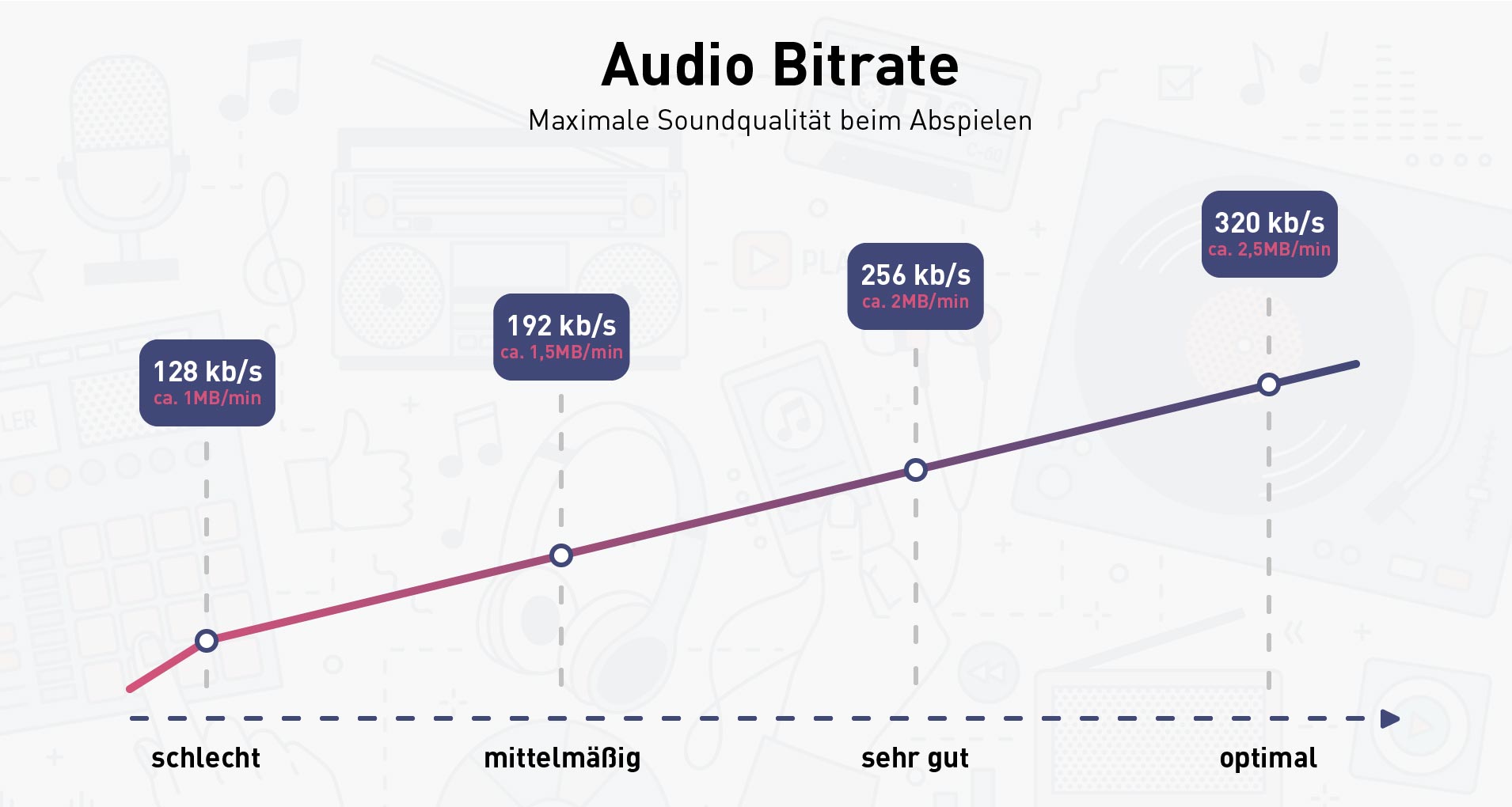
Bitrate (Bit Rate per second): Audio CDs have about 1,400 Kbps (44100 Hz * 16 Bits * 2 channels), meaning that an Audio CD would have a bitrate of 1,400 Kbps (In MP3 format the maximum Bitrate is 320 Kbps, however, it is assumed that an MP3 with a 128 Kbps Bitrate has a quality similar to CD, although in many cases to achieve a quality similar to CD it is necessary to use a Bitrate of 192 Kbps, and to obtain CD quality it is necessary use 256 Kbps or 320 Kbps).

Some of the most common Bitrates are:
8 Kbps Mono: Telephone Sound.
16 Kbps Mono: Better quality than shortwave.
32 Kbps Mono: Better quality than AM.
64 Kbps Stereo: Better quality than FM.
112 – 128 Kbps: Quality close to CD.
160 Kbps: Quality closer to CD.
192 Kbps: Virtually CD quality.
256 Kbps: Quality CD practically undisputed from an original CD.
320 Kbps: CD quality.

Coding method: It can be of two types:
VBR (Variable Bit Rate, Bit Rate Variable): Encodes the file in MP3 with a variable Bitrate.
CBR (Constant Bit Rate, Constant Bit Rate): Encodes the MP3 file with a fixed Bitrate.
In addition, another factor that influences the encoding of the MP3 file is the CODEC (Encoder-Decoder) used, one of the most common and the best result is LAME (Lame Ain’t an MP3 Encoder) which is also free.
One point to keep in mind is that if we recompress an MP3 file that originally has a 128 Kbps bitrate and convert them to 192 Kbps for example, audio quality is not really gained because the MP3 format has some quality loss (MP3 is a loss algorithm, also called lossy). which has occurred when converting the original file (Ex: CD Audio or a 320 Kbps MP3 to a 128 Kbps MP3) so this recompression does not make much sense since we will not gain in audio quality (As they say where there is no one can not get) and the only thing we will achieve in any case is to increase the initial size of the file.
The opposite case (Recompress a 320 Kbps MP3 file for example at 192 Kbps) if it makes some sense because in this case although we lose some audio quality we reduce the weight (Kilobytes or Megabytes) of each MP3 file somewhat.
In conclusion, it can be said that if we need to encode / compress an MP3 file with good quality, the “ideal” would be to do so:
To be able to start from an Audio CD, although an MP3 at 320 or 256 Kbps could also be valid for a recompression of the file.
In stereo mode (With two channels, right and left).
With at least 44100 Khz sampling rate and 16 Bits.
With a minimum bitrate of 192 Kbps or at most 256 Kbps (Using 320 Kbps would give higher quality but also increase the file size considerably).