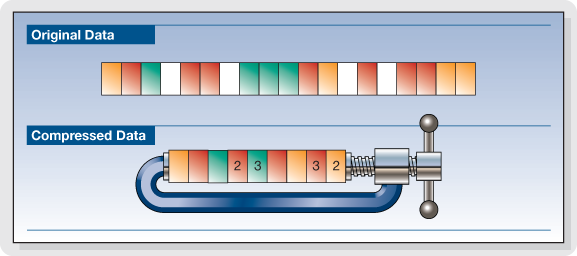
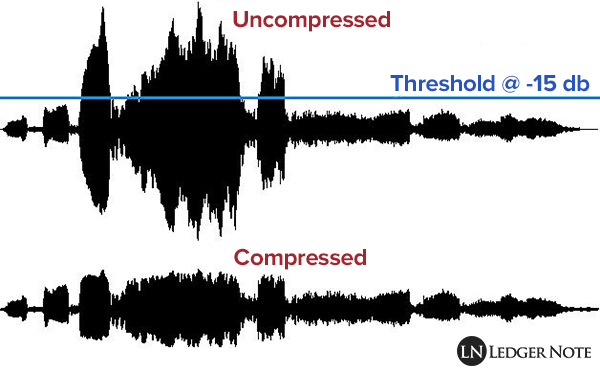
Today we use music almost exclusively digitally. It has become quite normal for us too that we always carry our music collections, often many thousands of titles, with us. Stored on a chip somewhere in our smartphone or MP3 player. It is thanks to the so-called audio compression that this was possible in the first place.
initial situation

Noises and tones, such as birdsong or the ringing of church bells, are analog events with an extremely wide spectrum. A good example of this is a bell. If it is struck, we think we only hear one note. In fact, its ringing consists of around 200 individual tones. These contain soft and strong tones, as well as frequencies that are outside our hearing range.
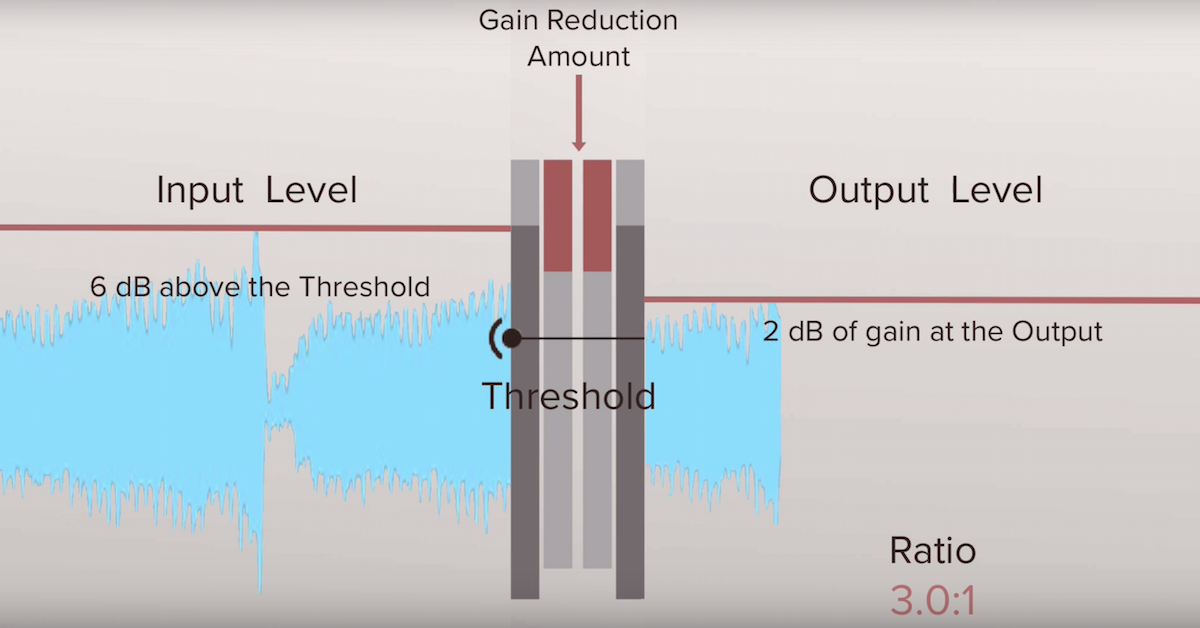
It is no different with music. However, the human ear can only perceive tones above a certain basic volume, so the thresholds for low, medium and high tones are very different. The ear is most sensitive in the tone range of human speech at around 3 kilohertz (kHz). The lower or higher tones have to be much louder for us to perceive them. The volume threshold, at which we begin to perceive sounds, is called the silent hearing threshold. A strong sound covers a lower one if its pitch is the same or similar.
For example, a 1 kHz high tone from an organ pipe can be heard clearly, while one or more soft tones that are close to each other in frequency are masked by higher ones. Although they are there, we still cannot perceive them. The secret that many hifi fans still trust the old record is that it stores all the tones and frequencies just as they are emitted by 1: 1 musical instruments. It also contains those tones that, strictly speaking, we cannot even perceive consciously. we still cannot perceive them.
The secret that many hifi fans still trust the old record is that it stores all the tones and frequencies just as they are emitted by 1: 1 musical instruments. It also contains those tones that, strictly speaking, we cannot even perceive consciously. we still cannot perceive them. The secret that many hifi fans still trust the old record is that it stores all the tones and frequencies just as they are emitted by 1: 1 musical instruments. It also contains those tones that, strictly speaking, we cannot even perceive consciously.
The essential
There are many standards for audio compression, such as MP3, AAC, or WMA. They are all based on the same fundamentals. The processes use the psychoacoustic effects of human auditory perception. All audio information that the human ear cannot perceive is filtered out of the data stream and therefore not saved. MP3 and Co make use of these human hearing effects by using mathematical analysis methods to determine and filter the imperceptible sound information.