What is digital audio?


Free Download Mp4Gain
picture

What is digital audio?
Digital Audio
Digital Audio

How does digital audio work?

Digital Audio
Digital Audio

In our daily lives, we listen to all kinds of music, and most of this music is transmitted in digital form, whether it is listened to or downloaded to a computer or played on an MP3 or CD player. Of course, you will often see various formats like MP3, WMV, APE, etc., but do you understand the meaning of these formats? Below I have compiled some of this content for you, I hope it helps you.


1. Introduction to digital music


Digital audio sources, that is, digital audio formats, first referred to CDs. After the CDs were compressed, a variety of formats suitable for playback on Walkmans were derived. These compressed formats can be divided into two categories: there is lossy and lossless compression. The compression mentioned here refers to converting the audio stream encoded in PCM or WAV format to other formats after special compression processing, so as to achieve the effect of reducing the file size. Lossy/Lossless refers to whether the sound signal retained in the new file is reduced compared to the original PCM/WAV format signal after compression.


PCM encoding is short for PulseCode Modulation, also known as Pulse Code Modulation, which is one of the digital communication encoding methods. The sampled value is rounded and quantized according to the hierarchical unit, and the sampled value is represented by a set of binary codes to represent the amplitude of the sampled pulse.

The final form of the digital audio signal is still made up of “0/1”. They can be any permutation and combination, such as “0001110101” or “11100001010”. Of course, different combinations have different effects. Seeing this, some friends should have noticed. If the sound is recorded in the form of “00101010”, then the final form is not a “dot”, that is, a simple “change” process. The sound is continuous, how can it be recorded with “dots”? Shouldn’t the sound we hear be segment by segment? The reason is not difficult to understand. Go home and turn on the fluorescent light, can you find the fluorescent light flickering? can not? In fact, fluorescent lights flicker constantly. Have you seen cartoons? They are all connected by a grid of still images. We can also simply understand the images one by one as “dots” one by one. Man against nature

There are limits to the sense of the world, both visual and auditory. The reason cartoons can produce coherent motion is that these “dots” are an illusion that people create when human vision doesn’t respond in time. With the exception of machines, people cannot distinguish these “dots”. So is the sound. If the frequency of the sound flicker is very fast, people cannot distinguish it. Also, when the sound performs a “digital conversion of analog signals” (D/A conversion), the decoder chip has already connected these “dots” coherently, so we hear a very coherent sound.


Free Download Mp4Gain
picture


Mp4Gain Main Window
picture


Mp4Gain Features
picture


Free Download Mp4Gain
picture

Audio digitization: how it works

Audio digitization: how it works

Audio digitization


How to translate sound into 0s and 1s without soul? . Let’s take a look at familiar devices: how computer sound, video, MP3s, streaming and streaming work, various algorithms, and more.

Audio digitalization


a bit of physics
Sounds are vibrations in the air. Like waves in the water, in the air. Air pressure enters the ear, which has sensitive parts that can subtly sense vibrations in the air. These vibrations are perceived by people as sounds. There is no sound in outer space because there is no air.

frequency. The faster the vibration, the weaker the sound we perceive. A person perceives vibrations that range between 20 and 20,000 vibrations per second. In other words, this is called the oscillation frequency: Hertz. That is, the range we hear is from 20 Hz to 20 kHz.

By comparison, dogs hear frequencies from 40 Hz to 60 kHz, so humans don’t perceive a dog’s whistle, but dogs can hear it. The sound of a dog whistle is only in the 23-54 kHz range.

amplitude. The stronger the vibration, the stronger the sound and vice versa. You can think of this as the height of the waves on the surface of the pond: there may be small ripples (soft sounds) or there may be large powerful waves.
Divide the sound into segments.


Now let’s do this: We divide the second part into 4 parts and find the magnitude value for each part:


We measure the state of the quadratic wave in one second. This is called sampling.

We measured the magnitude of each of the four points and, in relative terms, we got four numbers: +30, -50, -50 and -60. In theory, if we were to pass current and apply these four voltages to the speaker, we would be able to reproduce the same sound. But there are several problems:

• Since we only measure in four places, all oscillation is lost.
• We ended up with a very distorted sound compared to the original.

Sampling at a rate of 4 is too little for the sound. To get at least intelligible speech, one second must be divided into 8,000 segments, and for music, 41,000 segments are usually sufficient.

Let’s increase the sample rate: cut the sound into smaller parts in the same unit of time:


Measurements are now more accurate and the resulting sound is more natural.

convert to number
After dividing the sound into small segments and measuring the amplitude value of each segment, we can record it in table form:

Time ⠀⠀⠀⠀⠀ Amplitude

0.01 seconds. ⠀⠀⠀⠀ 5

0.02 seconds. ⠀⠀⠀⠀ 7

0.03 seconds. ⠀⠀⠀⠀ 10

If we divide the whole sound into equal segments, then the time cannot be written, since we know how it changes, it is enough to write the amplitude value on a line:

5 7 10 … −21

Digital audio: a simple but deep explanation about digital audio. Part 1

Sound is a phenomenon that implies a propagation of waves generally produced by a vibratory movement of a body. The propagation of sound implies a transport of energy without carrying out a transport of matter.

digital audio

As the sound is produced by a wave movement when applying the Fourier transform we can express it by a sum of sinusoidal curves that correspond to pure tones that can be characterized by the magnitudes of any wave such as:

-Period It is the time elapsed between two equivalent points of a wave.
– Wavelength It is the real distance a wave travels from its highest point to the next equivalent point.
-Frequency It is the magnitude that measures the number of repetitions in a space of time.
-Amplitude It is the distance between the furthest point of the wave with the equilibrium point.

These magnitudes give the sound a series of characteristics such as:

-Duration: Determines the length or short of the sound due to the time, measured in seconds, it occupies.
-Intensity: Determines the high or low sound due to what we know in relative terms as volume, which is measured in decibels (it is a logarithmic scale).
-Timbre: Determines the proper nuance of each instrument or sound source due to the different harmonics that compose it.
– Hue: Determines the acute or serious sound due to the frequency it has. The frequency is measured in hertz (Hz).

If we carefully consider it, we will see that the initial concept of Mp3Gain was intensity, which is measured in decibels and represents the loudness we perceive.

digital audio

Digital audio

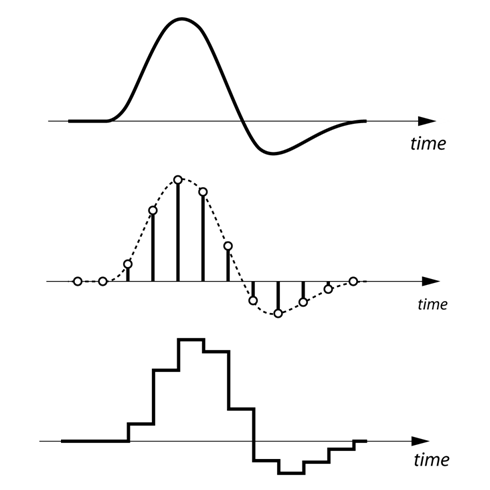
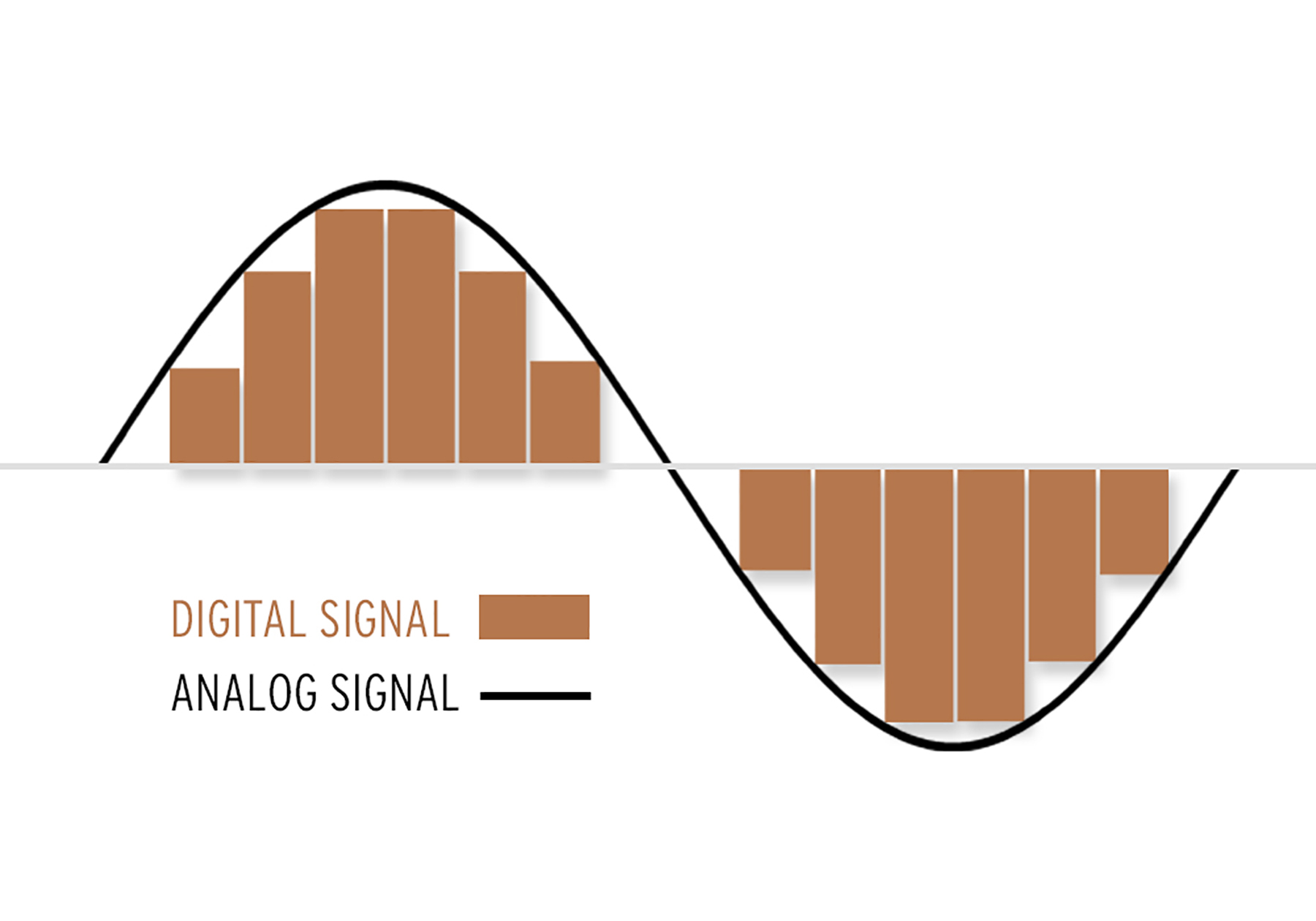
Digital audio is the digital coding of an electrical signal that represents any sound wave. This electrical signal is picked up for example by a microphone, which takes the sound whose nature is analog and transforms it into electricity that still has the same type of analog nature, then through the necessary hardware and software it can be transformed into binary information, turning Something continuous in discreet. This process involves two tasks: sampling and digital quantification of the electrical signal.

Within the digital audio there are different types of formats to represent the audio:

-PCM: They contain all the information received from the analog to digital converter, without any omission of data. This makes the type of formats that have the best quality in the digital world. WAV is an example of this type of format in question.

-Compressed: It is similar to the previous one, but specific compression techniques are used in which “non-essential” information can be lost to reduce the size of the final file. They usually have good quality in relation to the weight of the file, but as noted above, information is lost, so those with sufficiently developed / trained ears might perceive that there is something strange in a song for example. On the one hand we have formats such as MP3 and OGG that compress with loss, compared to FLAC that compresses without loss. Obviously between one format and the other there is a notable difference in the size of the final file.

-Descriptive: They are used primarily to make music and contain mainly a description of what would be the “score” of the song. With this description, the algorithm, which reproduces the song, can take a sound source with samples of the instruments that the composition needs, to synthesize the final sound based on the indications of the “score”. Examples of this format are MIDI and tracker formats (MOD, XM, IT, etc.). The difference between MIDI and tracker formats is that the latter bring built-in sound sources into the file, so the final file weighs more than using MIDI. However, with MIDI we will need to obtain a sound source on our own or use the one that brings the default sound card (which is not usually too good).