Mp3: What is it really?
MP3 is a data format that gets its name from an algorithm
encoding called MPEG 1 Layer 3, which, in turn, is an audio compression system that allows you to store sound with a quality similar to that of a CD and with a very high compression ratio, on the order of 1:11
In practice, this means that about 11 audio CDs can be recorded on a CD-Rom, that is, approximately 150 songs.
The encoding system that MP3 uses is a loss algorithm. That is, the original sound and the one that we obtain later are not identical.
This is because MP3 takes advantage of the deficiencies of the human ear and eliminates all the information that we are not able to perceive. A multitude of studies of acoustic perception have been carried out, discovering that there are a series of effects that can aid the coding of sound with the aim of reducing as much as possible the amount of useless or redundant information. The most important are: The limits of hearing. Our ear only works with frequencies that go between 20 Hz and 20 Khz
approximately, so the remaining frequencies are disposable.
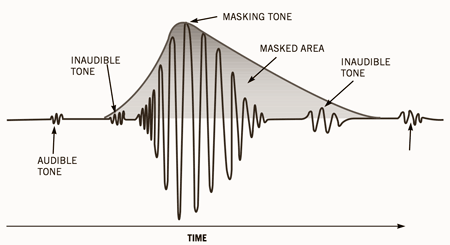
Masking effect.

It is one that occurs when two signals of similar frequency are
overlap. So we can only perceive the one that
it has more volume and, therefore, the one with a smaller volume is
liable to be removed
Stereo redundancy.

There are redundancies between the tonal and non-tonal components of the sound on the two stereo channels, and furthermore
below a certain frequency the human ear is not capable of
perceive the directionality of the sound, so below these
frequencies it is even possible to encode a single channel together with
complementary information to restore the spatial feeling for the other channel.
To carry out this “loss of information” action, a system called Subband Coding is used, a process by which the signal is broken down into subbands through a filter bank.
These subbands are then compared to the original using a psychoacoustic model that is responsible for determining which bands can be removed and which cannot.
Depending on the quality we want to obtain, more or less will be eliminated
bands. To end the process, the resulting subbands are quantized and encoded, and the final result is compressed using a standard algorithm, thus obtaining the resulting MP3 file. The encoding process is much more complicated than the decoding process, so it takes much longer to encode an MP3 file than to play it.
This perceptual coding algorithm was developed by the company MPEG (Moving Picture Expert Group) in conjunction with the Franunhofer Institute of Technology, and has been standardized as an ISO standard.