Improve quality of mp3s Part 3


Free Download Mp4Gain
picture

Improve quality of mp3s Part 3

MP3

Be aware of the difference between bit rate and bit depth!
Bit rate: amount of information per second
Bit depth: amount of information per sample divided by the sample rate
In other words, the calculation is “bit rate = bit depth x sample rate”.
What values ​​can be set when exporting MP3? What is the best export configuration?

MP3

~ What items can be set when exporting MP3? ~

When exporting MP3, you can set the following two items πŸ’‘

Bit rate: 16 kbit ~ 320 kbit
Sampling frequency: 32,000 Hz, 44,100 Hz, 48,000 Hz
For example, if there are no specifications in a competition and you want to export with good sound quality with mp3, let’s export with “320kbit, 48,000Hz” πŸ’‘

What is the best setting to reduce capacity and export with good sound quality?
The capacity is small!
Sound quality is good!
So if you want the capacity to be as small as possible but also the sound quality as best as possible, which setting is better to export?

The sample rate is generally 44,100 Hz.
Use ~ 44,100Hz! ~

In the video industry, 48,000Hz is mainstream, but in music, the sound quality is high enough if it is 44,100Hz, which is used for CD.

In the blind test, it is said that about half of the people can distinguish between them and in addition, there are two options, so even if you answer properly, there is a chance that you will win about half.

The bitrate is around 128 kbit, which is the limit between good and bad.
~ 128 kbit or more is recommended! ~

Even if the bit rate is reduced to around 128 kbit, the print does not change much and the roughness does not appear.

If you lower it to reduce capacity, “about 128 kbit is a guideline” πŸ’‘

If you want to reduce the capacity and stick to the sound quality, it is better to select 128 kbit ~ 192 kbit and 44,100 hz to export.
~ 44,100Hz 128kbit ~ is the best!

For those who want to reduce capacity and focus on sound quality, it is better to set the sample rate to 44,100hz and the bit rate to 128-192kbit πŸ’‘

MP3s also have export settings. What are the settings for exporting with even slightly better sound quality? summary of
MP3 stands for “MPEG 1 Layer 3” compression method
Depending on the compression settings, the capacity may be reduced by 1/10 or more.
MP3 removes sound components that are inaudible to humans, thus maintaining sound quality.
Set “bit rate” and “sample rate” when exporting
The sample rate is “number of samples per second”
Bit rate is “amount of information per second”
Bit depth is “amount of information per sample”
The best sound quality settings for MP3 export are 48,000hz, 320kbit
44,100Hz, 128 ~ 196kbit is the setting that balances capacity and sound quality when exporting MP3.
MP3s are often used to check demos and save space πŸ’‘

Even if you have exported it casually, put it in the corner of your head that there is a setting for MP3 export, and when you need it, remember it and use it


Free Download Mp4Gain
picture


Mp4Gain Main Window
picture


Mp4Gain Features
picture


Free Download Mp4Gain
picture

Improve quality of mp3s Part 2

Improve quality of mp3s Part 2

MP3

In other words, MP3 can be said to be a sound source file that was originally created by removing only the sounds that are difficult for humans to hear and without modifying the other sounds.

MP3

It is a commercially useful file format because it sounds very nice even if the capacity is small πŸ’‘

About MP3 Export Settings

When exporting MP3, the sound quality changes greatly depending on the bit rate (amount of data per second) and the sample rate (number of samples per second).

The sample rate determines how many divisions per second
~ How many divisions per second? ~

The sample rate determines how many divisions of information are handled per second.

At 44,100Hz, which is common, one second of information is divided into 44,100 samples, and at 44,800Hz, it is divided into 48,000 samples πŸ’‘

If you divide the sample into smaller samples, the information will be seamlessly connected, and if the information is approximate, it will be staggered.

Bit rate (kbit) determines the amount of information per second
~ Amount of information per second ~

On the other hand, the bit rate (bit) determines “the amount of information a sample has in one second”.

soon,

Bit rate = bit depth (1 sample information) x sample rate (number of samples per second)

For example, the bit rate of a 16-bit 44,100 hz wav file is 705.6 kbit.

Note that the bit rate is sometimes called “bps (bits per second)” because it is the number of bits per second πŸ’‘

caution!

* Bit depth is used in WAV export settings, etc. which is very similar, but the bit depth is the amount of information per sample. Be careful because it is confusing!

Improve quality of mp3s

Improve quality of mp3s

MP3 quality

MP3 is often used as a compressed sound source when the capacity of uncompressed files like WAV and AIFF is large and inconvenient, but in fact, you know that depending on the settings like bit rate and sample rate, it can “write with fairly high sound quality”. mosquito?

mp3 quality

This time about such MP3

Setting to export with high sound quality
Settings to export with good sound quality while saving space
Misleading Bitrate and Bit Depth Differences
I will also present on such things ^ – ^ No

1. What is MP3?
1.1 How do MP3s reduce their capacity?
2. About the MP3 export settings
2.1. The sample rate determines how many divisions per second
2.2. Bit rate (kbit) determines the amount of information per second
2.3 What values ​​can be set when exporting MP3? What is the best export configuration?
3. What is the best setting to reduce capacity and export with good sound quality?
3.1. The sample rate is generally 44,100 Hz.
3.2 The bit rate is around 128 kbit, which is the limit between good and bad.
3.3. If you want to reduce the capacity and stick to the sound quality, it is better to select 128kbit ~ 192kbit and 44,100hz to export.
4. MP3 also has export settings. What are the settings for exporting with even slightly better sound quality? summary of

What is MP3?
What is MP3?
MP3 is a compression technology (file format) that can reduce the capacity by 1/10 or more compared to the uncompressed compression method called “MPEG 1 Layer 3”.

It is also used when you want to save data capacity or when you collect a large number of songs in contests.

How do MP3s reduce their capacity?
~ How do MP3s reduce their capacity? ~

There are three reasons why MP3s can compress the capacity of a sound source πŸ’‘

Eliminate data in the “ultra high range (16 kHz or higher)” that is not as audible to humans at all frequencies.
It removes the data of small sounds that cannot be heard because they are erased by loud sounds for each frequency.
Humans cannot hear the small sound that plays immediately after the loud sound, so they cut it off.

What is MP3?

What is MP3?

MP3

“MP3” widely used in audio players. The official name is “MPEG-1 Audio Layer III”, which is the audio format for MPEG-1. The MP3 format itself is being standardized in parallel with MPEG as the video format, and in 1992 it will be standardized as “ISO / IEC IS 11172-3 (MPEG-1 Audio)”.

MP3

After that, MP3s will be distributed “as is” among enthusiasts, but this has not been a major advance since the introduction of the portable “mpman” audio player launched by SAEHAN International in South Korea in 1998. By combining this player, which can download and play music data over the Internet, with Napster, which appeared in 1999, the scene of portable audio players that used to carry cassettes, CDs, MDs, etc. it will change completely.

MP3s can also reduce the original data to less than one tenth. For example, it has become possible to compress a one-hour music CD to about 40MB and, using Napster, etc., we have established a new need for music sharing between users. After that, despite various “RIAA (Recording Industry Association of America)” procedures and the emergence of successor formats formulated by many manufacturers, MP3s remain a widely used audio. It is still used as a format.

β–  MPEG

To understand the working principle of MP3, let’s first explain about “MPEG Audio” itself. A feature of MPEG Audio is that it uses auditory psychology, the lower audible limit of hearing, and the masking effect.

Let’s start with this minimum audible limit. In general, it is considered that humans can hear sounds in the range of 20 Hz to 20 kHz. Of course, this is an average value, and some people can hear a wider range, while others can only hear a narrower range, but this time I’ll drop it.

So if you can hear any sound in the 20Hz to 20KHz range, that’s not the case. The lower audible limit curve is shown in Fig. 1, and it is possible to hear even a fairly low sound around 2KHz, but at frequencies above or below it, it is heard that it is not considerably loud. .

You may have heard the term “volume curve”, which is the curve shown in Figure 1. Therefore, even if there is a sound source that sounds in a wide range from bass to treble (Fig. 2 ), the human ear has the characteristic that it can only be heard with both ends drooping (Fig. 3). By taking advantage of this and omitting all inaudible frequency data, a great deal of compression is made possible.

Masking effect

The masking effect is another phenomenon. For example, when a very loud sound is generated at a certain frequency, a specific area called “Critical Band” is created before and after that. And you won’t hear any of the other sounds included in this critical band.

When sound A is generated, the sloping area that extends to the before and after frequencies is the Critical Band. I can hear the part of the B sound that sticks out of the Critical Band without any problem, but I can’t hear the C sound that completely fits into the Critical Band.

In MPEG Audio, compression efficiency is further improved by omitting sound data that cannot be heard due to this critical band as before. By the way, the masking effect itself is effective not only in the direction of frequency but also in the direction of the time axis. In other words, not only immediately after a loud sound is generated, but also just before that, you cannot hear a small sound for some reason. This is called the temporary masking effect, but in Figure 5, sound B and sound C become inaudible. This is also effective for data compression.

The mp3 phenomenon

The mp3 phenomenon

MP3

The MP3 music format (MPEG-1 Layer 3) is one of the most widely used digital audio formats in the world. It is compatible with all portable and stationary audio devices. In May 2017, the developers of the format announced his “death”.

mp3

On April 23, 2017, the Technicolor and Fraunhofer IIS licensed commercial program was canceled: the last patent included in the program expired, making the format standard in the public domain. Can we say that the days of the most popular format are numbered? MP3 development began in the late 1980s at the Fraunhofer Institute for Integrated Circuits (IIS).

In 1987, the University of Erlangen-Nuremberg and Fraunhofer IIS teamed up to work on the EU147 EUREKA Digital Audio Broadcasting (DAB) project. The first result of the alliance’s work was the LC-ATC codec, which made it possible to encode stereo music in real time. The next step was the development of an optimal frequency domain (OCF) coding algorithm, which already had some of the characteristics of the future MP3 codec. For the first time, it is possible to encode music in good quality at 64 kbps for a mono signal. OCF was the beginning of the path towards the standardization of MPEG (Moving Picture Expert), an organization, responsible for the development and implementation of international standards for the compression and transmission of digital video and audio content.

In 1989, MPEG received 14 proposals for the implementation of an audio coding standard, so participants were invited to combine their developments. This led to the emergence of four potential candidates, including MUSICAM from the Institute of Broadcasting Technology IRT and Philips and ASPEC (Adaptive Spectral Perceptual Entropy Coding), which is the result of further enhancements to OCF Fraunhofer IIS, as well as contributions from the University of Hannover in collaboration with AT&T and Thomson. After extensive testing, MPEG proposed combining MUSICAM and ASPEC to create a family of three encoding methods: Level 1: a low-complexity version of MUSICAM; level 2 – MUSICAM codec; Level 3 (later called MP3): based on ASPEC.

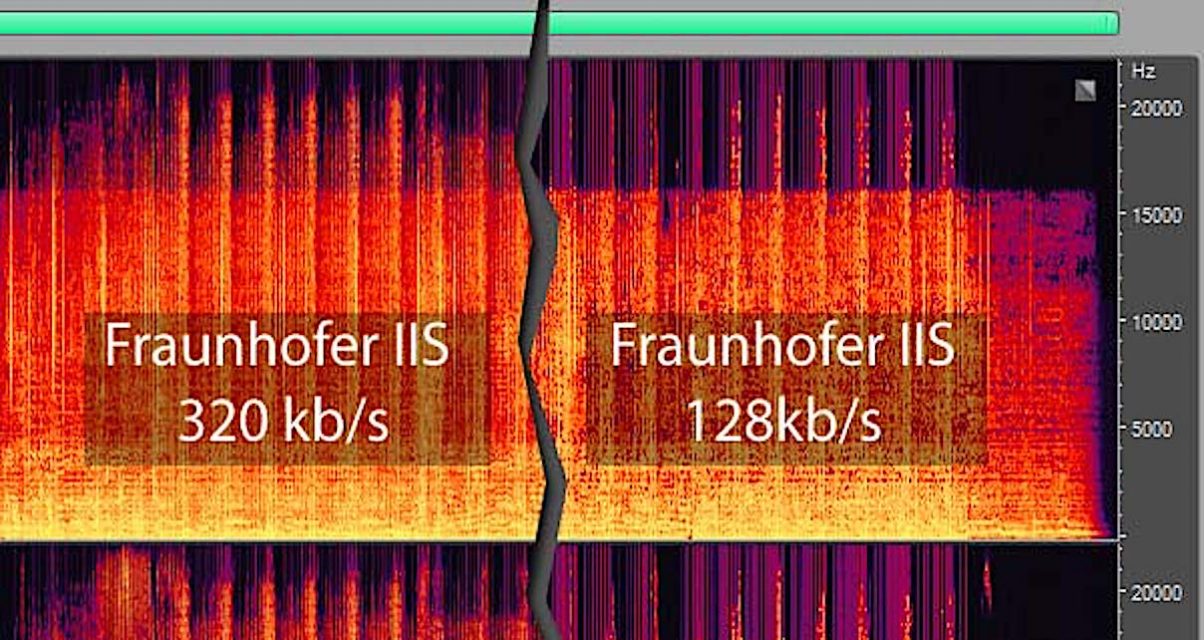
Technical development of the MPEG-1 standard was completed in December 1991. In 1994, Fraunhofer IIS introduced the world’s first MP3 encoder, the L3enc, and in 1995 the Fraunhofer researchers unanimously accepted “.mp3” as the file extension for MPEG Layer 3 [1]. Thanks to the compression algorithm used in the MP3 audio format, the size of the data required to reproduce the recording and ensure the quality of sound reproduction is significantly reduced to 10-12 times the original, depending on the recording bit rate. . Bit rate refers to the encoding / decoding rate of a digital audio stream; sound quality improves with increasing bit rate. The MP3 format has the following bit rates: 32 kbps (very low quality, acceptable only for voice), 96 kbps, 128 kbps (medium quality), 160 kbps, 192 kbps, 256 kbps, 320 kbps (highest best quality). The principle of the compression algorithm is as follows: during the compression process, the audio codecs analyze the signals, focusing on the audible fragments, which are saved for later playback or transmission.

This rules out sounds beyond the perception range of the human ear (20 to 20,000 Hz). That is why MP3 is called lossy. There are three ways to encode MP3 files: constant bit rate (CBR), variable bit rate (VBR), and medium bit rate (ABR). CBR is the default encryption mode. In this mode, the bit rate is constant for the entire file. This means that each part of the MP3 file uses the same number of bits. Regardless of the complexity of a piece of music, the encoder uses the same bit rate, so the quality of the final file is variable. Complex parts will be of lower quality than simpler ones. The main advantage of this mode is that the size of the final files does not change and can be accurately predicted.

When encoding in VBR mode, the user selects the desired quality on a scale of 9 (lowest quality, highest distortion) to 0 (highest quality / lowest distortion). The codec then tries to maintain a certain quality throughout the file by choosing the optimal number of bits for each part of the audio recording. The main advantage is the ability to specify the level of quality to be achieved, but a significant disadvantage is the unpredictability of the final file size. In ABR mode, the user sets the bit rate and the encoder tries to keep the average bit rate constantly while using higher bit rates for the parts of the music that require more bits. The

Size and quality of MP3 files

Size and quality of MP3 files

MP3 File

The MP3 file format is an “open format” supported by most manufacturers.

mp3 file

The MP3 format is one of the most common digital audio encoding formats. One feature of MP3 audio encoding is lossy encoding. However, the coding is based on a special model that takes into account the peculiarities of auditory perception. Therefore, the presence of losses does not lead to catastrophic sound degradation.

MP3 files have become a de facto standard and are compatible with the most popular operating systems, many CD and DVD players, and other devices.

Interestingly, the standard describes the actual storage format and not the way the sound is encoded. As a result, there are many tools available to play MP3 audio.

Special codecs are used to encode audio in MP3 format.
An audio codec can be of two types: hardware codec and software codec.

Hardware coding is done by special microcircuits.
Software coding is done using special computer programs.

Audio quality in MP3 format (all other things being equal) depends on the compression ratio (read the amount of loss) and the encoding program. That is why brand name players using well-known brand codecs and audio signal processing systems are significantly superior in playback quality to conventional devices assembled from standard assemblies.

The quality of actual playback depends on the size of the media data stream. The amount of data stream is sometimes called the stream width. There is a special term: bit rate. The data flow rate is defined in kilobits per second and is denoted kbs, kbps, kb / s. Recording can be encoded in several ways: constant bit rate and variable bit rate. Variable bit rate helps preserve details by increasing the amount of data.

Not all bit rates are suitable for high-quality music playback

Compress mp3 without losing quality

Compress mp3 without losing quality

Mp3

On lossless music compression, theory, practice, conclusions.
With this material, I want to open a series of articles with everything related to listening to music on a computer. The time has come to share experiences and summarize disparate articles on the Internet in one, although they are not intended to be precise, but relatively brief. In the first part, we will see the audio formats. What is FLAC, WavPack, TAK, Monkey’s Audio, OptimFROG, ALAC, WMA, Shorten, LA, TTA, LPAC, MPEG-4 ALS, MPEG-4 SLS, Real Lossless? Do you know how many types of audio files are registered today? So far, we are dealing with lossless compression formats for audio materials, and the answer to the question about the number of audio extensions is at the end of the article. Happy reading!

mp3

So first, let’s define the terms:

“An algorithm is a precise prescription that defines the computational process that goes from variable inputs to the desired result.”

β€œCodec (codec in English, of encoder / decoder – encoder / decoder – encoder / decoder or compressor / decompressor) is a device or program capable of converting data or signals. Codecs can encode a stream / signal (often for transmission, storage, or encryption) or decode, to view or change into a more suitable format for these operations. Codecs are often used in digital video and audio processing. Most codecs for audio and visual data use lossy compression to obtain an acceptable final (compressed) file size. There are also lossless codecs ”.

“Lossless data compress. – method of data compression, using encoded information that can be restored in one bit. This fully recovers the original data from the compressed state. As a rule, each type of digital information has its own lossless compression algorithms “.

Lossless data compression is used when the identity of the compressed data with the original is important. Common examples are executables, documents, and source code. Programs that use lossless compression formats are called archivers, everyone knows the most popular ZIP or RAR file formats, the Unix Gzip utility, etc. All these programs differ in the applied algorithms (one or more) and therefore in different compression properties of different files.

Part I. – THEORY:

Compression methods or lossless compression algorithms can be classified according to the type of data for which they were created. There are three main types of data: text, images, and sound. Basically any multipurpose lossless data compression algorithm (multipurpose means it can handle any type of binary data) can be used for any type of data, but most of them are inefficient for all basic types. Audio data, for example, cannot be compressed well with a text compression algorithm and vice versa.

Compression methods include the following: entropy compression, dictionary methods, statistical methods. Each method is good for a specific type of data and includes several algorithms.

Entropy compression: Huffman algorithm Adaptive Huffman algorithm Arithmetic coding (interval Shannon-Fano algorithm) Golomb codes Universal Delta code (Elias Fibonacci)

Dictionary methods: RLE Deflate LZ (LZ77 / LZ78 LZSS LZW LZWL LZO LZMA LZX LZRW LZJB LZT)

Statistical algorithm models for text (or textual binary data as executable) include: Burrows-Wheeler transform (block sort preprocessing that makes compression more efficient) LZ77 and LZ78 (used by DEFLATE) LZW.

Is it possible to improve the quality of an MP3?

Thanks to MP3 we can listen to our favorite music everywhere. When you put your MP3s on a USB stick, you can listen to your favorite music in the car, for example. But you can also put MP3 music on your smartphone. Allowing you to listen to music whenever possible.

MP3 quality

But sadly, it still happens that the quality of an MP3 is not really what it should be. In this article, we look at the options to solve that problem. So that you can not only listen to music everywhere, but also enjoy it everywhere.

Mp3 quality

What exactly is an MP3 music file?

Mp3 is a method of compressing digitally stored music. Uncompressed storage of a stereo digital music file takes up a lot of disk space. An average of 10MB of disk space per minute of recorded music.

However, compressing a music file and saving it as MP3 will leave only one-tenth the size of the original file.

Since the introduction of the CD, music has been recorded digitally in the form of samples or measurements. Sound is neither more nor less than vibrating air. These vibrations are also known as sound waves. Sound waves can be measured, recorded, and stored.

However, when sound waves are produced creatively, then it is music.

The number of vibrations per second determines the pitch of the sound. A large amount of vibrations creates a high tone, a small amount of vibrations for a low tone.

The number of vibrations per second is expressed in hertz. The human ear can perceive sounds between 20 Hz and 20,000 Hz.

It was once scientifically discovered that in order to record the highest pitch, a measurement must be taken 44,100 times per second. Therefore, the number 44,100 is the sample rate in hertz that is required for good quality recording.

In addition to high and low tones, a piece of music also contains high and soft passages. The difference between the loudest and the softest passages is called the dynamic range. For the dynamic range of a piece of music to be recorded digitally, you can choose 256 steps (8-bit) between the softest part and the hardest part or 65536 steps (16-bit).

The dynamic range is highest when recording with 16-bit samples or 65536 steps.

If we then do some math with this data, we see that 44,100 measurements are needed for one second of music. Each measurement (sample) is 16 bits (2 bytes) in size. That means 1 second of music takes up 88,200 bytes or 88Kb of disk space.

But since we like to listen to music in stereo, we can multiply that number by 2. For example, one second of music in stereo takes up 176 Kb of disk space and therefore 10 MB per minute.

When a compressed MP3 file is created from an original music file, this is done using a lossy compression method.

Lossy compression causes data loss. With an MP3 file, this means that information is omitted from the file that is beyond the reach of the human ear.

Humans are most sensitive to sounds between 2 kHz and 4 kHz. And we cannot hear loud and soft sounds simultaneously. Therefore, it is only necessary to keep the loud sound. In technical terms, this is called psychoacoustic masking.

What determines the quality of an MP3?
The MP3 format was developed by the German research institute Fraunhofer ISS. In addition to utilizing the limitations of human hearing just mentioned, the format consists of several mathematical formulas. This makes it possible to reduce the original file by a factor of 3 to 12.

The degree of compression is related to the bit rate. Bit rate is the amount of data that is processed per unit of time. This means, among other things, that the more data there is in one second of music, the larger the MP3 file will be. But also the better the sound quality of the MP3.

A bit rate of 64 to 96 kbps is enough to talk. A bit rate of 128 kbps is used for a good quality music file. Excellent quality can be achieved with a bit rate of 192 kbps or higher, with a maximum bit rate of 320 kbps.

A bit rate of 192 kbps or higher is only useful if the recording quality of the track is also excellent.

Obviously if you want the mp3 to sound even better, use Mp4Gain to mormalize mel volume, to correct the equalization and to make a series of changes or improvements.

MP3 quality – too compressed for hi-fi sound?

Audio quality

When it comes to the subject of “MP3 and sound quality”, one is entering a minefield. Hi-fi fundamentalists claim that many people no longer know what good sound really is because of MP3s. The accusation is not entirely unfounded, because MP3 is a lossy format. However, you shouldn’t make it too easy for him with judgment. After all, there is no uniform standard for MP3 quality. Another important question is: what about the sound quality of other formats?

audio quality

What “lossy” means for the sound quality of an MP3 file

MP3 and other lossy audio formats such as AAC may have been lost. to. designed with the aim of saving storage space. Because at the time of its development, the storage capacity of hard drives was much more limited than it is today, and the download and upload rates were also insufficient for large amounts of data. Today, the bandwidth for streaming and wireless transmission over Bluetooth are limiting factors. So compression still has to be. How is the amount of data reduced compared to the original recording?

On the one hand through compression and on the other hand through the omission of certain sound information. Because not everything that is captured in a recording also becomes the compressed file. To limit the effects of data loss on MP3 quality, only information that is acoustically insignificant is ignored. To be more precise: particularly low frequencies and particularly high tones are cut off. Because people can only perceive extreme highs and lows up to a certain point or not at all.

That’s how high MP3 quality really is

A general evaluation of the quality of MP3 sound is complicated by the fact that there are different levels of quality. They are the result of the respective bit rate (data rate, “bit rate”), specified in kilobits per second (“Kbit / s”). 64 Kbit / s as well as 128, 192, 256 or 320 Kbit / s can be implemented. The following applies: The higher the value, the less data loss will be compared to the source material.

A rule that is mentioned from time to time states that from a bit rate of 192 kbit / s data loss is no longer important for auditory impression. The file format alone says little about the quality of the audio signal.

But there is no clear limit. Factors like music genre, system, and last but not least individual hearing all play an important role when it comes to evaluating the quality of an MP3 file. There are also differences between the audio formats: a file encoded in AAC at 192 kbps tends to provide a better listening experience than an Ogg Vorbis file with the same data rate.

What is the sound quality on Spotify and other music streaming services?

Some 20 years after its invention, MP3 is still the most widely used audio format on the Internet. However, there are other formats that play an important role in music playback today. An example of this is the patent-free Ogg Vorbis format mentioned above. The streaming giant Spotify also relies on this.

Other audio formats used by streaming services are:

  • Apple Music: AAC
  • Spotify: Ogg Vorbis
  • Google Play Music: MP3
  • Deezer HiFi: FLAC

Streaming providers are quite reluctant to provide information on the respective data rates. When the service launched, Apple Music announced that the streams would be streamed at a bit rate of 256 kbps. With Spotify it is 320 Kbit / s with high sound quality, also with Google Play Music. At lower quality levels, the bit rate drops below 200 Kbit / s. However, providers of lossless transmission clearly exceed these values: Deezer, for example, announces its high fidelity subscription with 1,411 kbit / s. The stream here is in lossless FLAC format.

What exactly is an MP3 music file?

Mp3 is a method of compressing digitally stored music. Uncompressed storage of a stereo digital music file takes up a lot of disk space. An average of 10 MB of disk space per minute of recorded music.

However, if you compress a music file and save it as MP3, only a tenth of the original file size remains.

mp3 quality

Since the introduction of the CD, music has been digitally recorded in the form of samples or measurements. Sound is no more or less than vibrating air. These vibrations are also known as sound waves. Sound waves can be measured, recorded and stored.

However, when creative sound waves are produced, there is music.

The number of vibrations per second determines the pitch of the sound. A large amount of vibration produces a high tone, a small amount of vibration produces a low tone.

The number of vibrations per second is expressed in Hertz. Human hearing can perceive sounds between 20 Hz and 20,000 Hz.

Once it has been scientifically established that to capture the highest tone, a measurement must be taken 44,100 times per second. Therefore, the number 44,100 is the sampling frequency expressed in hertz needed for a good quality recording.

In addition to the high and low tones, a piece of music also contains hard and smooth passages. The difference between the highest and smoothest passage is called the dynamic range. For dynamic range on a digitally recordable track, you can choose 256 steps (8 bits) between the softest and loudest part, or 65536 (16 bits).

The dynamic range is highest when recording with 16-bit samples or 65536 steps.

If we then add a calculation to this data, we see that it takes 44,100 measurements for a second of music. Each measurement (sample) is 16 bits (2 bytes) in size. That means that 1 second of music takes up 88,200 bytes or 88 KB of disk space.

But since we like to listen to music in stereo, we can multiply that number by 2. For example, a second of music in stereo already takes up 176 Kb of disk space and, as said, 10 MB per minute.

When a compressed MP3 file is made from an original music file, it is done with a lossy compression method.

Data is lost on lossy compression. With an MP3 file, this means that the information is outside the file that is beyond human hearing range.

For example, people are more sensitive to sounds between 2 kHz and 4 kHz. And we can’t hear loud, soft sounds at the same time. Therefore, only loud sound needs to be preserved. In technical terms, this is called psychoacoustic masking.

What determines the quality of an MP3?

The MP3 format was developed by the German research institute Fraunhofer ISS. In addition to taking advantage of the limitations of human hearing just mentioned, the format consists of a series of mathematical formulas. This allows you to reduce the original file by a factor of 3 to 12.

The amount of compression is related to the bit rate. Bit rate is the amount of data processed per unit time. This means, among other things, that the more data there is in a second, the larger the MP3 file will be. But also the sound quality of the mp3 will be better.

For speech, a bit rate of 64 to 96 kbps is sufficient. A bit rate of 128 kbps is used for a good quality music file. Excellent quality can be achieved with a bit rate of 192 kbps or higher, with a maximum bit rate of 320 kbps.

A bit rate of 192 kbps or higher is useful only if the recording quality of the track is also excellent.

Check the quality of an MP3

Unfortunately, the quality of MP3 music is not always good. This applies, for example, when an MP3 comes from a somewhat unknown source. But of course you can also make an MP3 from a recording that is not very good in itself.

Generally, if you create MP3s from music on your own CDs or other sound media, you can guarantee the quality of the MP3s simply by choosing the appropriate settings in the software you are using.

However, if you get MP3 music in other ways like downloading from the internet for free, it will be a slightly different story.

Then you have to settle for what you get. With the knowledge of this article, it is already much easier to distinguish a low quality MP3 from a good quality MP3.

Something that can be useful. Because there is not much good to do of poor quality.
In summary, we can say that a good MP3 meets the following requirements:

-The MP3 file must have a bit rate of 128 kbps.
A higher bit rate is only desirable for excellent recordings.
-The recording quality must be good.
-The recording quality can be checked by listening to each MP3 before buying and / or downloading it. Preferably with headphones. This gives you the best impression of sound quality.

The MP3s that you buy online, for example at the Apple Store, are usually of good quality. Usually, it is the MP3 files you download from other sources that you should carefully check and listen before using them.

Music you download from sources other than online stores will definitely end up in the Downloads folder.

You can check the MP3 music downloaded from the Internet as follows:

Launch File Explorer and navigate to the Downloads folder.
To display only MP3 files in File Explorer, type: * .mp3 in the search box. This search will show you all the files in the Downloads folder with the extension .mp3.
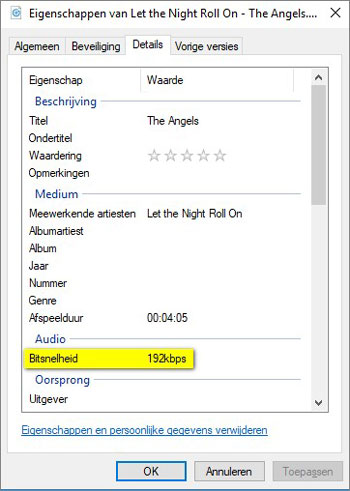
Right-click on the MP3 file you want to check and click Properties in the context menu that opens.
The [Music file name] property window is then displayed. The Details tab shows the exact bit rate of the MP3.

When you close the Properties window and double-click the selected MP3 file, the corresponding MP3 file will be loaded into your PC’s MP3 player and played.
That’s basically all you can do. A bad MP3 is impossible to improve on. Converting music to an MP3 file not only compresses but also removes data from the music file that you have been able to read.

And the lower the bit rate, the more data is generally lost and impossible to recover.

This means that when you have downloaded a low quality MP3 file, you have no choice but to search for a better quality MP3. The same goes for an MP3 whose recording quality is not very good.

Collecting the best possible MP3 files takes some effort. But this effort will be amply rewarded once you start listening to your favorite music, and the sound quality will certainly contribute to the actual enjoyment of the music.