What is the difference between 128k and 320k music? Part 2


Free Download Mp4Gain
picture

What is the difference between 128k and 320k music? Part 2
Bit Rate

In simple terms, we can think of a sound wave as a curve.

Bit Rate

We know that the curve is made up of points, and the sampling rate is the number of points in the middle of the length per second (the horizontal axis in the figure above). Sampling precision is the number of points in the dynamic range (upper vertical axis). The finer the positioning of these two dimensions, the greater the true sound restoration and the better the sound quality. Of course, the larger the audio file will be. The customer mentioned by the above colleague said that the latest Hi-Res Audio format released by SONY is a 6-channel 192kHz/24-bit recorded audio file. The size of the lossless format, of course, will be more than 200 megabytes.

The sampling frequency is approximately the following depending on the type of use (k is the thousand-bit symbol, 1khz=1000hz):

8khz: used for phones etc, is enough to record human voices.

22.05khz: transmission use frequency.

44.1kb: Audio CD.

48khz: used in DVD and digital TV.

96khz-192khz: used for DVD-Audio, Blu-ray HD, etc.

The common range of sample precision is 8 bits to 32 bits, with 16 bits generally used on CD.

Having said that, my friends are starting to get confused. It’s not the bitrate that determines the sound quality, so why is everyone saying that 320kb sound quality is better than 128kb?

【Audio Compression】

Well, in fact, the bit rate should be said to be another dimension, it is a compression of audio files.

Nowadays, most of the audio formats we use regularly are based on the original “WAV” file of the audio CD (44.1khz sample rate, 16bit sample precision, 2ch). The original recorded sound data is stored in a matrix, which is in PCM format, while WAV format is an encoding format developed by Microsoft. Its function is to reproduce the data in PCM format through encoding.

Since the data in WAV basically completely restores the PCM data, MP3, AAC and other lossless encoding formats are basically recompressed based on the WAV files. Therefore, we can simply think that WAV is the original audio format and other audio formats are compressed formats.

When it comes to compression, storage and transmission are inseparable. The purpose of compression is to improve storage and transmission, so before we talk about compression, we need to understand the basic units of computers.

We all know that the computer is a binary number system, and the files stored by the computer are made up of two numbers, 0 and 1. Therefore, the computer’s transmission is based on each number, and each number is called 1 ” bit”. For example, for an audio piece, its basic data is “0,1,1,1,0,1, 1 ,0”, and when transmitting, these numbers are transmitted one by one. The sampling precision mentioned above is this unit.

The storage unit of the computer is “byte (Byte)”. In the computer, 1 byte consists of 8 bits, that is, 8b(bit)=1B(Byte). In computer parlance, data storage is expressed in decimal and data transmission is expressed in binary, so 1KB=1024B=1024×8b. This is also part of the reason why the hard drive capacity we see does not match the actual capacity.

Go back and talk about audio compression, the bitrate of the audio is actually the compression ratio. So the bitrate really just defines the size of the file, but because under normal conditions the larger the file, the less data you lose, so the sound quality is relatively higher. However, the bit rate itself does not directly affect the quality of the file. For example, if we take a 128kb file as the source file, even if it is converted to a 320kb file, the sound quality will not be better than 128kb. .


Free Download Mp4Gain
picture


Mp4Gain Main Window
picture


Mp4Gain Features
picture


Free Download Mp4Gain
picture

What is the difference between 128k and 320k music?

What is the difference between 128k and 320k music?

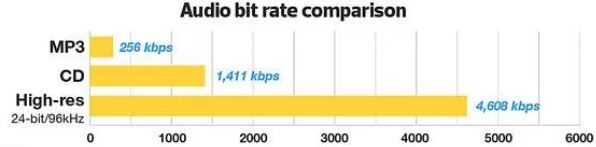
Bit rate comparision

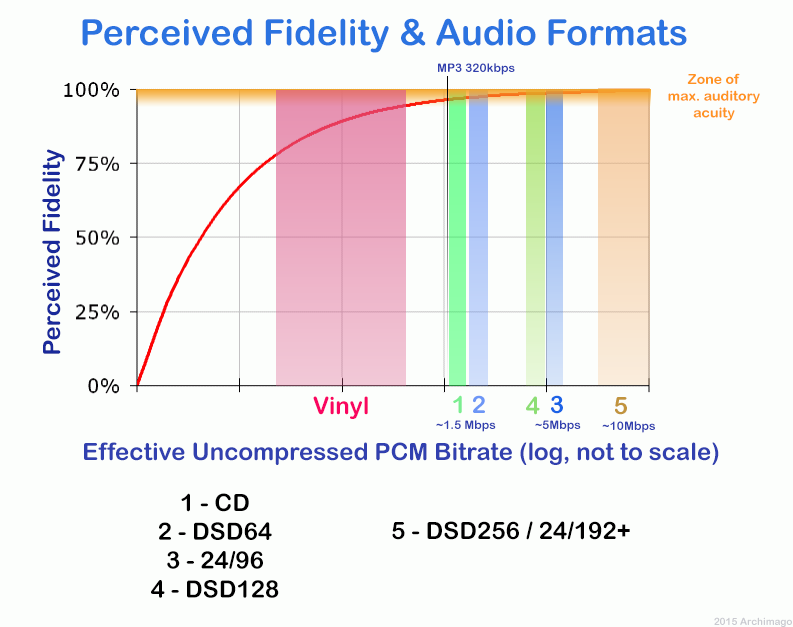
192k is a turning point. Below 192K, the sound quality is relatively damaged, especially the high-frequency part above 16Khz will be cut off.

bitrate

In a nutshell, mp3s above 192k can no longer be listened to with CD sound quality on ordinary home devices, except for Golden Ears and Hifi devices. Of course, these data are not 100% reliable. There are always people on the internet sharing fake mp3 above 192K. In fact, they are converting low bitrate music to high bitrate through software, but the sound quality will not improve. be improved. Windows Media Player compresses it. The resulting mp3 is absolutely wonderful, no matter how high the compressed bitrate is, it will cut perfectly around 16K.

Some time ago, a colleague came across a very troubled client. The mess was said to have been caused by the client asking him to provide song files larger than 100MB-200MB in size. And my colleagues don’t know much about audio formats, so they started endlessly fumbling about FLAC, WAV and audio size. In the end, the colleague did not explain to the client what was going on.

After that, other things happened that made me feel that in the music industry there are too many practitioners around me who have an extremely poor understanding of music and even lack some basic knowledge related to music. I don’t even have the idea to understand, which makes me very sad. It seems that music has only one merchandise attribute, and our practitioners only need to organize the shelves, encode various merchandise, and use the big data of users’ purchase records to recommend merchandise to users, no matter why to users. they like this. features that these products have, and use cold data to provide users with various services.

Therefore, I think it is necessary to write something. I don’t expect practitioners to become people who really love music. I just hope that even if you still think of “her” as a commodity, you can first figure out what you’re selling. and what is..

PS: The content of the first lesson is about media files. Since the relevant content involves a lot of technical stuff, it seems a bit boring, but if you read it carefully, you will find that it is actually very easy to understand, but this basic knowledge can be very helpful.

Bit Rate, Sample Rate, Lossless, MP3, FLAC, APE, 320kb, 192kb, 128kb, 44.1khz, CBR, VBR. Does this bunch of various names make you both familiar and unknown?

The higher the bitrate, the better the sound quality. Lossless music is the highest sound quality, right? So, let’s start with the sound collection.

【Audio composition】

Nowadays, when we talk about audio, everything is digital audio. Digital audio consists of three parts: sample rate, sample precision, and number of sound channels.

Sample Rate: Both the sample rate, which refers to the number of samples per second when recording the sound, expressed in Hertz (Hz).

Sampling Precision: Refers to the dynamic range of the recorded sound, measured in bits (Bit).

Introduction to codec comparison

Introduction to codec comparison

Codec Comparison

Codec comparisons are pretty common on the internet … Long and not very, emotional and not very, clearly skewed and not very. But most of the authors of such comparisons simply cite images from two movies side by side, as if by conspiracy to ignore the following things:

 Codec Comparison

Any codec provides a different quality for frames in the same movie.
Different codecs are “sharpened” for different types of movies.
The compression quality of a particular movie can be highly dependent on the encoding parameters.
More details about each of the points:
1. Any codec offers a different quality for the frames of the same movie.
This is due to many factors. First, the codec uses a mechanism like bit rate control, which provides quality fluctuations even for good codecs. Second, the user himself chooses different bit rate strategies, and in the case of choosing CBR (or constant bit rate), the quality will be high in slow scenes and low in fast scenes. Third, the codecs have so-called. keyframes, whose quality usually changes separately and differs from the quality of the rest of the frames. Fourth, quality is affected by pre-filtering (which all modern codecs have) … Fifth … Sixth … Seventh … 🙂
This means that in any movie long enough (and the average movie is 150,000 to 200,000 frames), you can choose good and bad enough frames. Especially if one pass CBR compression was used on a fairly dynamic movie.

Those. having a long movie, codecs A and B (which are roughly equal in quality), and simple means of automating quality comparison (or a lot of religious devotion to your codec :), you can easily demonstrate with examples that A is noticeably better than B (“look at these frames!”), and that B is notably better than A (“look at these (other) frames!”). 🙂 What is being done “successfully” in large quantities. Both in press releases (a holy cause!) And on video processing sites.

The graph shows the quality in terms of PSNR (the higher the quality).
If comparing “spiky” frames, VP will be better than DivX, otherwise vice versa.

2. Different codecs are “sharpened” for different types of movies.
Many people know that DivX 4.1 LowMotion and DivX 4.1 FastMotion existed at some point. Although they played movies in the same way, their internal parameters were “fine-tuned” by one for weak movements and the second for strong ones. As a result, they harvested films of markedly different quality. Notice again: the FORMAT, in which they harvested, was one! And the compression was carried out in different ways! As a result, for the same file size, their quality is different. A similar “customization” for “your” data type is characteristic of absolutely all codecs. Someone better push high bit rates. Some are on the contrary low. Someone sharpens with a strong movement, someone underneath a weak one. And yet someone is getting better for cartoons and someone for real video. Someone under “noisy” movies, someone under “clean” movies, and so on. Having the source texts of the codec, it is possible without changing its format, that is, without changing the decompressor, sharpen it for almost any type of film. And this is used successfully in practice. This means that by having codecs A and B (of roughly the same quality), you can easily find movies where A will be noticeably better than B and where B will be noticeably better than A. At the same time, it’s funny that, formally, there may be a movie, just a DVD copy and a pirated “rag” copy taken from a theater screen can give noticeably different results in the two codecs. Those. the movie will be “one”, but the “best” (world) codecs will vary. 🙂 Having the source texts of the codec, it is possible without changing its format, ie without changing the decompressor, sharpen it for almost any type of film. And this is used successfully in practice. This means that by having codecs A and B (of roughly the same quality), you can easily find movies where A will be noticeably better than B and where B will be noticeably better than A. At the same time, it’s funny that, formally, there may be a movie, just a DVD copy and a pirated “rag” copy taken from a theater screen can give noticeably different results in the two codecs. Those. the movie will be “one”, but the “best” (world) codecs will vary. 🙂 Having the source texts of the codec, it is possible without changing its format.