Better audio formats


Free Download Mp4Gain
picture

audio formats

You have decided to digitize the music tracks in your audio CD collection by transferring everything to your computer, and in doing so you have begun to evaluate the possibility of converting them to a more pleasant format for you. However, having little experience in this regard, you would like to receive some advice on the subject so that you can make the best decision. How to say Things are exactly this way and would you like to know if I can help you by indicating what are the best audio formats? Of course yes, that was exactly what he intended to do.

If you allow me a few minutes of your free time, I can actually tell you, by thread and by sign, what are the most popular audio formats in circulation, their strengths and weaknesses and for what uses they may be more or less convenient to contact . condition to opt for those that you think may actually be right for you. To complete the information and to give you an even more complete description of the matter, at the end of the article it will also be my concern to indicate what tools you can use to perform various conversion operations. You will see that after reading this guide, you will no longer have any doubts about what to do.

So? How about putting the talk aside and finally getting to the heart of the matter? You? Brilliant! Therefore, I suggest not wasting any more time and immediately start focusing on the topic. Get comfortable in front of your trusted computer and read everything below. I am sure you can say that you are happy and satisfied with what you have learned. I wish you, as always, happy reading.


Free Download Mp4Gain
picture


Mp4Gain Main Window
picture


Mp4Gain Features
picture


Free Download Mp4Gain
picture

What is the best audio format?

What is the best audio format?

Many are known, but there is always the question of which is the best audio format. The main and most recognized for listening to music are MP3, Wav, FLAC and Ogg.

But, to choose the best audio format, you must first know that they have multiple conformations, and you can always choose the best one. Music always goes everywhere, at home in front of the computer, in a living room with a hi-fi system, with headphones on public transport or when playing sports. Music that gives a special meaning to each moment and that encourages when heard.

There are many ways to enjoy it, but it is usually always done in digital format. Within the audio files, there is a great variety and normally many still use MP3 for convenience. But there are alternatives that are less popular and that seek to offer a different and higher quality experience. For those who do not know it, there are a number of main sound systems.

The best audio format

Beyond that the MP3 format is the most popular of all available audio formats, it is not the only one. Some others like “FLAC”, “WMA”, “OGG” have certain characteristics that, depending on what you want, can be very useful on certain occasions.

In technology, audio formats can generally be classified into 2 categories. There are those that retain all the quality and those that lead to quality losses in sound or information.

Those that preserve the quality of the audio are those that come from pure sources such as CDs. This is how those who lose quality and sacrifice this information are to save space.

Formats that preserve audio quality

“FLAC” is Free Lossless Audio Codec or “FLAC”. It is one of the formats that best preserves the audio quality and its compression algorithm is excellent. It is open source, does not generate quality losses and the size of the file because it is compressed, is much smaller.

Apple Lossless is known as “ALAC” and is very similar to “FLAC”. The difference is that it is not as efficient, so these files are larger, although they still have the unconditional support of iOS, something that “FLAC” does not have.

“APE” is another and although the problem with this format is that it is not compatible with the vast majority of players, it is considered similar to the “FLAC” or “ALAC” format in terms of audio quality. As it is highly compressed, it makes the computer’s processor work faster and therefore it is not recommended to use it in low-power computing equipment.

“WAV” and “AIFF” are not compression formats, but rather exact copies of the original content and differ in the way they save data. “AIFF” was created by Apple and “WAV” is more universal, but both have too much disk space.

Formats with loss of audio quality

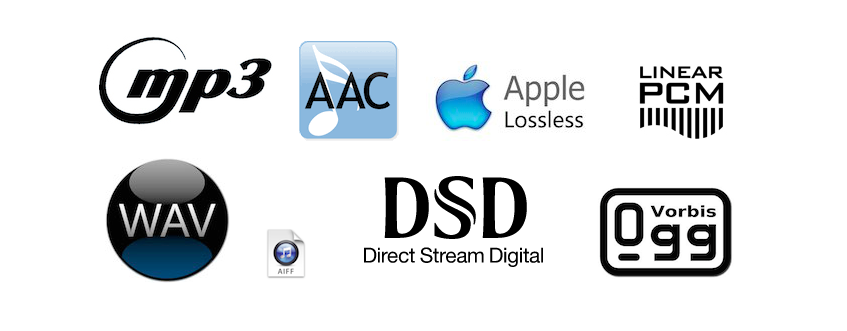
MP3, MPEG Audio Layer III or MP3, as many already know them, is the most common format that can be found. “ACC” is very popular on iTunes and is considered more efficient than MP3 since files in this format are smaller.

OGG Vorbis is one of the free and open source alternatives to MP3 and ACC. It is not restricted by patents, but it is also not supported by many players. WMA is Microsoft’s proprietary format and is very similar to MP3, but without great advantages over the others.

Which audio format to choose?

The one that is most recommended to choose is the “MP3” or “AAC”, since many players support them. Furthermore, if they are encoded with a high bitrate, they can hardly be distinguished from the original source. However, if what you want is to burn the music, formats such as “FLAC” are recommended, because then you can convert everything to other formats, without losing the audio quality.

Once the audio formats are known, when choosing, the differences between each one must be taken into account. In general, what experts recommend is to use “MP3” or “AAC” since they are compatible with most players and the quality of both is very similar to that of the original source, especially if it is encoded with a high bit rate. Unless you have a specific need, “MP3” and “AAC” are the most advisable options.

However, one thing to know is that to store music in lossless formats, there is no such thing as “FLAC”. You probably won’t notice a higher quality, but it’s good for storing music if you plan to convert it to other formats later. In these cases, “FLAC” is always recommended, and it is also possible to choose the format without loss or degradation of file quality.

As a final conclusion, it can be said that you should not be obsessed with the subject, but you just have to be sure of what you want and choose.

THE BEST AUDIO FORMAT

Sound as well as the image is a fundamental piece in an audiovisual production.

If you had to choose between these two extreme situations with which one you would stay.
A good image resolution, but with a sound of poor quality.
Poor image quality, but with a clear and defined sound.
The ideal is to have a good balance of quality between image and sound.

An audio format is a multimedia container that saves data an audio file.

Each of these has its own characteristics and capabilities to be able to be reproduced in one or another system.

They have a series of properties that greatly influence the quality of the file, including the speed or frequency of sampling and the bit depth of information.

AUDIO FORMATS ACCORDING TO ITS QUALITY

The best way to classify the large number of audio formats that exist, is depending on whether they have quality loss or not when compared to the original source of Sound.

Depending on this, we have:

Audio files without loss of compressed and uncompressed.
Files with loss of quality.

UNCOMPRESSED AUDIO FORMATS

These files contain the audio in the highest original recording quality even when it is processed and stored on a computer.

The main drawback is that they are relatively large, which means storing less audio files on a hard drive.

Two examples of uncompressed formats are WAV and AIFF.

The .WAV (Waveform Audio File Format) property of IBM and Microsoft is relatively similar to the AIFF (Audio Interchange File Format) co-developed by Apple Inc.

Both formats can be used in both operating systems.

They are very similar, the difference is that AIFF files allow metadata to be stored inside, that is, additional information such as:

Artist name.
Cover of the disk.
Copyright.
Different notes.
Not being compressed, they take up too much space, but without a doubt to edit the sound is the most successful option.

AUDIO FORMATS COMPRESSED WITHOUT LOSS

These types of formats achieve thanks to a series of algorithms smaller files without losing quality.

HOW CAN THEY COMPRESS WITHOUT LOSING QUALITY?

Uncompressed formats encode both the sound of a recording and the silences, a few seconds of sound from an audio file will weigh the same as the same seconds of silence.

These types of formats compress the file making the silence occupy almost no size.

Among these formats we have the FLAC (Free Lossless Audio Codec) which is the most popular, created by Windows, the ALAC (Apple Lossless Audio Codec) that was created by Apple Inc. and the APE format of Monkey’s Audio.

The three formats are very similar, the fundamental difference will be in its compatibility with the different players.

The FLAC file is the most popular because it is compatible with Windows and macOS, the ALAC created by Apple Inc is very exclusive and practically only works if we play it on iTunes.

Finally, the APE, a format only available in Windows that manages to compress more than the FLAC and the ALAC, but has the disadvantage that it is only compatible with a small number of players.

AUDIO FORMATS COMPRESSED WITH LOSS

Finally, we have compressed formats with loss of quality where you get a file that occupies less space by discarding some frequencies in the sound, usually parts of the audio that are inaudible to the human ear.

Among these formats we have the popular MP3, AAC, OGG and MP2 among others.

The MP3 file (MPEG Audio Layer III) is the standard format for sharing music on the network and the most popular of all since it is compatible with virtually all music players, making this the first option to choose between sounds at a loss.

AAC (Advanced Audio Coding) is similar to MP3, although a little more efficient, which means that files take up less space and have the same sound quality as MP3. It is a format widely used in iTunes and YouTube.

OGG (Vorbis) is a very popular open source compressed format in the spotify music application.

The MP2 is still used especially in radio and television transmissions, but it can be said that in other areas it has already been completely replaced by the MP3 that achieves greater compression with the same quality.

What is the best audio format for listening to music?

What is the best audio format for listening to music?

Although the MP3 format is the most popular of all available audio formats, it is not the only one, some such as FLAC, WMA, OGG and others, have features that, depending on what you want, can be very useful in certain occasions

Here I show you a summary of what to expect when you are looking for the best audio format to listen to music.

As a general rule, we can classify audio formats into two categories: those that retain all quality and those that lead to loss of quality in sound or information.

Those who retain all audio quality come from pure sources such as CDs, while those who lose quality sacrifice this information to save space.

Formats that preserve audio quality:

FLAC: Free Lossless Audio Codec or FLAC, for its acronym in English, is one of the formats that best preserves audio quality. Its compression algorithm is excellent and does not generate quality losses, it is open source and the file size when compressed is much smaller
Apple Lossless: known as ALAC is very similar to FLAC, but not as efficient as this, so these files are larger, although they have the unconditional support of iOS, which FLAC does not have

APE: The problem with this format is that it is not very compatible with the vast majority of players, but it is similar to the FLAC or ALAC format in terms of audio quality. Being very compressed makes the computer’s processor work faster so it is not recommended in low power computing equipment
WAV and AIFF: they are not compression formats, but exact copies of the original content, differing in the way they save the data. While AIFF was created by Apple, WAV is more universal, but both take too much disk space.

Formats with loss of audio quality:

MP3: MPEG Audio Layer III or MP3, as we all know them, is the most common format you can find
ACC: is more efficient than MP3, files in this format are smaller and is very popular on iTunes
OGG Vorbis: it is a free and open source alternative to MP3 and ACC, it is not restricted by patents but not supported by many players
WMA: this is the proprietary format of Microsoft very similar to MP3, without great advantages over the others
Which audio format to choose
You may be interested: «It’s proven: classical music modifies your genes and makes you smarter»
It is more recommended to choose MP3 or AAC, since many players support them, in addition, if they are encoded with a high bitrate they are almost indistinguishable from the original source. However, if what you want is to burn your music, I recommend formats like FLAC, then you can convert everything to other formats without losing audio quality.