Video formats: What you need to know


Free Download Mp4Gain
picture

Video formats: What you need to know
 

codec

Currently there is a wide variety of video formats available to store multimedia content in a file and play it on our devices. Depending on this format (and other multiple factors) the video will basically have a different video quality and a more or less small file size.

However, if you are not very up to date on these issues, you may get lost since we enter concepts such as formats, codecs, containers or among related terminology such as AVI, MP3, MP4, DIVX, XVID, OGG, MKV, OGG , FLV, MPG, VP9, ​​HEVC, AAC, H.264, AVC and a long etcetera.


Outline of a container format

To begin, we must be clear about the difference between these two concepts that are often very confused: the container format and the video codec. The first of them is really the file format, the one that surrounds everything (audio, video, etc …), while the second is the format directly related to the video part.

But let’s look at a description of each concept to make it even clearer:

Container format: A video file usually has a certain container format, such as AVI, MP4 or MKV, for example. As its name suggests, a file in this format contains several elements inside it (generally and at least, video and audio). However, it is possible that it only includes one of them, or for example multiple audio channels (to have several languages ​​from the same file). Some container formats also allow you to include other elements such as images or integrated subtitles, without the need for external files.

Video codec: It is often confused with the video format, but it is not really the same, since it is related to the content video and not the container format. It is not a mandatory element, since if a codec is not specified, the video is RAW (uncompressed) content, taking up a lot of space (for example, 200MB about 10sec). For that reason, a codec is generally chosen to compress the video. Depending on the choice of the codec, better or worse quality will be achieved, and in turn, larger or smaller size.

Video specification: Each video codec is usually based on a specific video specification (H.262, H.263, H.264 …), which is nothing more than a set of rules that define how it should behave. This can serve as an orientation to know if one codec is more or less recent than another.

Audio codec: In the same way that happens with video, we have possible audio channels included in the file. They are also usually compressed with a certain codec to save space: MP3, OGG Vorbis, WMA …


Free Download Mp4Gain
picture


Mp4Gain Main Window
picture


Mp4Gain Features
picture


Free Download Mp4Gain
picture

5 video formats you should definitely know

5 video formats you should definitely know

If you are just starting out in the world of videos and you are looking to learn what are the different formats that exist to record, you need to know that exporting a video to YouTube, Instagram, a mobile device or a movie film is not the same, it all depends of the characteristics of each production.

Container format is the file that stores video, audio, images, or subtitle tracks within a single file.

Here we tell you the 5 most used video formats today.

Video in MP4

Currently this format is the preferred and most used in digital devices such as cell phones, tablets and computers. It is a very docile format, it encodes the video in almost any resolution (iPod, HD, 2K, 4K).

So the next time you render a video, remember to set the proper size so that you get a high quality video.

MOV

This video and audio format was developed by Apple, you can use it to encode the video in digital cameras. We recommend using the QuickTime player, you can download the application for free on the internet.

It is also useful for streaming and is ideal for uploading videos online, it makes your videos quality and easy to compress.

WMV

A format developed by Microsoft and is found in all computers of this operating system. It uses an MPEG-4 codec to compress them, which allows for high resolutions and multi-channel audio.

It is an exclusive form of Windows Media Video, the files can have the extensions .wmv, .avi or .asf.

With this format we recommend you be careful, because it is not compatible with Apple equipment and to open or play a video, you will need an external converter or player.

MPEG

It is a standard format for digital video compression, you can play it with Windows Media Player and QuickTime. The maximum resolution supports 720 x 480 pixels.

FLV

FLV or flash video is a proprietary adobe format What is the Adobe Flash Player plugin that was previously known as The macromedia Flash Player.

It should be noted that Steve Jobs, already deceased founder of Apple, did not want the iPhone, iPad and Ipad to have the Flash player. This was one of the reasons that the Flash Player has been rapidly losing ground in the main video playback sites.

The other reason why Suso’s FLV song was due to the appearance of html5 that included the option of incorporating video natively and how html5 was adopted by the most popular browsers, for example Internet Explorer, Google Chrome and mozilla firefox. mp4 came to take the place of FLV

Modern life and audio and video files

Modern life and audio and video files

A few years ago, a science fiction scene would have appeared, but today it is absolutely a reality and more in situations like the one we are currently living in, where the mandatory quarantine has been decreed to combat this fearsome virus called coronavirus, which is sadly lashing most of the planet. .

Today, being quarantined in our homes, we have used more and more digital audio and video to inform ourselves and also to have fun as well as to be in contact with our loved ones.

The amount of audio and video communications through programs like WhatsApp are immense.

Needless to say, the number of hours we have spent distracting our minds from terrible worry by listening to music or watching television programs or movies recorded on video.

The number of hours we spend consuming digitized audio and digitized video is more and more and has been shown in all its magnitude in this coronavirus crisis.

Even internet connections have collapsed in many places since everyone is online. Therefore, resorting to digitized audio files and digitized video has been a remedy for the evil of the virus and the problem of internet connections.

It is really important that we reflect on how the news as well as entertainment and also the voice of our loved ones or music have come to occupy such an important place in our lives and they are all digitized.

And really the program What is practically the pioneer and the only one that can improve these digitized audio and video files is mp4gain, which can from normalize the volume of audio files and also of video files as well as offer another series of possibilities to improve and modify the quality of these files.

More and more, the audio or video capture that we treasure is still in our memories because they contain important moments of our lives and all this is important to be able to improve it with the mp4gain.

For example, the video records such important moments as our weddings, our children’s birthdays or the graduations of our children or grandchildren. And so many other important moments such as vacations or moments of fun and all this is saved and archived in videos such as antiquity happened with photo albums. So having a program like mp4gain that allows you to improve the audio of all the videos and a series of other improvements It turns out to be very important

How does 3GP work?

How does 3GP work?

With the advancement of technology, certain inventions that were once innovative are often forgotten. An example is the third generation of cellular technology known as 3G and currently replaced by 4G. Among its different characteristics, this technology brought with it the answer to the problem of how to view videos on smartphones. To be able to understand the way they did it you must know how 3GP works.

3GP comes from the association of several telecommunications groups, better known as 3GPP (Third Generation Partnership Project). This is a multimedia container format created for smartphones with 3G technology. However, it can also be used in some devices with 2G and 4G technology.

3GP is capable of containing files with the following video formats: H.263, PEG-4 and MPEG-4 Part 10 (AVC / H.264). In the case of audio tracks, it supports the following formats: AAC-LC, HE-AAC V1, HE-AAC V2, AMR-WB, AMR-WB + and AMR-NB. On the other hand, it offers a video resolution of 176 × 144 for cell phones that only support the 3GP format. On cell phones with other formats such as MP4, it offers a resolution of 320 × 240.

How does 3GP work?

To understand how 3GP works we must first go back to the need for which it arose. A few years ago the slow internet connection and the large size of multimedia files made it difficult to watch videos from a Smartphone. Because of this, 3GPP focused on creating a means to solve this problem, with the 3GP format emerging.

For their creation they were based on the MP4 format, which was created for PC. So 3GP is a less bulky simplification of that format. It was designed to reduce or decrease the storage bandwidth requirements, in order to adapt them to cell phones.

However, its small size is not the only important aspect of its functionality. Making use of 3G technology and the advances in network connection that it produced, this format allowed the transmission at high speeds of any multimedia medium.

Qualities of 3GP

Among the different characteristics of this format we have the following: the inclusion of a text, which can be opened using any type of text editor such as Notepad. Outside of 3G phones, 3GP files can be played in Windows Media Player, VLC Media Player, QuickTime and Media Player Classic. It is also compatible with playback media from the PlayStation 3 and Nintendo DSi consoles.

This format was created for phones with GSM technology, while its variation called 3G2 is used in CDMA technologies. Another of its qualities is that it does not require a 3G gadget to enable this format before viewing the file.

However, despite these design advantages, it also has certain disadvantages. The main one is that when compressing audio and video, the quality of these decreases compared to other formats. Also, it is not possible to change the file’s .3gp extension to another format, unless an actual file format conversion is performed.

What is the WMV file format

What is the WMV file format

Microsoft describes WMV as “Advanced Systems Format (ASF). Files that include.. Video” and is “compressed with.. Video (WMV) Windows Media codecs.” This type of file is very popular for use on sites. web and other applications that stream video online. Microsoft has incorporated support for Windows Media files into its Windows Media Player software. History
According to the TopBits website, Windows Media video files were first introduced in 1999. The WMV file type is one of several popular file types online, including DivX and RealVideo files. Microsoft has produced several updated versions of WMV technology.
In 2006, The Society of Motion Picture and Television Engineers (SMPTE) accepted WMV 9 as a standard codec known as VC-1.

WMV characteristics

Microsoft claims that its WMV 9 provides a compression ratio double that of MPEG-4 and three times that of MPEG-2. Additionally, the company says that WMV 9 technology is 15 to 50 percent better at compression than previous WMV 8 technology.
Microsoft explains that the WMV 9 codec supports “[s] of a wide range of bit rates, from high definition content at half to one third of the bit rate of MPEG-2, to low bit-rate Internet video. delivered more than one dial-up modem. ” Furthermore, “[c] creators ONTENIDO can use this profile to deliver any progressive or interlaced content at data rates of only one third of the MPEG-2 codec – with the same quality as MPEG-2.”
Windows Support


According to the FileInfo website, the following programs support Windows Media Player files on the Windows operating system: Microsoft Windows Media Player, CyberLink PowerDVD 10 CyberLink PowerDirector 8, Roxio Creator 2010, Bitberry Final Media Player and web browsers with the Windows Media Player plug-in

WMV Mac support

The following Mac programs can open WMV files:. Microsoft Windows Media Player, Apple QuickTime Player (with Flip4Mac WMV Components) and web browsers with Flip4Mac WMV plug-in.

physical means

in September 2004, the Blu-ray Disc Association (BDA) and Microsoft “agreed to include the advanced VC-1 video compression codec, the proposed SMPTE standard based on Windows Media video 9, as a mandatory codec on discs Blu-ray BD-ROM specification for video playback equipment. “

CHARACTERISTICS OF MOV FILES

What is the mov format for? Why is it so popular?

The MOV format was designed based on the MPEG-4 format, characterized by being a container and not a codec. MOV is considered the file format of the QuickTime player, the main characteristics of the mov format that works perfectly on Mac.

The Mov format has excellent compatibility with different editing tools and with some media players.

Similarly, it is considered a widely adopted and recognized format by computers and applications, and it is safe to use for file transmission.

MOV is indicated for editing videos and transmitting through the web, since it is capable of adjusting the main elements separately.

The MOV format has been the most widely used format for almost two decades since by providing a multimedia file that is organized and easily rearranged, it is still popular today.

Every time someone watches a video with QuickTime or edits using Final Cut, there is a good chance that a MOV file is being used.

Reasons to Use the MOV Video Format in Your Life

A mov file has the ability to be integrated into other programs, it allows editors to integrate things like subtitles without having to change anything else from the original file, MOV files can be divided and edited without having to rewrite the code and can be played in different platforms for their great compatibility.

It is the ideal format for publishing videos on the Internet due to its reasonable quality and weight. On top of that, this format uses its own codec that evolves into versions quite quickly.

It is important to mention that MOV has the ability to improve the sound, the quality of the images and the resolution of the images separately, which makes editing quite easy.

The tracks in MOV files can be separated easily allowing a much simpler editing process.

MOV files have the possibility of incorporating existing media into media located in another file. This format allows to save videos, 3D and animations.

Disadvantages of Using a Mov File

Because MOV has adopted lax compression of video tracks, this implies that the quality of the video cannot be the same as the original, each track in the MOV file is encoded by a specific codec and an application can only be played with the condition that you can recognize the codec. MOV takes up more storage space

It is important to mention that when compressing a file more than it should, an unfavorable result is obtained, and that is that the dynamic compression that the sound possesses generates a different equalization from the original recording.

This type of format does not have as much compatibility with other files from Apple, in fact it is usually only compatible with Quiktime, so its popularity in Windows is low.

If you want to sync your MOV videos to an iPod or cell phone, and you want to play the music from the MOV videos, you need to convert the MOV files to a compatible format.

Types of video formats and codecs

AVI format

This format is one of the best known and most widely used as a container mainly to store series, movies and other similar videos. The .avi was released in 1992 and was undoubtedly the quintessential video export file since it was fully compatible for Windows, Apple, Linux, Unix etc.

It is currently one of the most standard formats used with S.O Windows. But not everything can be good, and if we talk about disadvantages we will say that the memory it uses to store audio and video information is large. In other words, the compression of an .avi file is quite heavy.

Another disadvantage would be the reproduction, since it is an old format it has been updated with codecs making old players no longer be able to read these updated formats and vice versa.

MPG format

A video format with worldwide compatibility, whose compression of audio and video with little loss of quality makes it possible to easily download these files from a website. The MPG file in turn is divided into MPG-1, MPG-2, MPG-3, and MPG-4, each of these with a different quality and that I explain below:

MPG-1: Quality compared to the obsolete VHS format of yesteryear, 352 × 240 resolution

MPG-2: Endowed with a slightly higher quality that can be compared with that of analog television. Its resolution is 720 × 486. This format was responsible for the success of the DVD Video

MPG-3: It was an attempt or proposal to give high resolution television quality or what is the same, for HDTV, but it was discarded giving priority to the MPG-2, later the MPG-3 will become the known audio file called MP3

MPG-4: Based on the Quicktime format and identical to the .MOV format improves the compression efficiency of the MPG-2 used by default on Apple machines. MPG-4 and MP4 is exactly the same, let’s say it is the official extension for these records. If we talk about high definition, we are definitely talking about MP4

WMV format

Microsoft Windows owns this format. To play this video file we have the Windows Media Player, or its equivalent, the great VLC player. A curiosity of this format is that it offers support for digital rights management, preventing users from copying the information, an interesting feature for online digital audio and video sellers.

These files are compressed exclusively with Microsoft codecs. with resolutions higher than 300,000 pixels, making it an ideal format for Blu-ray and HD DVD discs.

MOV format

If you don’t have a Mac in your possession, you may have come across this file on some occasions. But due to the difficult reproduction of it you have discarded it, now the thing has changed.

This standard developed by Apple allows the transmission and reproduction of high-quality visual content on the Internet in both Apple and Windows operating systems. Quicktime comes with its built-in player and since version 7 it has become a player that recognizes most current video files.

H.264 format

One of the most current formats today among video editing. Created in 2003, it has evolved, producing high video quality while keeping its bit rate low, achieving a simple structure design and a flexible format for mass use. H.264 is a codec that needs a container format in order to store that video.

It is the ideal candidate to use as a YouTube format or any tool for internet transmission.

MKV format (Matroska)

MKV format is a format used mainly for movies, series, and 3D content. This format is used because it allows you to store a lot of data in the same file. For example, include audio tracks in multiple languages.

It plays mainly on computers, but also on other devices such as televisions that have a USB connection. It works in a very similar way to MP4 and usually uses the H.264 codec.

DIVX format

It is characterized by being the first video codec that was used in the first movies in DVD Video format to be able to reduce the size and burn that content to a CD.

Divx is a compression format that allows to give images of quality similar to DVD but requiring less storage capacity. In order to view videos with divx, it is necessary to install decoders or codecs that almost always work with plugins or executables that already contain these codecs.

The DIVx format does not act on the audio compression affecting only the video.

XVID

When the Divx stopped being so popular it gave way to the XviD surpassing it for its better quality, becoming more famous because it was supported by many DVD players.

All about the different Video formats: Xvid, Divx, mp4, h264, Flv

Currently we find countless video formats. Depending on the quality you are looking for, the video will be exported one way or another. In this post I help you differentiate and understand each of the formats and codecs so that I can apply it to your editing projects.

You can find various formats intended for both web pages and videos on Youtube or Vimeo, as well as to project in cinema quality or to view them on your mobile device or Tablet.

camera_2If there were no different video formats, we would be very limited when it came to doing any type of video production, since they would occupy countless megabytes, and they would all have extreme quality, which would make it difficult to carry out projects for an exclusive job. By the way, if you are looking for websites to download copyright free videos for your projects, here I leave you the best free video pages in HD and 4K

It is not the same to export a quality video for YouTube or any online platform than to export them for a mobile device or a film shoot. Each one has essential characteristics that make everything optimized to get the most out of your production.

Many times the problem with all these options and formats is compatibility. Each device records in a different format and we can have problems when playing them, so it is very interesting to know what options there are and how to manage them to avoid headaches.

The first of all is to differentiate between these important concepts:

Definition of container format and video codec

To clarify concepts it is important to define what a container format is with what a video codec is, totally different things. The container format is the file format, the drawer that encompasses all the material (video, audio, etc.) while the video codec is the format that is related to the part of the video and is not absolutely essential.

Container format: Every video file has a format inside, which can be AVI, MPG, H264, MOV, WMV etc. This one has several elements inside, among them the video and the audio generally. But they could also contain embedded subtitles, even multiple audio files with different languages.

Video codecs: Video codecs are the files that are inside the container format, therefore you have to know how to differentiate these two concepts. If there are no codecs there would be no problem since these are files that help compression. Depending on the choice of the codec you can have worse or better quality.

Main video formats: AVI.MPEG, WMV, MOV, ETC

Main video formats: AVI.MPEG, WMV, MOV, ETC

MPEG, different codecs for each use

It is based on the QuickTime format, which we will talk about later. In addition to video and audio it also allows storing subtitles or still images. Another of its advantages is that with MPEG you can stream. It is the standard format for digital video compression and depending on the type of codec it will be ideal for one use or for another.

If your goal is to burn your video to CD, MPEG-1 will be the codec you have to use. On the other hand, if you want a quality product on DVD, choose MPEG-2. When you want to create an audio file, your codec is the famous MP3. And finally, probably the most used by users, MP4 for the web.

If you are thinking of including a video in your Editafácil publication, we definitely recommend the mp4 format

AVI, quality but heavy

AVI is a digital video storage standard created by Microsoft in 1992. With the AVI format, videos of high quality but too heavy are obtained, therefore its use for the Internet is not recommended.

There are different compression codecs for AVI, but DivX and XviD offer the best compression-quality ratio.

AVI is ideal for storing original videos directly from the camera encoded in DV, it also allows including multiple audio streams, that is, including soundtracks in different languages.

MOV, the Apple format

MOV has been developed by Apple and has its own codec that is updated regularly. In addition to the MOV extension it can appear with the QT (QuickTime) extension

It has a very good quality-to-weight ratio, which makes it an ideal format for the web. Like the MPEG format, AVI also supports streaming.

Digital video format

WMV, Windows Media Video

It is a set of compression codecs that, as its name suggests, belongs to Windows and although it can be viewed by different players, nothing is better than Windows Media Player. It can even be a problem for users who do not use the Bill Gates operating system.

The result file is usually packaged in a multimedia container such as AVI, if it is only video in WMV and if it is only audio in WMA.

Occasionally, WMV format videos include features derived from the use of DRM (digital rights management) that prevents the viewing of the videos, but that can be easily removed with utilities such as SIdda or drm2wmv.

Windows Media Video: WMV

Here we leave you our small summary of digital video formats, and although not all of them are, yes they are all of them. Do you use any of these formats? Would you recommend another?

Video codecs and possible failures

Video codecs and possible failures

Numerous queries that you make to us as readers are caused by one of those incompatibilities in something that should be as simple as being able to put a file in a pendrive and that later (for whatever astral reason) it cannot be reproduced due to a failure or due to other. And this, dear reader, is almost always given by the codecs.

So with the intention of explaining and the desire to give you simple solutions, we elaborate this article where you can know what they are, how to detect them, how to convert them easily and by which way it is better to insert it to our precious Smart TV. But, let us start at the beginning.

But what is that about codecs?

The first thing to distinguish is what a codec and what a container. Sometimes they are confused and it is essential to define them to identify them and get to the point when we are presented with any incompatibility in any file that we want to reproduce.

Surely you sound files with formats as famous as .mpg, .avi, .mov, .divx, .mkv … Well, all these are containers of content both in the form of audio and video tracks so that later when playing them play all at once, in tune and with sufficient quality. That’s where the codec comes in.

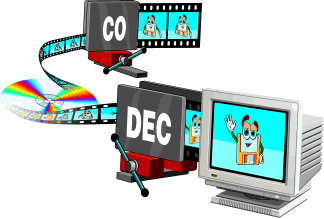
A codec is simply a program that creates a particular file with encryption. Hence its name … to encode and decode these files in a language or code that improves image and sound quality or reduces the file size for a better transfer over the network of networks.

So to sum up, one issue is the type of file format or extension that we have in front of us and a very different one, how it has been encoded, in what language, that our TV will then be able to interpret and reproduce correctly.

And it is that before a problem of reproduction of file the first thing that we have to know is with what type of codec it has been codified. To do this in a very simple way we can find out with a simple video player on our PC.

How to know the compatibility of Smart TV

Knowing what codec or container our “smart” television can play is critical to know what type of video file to download and that it doesn’t trouble us later when playing it with the smart TV model we have at home. But this information is not always at hand as we expect. There are brands that do not include this information in detail on their website or in the manual.