MP3: analysis of an MP3


Free Download Mp4Gain
picture

Different formats are used on the internet to let you listen to music. We will choose the MP3 format here.

On this page you will find all the help you need to listen to music on the internet and understand how it works. We answer the questions: What is MP3? Do radios use MP3? Why the MP3? Are record companies afraid of MP3? Mp3 is legal? How to listen and find an MP3? What is the future of MP3? Is the future of free MP3 in danger?
mp3 format

What is MP3?

MP3 (Mpeg-1 Audio Layer 3) is a destructive or compressed file format for data loss. A song deletes all data that may not be heard by the human ear. It is defined by ISO / IEC standards IS 11172-3 and IS 13818-3 and is recommended by the MPEG (Moving Pictures Experts Group).

mp3

The advantage of this format is that it can achieve a high compression rate in the sound file (for example, wav extension) without affecting the sound quality. The difference between the original sound of a compact disc and the compressed one in MP3 is inaudible. The compression speed is 1/12 (or even more than once, but in this case the quality is palpable), the files thus obtained have a really reasonable size:

Do radios use MP3?

This format is similar to the MiniDisc concept, but unlike DAT, MP3 works by deleting data. It is good to know that almost all radios currently use this format. All tubes are stored on a server and programming of the songs to be broadcast is done by computer. When the time comes, the computer searches for sound files with the extension .MP3 on the server and a decompression card automatically converts them into classic CD-quality sound files that are broadcast over the air. Now we can say goodbye to the old days when we were looking for vinyl records in the archives. It is a revolution in the world of radio!

Why the MP3?

Thanks to Mp3 it is now possible to store more than a hundred songs or more than a dozen albums on one blank recordable CD. Not long ago, it was not possible to play MP3 files only on computers, because playback requires real-time decompression that is not compatible with current audio CD playback devices. But given the possibilities this new format offers, Mp3 is on the rise with the public and manufacturers of computers and hi-fi equipment. Diamond Multimedia, famous for its graphics cards, designed the first MP3 player called “Rio”, which is barely bigger than a calling card !!! It allows you to store about 60 minutes of CD quality MP3 in the mass memory and about 9 hours of music if you choose the lowest quality. But many other models come out today with increasing capacity and lower costs … A DVD player in the living room is now also available and suitable for MP3 playback. The advantage is that you can create your own music compilation (MP3s are downloaded from the computer to the portable player through the serial port. Therefore, the songs can come from different sources (such as audio CDs or the Internet).

Are record companies afraid of MP3?

The arrival of Mp3 on the international market is likely to scare record companies, who think their profession will deteriorate and will probably disappear! We know that the copies were already possible with the cassette, the mini-disc and the CD … But it is true that the web is becoming a real database of illegal MP3s. Most artists believe that MP3 is a new way to publicize their works, especially since they can reach a wider audience via the Internet. The solution would be to pay Mp3 on the world network, according to record companies. We still don’t know when, but it is planned. Obviously, this format is not designed to be copy-protected. Many safe formats of comparable quality to MP3, such as “Liquid Audio”, are already offered, but less known, their future may not be very promising. The MP3 format raises the copyright problem as it can be downloaded for free on the internet, so there is some panic on the part of the music industry.



Free Download Mp4Gain
picture


Mp4Gain Main Window
picture


Mp4Gain Features
picture


Free Download Mp4Gain
picture

What exactly is an MP3 music file?

Mp3 is a method of compressing digitally stored music. Uncompressed storage of a stereo digital music file takes up a lot of disk space. An average of 10 MB of disk space per minute of recorded music.

However, if you compress a music file and save it as MP3, only a tenth of the original file size remains.

mp3 quality

Since the introduction of the CD, music has been digitally recorded in the form of samples or measurements. Sound is no more or less than vibrating air. These vibrations are also known as sound waves. Sound waves can be measured, recorded and stored.

However, when creative sound waves are produced, there is music.

The number of vibrations per second determines the pitch of the sound. A large amount of vibration produces a high tone, a small amount of vibration produces a low tone.

The number of vibrations per second is expressed in Hertz. Human hearing can perceive sounds between 20 Hz and 20,000 Hz.

Once it has been scientifically established that to capture the highest tone, a measurement must be taken 44,100 times per second. Therefore, the number 44,100 is the sampling frequency expressed in hertz needed for a good quality recording.

In addition to the high and low tones, a piece of music also contains hard and smooth passages. The difference between the highest and smoothest passage is called the dynamic range. For dynamic range on a digitally recordable track, you can choose 256 steps (8 bits) between the softest and loudest part, or 65536 (16 bits).

The dynamic range is highest when recording with 16-bit samples or 65536 steps.

If we then add a calculation to this data, we see that it takes 44,100 measurements for a second of music. Each measurement (sample) is 16 bits (2 bytes) in size. That means that 1 second of music takes up 88,200 bytes or 88 KB of disk space.

But since we like to listen to music in stereo, we can multiply that number by 2. For example, a second of music in stereo already takes up 176 Kb of disk space and, as said, 10 MB per minute.

When a compressed MP3 file is made from an original music file, it is done with a lossy compression method.

Data is lost on lossy compression. With an MP3 file, this means that the information is outside the file that is beyond human hearing range.

For example, people are more sensitive to sounds between 2 kHz and 4 kHz. And we can’t hear loud, soft sounds at the same time. Therefore, only loud sound needs to be preserved. In technical terms, this is called psychoacoustic masking.

What determines the quality of an MP3?

The MP3 format was developed by the German research institute Fraunhofer ISS. In addition to taking advantage of the limitations of human hearing just mentioned, the format consists of a series of mathematical formulas. This allows you to reduce the original file by a factor of 3 to 12.

The amount of compression is related to the bit rate. Bit rate is the amount of data processed per unit time. This means, among other things, that the more data there is in a second, the larger the MP3 file will be. But also the sound quality of the mp3 will be better.

For speech, a bit rate of 64 to 96 kbps is sufficient. A bit rate of 128 kbps is used for a good quality music file. Excellent quality can be achieved with a bit rate of 192 kbps or higher, with a maximum bit rate of 320 kbps.

A bit rate of 192 kbps or higher is useful only if the recording quality of the track is also excellent.

Check the quality of an MP3

Unfortunately, the quality of MP3 music is not always good. This applies, for example, when an MP3 comes from a somewhat unknown source. But of course you can also make an MP3 from a recording that is not very good in itself.

Generally, if you create MP3s from music on your own CDs or other sound media, you can guarantee the quality of the MP3s simply by choosing the appropriate settings in the software you are using.

However, if you get MP3 music in other ways like downloading from the internet for free, it will be a slightly different story.

Then you have to settle for what you get. With the knowledge of this article, it is already much easier to distinguish a low quality MP3 from a good quality MP3.

Something that can be useful. Because there is not much good to do of poor quality.

In summary, we can say that a good MP3 meets the following requirements:

-The MP3 file must have a bit rate of 128 kbps.
A higher bit rate is only desirable for excellent recordings.
-The recording quality must be good.
-The recording quality can be checked by listening to each MP3 before buying and / or downloading it. Preferably with headphones. This gives you the best impression of sound quality.

The MP3s that you buy online, for example at the Apple Store, are usually of good quality. Usually, it is the MP3 files you download from other sources that you should carefully check and listen before using them.

Music you download from sources other than online stores will definitely end up in the Downloads folder.

You can check the MP3 music downloaded from the Internet as follows:

Launch File Explorer and navigate to the Downloads folder.
To display only MP3 files in File Explorer, type: * .mp3 in the search box. This search will show you all the files in the Downloads folder with the extension .mp3.
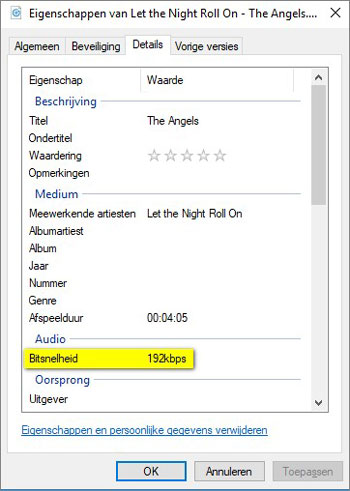
Right-click on the MP3 file you want to check and click Properties in the context menu that opens.
The [Music file name] property window is then displayed. The Details tab shows the exact bit rate of the MP3.

When you close the Properties window and double-click the selected MP3 file, the corresponding MP3 file will be loaded into your PC’s MP3 player and played.
That’s basically all you can do. A bad MP3 is impossible to improve on. Converting music to an MP3 file not only compresses but also removes data from the music file that you have been able to read.

And the lower the bit rate, the more data is generally lost and impossible to recover.

This means that when you have downloaded a low quality MP3 file, you have no choice but to search for a better quality MP3. The same goes for an MP3 whose recording quality is not very good.

Collecting the best possible MP3 files takes some effort. But this effort will be amply rewarded once you start listening to your favorite music, and the sound quality will certainly contribute to the actual enjoyment of the music.

What is an MP3 audio file and how does it work?

What is an MP3 audio file and how does it work?

MP3 is a method of compressing audio files that uses the MPEG standard to reduce the size from 10 to 12 while maintaining audio quality comparable to a CD. MP3 files are usually used to store a song or the entire CD and require very little hard disk space.

mp3 compression

Because of the small file size, a computer can store hundreds or thousands of titles. Therefore, a 30 megabyte audio file recorded in uncompressed form from a CD is reduced to approximately 3 megabytes after “compressing” in MP3. When you download and play the MP3 file, it sounds almost like the original file. If you want, you can download an MP3 file, expand it to its original size, and then burn it to a recordable CD so that you can play it on a CD player.

All it does is toggle between different formats for easy downloading. MP3 compression works with a formula that, among other things, tries to eliminate some noise or frequencies that cannot be heard by the human ear. This method is commonly known as perceptual coding or psychoacoustic modeling. The remaining audio information is recorded spatially efficiently using the MDCT and FFT algorithms.

If we compare CD-quality digital audio, the compression achieved in an MP3 format is about 74%. For example, an MP3 file encoded at a constant bit rate of 128 kbit would produce a file that is approximately 10% the size of the original. For this reason, you can easily transfer a thousand songs in MP3 format to a USB stick, which would not be possible with songs in WAV format. Unfortunately, the benefits of this reduced file size come at a price. The quality of the MP3 title is not as good as the original due to the way the song is compressed.

The quality of an MP3 file depends on the so-called “sampling rate” or “bit rate”. MP3 bit rate The bit rate of an MP3 (or the sampling rate) refers to the amount of audio information (measured in Kb kilobits) that is played back per second. The higher the bit rate, the better the quality. Increasing the bit rate also increases the file size. The higher the quality, the less it can fit on the storage device.

There is a noticeable difference in the sound quality of MP3s with variable bit rates, especially when the file is played on a hi-fi audio system at high volume. If you compress MP3s yourself, it can be helpful to experiment with the bit rate to get better quality or more MP3 playback on your storage device. A good compromise between quality and file size is 192 kps. With this bit rate we get songs with a quality that is very similar to that of CD.

We can only tell the difference to a CD with high-quality headphones or hi-fi systems. On the other hand, if we want better quality, we should opt for FLAC files, ie an audio codec with lossless data compression, ie without loss of quality.

MP3 – Everything you need to know about mp3

MP3 – Everything you need to know about mp3

The phenomenon of MP3 has revolutionized the Internet world, which has not been the same since then.
Never before have you seen a format that reduces an audio file from 40Mb to 4.
Truth be told, there was something similar, but the quality was not comparable to that
that the mp3 could achieve. But how the heck does this popular format called MP3 work?
This technology caused record companies to lose billions and save tens
(hundreds) of euros for us users?

mp3 format

The magic of the MP3 format.

Well, most of this “magic” resides in a science called psychoacoustics and a series of
very complicated mathematical calculations.
Uncompressed audio and CD audio store more data than our brains
can process and perceive. For example, if two notes are very similar and are together, your brain
you will receive only one of these. If there is a strong and weak sound, your brain will hear the loudest.
then your brain will not be able to hear the smallest sound.
The study of these phenomena and our perception of sound is called psychoacoustics.
MP3 compression technology analyzes sound and breaks it up, comparing it to models
sound included in the compressor itself. Will remove most mismatched sounds
to sound patterns and will keep the ones that match.

how mp3 works


The person performing the compression can specify the number of bits to be assigned to each
music second: the higher the number of bits and the less data will be deleted; with some bits in place
More sounds will have to be erased.
This type of compression is called lossy or lossy compression.
MP3 files are made up of a series of very short frames, as in the video, and
Each box is preceded by the header, which contains additional information about the data to come.
At the beginning or end of an MP3 file there is additional information about the file, such as the artist name,
Track title, album, year, genre and comments: This information is called ID3 data (tag).

How mp3 compression occurs.

As is known, the MP3 format eliminates what the human ear cannot hear.
These sounds are removed but there is a small part to not return
“drastic” cut.
But this is only part of the techniques used for compression … first:
the signal is analyzed and a decision is made on how to distribute the available bits, after which it is divided
in sub-bands, processed separately by algorithms.
The available bit rate is calculated, obtaining the number of bits that will be assigned to each frame.
This procedure determines how much audio will be kept and how much will be cut instead.
The frequencies of each frame are compared with the psychoacoustic models contained in the
compressor. From these models, it is determined which frequencies to elaborate with precision,
as perceived by human ear, and which can be partially removed or cut,
since we won’t be able to hear them anyway. Why save what is not needed?
Then the masking effects come into play: if there is a loud sound and a sound
weak it is possible to eliminate the latter, calculating the milliseconds during which it will not be audible.
Similarly, two overlapping sounds (due to intense intensity) or static parts of the sound.
(silence, whisper of sound) are cleverly masked.
Bitrates

How the sound chunks are removed also depends on the bit rate set by the user in
Compression moment. The bit rate corresponds to the number of bits per second used for the
file storage The higher the bitrate, the higher the resolution of the sound.
Imagine a movie: with multiple frames, the image will be fluid, in the same way at a bit rate
greater will correspond to a more complete sound, faithful to the original.

What are the advantages of WAV vs. MP3?

What are the advantages of WAV vs. MP3?

Wave is an uncompressed or lossless format, while MP3 is compressed or lossy. Technically .wav is just a container format and can contain various types of compressed or uncompressed audio, but normally you will see that it contains uncompressed LPCM audio (same as on audio CDs). With .wav files, you essentially get a raw bitstream representation of the audio signal in digital form. An analog sound produced in the real world essentially contains an infinite amount of information because it is a constantly changing wave (see below). To bring these sounds into the digital domain, you need to sample the signal at various intervals to approximate the sound. For .wav, the audio signal is generally sampled at 44,100 times per second or more, and each sampled value is recorded so that the sound wave can be played:

MP3 files are compressed to compress the same audio information into a smaller file size. The .wav format is ideal for very faithful representations of the analog signal, but as you probably know, that usually costs larger files. Compressed audio (and video in a similar way) is designed to reduce file size while maintaining a respectable level of fidelity. In simple terms, compression tries to remove unnecessary data from the stream and reduce the signal to its most necessary components. With MP3, compression and encoding algorithms use a model of how we listen to analyze audio in the frequency domain and remove any unnecessary information. For example, due to auditory masking if there are two sounds at close frequencies, we will often only hear the loudest if the volume difference between the two is significant. So for MP3, the lower volume sound could be ruled out and the audio would sound essentially the same to our ears. Learn more about the technical side of MP3 encoding here.

In practice, both .wav and MP3 have their uses. For production, .wav is the standard because it will almost always be a 100% accurate, bit-by-bit reproduction of the source material. MP3s can be a decent alternative at high enough bit rates. Bitrate is a measure of how many bits per second MP3 encoding will use, which means that the higher the bitrate, the closer the MP3 will be to the original uncompressed stream. Bit rate is generally measured in kilobits per second (kbps). I like the high audio quality for my digital music collection, so when I have a choice, I generally encode MP3 at constant 256 or 320 kbps. That’s the upper end of what MP3s are capable of, and unfortunately a lot of digital music isn’t encoded that high. When the bit rate drops, it can generally be heard first at the high frequencies, for example, the cymbals of a drum kit will sound. 160kbps is tolerable, but somewhat lower than that and you will really start to notice it. But then again, with a high enough bitrate, the differences between MP3 and .wav are barely distinguishable, especially for an untrained listener (most listeners).

For .wav files, we mainly look at the bit depth and the sample rate. Bit depth is the number of bits used to encode each sampled value. The sampling rate indicates how many times per second the audio is sampled. CD (.wav) and MP3 are encoded at a sampling rate of 44,100 Hz (Hertz means “cycles per second”). Newer computers and audio hardware / software are now accommodating higher sample rates, including 48kHz or 96kHz. For .wav, the bit depth is usually 16 bit or 24 bit on newer systems. For most purposes, when using .wav, 16-bit, and 44.1kHz is sufficient, but if you have the capabilities, it’s generally worth upgrading to 24-bit, 48kHz.

Some sample file sizes for a five-minute stereo recording:

.wav, 16 bit, 44.1kHz: 50 MB
.wav, 24 bit, 48 kHz: 82 MB
.wav, 24 bit, 96 kHz: 164 MB
MP3, 128 kbps, 44.1 kHz: 4.5 MB
MP3, 192 kbps, 44.1 kHz: 7 MB
MP3, 320 kbps, 44.1 kHz: 11 MB
FLAC, 24-bit, 44.1 kHz: 28 MB
FLAC, 24 bit, 48 kHz: 31 MB
FLAC, 24 bit, 96 kHz: 61 MB

There is also a variable bit rate option for MP3 encoding, which should offer slightly smaller file sizes for the same quality. It uses a coding scheme that changes (varies) the bit rate for different parts of the song depending on the complexity and how many samples would be needed to faithfully recreate a given section.

MP3 – the most popular digital audio format

MP3 – the most popular digital audio format

Initial release 1986

MPEG-1 Audio Layer 3, better known as MP3, is a lossy compressed digital audio format developed by the Moving Picture Experts Group (MPEGH) to be part of version 1 (and later expanded to version 2) of the MPEG video. The standard mp3 is 144 kHz and a bitrate of 317 kbps for the quality / size ratio. Its name is the acronym for MPEG-1 Audio Layer 3 and the term should not be confused with that of MP3 player.

Mp3 – History

This format was mainly developed by Karlheinz Brandenburg, director of electronic media technologies at the Fraunhofer IIS Institute, part of the Fraunhofer-Gesellschaft – network of German research centers – which together with Thomson Multimedia controls the bulk of MP3-related patents. The first one was registered in 1986 and several more in 1991. But it was not until July 1995 when Brandenburg first used the .mp3 extension for the MP3-related files he kept on his computer. A year later, his institute paid 1.2 million euros for patents. Ten years later this amount has reached 26.1 million.

The MP3 format became the standard used for streaming audio and compression of high-quality audio (with loss in hi-fi equipment) thanks to the possibility of adjusting the quality of the compression, proportional to the size per second (bitrate), and therefore the final size of the file, which could occupy 12 and even 15 times less than the original uncompressed file.

It was the first audio compression format popularized thanks to the Internet, since it made possible the exchange of music files. The legal proceedings against companies like Napster and AudioGalaxy are the result of the ease with which this type of files are shared.

After the development of autonomous, portable or integrated players in music (stereo) channels, the MP3 format reaches beyond the world of computing.

At the beginning of 2002, other compressed audio formats such as Windows Media Audio and Ogg Vorbis began to be massively included in programs, operating systems and autonomous players, which made it foresee that MP3 would gradually fall into disuse, in favor of other formats, such as the mentioned ones, of much better quality. One of the factors that influences the decline of MP3 is that it has a patent. Technically, it does not mean that its quality is inferior or superior, but it prevents the community from continuing to improve it and can compel paying for the use of some codec, this is what happens with MP3 players. Even so, in late 2009, the mp3 format continues to be the most used and the most successful.

Mp3 player

Mp3 – Technical details

In this layer there are several differences with respect to the MPEG-1 and MPEG-2 standards, among which is the so-called hybrid filter bank that makes its design more complex. This improvement in frequency resolution worsens temporal resolution by introducing pre-echo problems that are predicted and corrected. Additionally, it enables audio quality at rates as low as 64 kbps.

Mp3 Filter bank

The filter bank used in this layer is the so-called hybrid multiphase / MDCT filter bank. It is responsible for mapping the time domain to the frequency domain for both the encoder and the decoder reconstruction filters. The bench output samples are quantized and provide variable frequency resolution, 6×32 or 18×32 subbands, adjusting much better to the critical bands of different frequencies. Using 18 points, the maximum number of frequency frequency components is: 32 x 18 = 576. Resulting in a frequency resolution of: 24000/576 = 41.67 Hz (if fs = 48 kHz.). If 6 frequency lines are used, the frequency resolution is lower, but the temporal resolution is higher, and it is applied in those areas where pre-echo effects are expected (abrupt transitions of silence at high energy levels).

The psychoacoustic model

Compression is based on the reduction of the irrelevant dynamic range, that is, on the inability of the auditory system to detect quantification errors under masking conditions. This standard divides the signal into frequency bands that approximate the critical bands, and then quantizes each subband based on the noise detection threshold within that band. The psychoacoustic model is a modification of the one used in Scheme II, and uses a method called polynomial prediction. It analyzes the audio signal and calculates the amount of noise that can be introduced as a function of frequency, that is, it calculates the “amount of masking” or masking threshold as a function of frequency.

The encoder uses this information to decide the best way to spend the available bits. This standard provides two psychoacoustic models of different complexity: model I is less complex than psychoacoustic model II and greatly simplifies calculations. Studies show that the distortion generated is imperceptible to the experienced ear in an optimal environment from 256 kbps and under normal conditions. For the inexperienced or common ear, with 128 kbps or up to 96 kbps it is enough to make you hear “well” (unless you have high quality audio equipment where the lack of bass is excessively noticeable and the sound stands out of “frying” in the treble). In people who listen to a lot of music or who have experience in the listening part, from 192 or 256 kbps it is enough to hear well. The music that circulates on the Internet, for the most part, is encoded between 128 and 192 kbps.

Coding and quantification

The solution proposed by this standard regarding the distribution of bits or noise is made in an iteration cycle that consists of an internal and an external cycle. Examines both the filter bank output samples and the signal-to-mask ratio (SMR) provided by the psychoacoustic model, and adjusts the bit or noise allocation, depending on the scheme used, to simultaneously satisfy the bit rate requirements and masking. These cycles consist of:

Internal cycle

The internal cycle performs non-uniform quantization according to the floating point system (each MDCT spectral value is raised to the 3/4 power). The cycle chooses a certain quantization interval and Huffman coding is applied to the quantized data in the next block. The cycle ends when the quantized values ​​that have been encoded with Huffman use less or equal number of bits than the maximum number of bits allowed. lokaS

External cycle

Now the external cycle is in charge of verifying if the scale factor for each subband has more distortion than allowed (noise in the encoded signal), comparing each band of the scale factor with the data previously calculated in the psychoacoustic analysis. The external cycle ends when one of the following conditions is met:

Neither scale factor band has much noise.
If the next iteration amplifies one of the bands more than is allowed.
All bands have been amplified at least once.
Bitstream packaging or formatter

This block takes the quantized samples from the filter bank, along with the bit / noise allocation data and stores the encoded audio and some additional data in the frames. Each frame contains information from 1152 audio samples and consists of a header, the audio data along with error checking by CRC and auxiliary data (the latter two optional). The header describes what layer, bit rate, and sample rate are being used for the encoded audio. Frames start with the same synchronization and differentiation header and their length may vary. In addition to dealing with this information, it also includes variable length Huffman encoding, an entropic encoding method that without loss of information eliminates redundancy. It acts at the end of compression to encode the information. Variable length methods are generally characterized by assigning short words to the most frequent events, leaving long words for the most infrequent.

Structure of an MP3 file

An Mp3 file is made up of different MP3 frames which in turn are made up of an Mp3 header and MP3 data. This data stream is called “elemental stream”. Each of the frames is independent, that is, a person can cut the frames of an MP3 file and then play them on any MP3 player on the market. The header consists of a sync word that is used to indicate the beginning of a valid frame. Following are a series of bits that indicate that the analyzed file is a Standard MPEG file and whether or not it uses layer 3.

How is an mp3 analyzed inside?

How is an mp3 analyzed inside?

MP3 is the acronym for MPEG 1 Layer 3 and is a lossy digital audio format developed by MPEG (Moving Picture Experts Group) in conjunction with the Franunhofer Institute of Technology to include it as an audio format for the MPEG-video format. 1. It is currently an ISO (International Organization for Standardization) standard. The reason it has become so popular is that it allows for high sound quality in very little storage space: About 650 songs can be recorded on a 650MB CDROM, in instead of the 15 that we could store following the format of traditional CD-Audio. Furthermore, it is possible to adjust the quality of the output file by adjusting the bitrate (sampling rate and number of bits per sample), which will be proportional to the size of the output file. Thanks to its small size, high quality and versatility, it became a standard for streaming.

It was said at the beginning that MP3 is a lossy algorithm, this means that the original and encoded sound are not exactly the same. For this, the MP3 takes advantage of the “deficiencies” of the human ear, specifically 3 of them:

Limits of hearing in frequency: The human ear is only capable of hearing frequencies that are approximately between 20 and 20,000 KHz, with which the rest are filtered and discarded as they would not add relevant information to the encoded signal. Also, the closer you are to the 2-4 Khz range (and harder to hear as the frequency gets closer to the extremes of hearing), the more audible it will be.
Masking effect: When 2 signals of similar frequency overlap, human hatred is only able to hear the one with the highest power (volume), therefore, the rest can be eliminated without appreciable loss of quality.
Stereo redundancy: Sometimes there is redundancy between the 2 channels and, furthermore, below a certain frequency, the human ear is not able to distinguish the directionality of the sound with which a single channel can be encoded and add to the other certain complementary information to not lose the spatial sensation of the other channel.
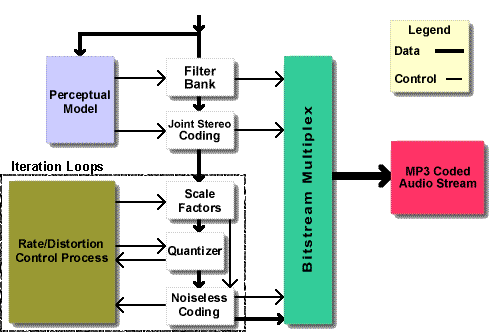
To carry out the three previous proposals, a system based on subbands is used in which the signal is filtered using several filters in order to have the signal separated into sub-signals, each covering a frequency range. Each of these bands is compared to a psychoacoustic model that determines which bands are important and which can be removed.

Specifically, a hybrid polyphase / MDCT (Modified Discrete Cosine Transform) filter bank is used: A filter bank is a set of band-pass filters that aim to separate the original signal into several frequency bands; A multiphase / MDCT hybrid filter bank is nothing more than a normal filter bank together with a block capable of doing the discrete cosine transform (MDCT).

The choice of which bands are maintained and which are removed is made by calculating the masking threshold, that is, it analyzes each audio sub-signal and calculates the amount of noise that can be input (signal is replaced by noise to save storage space) in function of the frequency, taking into account that a frequency masks signals of a higher frequency than yours rather than lower, without being noticeable to the human ear.

The following figure outlines the process described above:

The following figure represents the structure of an mp3 file:

As can be seen, an Mp3 file is made up of different frames which in turn are made up of an Mp3 header and MP3 data. Each of the frames is independent, that is, a person can cut the frames of an MP3 file and then play them back. The graph shows that the header consists of a sync word that is used to indicate the beginning of a valid frame. Following are a series of bits that indicate that the analyzed file is a standard MPEG file and whether or not it uses layer 3.

MP3 undoubtedly owes its success to Internet music downloads and portable audio players capable of playing the format. First, Discman compatible with MP3 were born, which allowed transporting 175 songs per cd instead of the usual 6. Subsequently, MP3 players based on a (small back then) flash memory were born. These had the advantage of being much smaller and lighter than portable CD players, but with the initial disadvantage that flash memory was small and expensive. Initially these devices had 64 or 128 MB memory, which allowed them to store between 16 and 32 songs. Currently these devices are sold with a memory of 1,2,4 or even 8GB. This allows them to store between 256 (for the 1Gb model) and 2048 (for the 8GB model)

Is the mp3 officially declared dead?

What audio formats govern in 2019?

youtube music

At the end of last month, the Fraunhofer Institute for Integrated Circuits IIS, a German organization specializing in the development of applications and technologies, announced that the Technicolor mp3 licensing program “for certain related mp3 patents and Technicolor and Fraunhofer IIS software has been finished”. In other words: the creator of the audio format that ruled the world at the end of the nineties and the beginning of the new century gave him, with these words, the last nail to the coffin of the mp3.

“We thank all our licensees for their great support in converting mp3 into the defacto audio format in the world, during the last two decades.”

The IIS recognizes that although there are currently more efficient audio codecs with advanced features, the mp3 is still very popular. However, most video and audio streaming services use “modern ISO-MPEG codecs such as the AAC family or in the future MPEG-H. Those can deliver more features and higher audio quality at much lower bitrates compared to mp3 ”.

loseless codecs

The format was the protagonist of the change of the business model of the music industry, when digital technologies and the Internet began to facilitate the sharing of music. Buying a CD and compressing it in mp3 format to store the music on other media (recordable CDs, basically) and thus starting a process of hand-to-hand transmission of albums and discographies became daily bread (access to broadband and email capabilities at the end of the last century complicated making this diffusion through virtual media).

The AAC or Advanced Audio Coding is the format used in applications and services such as Apple Music and is capable of providing high quality audio without requiring large amounts of information. This algorithm exploits two strategies for this: it discards from the audio what is not perceptible to the human ear and eliminates the redundant signals in the coding (remember that this, like the mp3 and other streaming formats is a method of music compression, therefore it constitutes an interpretation of an audio originally edited in formats such as FLAC or Free Lossless Audio Codec, another digital compression format that, unlike its other pairs, does not register any loss in the quality of the compressed audio).

However, Spotify, the paid streaming service that reigns in the world with 100 million subscribers (although Soundcloud has a total of 175 million users), uses another format, the Ogg Vorbis (OGG), which in premium quality grants audios to 320 kbps (in the desktop version of the application, because in its mobile version they only reach half the quality).

Deezer, a competitor of Spotify, on the other hand, offers an Elite service, with audio streaming in FLAC format (16-bit, at 1,411 kbps) at twice the premium subscription of its rival.

As you can imagine, at better quality, larger files, mass consumption of memory and storage. Perhaps this was not the strength of the mp3: to offer a decent audio format, depending on the codec and the player, without requiring the use of too much information (although the flatness of its compression and the metallization of the organic sounds that the conversion to mp3 meant I had nothing lovely about it). Anyway, today is official: the king is dead, long live the king.