Digital audio formats: the MP3 phenomenon


Free Download Mp4Gain
picture

Digital audio formats: the MP3 phenomenon
MP3 format

The MP3 music format (MPEG-1 Layer 3) is one of the most widely used digital audio formats in the world.

MP3 formatMP3 format : An Overview

It is compatible with all portable and stationary audio devices. In May 2017, the developers of the format announced his “death”. On April 23, 2017, the Technicolor and Fraunhofer IIS licensed commercial program was canceled: the last patent included in the program expired, making the format standard in the public domain.
Can we say that the days of the most popular format are numbered? MP3 development began in the late 1980s at the Fraunhofer Institute for Integrated Circuits (IIS). In 1987, the University of Erlangen-Nuremberg and Fraunhofer IIS teamed up to work on the EU147 EUREKA Digital Audio Broadcasting (DAB) project. The first result of the alliance’s work was the LC-ATC codec, which made it possible to encode stereo music in real time.

The next step was the development of an optimal frequency domain (OCF) coding algorithm, which already had some of the characteristics of the future MP3 codec. For the first time, it is possible to encode music in good quality at 64 kbps for a mono signal. OCF was the beginning of the path towards standardization MPEG (Moving Picture Expert): an organization, responsible for the development and implementation of international standards for the compression and transmission of digital video and audio content.

In 1989, MPEG received 14 proposals for the implementation of an audio coding standard, so participants were invited to combine their developments. This led to the emergence of four potential candidates, including MUSICAM from the Institute for Broadcasting Technology IRT and Philips and ASPEC (Adaptive Spectral Perceptual Entropy Coding), which is the result of further enhancements to the OCF Fraunhofer IIS in addition to contributions from the University of Hannover in collaboration with AT&T and Thomson.

After extensive testing, MPEG proposed combining MUSICAM and ASPEC to create a family of three encoding methods: Level 1: a low-complexity version of MUSICAM; level 2 – MUSICAM codec; Level 3 (later called MP3): based on ASPEC. Technical development of the MPEG-1 standard was completed in December 1991. In 1994, Fraunhofer IIS introduced the world’s first MP3 encoder, the L3enc, and in 1995 the Fraunhofer researchers unanimously accepted “.mp3” as the file extension for MPEG Layer 3 [1].

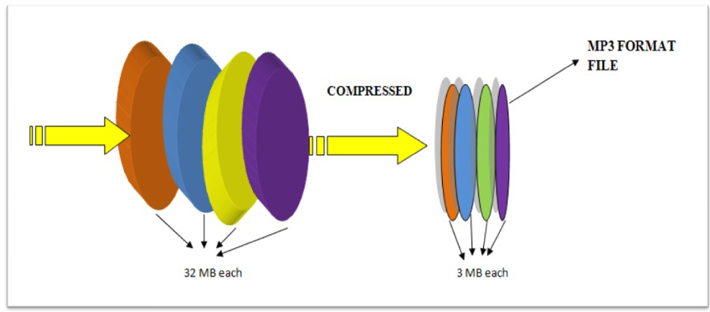
Thanks to the compression algorithm used in the MP3 audio format, the size of the data required to reproduce the recording and ensure the quality of sound reproduction is significantly reduced to 10-12 times the original, depending on the recording bit rate. . Bit rate refers to the encoding / decoding rate of a digital audio stream; sound quality improves with increasing bit rate. The MP3 format has the following bit rates: 32 kbps (very low quality, acceptable only for voice), 96 kbps, 128 kbps (medium quality), 160 kbps, 192 kbps, 256 kbps, 320 kbps (maximum optimal quality). The principle of the compression algorithm is as follows: during the compression process, the audio codecs analyze the signals, focusing on the audible fragments, which are saved for later playback or transmission.

This rules out sounds beyond the perception range of the human ear (20 to 20,000 Hz). That is why MP3 is called lossy. There are three ways to encode MP3 files: constant bit rate (CBR), variable bit rate (VBR), and medium bit rate (ABR). CBR is the default encryption mode. In this mode, the bit rate is constant for the entire file. This means that each part of the MP3 file uses the same number of bits. Regardless of the complexity of a piece of music, the encoder uses the same bit rate, so the quality of the final file is variable.

Complex parts will be of lower quality than simpler ones. The main advantage of this mode is that the size of the final files does not change and can be accurately predicted. When encoding in VBR mode, the user selects the desired quality on a scale of 9 (lowest quality, highest distortion) to 0 (highest quality / lowest distortion). The codec then tries to maintain a certain quality throughout the file by choosing the optimal number of bits for each part of the audio recording. The main advantage is the ability to specify the level of quality to be achieved, but the significant disadvantage is the unpredictability of the final file size.



Free Download Mp4Gain
picture


Mp4Gain Main Window
picture


Mp4Gain Features
picture


Free Download Mp4Gain
picture

What is an MP3 file?

We start with one of the most common files in the world of computing, that is, the one with the name MP3.

File Format Mp3

MP3 files have been around for years and that is why their development is so widespread.

But what does an MP3 file represent in practice?

Well, an audio file in general is a sequence of numbers obtained by sampling the analog signal.

MP3

This sampling then responds to some parameters that are the frequency, measured in Khz and the resolution that is instead expressed in Bit.

The MP3 file is the most compressed form of an audio file, so to speak.

At the end of the day, you have to understand that the MP3 file manages to eliminate all the superfluous parts of the digital file of the sequence and the final sampling, exploiting some imperfections of the human body to be able to give you a clear and clean melody.

However, on the other hand, the MP3 file considerably reduces the quality of the reproduced sounds.

In fact, all the different nuances of a given melody boil down to the bone.

An MP3 is small in size from the point of view of memory, it must be seen as a kind of concentrate that gives you an appreciable final result but not one hundred percent complete.

In the most extreme cases, an MP3 file can reduce the original sounds and nuances of the music or melody by up to 90%.

However, these formats are highly appreciated and used because in addition to being practical and straightforward, they are now compatible with any technological device.

This means that you can always carry them with you and any product you have will be able to read an MP3 file.

Mp3 format

MP3 (in full version Moving Picture Expert Group-1/2 Audio Layer 3) is a lossy audio compression algorithm, developed by the MPEG group, capable of drastically reducing the amount of data needed to store a sound, while still be a reproduction. acceptably faithful to the original uncompressed file.

Mp3 Format

Data compression is carried out by eliminating all those sounds that are not perceived by the human auditory system. In fact, recordings in wav format contain much more information than our ear is capable of distinguishing: by removing too much information, it is possible to obtain size reductions of more than 10 times (compared to uncompressed wav format).

Descargar MP3 Video Converter Pro 3.0f + Key Apk para Android 2020 3.0f  para Android

In practice, the mp3 format exploits the limits of our auditory system, limits that depend so much on the structure of our ear (not capable of perceiving frequencies above 20 kHz, but particularly sensitive to the intermediate range that goes from 700 Hz to around 6000 Hz) and the ways our brain perceives and interprets sounds. These perceptual limits are studied by psychoacoustics, a sector of psychology that deals with the perception of sounds.

A particularly important and exploited effect in mp3 compression is masking (masking), in which the perception (or less) of a sound is influenced by the presence of another sound. For example, conversation at a bus stop can become completely impossible if a noisy bus approaches: a weaker sound is “masked”, that is, made inaudible by the presence of a louder sound. Masking is all the more effective the closer the two sounds are to frequencies, since our auditory system is unable to discriminate sounds with very close frequencies.

As we have mentioned, mp3 compression is lossy type, that is, it causes irrecoverable data loss and consequently quality degradation. Mp3 encoding allows you to choose how much compression the compression should have, keeping in mind that higher compressions will always correspond to lower sound quality. The quality of mp3 compression is adjusted by a parameter called bitrate that specifies how many kbits the mp3 file should use for each second of recorded audio. There is also the possibility to vary the bit rate within a single mp3 file, using higher bit rates for some parts and lower bit rates for others (for example you can use a lower bit rate for the silent parts or that contain few instruments and use a higher bit rate for more complex parts).

The usable bit rate values ​​are many (from 8 to 320 kbit / s) but 128 kbit / s is considered a good compromise between compression and quality. Knowing the bit rate, it is easy to calculate the size of an mp3 file, since it is enough to multiply this value by the duration of the recording.

MP3: analysis of an MP3

Different formats are used on the internet to let you listen to music. We will choose the MP3 format here.

On this page you will find all the help you need to listen to music on the internet and understand how it works. We answer the questions: What is MP3? Do radios use MP3? Why the MP3? Are record companies afraid of MP3? Mp3 is legal? How to listen and find an MP3? What is the future of MP3? Is the future of free MP3 in danger?

mp3 format

What is MP3?

MP3 (Mpeg-1 Audio Layer 3) is a destructive or compressed file format for data loss. A song deletes all data that may not be heard by the human ear. It is defined by ISO / IEC standards IS 11172-3 and IS 13818-3 and is recommended by the MPEG (Moving Pictures Experts Group).

mp3

The advantage of this format is that it can achieve a high compression rate in the sound file (for example, wav extension) without affecting the sound quality. The difference between the original sound of a compact disc and the compressed one in MP3 is inaudible. The compression speed is 1/12 (or even more than once, but in this case the quality is palpable), the files thus obtained have a really reasonable size:

Do radios use MP3?

This format is similar to the MiniDisc concept, but unlike DAT, MP3 works by deleting data. It is good to know that almost all radios currently use this format. All tubes are stored on a server and programming of the songs to be broadcast is done by computer. When the time comes, the computer searches for sound files with the extension .MP3 on the server and a decompression card automatically converts them into classic CD-quality sound files that are broadcast over the air. Now we can say goodbye to the old days when we were looking for vinyl records in the archives. It is a revolution in the world of radio!

Why the MP3?

Thanks to Mp3 it is now possible to store more than a hundred songs or more than a dozen albums on one blank recordable CD. Not long ago, it was not possible to play MP3 files only on computers, because playback requires real-time decompression that is not compatible with current audio CD playback devices. But given the possibilities this new format offers, Mp3 is on the rise with the public and manufacturers of computers and hi-fi equipment. Diamond Multimedia, famous for its graphics cards, designed the first MP3 player called “Rio”, which is barely bigger than a calling card !!! It allows you to store about 60 minutes of CD quality MP3 in the mass memory and about 9 hours of music if you choose the lowest quality. But many other models come out today with increasing capacity and lower costs … A DVD player in the living room is now also available and suitable for MP3 playback. The advantage is that you can create your own music compilation (MP3s are downloaded from the computer to the portable player through the serial port. Therefore, the songs can come from different sources (such as audio CDs or the Internet).

Are record companies afraid of MP3?

The arrival of Mp3 on the international market is likely to scare record companies, who think their profession will deteriorate and will probably disappear! We know that the copies were already possible with the cassette, the mini-disc and the CD … But it is true that the web is becoming a real database of illegal MP3s. Most artists believe that MP3 is a new way to publicize their works, especially since they can reach a wider audience via the Internet. The solution would be to pay Mp3 on the world network, according to record companies. We still don’t know when, but it is planned. Obviously, this format is not designed to be copy-protected. Many safe formats of comparable quality to MP3, such as “Liquid Audio”, are already offered, but less known, their future may not be very promising. The MP3 format raises the copyright problem as it can be downloaded for free on the internet, so there is some panic on the part of the music industry.