Whenever I upload a video to YouTube, it deteriorates.


Free Download Mp4Gain
picture

Whenever I upload a video to YouTube, it deteriorates.

YouTube

When you upload a video to YouTube, it will be automatically encoded. “Encoding” is the compression and conversion of video data, which changes it to a format that can be played on YouTube.

YouTube

Depending on the size of the video, “compress” means that the uploaded video will be of lower quality than the original video.

Actually, even at the video editing stage, it will be encoded last, so there is a chance that it will deteriorate twice.

In particular, action games with intense movement tend to be easy to understand and the visuals tend to be crude.

It is recommended to record the highest quality video possible at the recording stage so that it will be fine if the image quality deteriorates a little later.

This blog introduces how to record game video on your smartphone and also introduces how to record in the highest quality possible. Try to reference.

What kind of video is “high image quality”?
There are three essential elements when it comes to “high quality” video: “resolution”, “frame rate” and “bit rate”. I think it is a value that is often seen when editing videos.

The details will be presented later, but it can be said that the higher the “resolution” and the “frame rate”, the higher the “bit rate” and the higher the image quality.

What kind of video is high image quality? [Game video / preparation 5 from scratch]
1. What is resolution?
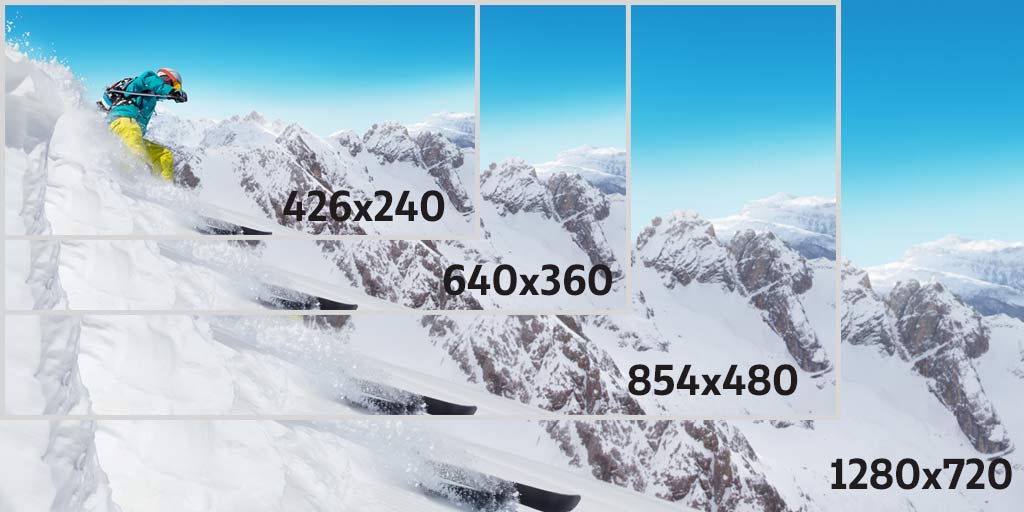
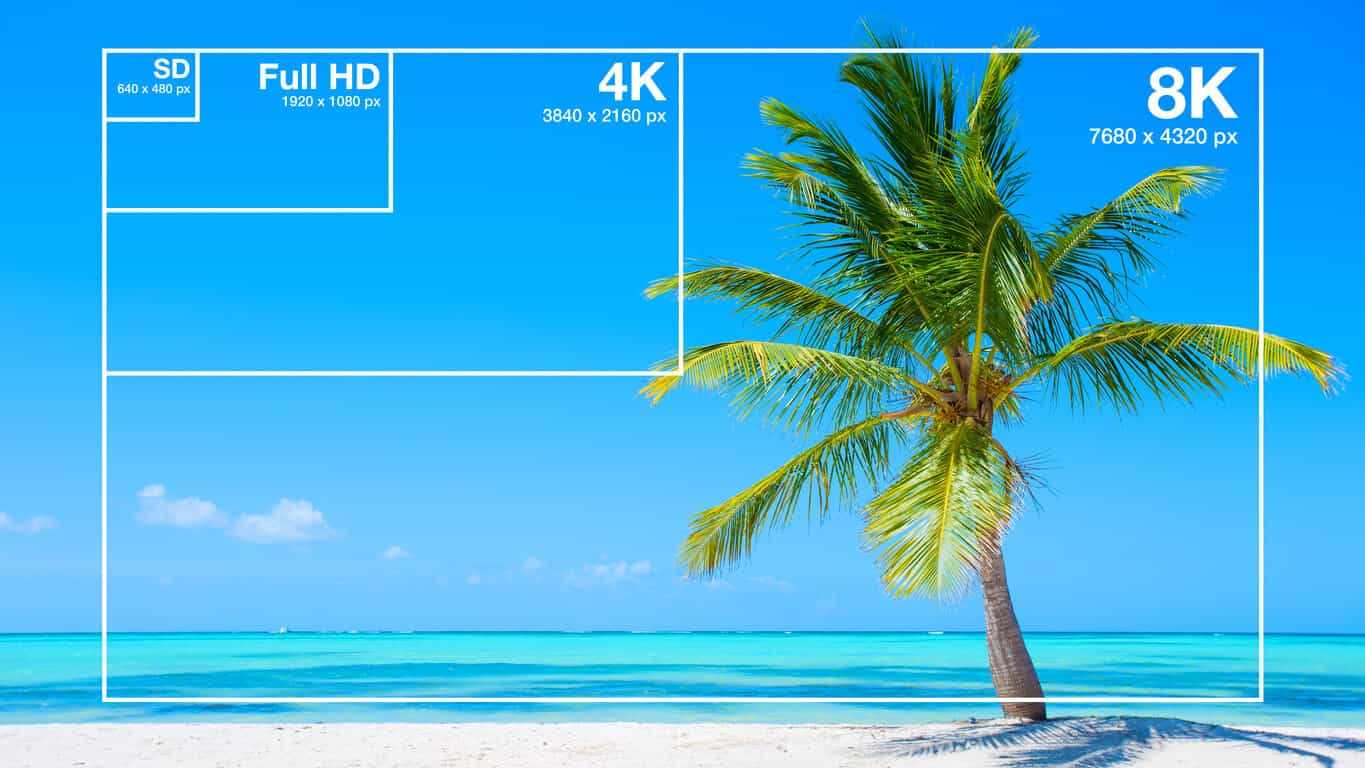
It is a word that expresses the number of pixels (pixels) in the vertical and horizontal directions of a video. It is something like “1920 x 1080” or “720P” that you see often. HD, Full HD, 4K, etc. They are also common names that refer to resolution.

If the screen resolution is high, it will be expressed in many pixels, and it will be a clear and detailed video, that is, of high quality.

What kind of video is high image quality? [Game video / preparation 5 from scratch]
I think there are many opportunities to see the resolution when recording a video or when exporting after editing a video.

When you want to get a rough idea of ​​the quality of your own recorded or edited videos, it’s a good idea to focus on resolution.

YouTube resolution (16: 9)
We recommend 1080p and 720p, but YouTube supports other resolutions as well. Basically let’s make a video that will be one of these.

resolution Known as comments
3840 x 2160 (2160p) 4K Transcendental beauty! Conventional TV picture quality
2560 x 1440 (1440p) WQHD Very beautiful! This is also the picture quality for TV.
1920 x 1080 (1080p) Full HD, Full High Definition, 2K It’s beautiful enough! The highest quality of videos recorded on smartphones.
1280 x 720 (720p) HD, high definition Everything is beautiful! If you record it with a small smartphone, this is what it is all about
854 x 480 (480p) full-width VGA It’s as beautiful as a DVD. The videos are tolerable, but each time they are more beautiful
Youtube Video recommends the aspect ratio of 16: 9. If you use a video with a different aspect ratio than this, a black frame will be displayed vertically and horizontally, so be careful.

2. What is the frame rate?
Frame rate is the number of still images (frames) displayed in a video per second. . The unit is “FPS (Frames Per Second)”. Basically I think it is often written in lower case (fps).

Please note that it is different from the “FPS (First Person Shooter)” shooting game genre! (It’s more complicated because conversations like “I want a monitor to do FPS at 120 fps” are also possible).

A movie is a series of still images. I think it is easy to understand if you imagine a flip book.

What kind of video is high image quality? [Game video / preparation 5 from scratch]
The smaller the number of still images displayed per second, the more inconspicuous the video will appear, and the higher the number, the more continuous it will appear. This is the difference in frame rate.

In other words, the higher the frame rate (= the higher the number of still images), the smoother the video will be. .

Frame rate is a numeric value that can be set at encoding time, and I think 30fps or 60fps is common.

If you also increase the fps, you will increase the file size of the video. If you want to stick to smoothness, like action videos, judge at 60fps, around 30fps otherwise.


Free Download Mp4Gain
picture


Mp4Gain Main Window
picture


Mp4Gain Features
picture


Free Download Mp4Gain
picture

Video On Demand

Video On Demand

bitrate

VOD (Video on Demand) services that let you watch the shows you want to watch whenever you want, such as Netflix, Hulu, and Amazon Prime, are popular.

Bitrate

In the past, PC-based devices such as PCs and tablets were required for viewing, but now it is possible to look directly into AV devices such as flat-screen televisions and video recorders.

Although it is such a VOD service, it was not seen with a large block noise at the beginning of playback, but after watching it for a while, the feeling of detail increased and after a few minutes the image quality became satisfactory. be all. That’s not the case with broadcast airwaves and record playback, but it’s weird when you think about it.

VOD services are available for direct viewing on AV devices such as flat screen televisions.

This “phenomenon that VOD video becomes beautiful during playback” is due to a technology called “ABR (adaptive bit rate)”. With the VOD service that supports ABR, the video quality can be adjusted according to the performance of the device and the speed of the communication line, and if the playability is considered to be the low / low speed line, the bandwidth (bit rate) of video will be reduced … On the other hand, if you know that the line has high playability / high speed, the bit rate will increase.

Immediately after playback, there may be little data buffered on the device side and the bit rate is set low, making image quality difficult. However, if the communication is stable and the video data buffer advances to a certain point, the bit rate will increase. Therefore, the image quality will improve after a while from the start of playback.

ABR supports many commercial VOD services along with “MPEG-DASH” transmission technology. The VOD service does not specify the playback device, and it can be said that it is an essential technology because it is not known if the communication line is Wi-Fi or cellular (3G / 4G) and if it is stable.

What is Bit Rate?

What is Bit Rate?

bitrate

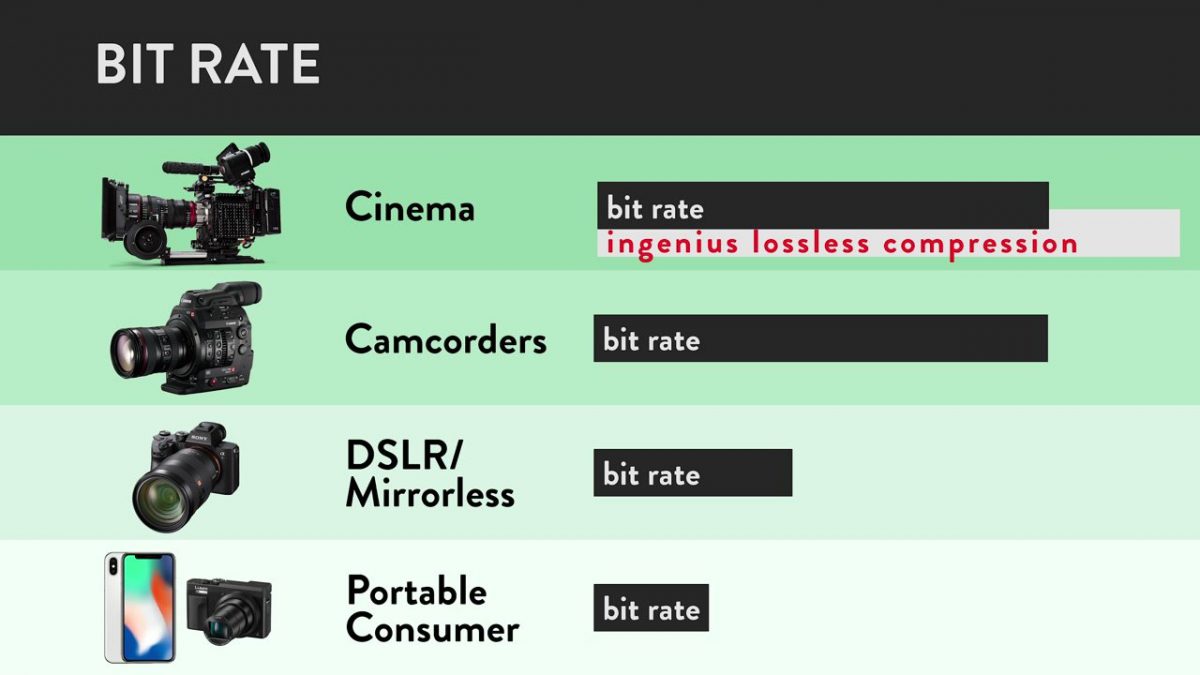
Bit rate is the amount of video and audio data transferred per second, and the unit called bps (bits per second) is used.

Bitrate

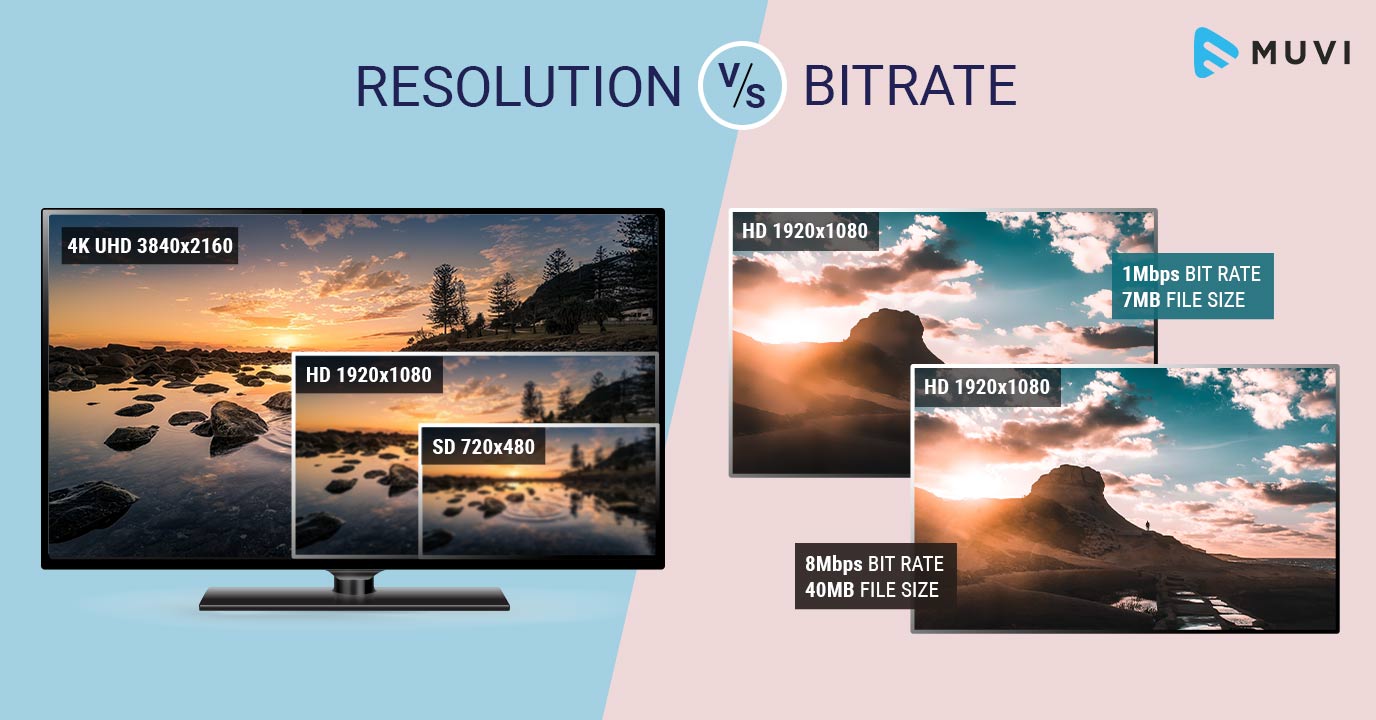
It is expressed as “video file capacity = bitrate value x time”. The higher the bit rate, the better the picture and sound quality, but the larger the final file size. Adjust the bit rate when you want to reduce the file size when encoding a video file or when you want to improve the image quality.

The higher the bit rate, the higher the image quality, but if the original video has a low bit rate, no matter how high the bit rate is, the image quality cannot be expected to improve. . Also, if you are using a CPU with a slow processing speed or a hard disk with a slow rotational speed, if you play a video created at a high bit rate, the processing may not be in time and they will be lost. frames. Also, when posting a video on the home page, it cannot be played properly if the internet line speed is slow.

The DVD-Video standard requires a total video and audio bit rate of 9848 kbps or less, and the Blu-ray standard (BDMV) requires a total video and audio bit rate of 40,000 kbps or less. Therefore, it is necessary to adjust the bit rate according to the purpose and environment. There are two kinds of

encoding methods: constant bit rate (CBR) and variable bit rate (VBR).
Select the encoding method that suits your purpose, such as image quality at encoding time and final size balance.

Constant Bit Rate (CBR)
All constant bit rates are assigned the same bit rate at all times. Set a high bit rate when you want all video files to be high quality, and set a low bit rate when you want to reduce the file size (a low bit rate can make noise noticeable in a scene with a lot of movement).

It always assigns the same bit rate, so you can easily predict the size of the finished file. Therefore, it is recommended to use it when there is an upper limit for the file size after encoding, or when you want to keep the data transfer rate constant.

Also, in WMV (Windows Media Video), etc., 2-pass CBR can be set. With 2-pass CBR, the amount of data distributed to each video is strictly adjusted and is a mechanism to target higher image quality.

Variable Bit Rate (VBR)
Variable bit rate automatically assigns a high bit rate to fast moving scenes and a low bit rate to slow moving scenes. Since the bit rate is assigned according to the scene, the file size can be reduced while the image quality is relatively high, but the final file size is difficult to predict.

VBR can be divided into two types. 1-step encoding (fixed quality) and 2-step encoding (average bit rate).
1-pass MPEG-2 encoding can shorten the processing time for export by analyzing the video and encoding while maintaining the specified constant quality. However, it is difficult to predict the size of the finished file.

In 2-pass encoding, after analyzing the information from all video data in the 1st pass, the bit rate is assigned and encoded in the 2nd pass based on that information. Although the processing time is long because it is processed twice, it is possible to assign the bit rate efficiently, making it possible to create high-quality video. By specifying the average bitrate, you can roughly predict the size of the file.

[Basic knowledge of video]

[Basic knowledge of video]

bitrate video

An easy-to-understand explanation of the differences between file formats and codecs!

Bitrate

Differences between video file formats and codecs

In this article, I will explain the difference between “file format” and video “codec” in an easy to understand way.

First of all, I don’t understand the meaning of “file format” and “codec”

Even such people can understand it without much thought.

To conclude first

File format (.mov / .mp4, etc.) → Video container
Codec (H264 / AIC, etc.) → Video compression method
It makes a big difference.

To summarize briefly, the codec is the method of compressing the file format.

There are many video file formats and codecs.

Even if the file format is the same, if the codec used is different, it may not be playable depending on the environment. Therefore, knowing these differences and types will be helpful when making or playing videos.

Come on ~

Table of Contents
Understand the file structure of videos
Featuring three main file formats
Quick time (.mov)
Windows Media Video (.wmv)
MP4 (.mp4)
Differences between file formats and codecs
resume
Understand the file structure of videos
First, let’s take a quick look at the structure of video files!

The file format of the video can be recognized by the “extension” when the video is placed on the desktop.

mov screenshot
By the way, this is a video file in “.mov” format.

There are several types of file formats (video containers), but the content is the same.

Video file structure
Video file structure Content
file format There are various formats such as “.mov”, “.mp4”, “.wmv” and “.avi” in terms of extension. Some file formats cannot be played depending on the type of terminal or PC.
Video data The visual part of the video file. Without this, the image will not be displayed on the screen. Due to the large volume of video data, it is almost always compressed.
Audio data Sound data. Without this, there will be no sound. Although the capacity is small compared to video data, it is often compressed as well.
Metadata Text data such as copyright information and shooting date and time.
Featuring three main file formats

I mentioned earlier that there are several types of “file formats” for videos.

If you know everything, you will lose motivation, which is why I will introduce three main video file formats.

Quick time (.mov)
It is a video file format created by Apple Inc. called Quick Time Movie.

You can play it with QuickTime Player on Mac or iTunes.

To play on Windows, you need to install the Windows version of QuickTime Player (free).

Orally, it is called a “mob file” or “M point or buoy”.

Windows Media Video (.wmv)
This is a video file created in Microsoft’s “Windows Media” format.

It can be played with Windows Media Player on Windows.

If you want to play it on Mac, you need to download a media player like LVC.

Taken by mouth, it is called “Double MV”.

MP4 (.mp4)
You have probably heard more about video files.

The reading is “MP4”.

This is the most widely used format.

You can play it with QuickTime Player on Mac, iTunes, and Windows Media Player on Windows.

It is also compatible with many mobile terminals.

Video Basics Part 2

Video Basics Part 2

Video Bitrate

There are two types of bit rates

Bitrate

Bit rate type
There are two types of bit rates.

Constant Bit Rate (CBR)
Variable Bit Rate (VBR)
Constant Bitrate keeps the set bitrate constant regardless of the video content.

An important feature is that the load on the playback device (PC or smartphone) is small, but since the pattern with violent movement becomes a block, it is necessary to set a relatively large bit rate.

In other words, the file size tends to be large.

On the other hand, variable bit rate is a method that automatically increases the bit rate for parts with complicated movements and reduces it for parts with little change, so the overall file size can be kept small.

Instead, the load on the playback device (PC or smartphone) will be high, so the movement may be choppy depending on the device.

Bit rate type Features
Constant Bit Rate (CBR) The
File size tends to be large, making it less burdensome for the playback device.
Variable Bit Rate (VBR)
The file size, which is a large burden on the playback equipment, can be kept small
Which is better depends on the application, but if the image quality is fixed, like Youtube, we recommend variable bit rate with high image quality and light file size.

He didn’t know the difference between the two when he was working. Let’s keep it in our head as knowledge.

Video Basics: What is Frame Rate?

Frame rate knowledge is essential for those who are just starting to record and edit videos!

The video appears to move “showing continuous still images one after another.” Right now, “frame rate (fps)” is the number of still images displayed per second.

It is easy to understand if you imagine a flip book.

Photos and videos feel different, but videos are a collection of photos.

The frame rate is expressed in the unit of “fps”.

This is an abbreviation for “Frame Per Second” and is the number of still images displayed per second.

Remember the general frame rate
Generally, movies are recorded at 24 fps and TV shows are recorded at 29.97 fps.

29.97fps is often downgraded to 30fps because the numbers are not sharp.

The camcorder was originally designed to record video for viewing on a television, so by default it records at the same 30fps as a television.

You can see that a movie has 24 photos per second / a TV has about 30 photos per second.

Frame rate (fps) Features
15 fps Single segment stream frame rate
30 (29.97) fps Domestic TV broadcasts and video cameras in general.
24 fps Frame rate used in movies
60 fps In recent video cameras, as a project with a definition higher than 30 fps, the number of cameras that can record and play back at 60 fps per second is increasing.
The higher the frame rate, the smoother the video will be, but it won’t be blurry and the video won’t be natural.

When exporting as video, there is no question that it should be set to 30 fps or 24 fps general.

Please note that if you edit a video recorded at 24fps to 30fps, you will end up with choppy video due to a lack of still images.

When recording a video → edit, be sure to check the camcorder’s settings (frame rate).

resume
that’s it! As a basic knowledge of video, I explained the difference between “bit rate” and “frame rate”.

The names are similar, but they are completely different.

By the way, what can you think about when video motion stutters

The bit rate is too high to keep up with the playback device’s processing.
The frame rate setting is too low
These two are possible.

There is no doubt that the bit rate and frame rate should be basically set according to the presets.

However, it is easy to fix it if you know the cause, such as when there is a problem playing the video.

Video basics

Video basics

Video Bitrate


An easy to understand explanation of the difference between bit rate and frame rate!

Video Bitrate

Difference between bit rate and frame rate

In this article, I will explain in an easy to understand way the words “bit rate” and “frame rate” that appear when recording and editing videos.

First of all, I don’t understand the meaning of “bit rate” and “frame rate”.

It is easy to understand content for those people.

To conclude first

Bit rate (kbps) → Amount of information recorded / played back in 1 second
Frame rate (fps) → Number of still images displayed per second
It makes a big difference.

Yes, it is something else entirely!

To summarize more simply

Bit rate: determines the video quality (image quality / sound quality)
Frame rate: determines the smoothness of the video.
Does it look like this.

Video shake is uneven … Picture quality and sound quality are worse than I expected …

These causes are usually related to “bit rate” and “frame rate”.

Now let’s understand the two concepts ~

Table of Contents
Video Basics: What is Bitrate?
There are two types of bit rates
Video Basics: What is Frame Rate?
Remember the general frame rate
resume
Video Basics: What is Bitrate?
What is a bit rate?
Bit rate (kbps) is an important factor in determining video quality.

Bit rate represents “how much information is used to record and play back per second” for a video.

For example, in the case of 5 Mbps (5 M bits per second / 5 megabits), it means that the amount of information equivalent to 5 megabits per second is used.

1 Mbps = 1000 Kbps

The higher the bit rate value, the higher the picture and sound quality, but the larger the file size.

Conversely, the lower the bit rate value, the poorer the picture and sound quality, but the smaller the file size.

bit rate Features
High bit rate High image quality and high sound quality
Large file size
Low bit rate Low image quality / low sound quality
File size is small

The higher the bitrate, the better! If you overthink it, the file size will be too large and the playback device will not be able to keep up with the processing. When exporting a video, you basically choose the best setting from the presets.

What is the bit rate, which is said to be indispensable for video distribution?

What is the bit rate, which is said to be indispensable for video distribution?

Bitrate

1Bit rate is the number of bits that can be sent and received per second.

Bitrate

Advantages and Disadvantages of Setting a High Video Bitrate
# There are merits such as being able to offer clearer images
#There are disadvantages such as not being able to play fluently
Five What are the factors that affect the image quality of videos?

#frames per second
#resolution
#Codec
6 Relationship between YouTube and bit rate
7 Relationship between video conferencing and bit rate
8summary
One of the important factors affecting the image quality of a video is the “bit rate”. Generally, the higher the video bit rate, the better the image quality. But what is the bitrate of the video? How should I set the bitrate of the video? I wonder if there are a lot of people worried. In this article, we will discuss video and audio bit rates, video bit rate guidelines, advantages and disadvantages of setting a high video bit rate, factors that affect video quality, the relationship between YouTube and bit rates and video conferencing. about.

Bit rate is the number of bits that can be sent and received per second.

Bit rate refers to the number of bits that can be sent and received per second, and the unit is bps, which is short for Bit Per Second.

For example, if it is 100 bps, it means that 100 bits of data can be sent and received per second.

The higher the bit rate value, the more data can be sent and received per second. Video bit for bit rate

There are two types, audio bit rate and rate, and the value calculated by adding these two bit rates is called the oval bit rate.

# Voice bit rate

The audio bit rate refers to the bit rate related to the audio in the video file, and basically the value of the audio bit rate is less than the bit rate of the video. As a guideline for audio bit rate, it is approximately 96 to 128 kbps for lossy codecs such as MP3 and AAC, while it is approximately 192 to 320 kbps for high-quality video.

# Video Bitrate

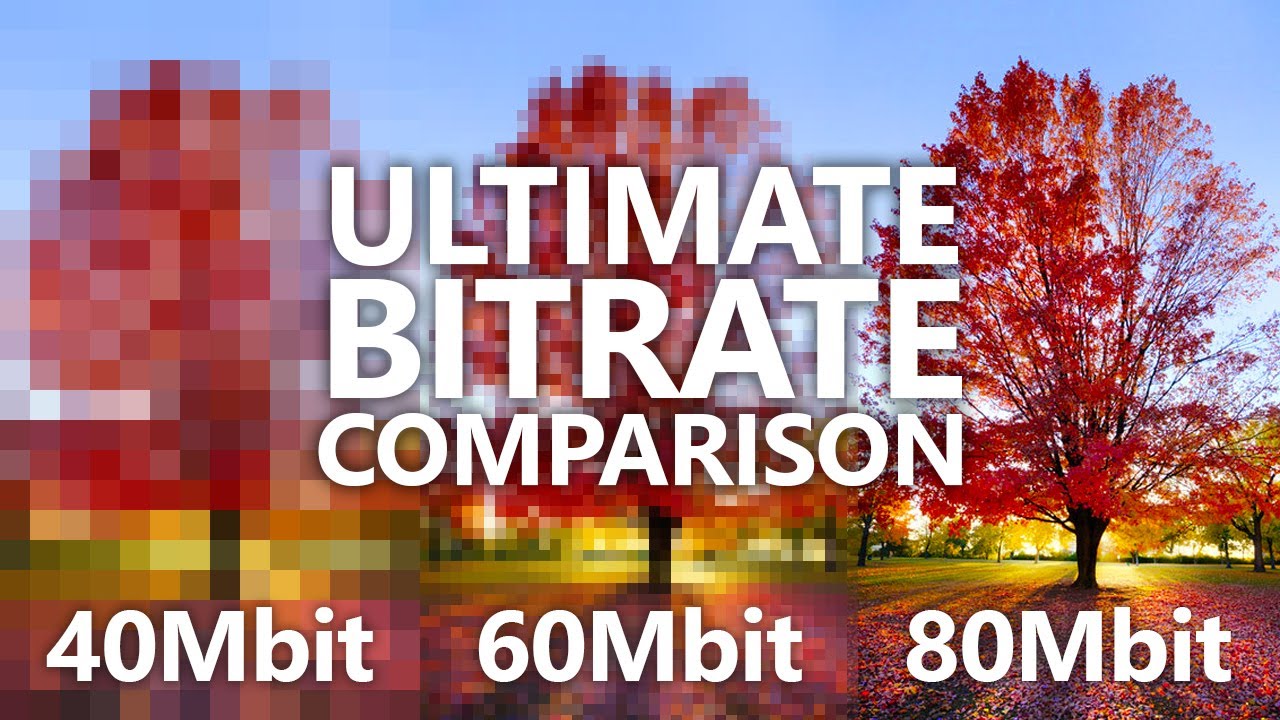
Video bit rate refers to the bit rate associated with video in a video file. The video bit rate value is large compared to the audio bit rate. The guideline for video bit rate varies greatly depending on the quality of the image to be delivered, and the value varies, but it is also said to be 500 kps at 70 Mbps.

Since the standard audio bit rate is approximately 192 to 320 kbps, the video bit rate occupies most of the oval bit rate when watching the entire video file. Basically, the characteristic of video bitrate is that the higher the value, the better the image quality.

However, it does not mean that the video bit rate value should be high. When viewing an image on a small monitor screen, it can be said that the roughness of the image is not that noticeable even if the bitrate value is a bit low. Even if you increase the value of the video bit rate, you cannot get the feeling that the image quality has improved, and there are many cases where the file size just increases.

Estimated video bit rate
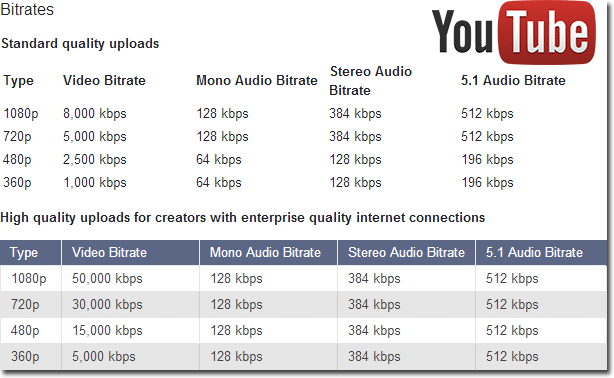
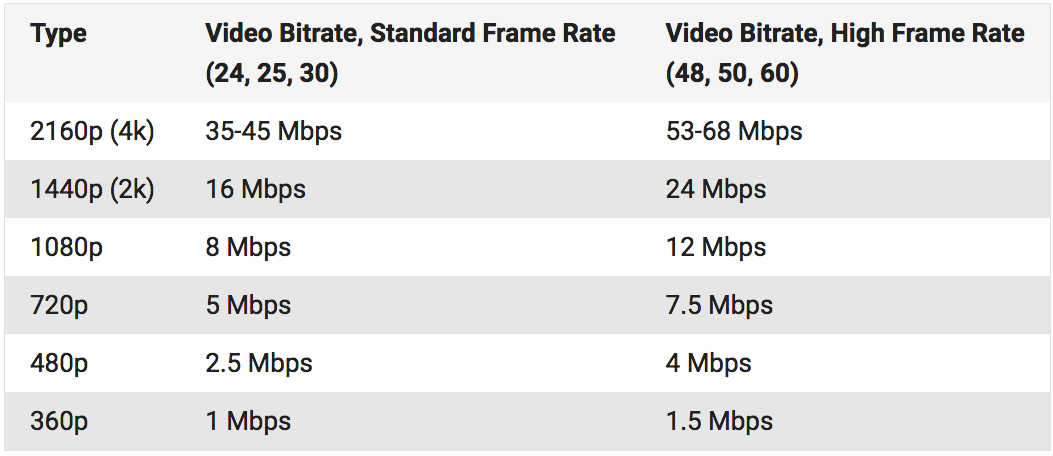
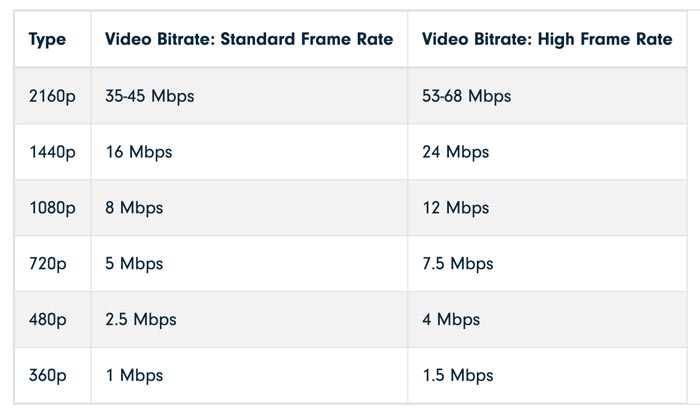
Even if the bit rate value is the same, the image quality will change depending on whether the video content is moving or not. Therefore, it is necessary to determine the bitrate that appears to be optimal for the video. The following is a guide to the proper bit rate for frequently used video resolution when distributing videos on YouTube.

Resolution SD (720 x 480px) 1-2 Mbps (video with a lot of movement) 500kps ~ 1Mbps (video with little movement)
HD resolution (1280 x 720px) 4.5-9Mbps (video with a lot of movement) 2.4-4.5Mbps (video with little movement)
Full HD resolution (1920 x 1080px) 9Mbps-18Mbps (high-motion video) 4.5-9Mbps (low-motion video)
4K resolution (4096 x 2160px) 35 ~ 70Mbps (high motion video) 25-35Mbps (low motion video)

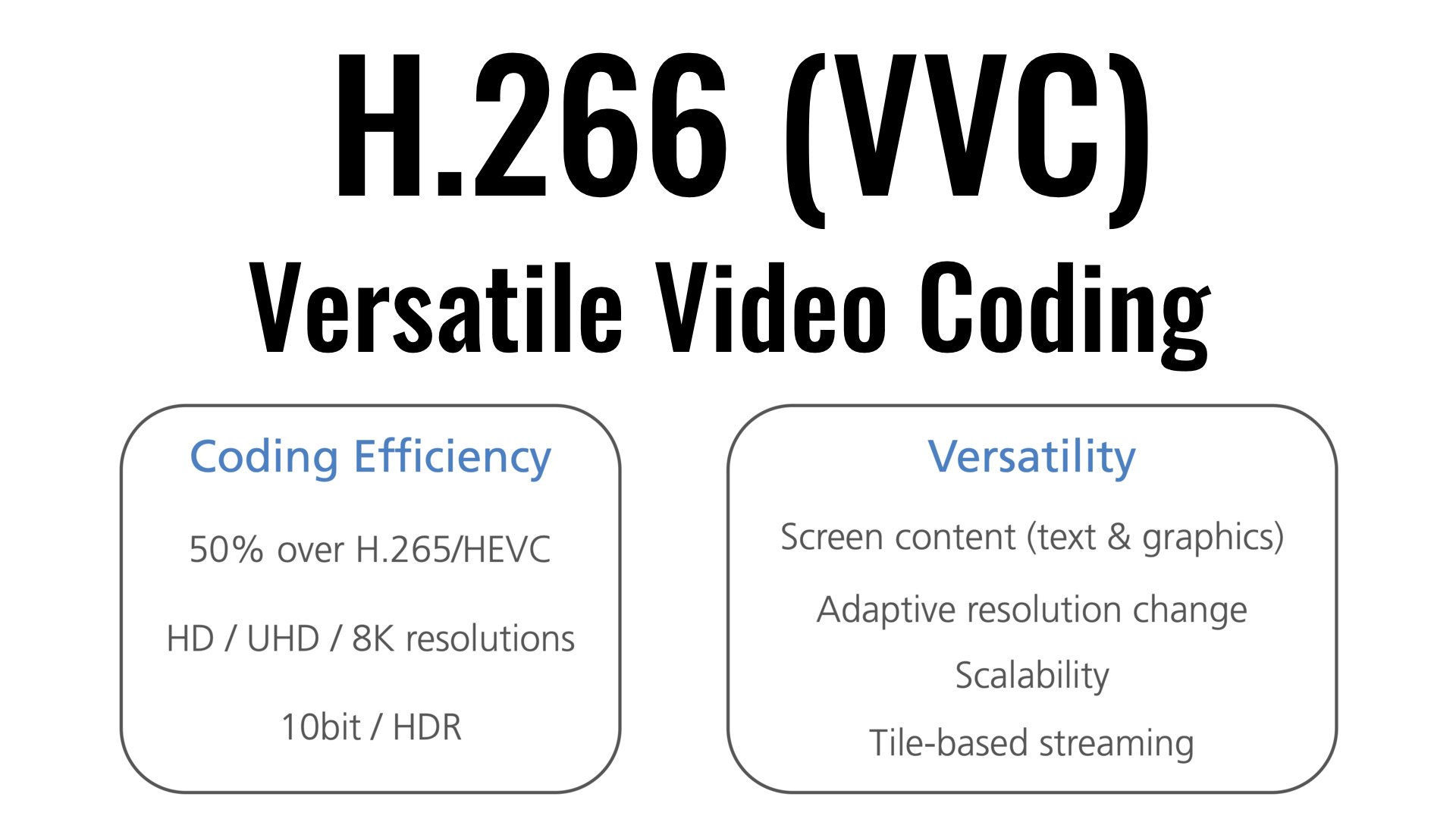
H.266 video encoding method

H.266 video encoding method

H.266

| It was successful in transmitting 4K / 60fps video using a VVC compliant real-time codec – It is possible to provide highly realistic video services at a bit rate less than half that of the method.

H.266/VCC

KDDI R&D Laboratories, Inc. (Headquarters: Fujimino City, Saitama Prefecture, Director: Gen Nakamura, hereinafter “KDDI R&D Laboratories”) is the latest international standard H.266 video encoding method | VVC (Versatile Video Coding) Using a real-time codec system (hereinafter “this system”) compatible with “VVC”), we achieved a demonstration experiment of streaming 4K video at a bit rate of 12 Mbps (megabit / sec) and a frame rate of 60fps (frames / sec.) We have confirmed that stable video quality can be maintained even if the bit rate is reduced to less than half that of the current stream.
Current 4K streaming video is streamed at a frame rate of 60fps, and by using this system, viewers can be provided with a highly realistic video service comparable to 4K streaming, including not only streaming but also mobile lines. . provide a more flexible network configuration.

[Background]
KDDI R&D Laboratories is dedicated to the research and development of compression technology with the aim of realizing a content experience that maintains a high sense of presence by providing the optimal transmission media according to the situation of the user who is viewing the video. Is working.

1. 1. This demo experiment follows the following two VVC research results announced by KDDI R&D Laboratories in September and December 2020.
・ Developed the world’s first newest video encoding method H.266 | VVC Compliant 4K Realtime Encoder (September 1, 2020)
・ The world’s first newest video encoding method H.266 | VVC Compatible Realtime Codec 4K Live Streaming Successful Demo Experiment (Dec 23, 2020)

2. VVC is the latest video encoding method, and is the international standard video encoding method widely used in today’s Internet 4K / 8K video transmission and distribution services. H.265 | HEVC (High Efficiency Video Coding, hereinafter “” Achieves twice the video compression performance of “HEVC”). It was standardized in August 2020 by the international standardization bodies ITU-T and ISO / IEC. In Japan, its adoption is being considered as one of the video coding methods in the sophistication of terrestrial digital television broadcasting, which is being studied by the Ministry of the Interior and Communications (Note 1).

The 3.4K video streaming has a frame rate of 60fps and is superior in reproducibility of high-speed moving scenes compared to 30fps, which is generally used for Internet video distribution, especially in sports scenes. It helps to improve the quality of the experience. In the experiments so far, it was aimed at 30fps and it was difficult to use it for streaming.

[Scheme and results of the demonstration experiment]
On December 21, 2021, a network line was used from Kansai Television Broadcasting Corporation (Kita-ku, Osaka) to the KDDI Research Workshop (Minato-ku, Tokyo) using this system developed by KDDI R&D Laboratories. a video streaming demonstration experiment over.

In the demo experiment, we managed to stream 4K video at 12 Mbps bit rate and 60 fps frame rate, and confirmed that stable video quality can be maintained even if the bit rate is reduced to less than half of the current one. transmission.
We have improved acceleration processing and parallelization processing that are effective for making VVC encoders on multi-core CPU platforms, and we have devised and realized technology that scales not only at a frame rate of 30fps but also at 60fps. .

Factors related to the quality of video and audio data Part 2

Factors related to the quality of video and audio data Part 2

Bit Rate

resolution
This is also an item dedicated to video.

Video Bitrate

Resolution is a numerical value that represents the density of pixels in an image. We use the unit “dpi (dots per inch)” or “ppi (pixels per inch)”. The “image” in digital is expressed by “a collection of very small colored dots (pixels).” The higher the resolution value, the higher the density of this point and the finer and more natural the image will be.

There is also a concept similar to this, which is the concept of resolution using pixels (dots, pixels). Uses pixels [pixel], dots [dot], or pixels as the unit. It is often written as “1920 x 1080 pixels” or “2 million pixels”, and in the case of this video, there are “1920 horizontal and 1080 vertical color points (pixels), and the total number of points is 2,073,600 ( approximately). It means “2 million pieces)”. (* Pixel = dot = pixel)

For resolutions that use “dpi”, it represents the density of pixels per 1 inch (= 0.0254 meters) of a straight line.
For resolutions that use “pixels”, it represents the total number of pixels used in the video.

The exact definition of resolution is the first. However, the latter is also widely recognized. Be careful not to get confused.

▲ Source: Wikipedia “Resolution”

Screen resolution / ratio
In the field of displays, there is also “screen resolution”. This is represented by pixels. Because it uses pixels, it represents the total number of pixels on the screen. You can also express the “screen aspect ratio (screen aspect ratio)” by multiplying it by something like “1920 x 1080 pixels”. If it is “1920 x 1080 pixels”, the aspect ratio of the screen is “16: 9”.

If the aspect ratio of the image and the aspect ratio of the screen do not match, black bands may appear at the top and bottom or left and right when the image is fully displayed (enlarged display), or the image may be to stretch.

Some screen aspect ratios have special names. The following are pixel counts, screen aspect ratios, and commonly used screen names. (* Since most pixel ratios are square, screen aspect ratio = screen aspect ratio)

Known as Horizontal x Vertical Ratio
(horizontal: vertical) Number of pixels
VGA 640 × 480 4: 3 307,200
SVGA 800 × 600 4: 3 480,000
XGA 1024 × 768 4: 3 786,432
SXGA 1280 × 1024 5: 4 1,310,720
WSXGA + 1680 × 1050 16:10 1,764,000
FHD (Full HD) 1920 × 1080 16: 9 2,073,600
WUXGA 1920 × 1200 16:10 2,304,000
Wikipedia: screen resolution that

By the way, continuing from last time, there is too much basic knowledge and it seems frustrating, but please do your best. Knowing this and not knowing it will make a big difference in your video and audio conversion and playback work. Remember it little by little as it is a necessary knowledge to be able to play and convert optimally while maintaining quality without waste.

Factors related to the quality of video and audio data

Factors related to the quality of video and audio data

Video Bitrate

Last time, I wrote about “codecs” and “containers” that determine the format of the video and audio data. Now, I would like to write about each item related to the “quality” of that data.

Bit Rate

Bit rate
Bit rate [bit rate], or bits per second, is a unit of data transfer rate.
It is defined as the number of bits that have passed (transferred) at a given point on the data transfer path per second. Also known as bps [bits per second] and b / s. Other names include “bit rate” and “bit efficiency”, all of which have the same meaning.

In short, it is a unit that expresses “how much data (information) can be transferred”. A large number means that the amount of data passed at a certain point is large and the quality of the video and audio is improved. The greater the amount of data (that is, video / audio information), the higher the image quality and sound quality.

An SI prefix can also be added, and the unit is as follows.

Bits per second [bps: b / s]
Kilobit per second [kbps: kb / s]
Megabit per second [Mbps: Mb / s]
Gigabit per second [Gbps: Gb / s]
Since it is a unit of data transfer speed, it is also used for the speed of Internet lines. There is also a unit called bytes per second, which is expressed as “Bps” or “B / s” by capitalizing b. 1 byte = 8 bits.

For example, with MP3 audio data, the bit rate value can be increased up to “320 kbps”. The higher the number of bit rates, the greater the amount of data transferred and the greater the original data capacity.

The phrase “high bit rate” is essentially incorrect
I often hear the phrase “high / low bit rate”, but this phrase is really inappropriate.

The word bit rate is a unit, not a physical quantity. It is the same as the relationship between “length (physical quantity)” and “meter (unit)”. We say “long” but not “long meter”.

The physical quantities that represent bit rates are called “transfer rate”, “transfer speed”, “transfer efficiency”, “transmission rate”, “transmission speed”, “transmission efficiency”, and so on. However, the phrase “high bit rate” has become mainstream, so you don’t need to worry too much about it. Remember “To be exact …”.

frames per second
This is a value for video data only.

The frame rate [frame rate] is an index that shows how many frames (still images: frames) can be processed per unit of time. Use fps [frames per second] or f / s as the unit.

Digitally speaking, a video is not recorded as a continuous image, but is taken continuously and displayed at high speed like a flip book, so that it “appears to be moving.” I’m doing. It is a method that uses the effect of human residual image.

The “one-by-one still images” are called “frames” or “frames.”

If the frame rate value is large, the number of processed frames per second will increase, resulting in smoother video. If it is 30 fps, 30 frames per second are processed.
Currently, “30 fps” or “29.97 fps” is very widespread. When you increase to 60fps, the video becomes smooth enough and when you decrease to 15fps or less, the video becomes jerky.

Increasing the value of the frame rate will result in a smoother video, but it will be heavier and of higher capacity.

There is no point in raising him innocently

There is no doubt that increasing the value of the frame rate will result in a smoother video, but if the value called “response speed” of the screen or monitor displaying the video is large (that is, slow), the frame rate value will be increased. It may not make sense to increase it.

Response speed is the time it takes for a signal to actually enter. The unit is milliseconds [ms: 1 ms is 1/1000 second of 1 second]. The “Response Speed” on a screen or monitor indicates the speed when changing from “black to white to black”. (Currently the definition is blurry because it handles colors other than black and white, but it is omitted here.)

If this response speed is high, it means that the video (color) change is fast. If the speed is high, the response speed value will be small and it will be able to display “smooth and clear video, even when moving fast.” At low speeds, the value increases and “residual images are likely to occur in videos being played.