MP3 vs. AAC


Free Download Mp4Gain
picture

MP3 vs. AAC: Audio Quality Comparison
MP3 vs. AAC
MP3 vs. AAC
MP3 vs. AAC
MP3 vs. AAC

MP3 Audio Compression

MP3, or MPEG Audio Layer-3, is a widely-used audio format known for its efficient compression. It uses perceptual coding techniques to discard certain audio frequencies that are less perceptible to the human ear. This compression allows for smaller file sizes while maintaining an acceptable level of audio quality.

AAC Audio Codec

AAC, or Advanced Audio Coding, is a successor to MP3 and offers improved audio quality at similar bitrates. AAC utilizes more advanced compression algorithms, including perceptual noise shaping and temporal noise shaping, resulting in better sound reproduction and higher fidelity compared to MP3.

Differences in Audio Quality

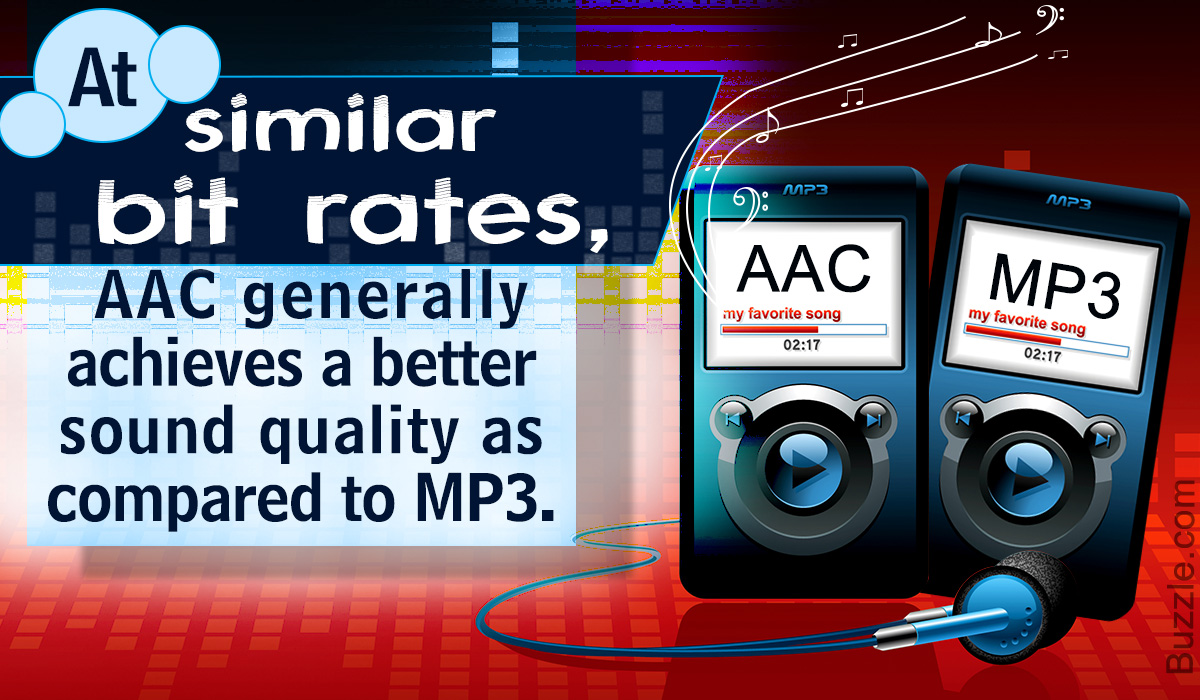
When comparing MP3 and AAC in terms of audio quality, there are several factors to consider. AAC generally provides better sound quality than MP3 at similar bitrates. This is because AAC is capable of preserving more audio details and nuances, resulting in a more accurate reproduction of the original sound.

Bitrate Efficiency

One advantage of MP3 over AAC is its superior bitrate efficiency. MP3 achieves good audio quality while keeping file sizes relatively small. This makes it suitable for applications with limited storage or low bandwidth, such as online music streaming or portable audio players.

Transparent Compression

AAC is often considered a “transparent” audio codec, meaning it can achieve audio quality indistinguishable from the original source, even at lower bitrates. This makes AAC a preferred choice for high-quality audio applications, such as digital music distribution and professional audio production.

Compatibility and Support

MP3 enjoys broad compatibility across various devices and platforms due to its widespread adoption. It is supported by virtually all audio players, software, and hardware devices. AAC, on the other hand, may require specific codecs or software support, although it has gained significant popularity and compatibility in recent years.

Application Considerations

Choosing between MP3 and AAC depends on the specific application and user preferences. If file size and compatibility are the primary concerns, MP3 may be the preferred choice. However, for applications where audio quality is paramount, such as music production or high-fidelity audio playback, AAC offers a superior option.

Transcoding and Conversion

Transcoding or converting audio files from one format to another may result in some loss of audio quality. If transcoding from MP3 to AAC, the original MP3 compression artifacts may be retained or exacerbated. It is generally recommended to use the highest-quality source file available to maintain audio fidelity.

Subjective Listening Tests

Subjective listening tests involving trained listeners have consistently shown that AAC often provides better audio quality compared to MP3 at similar bitrates. However, individual preferences can vary, and some listeners may not perceive significant differences between the two formats in certain scenarios.

Choosing the Right Format

Ultimately, the choice between MP3 and AAC depends on factors such as the intended use, available storage or bandwidth, desired audio quality, and compatibility requirements. Evaluating these factors and conducting listening tests can help determine the most suitable audio format for a specific application or use case.

Optimizing Audio Quality

To optimize audio quality, it is important to consider not only the choice of audio format but also factors such as the source recording quality, mastering techniques, and the playback equipment used. Additionally, using higher bitrates


Free Download Mp4Gain
picture


Mp4Gain Main Window
picture


Mp4Gain Features
picture


Free Download Mp4Gain
picture

AAC vs. MP3

Understanding Audio Codecs: AAC vs. MP3

AAC vs. MP3
AAC vs. MP3
AAC vs. MP3
AAC vs. MP3


Audio codecs are a type of data compression algorithm that is used to reduce the size of digital audio files. This makes it possible to store and transfer audio files more efficiently, and to play them back on devices with limited storage space.

There are two main types of audio codecs: lossy and lossless. Lossy codecs reduce the size of audio files by removing some of the data from the original audio signal. This can result in a loss of quality, but it can also result in a significant reduction in file size. Lossless codecs, on the other hand, do not remove any data from the original audio signal. This means that the quality of the audio is preserved, but the file size is not reduced as much.

In this article, we will compare two of the most popular audio codecs: AAC and MP3. We will discuss the advantages and disadvantages of each codec, and we will help you decide which codec is right for you.

AAC

AAC stands for Advanced Audio Coding. It is a lossy audio codec that was developed by the Moving Picture Experts Group (MPEG). AAC is designed to provide better sound quality than MP3 at the same file size. AAC is also more efficient than MP3, which means that it can achieve even better sound quality at lower file sizes.

AAC is supported by a wide range of devices, including smartphones, tablets, computers, and home audio systems. It is also the default audio format for many streaming services, such as Spotify and Apple Music.

MP3

MP3 stands for MPEG-1 Audio Layer 3. It is a lossy audio codec that was developed by the Moving Picture Experts Group (MPEG). MP3 is the most popular audio codec in the world. It is supported by a wide range of devices, and it is the default audio format for many music file sharing services.

MP3 is not as efficient as AAC, which means that it cannot achieve the same sound quality at lower file sizes. However, MP3 is still a good choice for most people. It is a reliable and widely supported codec that offers good sound quality at a reasonable file size.

Which Audio Codec is Right for You?

The best audio codec for you depends on your needs. If you want the best possible sound quality, then AAC is the better choice. However, if you are looking for a codec that is widely supported and that offers good sound quality at a reasonable file size, then MP3 is a good option.

Conclusion

AAC and MP3 are two of the most popular audio codecs in the world. Both codecs offer good sound quality, but AAC is generally considered to be the better choice for people who want the best possible sound quality. MP3 is a good option for people who are looking for a codec that is widely supported and that offers good sound quality at a reasonable file size.

Comparison of sound quality between AAC and WMA

Comparison of sound quality between AAC and WMA

AAC vs WMA

General description

AAC vs WMA

Comparison of AAC, WMA and MP3 sound quality. Since the difference in AAC is very large according to the encoder, we use two types, QAAC as a representative of excellent coders and VO-AEACENC as a representative of deficient coders.

QAAC 1.18, which borrows and encoding the Apple engine (Apple Support Software), which is also used in iTunes, wmaincode_0.2.9, encoding the Microsoft engine that comes with Windows XP or later, and the known open source encoder MP3 Lame We heard and qualify a total of 4 Visualon Vo-Aacenc 0.1.1 types, which recently became open source, 3.98.4, which also serves as a billing standard.

result
QAAC 192KBPS> WMA 192K> QAAC 128K ≒ LAME 192K ≒ WMA 128K> LAME 128K ≒ VO-AAC 192K ≒ VO-AAC 128K 128KBPS, VO-AAC 192KBPS, VO-AAC 128KBPS were the highest ratings.

evaluation
F: ID: Kamedo2: 20120124200328P: Image

Encoder QAAC VOAAC WMAE boring Qaac Voac Wmae boring
Year of launch 2012 2011 2011 2009 2012 2011 2011 2009
Version 1.18 0.1.1 0.2.9 398.4 1.18 0.1.1 0.2.9 398.4
CAA CAA AMM Format MP3 CAA CAA AMM MP3
Profile LC LC Standard —- LC LC Standard —-
Classification control CVBR ABR ABR CBR CVBR ABR ABR CBR
128K 128K 128K 128K 192K 192K 192K 192K 192K
41_30SEG percussion instrument 3.9 2.6 2.6 3.3 3.3 2.1 2.1 5.0 5.0 2.8 3.7 3.7 3.3 3.3
Final fantasy Rope repellent 4.4 4.4 3.4 3.4 4.0 4.0 2.9 4.6 3.9 5.0 5.0 3.7 3.7
A Train Jazz 4.6 2.7 2.7 4.6 2.3 5.0 5.0 2.9 5.0 5.0 4.5 4.5
Big Yellow Cups 3.8 3.8 2.8 3.1 3.1 2.3 4.7 3.2 3.2 4.2 4.2 4.0 4.0
Floor essence Tecno 3.4 3.4 2.5 3.4 3.4 2.5 5.0 5.0 2.4 4.1 3.4 3.4
Macabre orchestra 4.6 2.8 5.0 5.0 3.4 3.4 5.0 5.0 2.8 4.7 4.7
My blood is oxidized Rope instrument 5.0 5.0 2.4 3.9 2.8 5.0 5.0 2.4 5.0 5.0 3.9
Maybe Latin 4.1 2.3 3.6 3.1 3.1 5.0 5.0 2.3 4.3 4.5 4.5
Velvet Kingdom TECNO 3.8 3.8 2.5 2.7 2.7 3.0 3.5 4.5 2.6 2.6 3.5 3.5 3.2 3.2
Rain flowers Cups 4.0 4.0 2.3 4.4 4.4 2.8 5.0 5.0 2.3 4.7 5.0 5.0
Confidence Gossip 3.7 3.7 2.8 3.6 3.3 3.3 4.3 3.2 3.2 4.6 4.1
Wait Rock 3.8 3.8 2.6 2.6 3.7 3.7 2.8 4.2 4.2 2.7 2.7 4.6 4.0 4.0
Latin experience 3.8 3.8 3.8 3.8 3.7 3.7 3.5 3.5 5.0 5.0 2.8 5.0 5.0 4.0 4.0
Heart to Heart Cups 3.7 3.7 3.1 3.1 3.5 3.5 2.8 4.6 3.5 3.5 4.5 4.5 3.9
Female Voice Dining Room 4.6 2.7 2.7 3.6 3.3 3.3 5.0 5.0 3.0 3.0 4.5 4.5 4.1
↑ SOUND SOURCE Average score 4.05 2.74 3.73 2.85 4.78 2.83 4.47 4.00
Real Rate 136K 130K 135K 128K 208K 194K 203K 193K
All sizes (KB) 5803 5555 5782 5495 8894 8294 8674 8242
Encoder QAAC VOAAC WMAE boring Qaac Voac Wmae boring

Method
Eight eight audio files were shuffled using ABC / HR for Java 0.53A and MHP -A1 to listen and scoring with the brand face down so that the preconceived ideas on the brand will not affect it. 1.0 = I am very concerned about the deterioration of sound quality 2.0 = I am worried 3.0 = I am a little worried 4.0 = I can see the change in sound quality with respect to the original sound, but I do not care 5.0 = I do not know the Change in sound quality, I can not distinguish. If you want to grant a score of 4.9 points or less, perform the ABX test 20 times, answer 15 times or more (the likelihood of getting a higher rating in a coincidence is approximately 2%) and make sure you can listen to The difference before doing so (2.9 is omitted if it is less than or equal).
The same test was repeated in the SE-DIR800CII and the average was calculated. The score in this test is 15 (sound source) x 4 (BITS rate) x 2 (times) = 240 (times).