The Moving Picture Expert Group 1/2 Audio Layer 3, the audio compression format that has changed the music world forever, has officially disappeared, at least for the Fraunhofer Institute for Integrated Circuits.

The German institution that was working on the format and that funded its development in the late 1980s recently announced his death at the end of the licensing program for some registered patents related to the MP3 format. According to the official statement, the reason is: “More efficient audio codecs are available today.”
Despite the enormous popularity that was gained in about 30 years, the MP3 format was surpassed by the formats of the Aac family used by modern multimedia services such as streaming or TV and radio broadcasts, and soon also by the extraordinary Mpeg-H .

The new formats guarantee better audio quality and a lower bit rate, hence a heavier audio file with the same quality compared to MP3 and offer greater functionality. According to Bernhard Grill, director of the institute, AAC is today the de facto standard for downloading music and videos on smartphones. If MP3 was the symbol of a revolution, today nobody cares about the name of the institute format in which an audio file is encoded, only “sounds” good.
Let’s return to the history of MP3 thanks to these 10 “Maybe not everyone knows”:
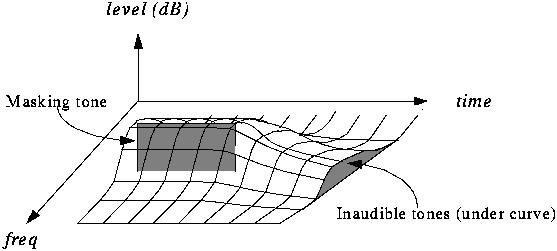
1) An idea from the late 19th century. Studies of an algorithm that reduced the weight of audio files in order to transmit them more easily through very slow networks in the late 1980s relate to the concept of “auditory masking” or the phenomenon by which the perception of a Presence of another sound masked.
The first observations on this phenomenon were made in 1894 by the American physicist Alfred M. Mayer.
2) Hello, I’m MP3 The father of MP3 can be seen as a codec for the psychoacoustic masking introduced in 1979. The aim was to create an audio format for telephone messages that does not “weigh” the lines. The basic idea that was later taken up when creating the MP3 format is that the human ear cannot perceive some audio frequencies.
For this reason, it is sufficient to eliminate these frequencies in order to reduce the weight of an audio file while maintaining an apparent quality. In fact, the basic assumption has proven to be wrong in recent years. Read also: The virtual reality changes the music and fights the secondary ticket sales. And Keith Richards teaches you how to play
3) An Italian is listening Leonardo Chiariglione Mp3 seen at “The Visible City” at the Turin International Book Fair 2012. Valerio Pennicino / Getty Images Leonar do Chiariglione, an engineer from Almese, Turin, is considered one of the fathers of the MP3 format as the founder of the working group MPEG (Moving Pictures Expert Group) in 1988, which developed several audio / video compression formats in world standards.
In December 1988, the MPEG group launched a public request to develop an audio compression algorithm. Because of their similarity, the 14 algorithms obtained were divided into four main categories.
4. Brandenburg uses it. Suzanne Vega. Carlos Alvarez / Getty Images It is the thesis of the doctoral student Karlheinz Brandenburg that was discussed in 1989 at the German University of Erlangen-Nuremberg to illustrate the specifications of the MP3 format in detail.
The first song encoded in the new format was Tom’s Diner by singer Suzanne Vega. Brandenburg coded it countless times to understand whether the omitted frequencies had affected the sound of Vegas’ voice. Also Read: 10 Songs To Keep Fit: Here’s The Spotify Playlist
5. Light weights With the introduction of the MP3 format, the weight of a song was reduced to approximately 4 MB compared to ten MB of an audio file on a CD. It was a revolution because it was finally possible to transmit the songs over the Internet, although the transmission speed was still tied to the limits of the 56 kbit / s modems or even to a lower download speed.
6. The hacker in a coat In the summer of 1996, the NetFrack user published a message in the Affinity online fanzine that he had found a way to reduce the size of audio files thanks to a new compression format and thus hard drives. from that time on they could have contained many more songs. Subsequently, NetFrack founded the online group Compress Da Audio, which only distributed music files, and made Metallica’s song Doesi It Sleeps available in MP3 format.
August 10, 1996 is the official date of birth of music piracy.
7. The beginning of the revolution. In 1997 NullSoft created Winamp, the first software to encode audio files in MP3 format. The following year, Diamond Multimedia introduced the first portable MP3 player, the Rio PMPm300, which could hardly hold the contents of an album, used a pencil battery, and cost around $ 200. In 1999 it was Shawn Fanning and Sean Parker. Years later, when Mark Zuckerberg advised to remove “The” from the Facebook name, Napster founded it.
8. A useful service. Despite about $ 35 million in claims and considered utterly evil, Radioheads Kid A wouldn’t have had the success it had had without Napster. The group was not yet known worldwide and the record company had not planned to advertise the new album, release or video clips. In October 2000, the album was Radiohead’s first to top the billboard charts, also thanks to the fact that it was released three months before Napster’s official release.
And Thom Yorke said unlike Madonna, Metallica and Dr. Dre, who had filed million dollar lawsuits: “The best thing about Napster is that it instills enthusiasm for music in a way that the music industry has stopped. Hour”.
9. Apple, thank you In 2001, Apple introduced the iPod, the MP3 file player that played a key role in tracking china down to the Cupertino home. Almost 400 million units were sold in around 13 years of life. In 2003, Apple always invented the first paid and legal music download service. Today, 70% of online music is purchased on iTunes, which is an average of approximately 20,000 songs per minute.
10. An announced death. The development of the AAC format, which is now the de facto standard for digital audio, began in 1990, but only understood in 2007 when Apple decided to only make audio files in Aac format with 256 Kbit / s available in iTunes Plus Experts the end. MP3 was close.