What is bit rate? Knowledge of the MP3 audio format.


Free Download Mp4Gain
picture

What is bit rate? Knowledge of the MP3 audio format.

mp3

Digital audio formats are audio signals that are recorded, processed, and reproduced in digital form.

MP3

The emergence of digital audio formats is to meet the needs of high-fidelity playback, storage and transmission. Simply put, early analog audio formats had issues with playback distortion and glitches due to media wear. Since the advent of the CD, digital format audio files have become popular, but another problem has arisen: the limitation of the storage volume, and the CD still has the phenomenon of wear. Saving to hard drive (relatively longer storage time) is not a good solution when storage media (mainly hard drives) are still expensive at the time. The rise of the Internet has created a requirement for long-distance file transmission. Under the restriction of bandwidth, the demand to reduce file size has become more intense. All this has led to the generation of lossy compressed digital audio formats from external factors!

In terms of internal factors, with the improvement of computer operation and coding capabilities, the progress of various acoustic psychological models has promoted the emergence of various lossy compressed digital audio formats. Some of the most commonly used audio formats in MP3 players are briefly introduced below: MP3 (CBR, VBR, ABR), WMA, WAV, ADPCM, and the emerging audio formats AAC, ASF, and OGG.

Before introducing various digital audio formats, let’s clarify one concept: bitrate.

In the field of computing, all information is digitized. Bit is the smallest unit of data in a computer, it refers to a number of 0 or 1, which is a mathematical binary number, a “0” or “1” , is a bit. For example, when we say a 2-digit number, it means that it is a two-digit binary number, and there are 4 combinations of “00”, “01”, “10” and “11”, which represent 0, “11” in decimal respectively. 1, 2 and 3 are four numbers.

Bitrate is a benchmark indicator of the efficiency of digital music compression. The bit rate represents the number of bits bps (bit per second, bits per second) transmitted per unit of time (1 second). We usually use kbps (in simple terms, it is per second) clock 1000 bits) as the unit. The bit rate of digital music on CD is 1411.2 kbps (ie recording 1 second of CD music requires 1411.2 × 1024 bits of data). The higher the bit rate of the music file, the more data (Bit) must be processed in a unit of time (1 second), and the better the sound quality of the music file. However, when the bit rate is high, the file size increases, which will occupy a large amount of storage capacity. 8 to 320 kbps.

1. WMA (Windows Media Audio, Windows Media Audio)

As a Microsoft media compression method, it is a part of the technology that compresses only audio data in Windows Media Technologies. The sound quality is similar to MP3 and can be compressed with half the technology of MP3. It has the copyrighted Windows Media Rights Manager and can be played by installing it in WMP (Windows Media Player, Windows Media Player). Due to the strong influence of Microsoft and Windows, as well as major copyright reasons, the major American record companies EMI and BMG have officially confirmed that they use the WMA method developed and produced by Microsoft. It is believed that this advanced method will become even more popular in the future.



Free Download Mp4Gain
picture


Mp4Gain Main Window
picture


Mp4Gain Features
picture


Free Download Mp4Gain
picture

What is MP3?

What is MP3?

MP3

“MP3” widely used in audio players. The official name is “MPEG-1 Audio Layer III”, which is the audio format for MPEG-1. The MP3 format itself is being standardized in parallel with MPEG as the video format, and in 1992 it will be standardized as “ISO / IEC IS 11172-3 (MPEG-1 Audio)”.

MP3

After that, MP3s will be distributed “as is” among enthusiasts, but this has not been a major advance since the introduction of the portable “mpman” audio player launched by SAEHAN International in South Korea in 1998. By combining this player, which can download and play music data over the Internet, with Napster, which appeared in 1999, the scene of portable audio players that used to carry cassettes, CDs, MDs, etc. it will change completely.

MP3s can also reduce the original data to less than one tenth. For example, it has become possible to compress a one-hour music CD to about 40MB and, using Napster, etc., we have established a new need for music sharing between users. After that, despite various “RIAA (Recording Industry Association of America)” procedures and the emergence of successor formats formulated by many manufacturers, MP3s remain a widely used audio. It is still used as a format.

■ MPEG

To understand the working principle of MP3, let’s first explain about “MPEG Audio” itself. A feature of MPEG Audio is that it uses auditory psychology, the lower audible limit of hearing, and the masking effect.

Let’s start with this minimum audible limit. In general, it is considered that humans can hear sounds in the range of 20 Hz to 20 kHz. Of course, this is an average value, and some people can hear a wider range, while others can only hear a narrower range, but this time I’ll drop it.

So if you can hear any sound in the 20Hz to 20KHz range, that’s not the case. The lower audible limit curve is shown in Fig. 1, and it is possible to hear even a fairly low sound around 2KHz, but at frequencies above or below it, it is heard that it is not considerably loud. .

You may have heard the term “volume curve”, which is the curve shown in Figure 1. Therefore, even if there is a sound source that sounds in a wide range from bass to treble (Fig. 2 ), the human ear has the characteristic that it can only be heard with both ends drooping (Fig. 3). By taking advantage of this and omitting all inaudible frequency data, a great deal of compression is made possible.

Masking effect

The masking effect is another phenomenon. For example, when a very loud sound is generated at a certain frequency, a specific area called “Critical Band” is created before and after that. And you won’t hear any of the other sounds included in this critical band.

When sound A is generated, the sloping area that extends to the before and after frequencies is the Critical Band. I can hear the part of the B sound that sticks out of the Critical Band without any problem, but I can’t hear the C sound that completely fits into the Critical Band.

In MPEG Audio, compression efficiency is further improved by omitting sound data that cannot be heard due to this critical band as before. By the way, the masking effect itself is effective not only in the direction of frequency but also in the direction of the time axis. In other words, not only immediately after a loud sound is generated, but also just before that, you cannot hear a small sound for some reason. This is called the temporary masking effect, but in Figure 5, sound B and sound C become inaudible. This is also effective for data compression.

Mp3, the star format, the reasons

Mp3, the star format, the reasons

MP3

Another interesting property of hearing is that the lower the volume level, the lower its resolution, the lower the number of sounds perceived. When the volume is lowered the high frequencies are better perceived, when the volume is increased the low frequencies are perceived. And they do not complement each other, but rather replace each other.

File MP3 Icon - Silverblue Icons - SoftIcons.com

A person does not perceive some sounds, focusing on others. Pay attention: an instrument, or a voice, is usually audible clearly and consciously. Everything else becomes a background or a single tune. And no matter what we focus on in composition, we cannot increase the number of basic sounds perceived.

How to create the mp3

All these data obtained from experimental studies are gathered and presented in the form of an ideal model of human hearing. The MP3 standard focuses on this.

Everything that a person does not hear unambiguously is immediately cut off. Post-processing degrades the sound according to the understanding of this model.

Thanks to the great work done, modern psychoacoustic models accurately evaluate human hearing and do not stand still.

In fact, despite the assurances of music lovers, musicians and audiophiles, to the inexperienced middle ear, the highest quality MP3 has almost extreme parameters.

There are exceptions, they cannot cease to exist. But they are not always easily noticed by blind listening. And they are no longer derived from the mechanisms of hearing, but from the algorithms for processing sound information in the brain.

And here only personal factors play a role. All of this explains why we love different headphone models and why the numerical characteristics of the audio cannot unequivocally determine the sound quality.

MP3 fits everything: analog quality

Audiophiles’ insistence on picky FLACs is worth going through another serious sift. Most analog recordings do not contain enough information for lossless formats.

All CDs are recorded at 44.1 kHz sample rate and 16-bit quantization. Where does 192 kHz and 24/32 bit come from, which is used when encoding in FLAC? They are not, this is a doll!

You will object that these parameters are higher for analog sound … But for an audio cassette and a magnetic tape (unless, of course, it is a Japanese master tape), the characteristics of an audio CD are NOT ACCEPTABLE. For conventional studio equipment, the ability to record analog sound corresponding to AudioCD is relatively new.

Therefore, it makes no sense to digitize recordings from the pre-digital era in frenetic quality, especially those made on magnetic media. They do not contain those spectra and the amount of information that containers can store without compression.

Everything fits in MP3: digital

Strictly speaking, with most digital recordings, the image is the same. In the 90s and later, cheap plastic boomboxes appeared. The sound engineers had to take care of the uniform sound on all devices: the dynamic range of the recordings was reduced to 10-12 bits.

One more point. Until recently, no one recorded in a very high-quality studio. Because it is difficult to work simultaneously with several dozen audio tracks with high recording quality, and sometimes there are simply not enough human and technical resources.

Why mp3 is enough for you, but Lossless is not necessary

Why mp3 is enough for you, but Lossless is not necessary

Mp3

Did you finish the greenhouse? So you don’t need to lose, listen to high quality mp3.

MP3

Very often there are people who, in principle, despise compressed formats. You should not be guided by your opinion. The following mods that in the studio with a 90% probability will not hear the difference between compressed and uncompressed audio.

What is mp3

MP3 isn’t just about cutting quality. It was developed by the Fraunchhofer Society, an association of applied research institutes in Germany. Later they came up with AAC, which could become the main compressed audio format … But it didn’t work.

Did you know that MP3 comes with variable (VBR) and constant (CBR) bit rate? The constant bit rate, due to the operation of the algorithm, is encoded each time as the first. Therefore, it can produce uneven quality, which means that not all sounds in this situation will be recorded in high quality.

Since MP3 has been around for a long time, it has many limitations. Bit width is 16-24 bits. The sample rate is represented by the following set of options: 8; 11,025; 12; sixteen; 22.05; 24; 32; 44.1; 48. The maximum bit rate does not exceed 320 kbps. The maximum number of channels is 2. But we are still talking about music, we still have to search for multi-channel recordings.
25104704-2
Now let’s see how MP3 is encoded. The illustration shows the time-frequency distribution of sound. Same recording: Audio CD, OGG file, MP3 well encoded. What we observe is that the pieces on the right and left almost completely coincide. This means that the MP3 file sounds almost the same as the original CD recording.

Human hearing and its limits – psychoacoustics

The fact is that the main task of the Fraunchhofer Society is the development of psychoacoustic models of human perception of sound. And here are many subtleties. The main thing is that we are not dolphins.

Second, there are certain restrictions on the number of sounds perceived simultaneously. A person cannot simultaneously hear more than 250 sounds of 24 ranges (in addition, the number of simultaneous sounds in the range is also quite small).

Third, the audible range is 16 Hz to 20 kHz and at the age of 60 it is reduced by almost half. Ideally, and during training (yes, you have to train it!).

All frequencies below 100 Hz are perceived not by the hearing cells, but … by the skin. Then the low waves are reflected in the ear canal; these waves are perceived as infrabass. (This is from the bone conduction area).
and
Also, the number of cells that register acoustic waves is different for each one. But what is there? For each individual, their number in the right and left ear is different.

By the way, the perception of each ear is different. Change channels of your favorite song – get a new sound.

If you dig deeper, it turns out that each sound frequency is perceived only at a certain volume. When it is reached, the silence is replaced by a sharp and quite different sound. After that, a person can hear a lower sound of this frequency.

What you need to know about MP3

What you need to know about MP3

Mp3

What is MP3?

Mp3

MP3 is short for MPEG Layer3. It is one of the transmission formats for storing and transmitting audio in digital form, developed by Fraunhofer IIS and THOMSON, and later approved as part of the MPEG1 and MPEG2 compressed video and audio standards. This scheme is the most complex scheme in the MPEG Layer 1/2/3 family. It requires the most amount of machine time to encode compared to the other two and provides higher encoding quality. It is mainly used for audio CD encoding.

The high degree of compactness of MP3 compared to other formats such as PCM (i.e. normal WAV- file) and similar formats while maintaining similar sound quality (considered 16-bit stereo at 44.1 kHz) is achieved using additional quantization according to a certain scheme, which minimizes the loss of quality. This is achieved by taking into account the peculiarities of human hearing, including the masking effect of a weak signal from one frequency range with a stronger signal from an adjacent range, when it occurs, or a strong signal from the previous frame, which causes a temporary decrease in the ear’s sensitivity to the current frame signal (simply, background sounds are eliminated, which are not heard by the human ear due to the presence at a given / previous moment of another – louder). It also takes into account the inability of most people to distinguish between signals that are below a certain power level,

This is called adaptive coding, and it allows you to save on the less perceptually significant sound details. The compression ratio (and therefore quality) is not determined by the format, but by the width of the data stream when encoded in MP3. The bit rate when encoding a signal similar to an audio CD (44.1 kHz 16 bit stereo) varies from the largest, 320 kbs (320 kilobits per second, also kbs, kbps or kb / s), up to 96 kbs and less.

Why MP3?

MP3 has two huge advantages over other formats available today. It is true that MicroSoft is trying to squeeze MP3 with its new WMA format, and there are also alternative VQF and AAC formats, but they have not yet received proper distribution and the quality is often a little worse. However, WMA is still, in fact, closed for free use, so you have problems with various encoding / listening / maintenance programs (although, who doubts MicroSoft’s mobilization capabilities :-).

The first advantage of MP3 is that none of the existing similar formats can yet be said to fully guarantee the stable preservation of sound quality at sufficiently high bit rates, except MP3, which has stood the test of time with dignity.
The second, no less important advantage: over the next few years, and perhaps the entire decade, MP3 has become the de facto standard, as the parties that use it (eg me 😉 have made a lot of investments in him, including digital radio stations. There are also many easy-to-use software programs written for MP3. Now the production of hardware MP3 players has been launched, both pocket and car. Thus, MP3 became the first massively recognized audio storage format after Audio CD (although it is often illegal).

The most famous encoders

Today there are 3 main sources that have created programs to encode MP3 music. These are Fraunhofer-IIS, Xing Technologies, and ISO itself, which adhere to the ISO MPEG standard developed by it.
Most of the encoders created to date use modified code from one of these organizations. Fraunhofer-IIS based encoders are not very fast, but very high quality, quality optimized for low bit rates.

128 kbps (11: 1)
The most popular bit rate today. The 11: 1 compression ratio is of course an argument, especially for the internet, where every kilobyte counts. However, the high frequencies are not very well preserved and there is some distortion in the sound. At the same time, I can safely say that on an ordinary computer, for example, using an ordinary sound card, computer speakers, albeit of good quality, or output through a simple recorder to your speakers (using the input for a External CD, like me), the difference will not be noticeable unless you are a sound expert.
However, in normal speakers (at least large and expensive), the lack of high frequencies is quite noticeable.

MP3: features and alternatives

The peculiarities of the MP3 format and some clues about other solutions of equal or even higher quality.

Impossible to deny, the MP3 format is the most common and most enjoyable to listen to music on the go or, as it has been for some years, streaming. We use it everywhere now and any device can play it today.

MP3 is part of the family of audio files called “lossy”, that is, the types of formats that can also reduce the amount of data that should contain a sound, in any case try to maintain at least an acceptable quality.

The peculiarities of the MP3 format and some clues about other solutions of equal or even higher quality.
The parameters that determine the quality level of an MP3 file are: the sampling rate, bit rate, encoder and of course the source. Now let’s move on to the order.
At the origin of everything is the source, that is, the support or source from which the MP3 file can be downloaded. The higher the quality of the source, the greater the end result: purchasing MP3s from particularly reliable sites or extracting them from compact discs in good condition is the basis for a successful MP3. What becomes crucial is the encoder (the most famous and free is LAME) or the software that takes care of creating the file after properly configuring its parameters.

Portada

The sampling rate is measured in Herz and expresses the number of times per second. Second, as the analog signal is measured and digitized; for MP3 it must be as faithful as possible on a CD, ie 44 100 Hz (44.1 KHz).

Bitrate is the number of binary units flowing, measured every second. The value of the bit rate is not fixed: as it increases, the similarity to the original file will also increase proportionally. The higher the bit rate, the higher the quality, the larger the file size. The bit rate range ranges from 32 kbps to 320 kbps, the maximum that can be obtained from an MP3 file.

The ones we’ve just listed are an important part of the tricks that allow us to have an MP3 quality; however, be aware that a lost file is by no means faithful in all respects to the original source. The most famous lost alternatives are: AAC (the format Apple uses to sell music in the iTunes Store and since July to stream audio from the Apple Music service); WMA; MPC; OGG (excellent quality open source format).

If you are looking for maximum faith in digital audio, give up MP3 and its loss-free alternatives to switch to “loss-free” audio formats, ie loss-free quality. Overall, this file type compresses the original sound while keeping the number of bits intact. Needless to say, quality comes at a cost in terms of the space taken up: a lossless file takes about half of the original audio file, but “weighs” nearly three times as much as a 320Kbps MP3. Of these, the most famous and used are: FLAC; ALAC (Apple Lossless Format); BEE; WavPack. The “lossy” and “lossless” file distinctions are extremely applicable to images and videos as well, not just audio files.

On several occasions it has been said how absolutely difficult it is to distinguish an MP3 at 320 kbps, obtained under the best conditions, from its original version on CD or in lossless files; It is only possible to notice it with instruments at a certain level and with a good ear. When noted, the MP3 format is excellent for listening on the move, as highlighted above; On the other hand, to better preserve our music or listen to it on systems of a certain level, it is better to resort to lossless formats such as FLAC or ALAC.

Advantages and disadvantages of MP3 technology

Advantages and disadvantages of MP3 technology

In the Internet age, MP3 became a de facto standard for digital audio files. With the popular Napster peer-to-peer application, music lovers can exchange MP3 files so they can get songs without paying for them. This article has been written to highlight the advantages and disadvantages of MP3, as well as to help you decide if you want to convert your existing music files in some other format to MP3 or not.

Advantages of MP3

The advantage of MP3 is its high fidelity. The quality of an MP3 file is determined by its bit rate. The bit rate is measured in kilobits per second. The bit rate of an MP3 file can range from 8 kbps to 320 kbps. You should save your songs at 160kbps if they don’t like it very much and don’t put them at the top of the list of MP3 players. Keep your songs at 192kbps if you like them a little. Use 256kbps for the songs you like. And using 320kbps for your all-time favorite songs. Anyway, even a 320kbps MP3 doesn’t sound as good as the song’s WAV file version. But a 320kbps MP3 takes up four times less space than a WAV file. To use an analogy, an MP3 file is a WAV file, which is a JPEG image to a BMP image.

The second advantage is that it can be played by many types of devices, such as CD players and Apple’s iPod. You can also play MP3 files with multimedia players like Winamp, Windows Media Player or QuickTime. The third advantage of MP3 ID3 tags. The ID3 tag of an MP3 file stores the artist name, song title, year, and genre. You can also create your own playlists.

Another benefit of MP3 is that encoding is easy. It’s easy to rip audio CDs, and as easy as burning custom MP3 CD-R files. The encoding speed is also very fast, it also depends on the speed of the CD drive. It takes very little time to produce MP3 files. You can use lossless audio compression if you have a lot of free disk space and lossy audio compression if you have little free disk space. MP3 LAME encoders, as they are free and open source, so that everyone can contribute to their development.

Another point in favor of MP3 is that the distribution is simple. MP3 files can be downloaded through HTTP or FTP sites. You can also distribute MP3 files through portable storage devices, such as USB flash drives. You can also buy MP3s from online music stores like iTunes and eMusic.

You can also use a server to transmit these files. The MP3 stream uses a playlist format, such as M3U (meaning MP3 URL) or PLS. MP3 Streaming is also used by Internet radio stations. You can embed MP3 streams with the help of a Flash player. You can have different rates of dial-up and broadband connections. MP3 audio is not saved on the hard disk.

Problems with MP3

A downside to MP3 is that it takes up quite a lot of storage space. Since an MP3 file usually takes up to 5 megabytes (MB) of disk space, the number of files that can be stored is limited. Also, the relatively large size of an MP3 file makes downloading the file slow if you have a slow Internet connection.

Another problem is that the song may skip in random places. This occurs especially if you have a slow computer and simultaneously with several programs that are hogging the processor. It is not technically free. You will also need an MP3 decoder if you want to convert audio from MP3 format to WAV format. The MP3 format has very little security available. For example, people using the Morpheus file sharing service had their computers accessible by hackers.

Another limitation is that this file is not the highest format fidelity for audio files. Other audio formats, such as Ogg Vorbis and Advanced Audio Coding (AAC), are superior to MP3 in terms of quality. AAC is the format used in Apple iTunes player. However, MP3 is still the most popular audio format in the world.

The advantages and disadvantages of MP3, which I have listed, will help you make an appropriate decision before going for music download next time.

How is an mp3 analyzed inside?

How is an mp3 analyzed inside?

MP3 is the acronym for MPEG 1 Layer 3 and is a lossy digital audio format developed by MPEG (Moving Picture Experts Group) in conjunction with the Franunhofer Institute of Technology to include it as an audio format for the MPEG-video format. 1. It is currently an ISO (International Organization for Standardization) standard. The reason it has become so popular is that it allows for high sound quality in very little storage space: About 650 songs can be recorded on a 650MB CDROM, in instead of the 15 that we could store following the format of traditional CD-Audio. Furthermore, it is possible to adjust the quality of the output file by adjusting the bitrate (sampling rate and number of bits per sample), which will be proportional to the size of the output file. Thanks to its small size, high quality and versatility, it became a standard for streaming.

It was said at the beginning that MP3 is a lossy algorithm, this means that the original and encoded sound are not exactly the same. For this, the MP3 takes advantage of the “deficiencies” of the human ear, specifically 3 of them:

Limits of hearing in frequency: The human ear is only capable of hearing frequencies that are approximately between 20 and 20,000 KHz, with which the rest are filtered and discarded as they would not add relevant information to the encoded signal. Also, the closer you are to the 2-4 Khz range (and harder to hear as the frequency gets closer to the extremes of hearing), the more audible it will be.
Masking effect: When 2 signals of similar frequency overlap, human hatred is only able to hear the one with the highest power (volume), therefore, the rest can be eliminated without appreciable loss of quality.
Stereo redundancy: Sometimes there is redundancy between the 2 channels and, furthermore, below a certain frequency, the human ear is not able to distinguish the directionality of the sound with which a single channel can be encoded and add to the other certain complementary information to not lose the spatial sensation of the other channel.
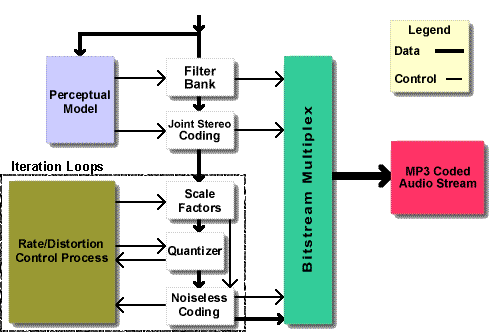
To carry out the three previous proposals, a system based on subbands is used in which the signal is filtered using several filters in order to have the signal separated into sub-signals, each covering a frequency range. Each of these bands is compared to a psychoacoustic model that determines which bands are important and which can be removed.

Specifically, a hybrid polyphase / MDCT (Modified Discrete Cosine Transform) filter bank is used: A filter bank is a set of band-pass filters that aim to separate the original signal into several frequency bands; A multiphase / MDCT hybrid filter bank is nothing more than a normal filter bank together with a block capable of doing the discrete cosine transform (MDCT).

The choice of which bands are maintained and which are removed is made by calculating the masking threshold, that is, it analyzes each audio sub-signal and calculates the amount of noise that can be input (signal is replaced by noise to save storage space) in function of the frequency, taking into account that a frequency masks signals of a higher frequency than yours rather than lower, without being noticeable to the human ear.

The following figure outlines the process described above:

The following figure represents the structure of an mp3 file:

As can be seen, an Mp3 file is made up of different frames which in turn are made up of an Mp3 header and MP3 data. Each of the frames is independent, that is, a person can cut the frames of an MP3 file and then play them back. The graph shows that the header consists of a sync word that is used to indicate the beginning of a valid frame. Following are a series of bits that indicate that the analyzed file is a standard MPEG file and whether or not it uses layer 3.

MP3 undoubtedly owes its success to Internet music downloads and portable audio players capable of playing the format. First, Discman compatible with MP3 were born, which allowed transporting 175 songs per cd instead of the usual 6. Subsequently, MP3 players based on a (small back then) flash memory were born. These had the advantage of being much smaller and lighter than portable CD players, but with the initial disadvantage that flash memory was small and expensive. Initially these devices had 64 or 128 MB memory, which allowed them to store between 16 and 32 songs. Currently these devices are sold with a memory of 1,2,4 or even 8GB. This allows them to store between 256 (for the 1Gb model) and 2048 (for the 8GB model)