What is digital audio?


Free Download Mp4Gain
picture

What is digital audio?
Digital Audio

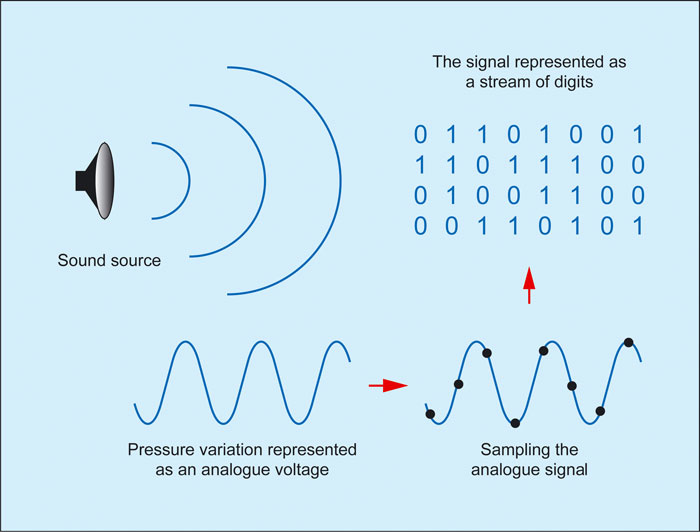
Digital sound is nothing more than a combination of numbers. With a certain algorithm, sound, such as air pressure, is converted into data streams and encoded for further processing and playback. Depending on the algorithm used, the music file has one format or another, one or another extension.

Analog Vs. Digital Sound

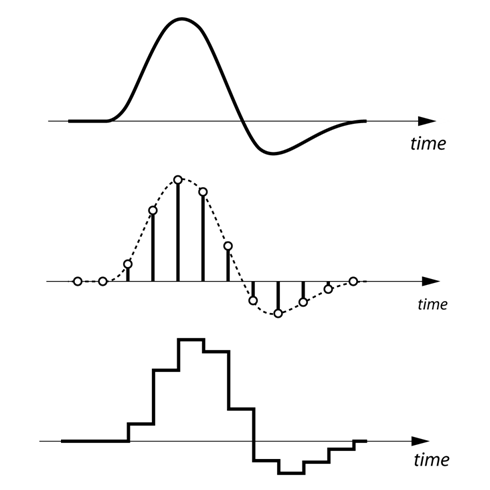
Remember that along with digital sound, there is analog sound, which is represented by a continuous electrical signal that reflects the change in the sound wave. The analog to digital sound conversion is a setting of the numerical value of the amplitude at a given time with a given density of values. Consequently, the more values ​​that are recorded, the more reliable and accurate the image of the digitized sound fragment is recreated. With such digitization, very voluminous data matrices emerge that, depending on the format used, differ in the sound quality / volume ratio of the final file.

Perhaps the main advantage of digital audio over analog is the ability to store and copy data indefinitely without losing the original quality (whereas when copying from one analog medium to another, a decrease in recording quality is quite noticeable).

The most widespread and popular digital audio format today is MP3 (MPEG Layer 3). It was developed, after a series of intermediate formats and investigations, started in 1987, by the Fraunhofer Institute in Germany.

The developers of the format were faced with the task of simplifying and reducing the cost of shipping long musical fragments. As you know, one minute of a stereo signal from a CD (16 bit, 44.1 kHz sample rate) takes up about ten megabytes of memory. At the same time, unlike text or graphic files, the audio signal cannot be compressed without loss of quality. Thus, modem transmission of an uncompressed composition from an audio CD lasting 3 minutes at a data transfer rate of, say, 24 kbps will take several hours. Scientists at the Fraunhofer Institute managed to achieve multiple file size compression: on average, one minute of a compressed audio signal in MP3 format takes about 1 megabyte. The principle of compression is based on the elimination of “unnecessary” sounds from the music file, to which the human ear is immune, or that duplicate each other.

The main factor that determines the relationship between file size and sound quality within a given format is the bit rate. Bit rate is an indicator of how much information a second of sound encodes. The higher it is, the less distortion and the closer the encoded composition is to the original. The most common on the Internet are compositions with 128 and 192 Kbps bitrates. The maximum bitrate supported by programs and devices that work with MP3 is 320 Kbps. In practice, only an expert or a professional who works with sound can notice the differences between an MP3 file with a 320 bit rate.

To optimize the size of MP3 music files while maintaining decent quality, a variable bit rate (abbreviation VBR – variable bit rate) is used. In this case, the encoding program divides the file into fragments of different spectral saturation and encodes them with a suitable bit rate. Most modern MP3 players support variable bit rate playback. A significant advantage of MP3 files is that they can contain the name of the artist, the name of the track and the album, the year of its release, etc. The set of this data is called ID3 tags. Most modern gamers can read and display them on the screen.

In 2001, Swedish Coding Technologies and Thomson Multimedia developed the MP3 Pro codec. It is MP3-based and as a result is fully MP3 backward compatible and only partially forward compatible. It uses SBR (Spectral Band Replication) technology, so the codec provides good quality at low bit rates. However, the encoding quality at medium to high bit rates is inferior to that of most other codecs. For this reason, this format is mainly used for broadcasts on the Internet and demonstrations of fragments of new musical compositions.

Another type of MP3 was the development of MP3 Surround, recently introduced by the creators of MP3: the Fraunhofer Institute. This format repeats all the characteristics of multichannel sound, while still being compatible with standard stereo MP3: information describing the spatial characteristics of the sound is recorded on an additional track. By playing files of this format on special equipment capable of reading this track, you can obtain surround sound that conforms to the Surround 5.1 standard.


Free Download Mp4Gain
picture


Mp4Gain Main Window
picture


Mp4Gain Features
picture


Free Download Mp4Gain
picture

MP3: the digital audio revolution

Perhaps not many people know that in 1992 a silent and unstoppable revolution of digital audio began for mass, until then essentially represented by CD-Audio. This was, in fact, the year that the algorithm underlying the MP3 format was born by the Fraunhofer-Institut für Integrierte Schaltungen (IIS).

Mp3

Part of a European research project called EUREKA, which started in 1987 and ended in 1994, the then-MPEG 1 Layer 3 was one of the most important and mature fruits in the field of psychoacoustic compression algorithms. This family of compression algorithms, whose first studies date back to 1979 by Manfred R. Schroeder, German physicist at AT & T-Bell Labsc, aims to reduce the amount of information capable of describing an audio sequence, from the assumption that the human ear, fortunately for us, is not perfect. The basic idea is to exploit the inability of the man’s auditory system to recognize certain sounds and frequencies, when they are masked by others.

MP3

Audio masking is detected at two levels: frequency and temporal masking. To explain the principle quickly, let’s take an example: in the presence of two tones, depending on their frequency and intensity, our ears will be able to recognize both or only one.

In the latter case, we have a frequency masking, and therefore information related to the least audible tone can be discarded. What happens, however, if the most intense tone is lost? It will happen that the tone that was not noticed before, will now return to the foreground. However, for the hearing system to notice, time will inevitably pass, because the membrane needs to stop vibrating and readjust.

We speak, of course, of times in the order of milliseconds, which are however precious, because the sound that falls within this time will be cut by the compression algorithm and, consequently, will help to reduce the amount of information necessary to describe what is audible.

The first MP3 encoder, called l3enc, was released by the Fraunhofer Society on July 7, 1994, while the MP3 extension was officially born on July 15 of the following year.

Those who lived through this time know that we are talking about years in which ADSL did not exist, hard drives were a few hundred MB in size, and in general, both from the point of view of communications and data storage, the figures they were far from being as generous as they are today. With these limitations in mind, I want to remind you that an uncompressed audio file in PCM WAV format, with a resolution of 44 kHz and 16 bits, stereo, as required by the CD-Audio standard, has a bit rate equal to 1411.2 kbit / s. This means that if you want to rip a song from an audio CD on your hard drive, the occupied space in uncompressed WAV format is approximately 10MB per minute. Today perhaps it would not be a problem to have this space, but in the mid-nineties it was a notable limitation.

The compactness of the MP3 format combined with the more than acceptable quality (a very optimistic estimate is a bit rate of 128 kbit / s to obtain a quality comparable to CD-Audio), made it in a few years the vehicle of transmission par excellence for music. The milestones that contributed to this unstoppable technological success were the launch of the Winamp player software by Nullsoft in 1997, and the arrival on the market just one year after the first portable media players: the MPMan F10 from Eiger Labs and the Rio PMP300 from Diamond. Multimedia.

Finally, it is impossible not to mention the birth of peer-to-peer networks aimed at exchanging MP3 files with Napster, one of the most famous applications in history, both for the innovative service that was made accessible and for the inevitable judicial events that followed and which decreed its closure in 2001.

In the same year, another symbol of the multimedia revolution, the result of the same technological horizon drawn by the MP3 format, appeared on the market: the Apple iPod.
Continuing until today we find, in parallel with the birth of new and more efficient compression formats, increasingly evident examples of the revolution, also social and commercial, that led to the arrival of the MP3 format.

There was a time when playlists were decided exclusively by record companies that were mixed into albums with mediocre songs, greatest hits; Today you can create your favorite playlist, selecting the songs and the order of play without any difficulty.

DIGITAL AUDIO explained

Audio is the electronic information that represents sound, or rather, having sound of a temporary nature is the flow of information that represents it.

Sound is made up of pressure waves traveling in space, therefore it is represented by a sinusoidal.

Digital Audio

The characteristics of a sound are:

Amplitude: Measured in Hertz (Hz) and determined by the frequency of a sound, the higher the frequency, the louder the sound, the lower it is, the lower the sound.

Intensity: it is measured in decibels (db) and is determined by the power of a sound, the more intense a sound is, the greater its volume.

Duration: It is measured in seconds (s) and dermal how long a sound lasts over time.

Timbre: It is not directly measurable, but it is that sound parameter that allows us to distinguish a trumpet from a drum. It constitutes the trace of a sound and is characterized by harmonics.

digital audio

ANALOGUE AND DIGITAL

There are two different ways of representing sound as electronic, analog and digital information.

Analog audio was the first, in chronological order, to be developed.

The information varies similarly to the information it represents and can (in theory) assume any value.

If we greatly expand the sine wave that describes an analog sound, we would see that it is a continuous line without interruptions.

Instead, digital audio is encoded with a number system, which allows discretization (transition from analog to digital), during this step information is lost, but once the sound is written as a series of numbers (digital information) it is possible to reproduce it. , transmit and modify it without losing anything in terms of quality, which is impossible with analog information.

If we greatly expand the sine wave that represents a digital sound, we would realize that it is not a continuous line as in the previous case, but a series of points very close to each other.

The amount of these points in one second of information will define the “sampling frequency”.

The amount of information that each point can contain is called “bit depth”.

THE CHARACTERISTICS OF DIGITAL SOUND

Sampling rate

Determine the number of samples contained in one second of information.

It is expressed in hertz (Hz) and generally assumes the following values ​​in the musical field: 22050Hz, 44100Hz, 96000Hz.

According to Nyquist’s theorem, each sampling frequency can record and reproduce sounds that have a maximum frequency equal to half of the chosen sampling frequency, this means that a piece sampled at 44Mhz can assume values ​​of up to 22Mhz only

Bit depth

Determine the amount of information contained in each sample.

It is expressed in Bit (bit) and generally assumes the following values ​​in the musical field 8Bit, 16Bit and 24Bit.

Above all, this is the parameter that depends on the quality of a sound.

Transmission rate (bit rate)

It is a characteristic of codecs, that is, of the “machine language” used to describe a sound.

Sets the total amount of information needed to play a second of a sound.

It is expressed in Bit / s.

AUDIO PROCESSING

Whether you’re talking about studio recording or live performances, the audio signal is never sent directly from the microphone to the speakers / recording medium, but is always processed first, through tools that allow you to perform different interventions. in the sound

These instruments can be analog, therefore they have the instrument physically in the studio (which is usually inserted inside a shelf), which must be connected between the microphone and the mixer or between the mixer and the speakers / recording medium.

Or you can simulate them through some plugins for your computer.

It is necessary to have a Daw (Digital Audio Workstation), which is the workspace in which all editing operations are performed. (Ableton, Cubase, Fruitloops, Logic, Reaper).

Within this software it is possible to install smaller ones, called VST (Virtual Studio Technology) that simulate the circuits of the studio equipment, emulating the effect.

(There are also other proprietary plugins with extensions other than the classic VST like .component or .au).

Some tools are essential and are used in all audio recordings, others are used only in particular situations or to obtain / avoid certain effects.

The main ones are:

Equalizer, is used to emphasize or attenuate some frequencies, this way you get a cleaner sound and a less “mixed” mix where all the instruments occupy only the correct frequencies, without overlapping.

The compressor, as the name suggests, serves to compress the dynamic range, so that the sound is more consistent and less dispersive.

Amp, wavering of different kinds, is used to increase the intensity of a sound.

Limiter works in a similar way to the compressor, but instead of compressing all frequencies, it attenuates those that exceed a predetermined threshold (threshold), avoids entering faults.

Reverb adds a slight reverb that makes a sound recorded in a soundproof studio much more natural than it would be too “dry”.

Filters (high / low cut) allow you to cut some useless and sumptuous frequencies too low or too high. (They are just 1 band parametric equalizers).

Digital audio formats on the network

Digital audio formats on the network:

WAV: Waveform files (or simply wave) are the most common sound formats on Windows platforms. WAV files can also be played on Mac and other systems with player software.

MPEG (MP3): The Motion Pictures Experts Group (MPEG) format is a standard format with significant compression capability. MPEG level 3 or MP3 files are frequently used for web music distribution. However, due to their size, MPEG files must be downloaded completely before playing them.

RealAudio (.rm): Real Audio is the technology that currently predominates on the Web. You need a proprietary player, but the basic versions of the player are available for free.
MIDI: The Musical Instrument Digital Interface format is not a digital audio format. It represents notes and other information so that music can be synthesized. MIDI has good support and its files are very small, but it is only useful for certain applications because of the quality of its sound when played on PC hardware.

AU: The u-law format is one of the oldest sound formats on the Internet. Players are available for almost all platforms.

RMF: The Rich Music Format supported by Beatnik (www.beatnik.com) is a high quality audio format, primarily for “download-and-play”, which is becoming increasingly popular.

AIFF: The Audio Interchange File Format is very common on Macs. It is widely used in multimedia applications, but it is not very common on the Web.

Flac: Free Lossless Audio Codec (FLAC) (Lossless audio compression codec) Ogg project format without loss. The initial file can be completely recomposed with the disadvantage that the file occupies much more space than would be obtained when applying lossy compression or Lossy.

Digital audio on the network:

The digital sound is measured by the sampling frequency, or how many times the sound is digitized over a certain period of time. The sampling frequencies are indicated in kilohertz (kHz), which indicate the number of times the sound is sampled per second. The CD sound quality is obtained with 44.1 kHz, or 44,100 samples per second. For stereo sound, two channels are required, each 8 bits; At 16 bits per sample, this results in 705,600 bits of data on a CD, producing high quality sound, at the request of the end user. In reality, the transmission of this amount of data would occupy almost half the bandwidth of the T1 network. As the average user of the Web does not have this bandwidth, another solution is necessary. One possible solution is to decrease the sampling rate when digital sound is created for sending through the Web. A sampling frequency of 8 kHz, in mono, would produce acceptable results for simple applications, such as language, especially if we consider that the playback hardware generally consists of a combination of a simple sound card and a small speaker. Low quality audio does not require more than 64,000 bits of data per second, but the end user still has to wait to download the sound. Modern users need several seconds to receive, even in the best conditions, a single second of low quality sound, making continuous sound impossible.

Digital audio: a simple but deep explanation about digital audio. Part 1

Sound is a phenomenon that implies a propagation of waves generally produced by a vibratory movement of a body. The propagation of sound implies a transport of energy without carrying out a transport of matter.

digital audio

As the sound is produced by a wave movement when applying the Fourier transform we can express it by a sum of sinusoidal curves that correspond to pure tones that can be characterized by the magnitudes of any wave such as:

-Period It is the time elapsed between two equivalent points of a wave.
– Wavelength It is the real distance a wave travels from its highest point to the next equivalent point.
-Frequency It is the magnitude that measures the number of repetitions in a space of time.
-Amplitude It is the distance between the furthest point of the wave with the equilibrium point.

These magnitudes give the sound a series of characteristics such as:

-Duration: Determines the length or short of the sound due to the time, measured in seconds, it occupies.
-Intensity: Determines the high or low sound due to what we know in relative terms as volume, which is measured in decibels (it is a logarithmic scale).
-Timbre: Determines the proper nuance of each instrument or sound source due to the different harmonics that compose it.
– Hue: Determines the acute or serious sound due to the frequency it has. The frequency is measured in hertz (Hz).

If we carefully consider it, we will see that the initial concept of Mp3Gain was intensity, which is measured in decibels and represents the loudness we perceive.

digital audio

Digital audio

Digital audio is the digital coding of an electrical signal that represents any sound wave. This electrical signal is picked up for example by a microphone, which takes the sound whose nature is analog and transforms it into electricity that still has the same type of analog nature, then through the necessary hardware and software it can be transformed into binary information, turning Something continuous in discreet. This process involves two tasks: sampling and digital quantification of the electrical signal.

Within the digital audio there are different types of formats to represent the audio:

-PCM: They contain all the information received from the analog to digital converter, without any omission of data. This makes the type of formats that have the best quality in the digital world. WAV is an example of this type of format in question.

-Compressed: It is similar to the previous one, but specific compression techniques are used in which “non-essential” information can be lost to reduce the size of the final file. They usually have good quality in relation to the weight of the file, but as noted above, information is lost, so those with sufficiently developed / trained ears might perceive that there is something strange in a song for example. On the one hand we have formats such as MP3 and OGG that compress with loss, compared to FLAC that compresses without loss. Obviously between one format and the other there is a notable difference in the size of the final file.

-Descriptive: They are used primarily to make music and contain mainly a description of what would be the “score” of the song. With this description, the algorithm, which reproduces the song, can take a sound source with samples of the instruments that the composition needs, to synthesize the final sound based on the indications of the “score”. Examples of this format are MIDI and tracker formats (MOD, XM, IT, etc.). The difference between MIDI and tracker formats is that the latter bring built-in sound sources into the file, so the final file weighs more than using MIDI. However, with MIDI we will need to obtain a sound source on our own or use the one that brings the default sound card (which is not usually too good).