Mp3, the star format, the reasons

Another interesting property of hearing is that the lower the volume level, the lower its resolution, the lower the number of sounds perceived. When the volume is lowered the high frequencies are better perceived, when the volume is increased the low frequencies are perceived. And they do not complement each other, but rather replace each other.

A person does not perceive some sounds, focusing on others. Pay attention: an instrument, or a voice, is usually audible clearly and consciously. Everything else becomes a background or a single tune. And no matter what we focus on in composition, we cannot increase the number of basic sounds perceived.
How to create the mp3
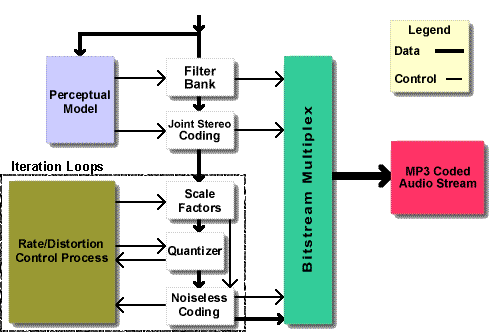
All these data obtained from experimental studies are gathered and presented in the form of an ideal model of human hearing. The MP3 standard focuses on this.
Everything that a person does not hear unambiguously is immediately cut off. Post-processing degrades the sound according to the understanding of this model.
Thanks to the great work done, modern psychoacoustic models accurately evaluate human hearing and do not stand still.
In fact, despite the assurances of music lovers, musicians and audiophiles, to the inexperienced middle ear, the highest quality MP3 has almost extreme parameters.
There are exceptions, they cannot cease to exist. But they are not always easily noticed by blind listening. And they are no longer derived from the mechanisms of hearing, but from the algorithms for processing sound information in the brain.
And here only personal factors play a role. All of this explains why we love different headphone models and why the numerical characteristics of the audio cannot unequivocally determine the sound quality.
MP3 fits everything: analog quality
Audiophiles’ insistence on picky FLACs is worth going through another serious sift. Most analog recordings do not contain enough information for lossless formats.
All CDs are recorded at 44.1 kHz sample rate and 16-bit quantization. Where does 192 kHz and 24/32 bit come from, which is used when encoding in FLAC? They are not, this is a doll!
You will object that these parameters are higher for analog sound … But for an audio cassette and a magnetic tape (unless, of course, it is a Japanese master tape), the characteristics of an audio CD are NOT ACCEPTABLE. For conventional studio equipment, the ability to record analog sound corresponding to AudioCD is relatively new.
Therefore, it makes no sense to digitize recordings from the pre-digital era in frenetic quality, especially those made on magnetic media. They do not contain those spectra and the amount of information that containers can store without compression.
Everything fits in MP3: digital
Strictly speaking, with most digital recordings, the image is the same. In the 90s and later, cheap plastic boomboxes appeared. The sound engineers had to take care of the uniform sound on all devices: the dynamic range of the recordings was reduced to 10-12 bits.
One more point. Until recently, no one recorded in a very high-quality studio. Because it is difficult to work simultaneously with several dozen audio tracks with high recording quality, and sometimes there are simply not enough human and technical resources.