Mp3 – Subjective perception of sound: timbre


Free Download Mp4Gain
picture

Mp3 – Subjective perception of sound: timbre
Audio Timbre mp3

Tone is a concept that we often come into contact with in our daily lives, and it can even be said that it is an essential concept.

Mp3 timbre

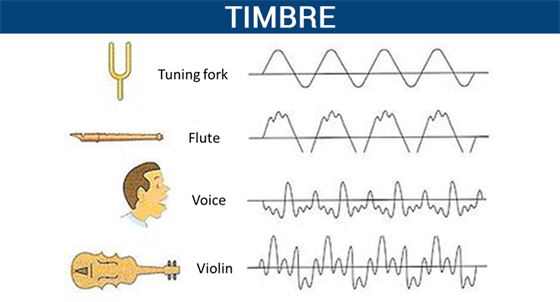
In high school physics textbooks, timbre, along with pitch and volume, are considered the three basic attributes of sound. Although we often deal with the word doorbell, and doorbell has more mature applications in many respects, doorbell is actually a very vague concept. What physical phenomenon determines the timbre? Why can we only use vague words like light and shadow, thickness and warmth to describe timbre?

Pitch and volume are well understood and correspond to physical phenomena: pitch corresponds to the vibrational frequency of an object, and volume corresponds to the object’s vibrational amplitude. However, we were unable to find a physical phenomenon that corresponds to the timbre. There are also no precise words to describe the timbre in our language.

We can create great music by precisely controlling the combination of pitch, duration, and volume. So can we control timbre like we control pitch and duration?

What exactly is pitch? What physical processes are involved in the timbre?

This is something that many people have been exploring and researching for the last few hundred years. But to this day, there is still no perfect answer.

In this article, I have classified some of the research results of my predecessors and presented some of my own thoughts. I hope that it can give everyone a systematic understanding of timbre, and I hope to inspire those who are interested in studying timbre in the future.

This article will start with the definition of timbre, discuss what timbre is, the subjective perception of timbre, the main factors that affect timbre, the description of timbre in language, the application of timbre in music, and personal perspectives for timbre. doorbell investigation. This article also proposes a sound classifier model for the timbre. At the same time, there are some conjectures that I have not been able to study in the article. I will check them out in the future.

The definition of sound
There are many definitions of timbre.

The word timbre comes from the French   . In old French it referred to the sounds produced by different musical instruments.

In his music textbook “Fundamentals of Music Theory,” Li Chongguang noted that “timbres are different due to the nature, shape, and number of harmonics of the sounding body.”

The American Standards Association (ASA) defines ringing from the opposite perspective. It does not define what timbre is, but what timbre it is not: “timbre is any other difference between sounds of the same loudness, pitch, and duration.”

All the above definitions tell us what tone it is. But none of these definitions is as clearly linked to the corresponding physical laws as other physical properties.

Like pitch and frequency of vibration, like speed and time and displacement, like color and wavelength.

Why can’t the word timbre clearly correspond to a certain physical phenomenon? I think this is due to the complexity of the timbre.


Free Download Mp4Gain
picture


Mp4Gain Main Window
picture


Mp4Gain Features
picture


Free Download Mp4Gain
picture

How does the normalization of an mp3 work?

How does the normalization of an mp3 work?

mp3 volume normalizer

The normalization of the loudness of an mp3 is based on perception.

How MP3 Compression Works

The human ear has its peculiarities and the study of these have allowed the development of the normalization algorithm for mp3 files.

Initially what was needed was simply to reduce the space an audio file took up, while maintaining high quality.

We must remember that in the early years of the internet, it was very slow and hard drives had very little capacity. What made it impossible to download a wav file (this option is still not used today), which is the one with the “original” quality because the wav takes up a lot of space.

So the normalization algorithm of an mp3 was based on being able to understand how the human ear works to be able to discard information without sacrificing quality, based on the way we perceive music and thus, the mp3 file, which occupies much less space ( a tenth of the original) sounds almost the same as the original.

But… what information can be discarded without the human ear noticing? How is it achieved that even discarding information, an mp3 sounds almost the same as the original?

The first thing is to discard all the sounds that are not perceived by the human ear, but are nevertheless present in the original music wav file. Because the human ear can only perceive sounds in a range of frequencies, any lower frequency will not be heard and any higher frequency will not be heard either. So it’s safe to rule out silences, and also to rule out low and high frequencies that are beyond our ability to perceive.

But there are other phenomena in human hatred, such as the so-called masking. It happens that if we listen to a frequency at high volume and immediately after (or even at the same time) we listen to another instrument or sound with a similar frequency, our ear will not perceive this second sound… Then it is also possible to discard these sounds that are masked by first. Almost all frequency redundancy can be discarded without the human ear being able to perceive it.

So if we take a wav file and remove all the frequencies that are outside of our hearing range and also the masking, we will have been able to reduce the new audio considerably. If we also add a compression (like the one used for a .zip file), we will have a reduction so great that the new file will weigh one tenth of the original.

This allows the new file to be much more manageable than the original and to take up much less space on the hard drive, which was of crucial importance in those years.

This method that we are explaining in general was the one that was used two decades ago or more. Today Mp4Gain uses much more modern and complex methods, which provide more surprising results.

In addition, Mp4Gain is capable of normalizing not only mp3 files, but all popular audio formats and it can also normalize videos. And this is based on more modern, efficient and state-of-the-art algorithms, which provides a much better result.

Generally speaking, we have provided a non-technical explanation of how audio files were compressed to make an mp3.

We advise you to download Mp4Gain and check its quality for yourself. You guys are going to love it.

Loudness Normalization – Mp4Gain

Loudness Normalization – Mp4Gain

Loudness Normalization

Mp4Gain is the most advanced normalizer and practically the only loudness normalizer that is still current and updated according to new technology and new formats.

Loudness Normalization

In fact, it is the only one that handles the most popular audio and video formats. You can even extract the audio from any cvideo and save it as an audio format (mp3, acc, m4a, flac, ogg, etc).

These are the formats that Mp4Gain handles:

Video formats:

mp4, flv, avi
mpg, 3gp, wmv

Audio formats:

mp3, mp2, flac
ogg, m4a, acc
wav ac3

And very soon we will add more formats…

In fact, Mp4Gain offers other features, such as the ability to alter the pitch of a song without changing its speed and vice versa.

In fact, normalization offers a whole series of parameters that will allow you to achieve exactly what you are looking for. You can add the option to include Replay Gain, for example…

It also offers the option that, within the same song or video, all its parts have a similar sound. Avoiding, in this way, the existence in the audio or video file, parts that are very loud and others that have a very low volume.

Of course you can equalize as you like, to improve the quality of the audio.

For all these reasons, we believe that it is best that you download a copy of Mp4Gain and try it for free on your computer.

The program is very simple to use, you could practically say that it is intuitive. In other words, it is possible to use Mp4Gain without needing to read any manual, since it usually only loads the songs or videos and clicks the normalize button and that’s it.

Never again will you suffer from the situation that your different audio or video files have a very different loudness, forcing you to manipulate the volume knob to manually compensate for the difference in volume levels.

Download it today and give it a try.

The audio compressor or normalizer

Adjust volume level

Many instruments tend to be very dynamic, and when recorded can result in large note amplitudes, some very strong and some very weak. We could imagine following the volume of each of these tracks through the fader race of our console, but even with a very good automation system, this task could be very long and very complicated.
This is where the compressor or normalizer comes in. It is used to restrict the dynamics of an audio signal, making it easier to find a more stable level in the mix and to have an optimal volume level.

Here is the diagram of a sound wave recorded without compression and with compression:

¿Cómo ajustar un compresor?¿Cómo ajustar un compresor?

How to adjust a compressor?

As you can see, when applying compression, the dynamic range of this wave has been reduced. In the original wave, the difference between the lowest amplitude and the highest amplitude is around 15 dB. After applying compression, the dynamics are only 5 dB. What happens is that the compressor detects and compresses the loudest sounds in the wave. After compressing these louder sounds, I can raise the entire level of the wave, so that the weak and strong notes are leveled out in the rest of the mix.

Threshold :

Compressors, like all dynamic processors, including the normalizer, work by measuring the amplitude of an incoming signal relative to a reaction point that must be configured to tell the compressor when to start operating. This reaction point is called the threshold.

Consider our example of watching TV and turning the volume down when advertising. We all have our own threshold that tells us when a sound is too loud and that will force us to take the remote control to lower the volume. This volume level is our threshold. The threshold that is, in fact, the most important component of any dynamic processor.

How to adjust a compressor?

In a compressor, a signal level above the threshold will activate the compressor, while a lower signal level remains unchanged

Normalization of an audio file.

How to normalize an audio or video file.

Normalization is used to increase or decrease the level of the song as a whole, so that its maximum volume peaks assume the indicated level.

For example, if the maximum intensity points of the song are at -3 dB (therefore, well below 0, which should represent the maximum before distortion), normalizing to 0 dB means increasing the level of the entire song so that these peaks reach 0 dB.

audio level

This is the typical normalization of the peaks.

There is also RMS normalization (which takes into account not the peaks, but the actual average level of the song).

AUDIO CDs, which have good dynamic possibilities (various intensity tones, from pianissimo to fortissimo), are generally recorded so that the maximum volume points are at 0 dB.

Free image of audio levels

Normalizing your recordings in WAV can be useful to adapt them to the average level of a CD in case they are too low (because you had been careful in the level during the recording) but there is one important thing to keep in mind:

normalization of this type alters the original dynamics, that is, the reciprocal relationships between weak and strong sounds.

Although all levels are raised by the same amount, the relationship between 2 levels changes (small mathematical example:
2/5 = 0.4 ma (2 + 1) / (5 + 1) = 0.5 …

The result is that the weaker sounds, after sudden normalization, sound much louder and those that were already loud only sound a little louder … altering the dynamic relationships that had been envisioned by those who originally recorded the music and causing the sound output to lose depth.

Some types of music, generally already deficient dynamics (rock, metal, etc.) since the excursions between the minimum and maximum volume are almost never very consistent, are more “normalizable” without problems, while the genres in which there may be Large Dynamic excursions (classical music or music with passages from pianissimi to fortissimi) are more problematic.

Furthermore, it is necessary to keep in mind that if you normalize a large wav file that contains many songs (not yet divided) there can still be, even in genres with little dynamics, consistent differences, in this case between one song and another and not between different points of the same song.

So a light normalization can do and is actually used (to raise the level of the song), but it would be better to make sure you don’t need it (recording from the beginning with a good level) or at least not have too much need. and remember, however, that the dynamics are somewhat flattened.

Normalization of an mp4 or normalization of a video.

We are in the video age, it is said that 2,000 hours of video per minute are uploaded on YouTube.

HOWEVER, THERE IS NO OTHER SOFTWARE THAT IS ABLE TO NORMALIZE THE AUDIO OF THE VIDEOS !!

Mp4Gain is used by television channels throughout the world. Also by radio stations … even by some famous musicians, of whom we cannot give the name for reasons of confidence … but we are talking about musicians of global fame.

One of them is the guitarist of one of the groups that generates the most money on their world tours … or perhaps the one that generates the most money on their world tours. He uses Mp4Gain …

And so, many other celebrities are our clients. NBA players belonging to the legendary dream team, etc.

What is Normalize audio?

What is Normalize audio?

The battle of volume

For decades, but especially in recent years, music producers discovered that by being able to manipulate volume levels on the mixing console, they were able – artificially – to get people to listen to a recording as “better” with just push the recording volume up a bit, its decibels.

audio & video normalizer

Indeed, tests carried out by universities have shown that a little more volume makes the music sound “better” when listening.

Hence, in the last few decades, especially from the 80s, there has been a war to make each musical production sound louder to achieve that effect of better sound quality.

This has resulted in recordings showing extremely uneven volume levels, some sounding very loud and others sounding too low.

But today everyone wants the music to sound at high volume, to boost the volume level, to boost the volume of the song.

Even when it comes to loud music like dance music, rock, etc. trying to boost the bass, which produce an effect not only in the ear, but literally “feel” and to make people “feel” that music, the producer must be generous in the recording console and with the equalizer.

This usually results in people perceiving that their collection of musical files has uneven volume levels, that some recordings sound very loud and others sound very low in volume.

So it has become an urgent need to find an audio volume normalizer that manages to boost the music level, that manages to boost the bass and that manages to improve the sound of each music file, that makes it sound louder.

Mp4Gaines the answer. It is without a doubt the most efficient normalizer that manages to boost the volume and make it sound louder and at the same time sound at a more equal volume level.

If you are looking to improve the volume level of your audio and video files, of the main formats, not just mp3s, Mp4Gain is definitely the most powerful, modern and efficient solution.

NORMALIZE DIGITAL AUDIO

NORMALIZE DIGITAL AUDIO

The “Normalize” feature has the function of scanning all or part of a selected audio file and detecting the highest peak.

In fact, it passes all samples in the file one after the other (counting at a rate of 44, 48 or 96000 per second of recording), temporarily stores the value until it finds a sample, the highest value ignores all the lowest values ​​that the last.

Once this final value is detected, you can imagine a value of -8 dB, the software applies an increase of 8 dB to all the samples in the file and therefore raises the total level of the file by 8 dB to find the main peaks at zero dB.

Normalize audio

Signal normalized to 0 dB peak or 0 dB at Absolute Peak – Listen

The advantage? Normalization does not allow “partial” to systematically change the listening volume from one song to another or from one fragment to another, from one disc to another. This feature says what it does, normalizes (bring it to the default).

Note: In general, a maximum normalization level of zero dB can be defined. For example: -1 dB. To prevent some intermediate CD player converters or some output amplifiers from these players from being distorted (?). Subject to debate.

Advantage: This processing only changes the overall level of the file, but by no means its dynamics (it does not reduce the difference between the highest and lowest levels of recording). So nothing to do with a limiter, a compressor or an expander.

Problem: if only one of the samples in the recording or the selected part reaches 0 dB (either positive or negative), even if all the others are -20 dB or less, the system will consider that the file does not need to be changed and then normalization will still be strictly ineffective, which is kind of silly, right?

Original signal with 0dB peak – Listen

Therefore, before normalizing the recording or marking, make sure that some isolated peaks do not deceive the system and, if necessary, remove or reduce them with the “volume” function or another (select the peak, reduce or redraw with the pencil tool) .

Also, remember to select your file in parts to apply appropriate “volume” or “normalization” levels for the sounds to be normalized.

Danger 2 (Return): It is good when the software allows it not to normalize certain recordings or fragments of recordings to zero dB.

For example: Record steps on the lawn whose average level is -35 dB and less, which is perfectly correct. If you “normalize” it to ZERO, you end up with an outrageous sound that will sound like anything but footsteps on the grass.

Mistrust: Some software offers various options for “normalization”: either in “RMS” or “Peak”. The two processes must be clearly differentiated.

RMS: It has nothing more to do with it. In fact, the software will apply a compression algorithm to the processed file. For SF, it will have 3 other predefined values, but you can choose any other value.

Peak: The software performs a “normalization” according to the technique described above. Therefore, there is no change in the recording dynamics.

Normalize the volume of an mp3

For several decades, with the appearance of MP3, it has become a customary practice that people accumulate a large number of music files, mainly in MP3 format.
Some people get to accumulate thousands of songs in the MP3 format. which are easily transported with a pendrive using any other device, to be able to listen to them anywhere, and at any time.


This is very comfortable because one does not need to load any hard disk and much less large numbers of CDs or cassettes.
but it has the disadvantage here when mixing the songs that comes from very different recordings, times, etc. It occurs very frequently in volume level differences.
It is a typical problem today, want to Play favorite songs meets the fact that some sound much louder than others. And this eventually becomes a problem.

for this the volume normalizers have been created. The volume means all the songs have a volume as optimized as possible every possible level that each of them can play.
Volume normalizers have also existed for decades, and their algorithms to achieve amazing results. today download Mp4 Gain and check results no other software can offer. Russian other options How to change the pitch of a song Without altering its speed on the contrary modify the speed without affecting the Pitch. You can also equalize it and perform various functions that will be very useful.