Analyzing the main audio formats Part 3


Free Download Mp4Gain
picture

Analyzing the main audio formats Part 3
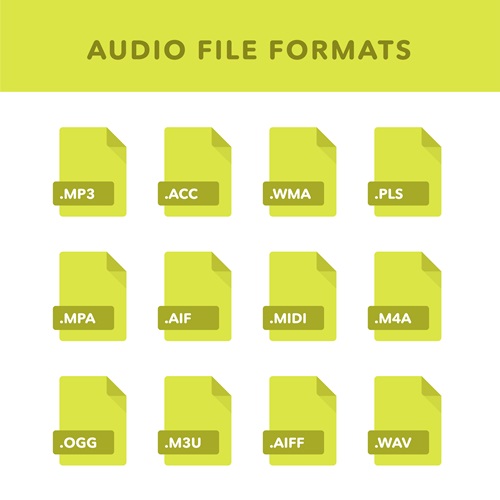
audio file formats

How about high definition music?

Audio Formats

Unlike HD video, there is still no universal standard for high definition audio.

Without going into detail, this term generally refers to recordings with a higher sample rate and / or bit depth than CD (i.e. 16 bit / 44.1 kHz). Examples of high-resolution audio are 16-bit / 96 kHz or 24-bit / 192 kHz files.

Due to the presence of additional audio information, high-resolution files sound much better than compressed files, which lose this information during the compression process. These formats require more disk space, but their quality is definitely worth the investment.

High-resolution audio includes uncompressed formats, such as AIFF and WAV, and lossless formats, such as FLAC and ALAC. DSD (partly a niche format used on Super Audio CDs) also falls under the Hi-Res Audio category, but it is compatible with a much smaller number of devices. When it comes to streaming, services like Tidal Masters use an MQA container to stream high definition files over networks using the lowest possible signal bandwidth.

When it comes to playing high-resolution audio formats, it is already supported by many devices today. The 24-bit files can be played with Denon HEOS wireless speakers, as well as premium portable music players like Cowon Plenue D2 and Astell & Kern A & norma SR15.

Also, most flagship Android smartphones support Hi-Res Audio, for example the highly rated Samsung Galaxy S10 +, but you won’t be able to immediately hear them on a new iPhone. We’ve found ways around this limitation, but keep in mind that Hi-Res Audio files are still not as compact as their lossy counterparts.

What is the best audio format for you?
The format you choose depends on whether you are more concerned about memory capacity or sound quality, and what type of device you intend to use it with.

The popularity of MP3s came at a time when the cost of disk space was very high. Today’s smartphones, music players, and laptops are equipped with an impressive amount of memory, so it makes sense to pay attention to higher-than-CD quality formats.

If you have decided to archive your audio files, FLAC or another lossless format might be a good option. They represent a good compromise between compression level and sound quality, allowing you to listen to high-quality digital music and save disk space. Just be sure to check the compatibility of the selected format and available devices.


Free Download Mp4Gain
picture


Mp4Gain Main Window
picture


Mp4Gain Features
picture


Free Download Mp4Gain
picture

Lossless Audio Compression Part 3

Analyzing the main audio formats Part 2

Audio File Format

Compressed and uncompressed audio files

audio file format

Let’s start by examining three categories into which all audio file formats can be grouped. They are determined by the degree of data compression and the associated loss of sound quality.

If a special algorithm (or codec) was not used to compress the audio in your file, this will lead to a double result: first, there will be no loss of sound quality, and second, you will soon run out of audio space. your hard drive.

In essence, the uncompressed recording is fully consistent with the original audio file, in which real sound signals are recorded in digital representation.

WAV, AIFF or FLAC: uncompressed formats
WAV and AIFF are the most popular uncompressed audio file formats. Both are based on PCM (Pulse Code Modulation), a well-known mechanism for directly converting audio to digital format. WAV and AIFF use similar technologies, but the storage methods are slightly different. CD-quality files and higher resolution files can be burned in these formats.

The WAV format was developed by Microsoft and IBM and is therefore used on Windows-based platforms; it is the standard CD recording format.

The AIFF format was created by Apple as an alternative to WAV; And while AIFF files are less common, they provide more comprehensive metadata support, allowing you to store album art, song titles, and the like.

The downside to these formats is that they require a large amount of memory. CD-quality files (16-bit, 44.1 kHz) occupy approximately 10 MB of disk space per minute of sound.

ALAC, FLAC, WMA Lossless: lossless audio formats
We all love FLAC. Lossless format, files in FLAC (Free Lossless Audio Codec, Free Lossless Audio Codec) are almost half the size of uncompressed WAV or AIFF files with equivalent sample rate, but in terms of sound, no loss of quality is noted. FLAC also supports higher resolution than CD quality, up to 32-bit and 192 kHz.

Besides FLAC, there are other lossless formats: ALAC (Apple Lossless) and WMA Lossless (Windows Media Audio). The former is a great alternative for iOS and iTunes, although the file size is slightly larger than FLAC. Not all smartphones and tablets support it.

AAC and MP3: lossy audio formats
Who has not heard of MP3? Everyone has heard of him. This most common audio format is convenient for storing music on iPods or tablets and is compatible with almost any device. However, this requires the sacrifice of a significant amount of information. To reduce file sizes by an order of magnitude compared to CD-quality recordings, a significant percentage of the original data needs to be discarded, leading to a loss in sound quality.

The bit rate at which the MP3 file is recorded also affects the sound quality. 128 kbps MP3s lose more information than 320 kbps files (this means “kilobits per second”, where each “bit” is essentially a small part of a song). Given the steep decline in memory costs, there is no reason these days to listen to files at 128 kbps; 320kbps MP3s make sense with limited storage space and are also still the standard format for downloading files from online stores.

Another lossy format, AAC (Advanced Audio Coding), also offers compression like MP3, but thanks to slightly more efficient algorithms, it provides better sound quality. AAC is used for iTunes downloads and Apple Music (256 kbps) streams and YouTube streams.

The Vorbis format, often referred to as Ogg Vorbis to emphasize the use of the Ogg container, is an open source, patent-free alternative to MP3 and AAC. This 320 kbps bit rate format is used in Spotify streams.

If you plan to use lossy formats, consider the following fact: increasing the number of “bits” generally leads to an increase in sound quality, but it is highly dependent on the efficiency of the codec with which the file is converted. If most of the music in your collection is encoded at 128 Kbps, you may have noticed that despite the fundamental similarity in sound, due to the low efficiency of the codec, MP3 files are likely to be somewhat audible. worse than AAC or Ogg. Vorbis.

Lossless Audio Compression Part 3

Analyzing the main audio formats

Audio File Formats

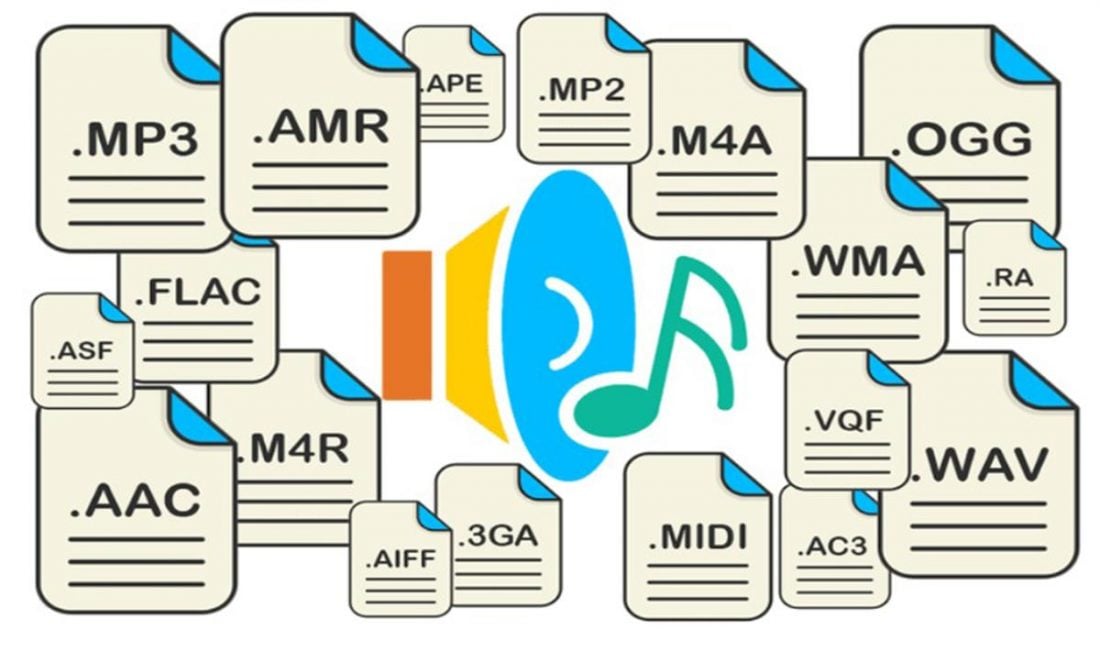
As you organize your digital music collection, you can dive into a variety of audio file formats. Almost everyone has heard of MP3, but what is OGG, AIFF, or MQA?

audio formats

If, after reading the list, you have the suspicion that all these formats for obtaining such chic abbreviations were studied in different universities, we will help to dispel it. This material will clarify the essence of some popular music formats, the difference between them and why it is important to know them.

Regardless of what you’re listening to – low-bit-rate MP3s, slightly better tracks in AAC, or high-resolution audio in FLAC or WAV – it’s time to find out exactly what you’re getting in each case and how to choose the optimal format.

Let’s take a look at the pros and cons of each.

A quick overview of file formats and codecs

In order not to beat around the bush, we’ll provide a quick guide to all file formats and the differences between them at first. If you want to know more, here is a more detailed description of the differences in size, sound quality and compatibility.

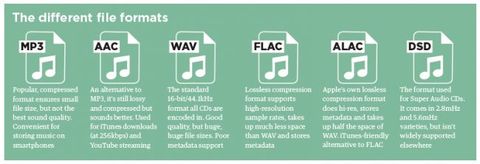
AAC (not a high resolution audio format). Apple’s popular alternative to MP3. Compressed and lossy, but with higher sound quality. Used to download from iTunes and stream from Apple Music.

AIFF (high resolution). Apple’s alternative to WAV with more complete metadata. It is not an uncompressed and lossy format very popular with large files.

DSD (high resolution). One-bit format used in Super Audio CD. Available in 2.8 MHz, 5.6 MHz and 11.2 MHz sample rates. Due to the use of a high quality codec, it is currently not used for transmission. Uncompressed format.

FLAC (high resolution). Lossless compression format supporting high-resolution supporting sample rates and metadata storage; the file size is half that of WAV. Due to the absence of royalties, it is considered the best format for downloading and storing albums in high resolution audio. Its main drawback is the lack of support for Apple devices (and therefore incompatibility with iTunes).

MP3 (not high resolution audio format). Popular compression and lossy format with small file size and far from the highest sound quality. Convenient for storing music on smartphones and iPods.

MQA (high resolution). Compressed format for storing high resolution files in an easier way to transmit. Used by the Tidal Masters service for high resolution audio streaming.

OGG (not high resolution audio format). He is sometimes referred to as his full name: Ogg Vorbis. An open source alternative to MP3 and AAC that is not covered by patents. This 320 kbps bit rate format is used in Spotify streams.

WAV (high resolution). The standard format in which all CDs are recorded. Great sound quality, but large files due to lack of compression. Weak support for metadata (versions, song titles and artists).

WMA Lossless (high resolution). An uncompressed version of Windows Media Audio, the compatibility of which is no longer often found on smartphones and tablets.

Why upsampling? Part 2

Why upsampling? Part 2

Upsampling

For every doubling of the sampling frequency, the spectral density of the noise is reduced by half and the signal-to-noise ratio increases by 3 dB. Since the resolution limit for the pressure level is approximately 1 dB, these decibels are unlikely to have a noticeable effect on sound perception in the high-frequency region. Based on these numbers, it is absolutely impossible to draw tentative conclusions about the change in sound quality.

In order to relate the spectrum of quantization errors, sampling frequency and sound quality, in this article it is proposed to use a tonal signal as a music model, as is usual to evaluate the quality of sound paths. This approach relies heavily on materials published in the “Sound Engineer” magazine.

The results can be summarized as follows. Unlike analog audio, digital audio is the product of amplitude modulation. This is manifested in a rigid functional dependence of the quantization error spectrum of the frequency multiplicity factor of the audio signal F and the sampling frequency fs, represented as the ratio of prime numbers y and x (k = fs / F = y / x). The frequency spectrum of quantization errors is always discrete and is determined solely by the multiplicity factor; the components of this spectrum are also determined solely by the amplitude of the audio signal, expressed in quanta. This means that the mechanism for shaping the quantization error spectrum does not depend on the number of bits used. With an increase in the quantization bit depth, the spectrum does not change in shape and composition, but only changes in level by 6 dB with each additional digit. (There are situations where a change in bit depth leads to a change in spectrum, – Ed.) The auditory perception of the quantization error spectrum is largely determined by the frequency response of hearing, which, in turn, it depends largely on the sound pressure level.

The frequencies of digital sound are divided into multiples when x = 1 and submultiples when x> 1. At multiple frequencies, the spectrum of quantization errors is harmonic and the main pitch is the frequency of the audio signal. If y is an even number, then the spectrum contains only odd harmonics. If y is an odd number, then the odd and even harmonics of the audio signal are present in the spectrum.

At multiple sub-frequencies in the quantization error spectrum, the components appear below the frequency of the audio signal, down to zero, and the lower limit of the spectrum Fn (x) is determined by the formula x – Fn (x) = F / X. In this case, the frequency Fn (x) becomes the fundamental pitch of the sound for quantization errors, and all other components, including the frequency of the sound signal, are converted to its harmonics. If the number is even at the submultiple frequency yskr, then the spectrum contains only odd harmonics of the frequency Fn (x). If yskr is an odd number, then the spectrum contains odd and even harmonics of this frequency. Low-frequency components in the quantization error spectrum lead to the appearance of harmonics in the form of pitch or consonance. They are especially noticeable at high frequencies in the audio signal when there is no frequency masking effect.

To clarify, we will give an example of a quantization error spectrum at an audio signal level of minus 30 dB with 8-bit quantization. Let fs = 48 kHz and F = 12800 Hz, then the multiplicity factor k skr = y / x = 48000/12800 = 15/4 and therefore the lower cutoff frequency Fn (x) = F / x = 3200 Hz, and the spectrum consists of odd and even harmonics of this frequency.

1.jpg

Figure 1. Quantization error spectra at submultiple frequency deviation

When the frequency of an audio signal deviates from a submultiple value by a small amount, sidebands appear around all harmonics of the spectrum, including zero (Fig. 1a), the number of spectrum components increases dramatically, and the limit bottom of the spectrum decreases, since the current value of x increases a lot.

Suppose, for example, that the frequency increment of the audio signal is 1 Hz, then the value of the multiplicity factor k = y / x = 48000/12801 = 16000/4267 and the lower limit frequency of the deviation spectrum becomes Fno = 12801/4267 = 3 Hz, and the interval between the components of the spectrum decreases to 6 Hz (Fig. 1b).

Why upsampling?

Why upsampling?

Upsampling

When it comes to improving digital sound quality, experts in this field agree on only one thing: with an increase in sample rate, sound quality improves dramatically.

Why upsampling?
When it comes to improving digital sound quality, experts in this field agree on only one thing: As the sample rate increases, the sound quality improves dramatically. Also, under the word “improvement”, everyone already understands something for himself. All the variety of opinions on this topic boils down to the following: the sound becomes clearer, softer, more natural, the low frequencies are perceived more clearly.

However, these nuances are only noticed by listeners trained with a good ear for music on specially selected sound material and using technically advanced equipment.

There are many hypotheses that explain why sound quality is improved by higher sampling. Many technicians are inclined to believe that this relationship is due to distortions that arise from filtering and interpolation during audio signal reconstruction.

On a modern technical level, high-quality interpolators may be practically impossible to implement, therefore, instead of improving them, manufacturers simply increase the sample rate. Maybe it’s not about them at all.

Another version, which many music lovers adhere to, is that at a low sampling frequency, for example 44100 Hz, digital sound is completely devoid of nuances of high sounds, the main frequencies of which are above 7 kHz. , and at lower frequencies there are very few harmonics for a high quality perception of music.

In fact, many musical instruments generate vibrations of up to 100 kHz. It is true that the fraction of energy that falls in the frequency band above 20 kHz is 0.01 to 2% for sounds of a harmonic nature and 0.02 to 68% for sounds created by a cymbal, triangle or striking the metal edge of a drum (hoop shot – editor’s note).

Even the frequency range of speech in hissing-hissing sounds extends up to 40 kHz. Supporters of this version are not ashamed that a person cannot perceive sounds with a frequency higher than 20 kHz. Ultrasound is assumed to be perceived bypassing the auditory system, for example through bone conduction.

Discussions that harmonics above 20 kHz make a significant contribution to sounding have culminated in the creation and widespread introduction of analog-to-digital converters using 96 kHz and 192 kHz sample rates; The sample rate is expected to increase to 384 kHz.

Based on modern knowledge of human perception of sound, it must be assumed that the relationship between digital sound quality and sampling frequency is due to the transformation of the quantization error spectrum in the audio frequency range.

In technical literature, this topic is considered only for a particular mathematical model, when music is represented by a signal with a uniform distribution in level and frequency. In this case, the quantization errors are converted to noise with a uniform spectral density from 0 Hz to the Nyquist frequency.

Relationship between sound quality and sample rate

Relationship between sound quality and sample rate

SAMPLE RATE

The conversion of an analog signal to digital consists of two steps: sampling in time and quantization in amplitude.

sample rate

Time sampling means that the signal is represented by a series of samples (samples) taken at regular intervals. For example, when we say that the sample rate is 44.1 kHz, this means that the signal is measured 44 100 times in one second.

The main problem in the first stage of converting an analog to digital signal (digitization) is the choice of the sampling frequency of the analog signal. The higher the frequency, the closer the digital signal is to the analog. However, in proportion to the increase in frequency, they increase:

The intensity of the digital data flow and the bandwidth of the interfaces are not unlimited, especially if several channels are recorded / played simultaneously;
The computational load on digital processors and their computing capabilities are also limited;
The amount of memory required to store the digital signal is increased.
Obviously, a compromise is needed. The choice of the sampling frequency affects the frequency range of the received digital sound and the maximum frequency of the analog signal, correctly represented in the digital one. It is believed that a person hears frequencies in the range of 20 to 20,000 Hz. According to the well-known Kotelnikov theorem, in order for an analog signal (continuous in time) to be accurately reconstructed from its samples, the sampling frequency must be at least twice the maximum audio frequency.

An audio frequency equal to half the sampling frequency is called the Nyquist frequency and is the maximum frequency that a given digital system can store and reproduce correctly. Therefore, if the actual analog signal that we are going to convert to digital format contains frequency components from 0 to 20 kHz, then the sampling frequency of that signal must be at least 40 kHz. The most common sample rates today are 44.1 kHz (CD) and 48 kHz (DAT).

Digital sound compression.

Digital sound compression.

digiTAL SOUND PROCESSING

Principle and method of digital audio compression.

DIGITAL SOUND PROCESSING

Audio data compression is a process of lowering the bit rate by reducing the statistical and psychoacoustic redundancy of the digital loop signal. Methods for reducing the statistical redundancy of audio data are also called lossless compression, and consequently methods for reducing psychoacoustic redundancy are called lossy compression. Lossless compression The reduction of statistical redundancy is based on consideration of the properties of the audio signals themselves. It is determined by the presence of a correlation between adjacent samples of a digital audio signal, the elimination of which allows the amount of transmitted data to be reduced by 15 … 25% compared to its original value. To transmit a signal, you need to obtain a more compact representation of it, which can be achieved with the help of orthogonal transformation. Important conditions for the application of such a transformation method are: the ability to restore the original signal without distortion. the ability to provide the highest energy concentration in a small number of conversion factors. fast computational algorithm

Lossy compression Lossy compression of audio data is based on the imperfection of the human ear in the perception of audio information. The inability of a person in certain cases to distinguish between silent sounds in the presence of louder sounds, called the masking effect, has been used in algorithms to reduce psychoacoustic redundancy. The auditory masking effects can be divided into two main groups: frequency masking (simultaneous). Temporal (non-simultaneous) masking The masking effect in the frequency domain is associated with the fact that, in the presence of large amplitudes of sound, the human ear is insensitive to small amplitudes of nearby frequencies.

24. Analog and digital video signals. Hardware for digital video recording (digital cameras).
A video signal is usually a low-frequency signal, the value of which itself carries information. For example, it controls the strength of an electron beam in a cathode ray tube on a television. The beam “runs” across the screen and changes its value (according to the law, which is set by the video signal) – as a result, you get a frame.

Analog video signal

Analog television: Television produced by analog signals whose magnitude changes continuously over time. Today’s television system uses magnetic waves to transmit and display images and sound.

Digital video signal

Digital television is a method of transmitting and receiving compressed MPEG-2 digital video signals. Simply put, it is a modern replacement for traditional analog television, allowing you to transmit and receive television programs in greater quantities at the same costs and in much higher “digital” quality (as opposed to analog television, where the quality of television programs depends on the level of the received signal and the signal-to-noise ratio, in digital television, the quality of television programs does not change and is initially high.If the received signal exceeds a certain threshold level for open a digital package of television programs, then the programs are displayed with a constant quality that depends only on the quality of the original video material and the bitrate chosen by the broadcaster to broadcast a specific TV program). ..

Digital video cameras.

“What is the difference between digital and analog video cameras?

+ Let’s start by listing the most important advantages of a digital video camera in our opinion. First of all, digital video cameras deliver such excellent image quality that you could hardly have dreamed of more. Also, multiple copies are possible, and each subsequent copy is no worse than the first. In addition, it is important that from the moment of filming until the moment of watching your film, a minimum of time passes, and if you want to print a photo from a separate frame, then if you have a computer and a color printer (which is not necessary, as such services are also provided in classrooms) It only takes a few minutes. The quality of photos taken this way is very high (this, of course, is determined by the quality of your camera).

Digital sound processing Part 2

Digital sound processing Part 2

DIGITAL SOUND PROCESSING

Psychoacoustic model

Digital Signal Processing

Using psychoacoustic models, the encoder determines the acceptable quantization noise threshold. The MPEG standard defines 2 psychoacoustic models.

The MPEG audio compression standard allows great freedom in the implementation of the model. The essence of this implementation in a particular encoder depends on the required compression ratio. In consumer applications that do not require a high compression factor, the psychoacoustic pattern may not be present at all. In this case, the bit allocation algorithm does not use the SMR (signaltomaskratio) relationship.

Steps of psychoacoustic models:

1. Using Fourier methods, native sounds are transitioned to their frequency coefficients.

2. The received frequencies are distributed in the critical bands.

3. The spectral values ​​of the critical bands are divided into tonal and non-tonal components.

4. Before determining the noise masking thresholds for different critical bands, the model applies the masking function to signals from different critical bands.

5. The model determines the masking thresholds for each subband.

Conclution

The purpose of researching the abstract topic was to provide the necessary theoretical information in the field of digital sound processing.

In addition, the main summary tasks were completed: identify the principles of psychoacoustics and psychoacoustic models, second, explore digital digital sound compression methods, third, investigate the work of the MP3 format, fourth, formulate the concept of adaptive digital sound coding, and fifth, learn more about digital audio storage and digital audio media.

Based on the above, the following conclusions were drawn.

Psychoacoustics is a scientific discipline that studies the psychological and physiological characteristics of the human perception of sound, based on the fact that the human ear perceives only a fairly small region of the spectrum and tolerates small distortions of sound.

Modern digital audio compression techniques use sophisticated mathematical algorithms and psychoacoustic knowledge. Conventionally, they can be divided into two main types: lossless compression (for example, the flac format) and lossy compression (this includes the popular MP3 format).

MP3 is one of the most widespread and popular lossy digital audio encoding formats. It is widely used in file-sharing networks for evaluative transmission of musical works.

Therefore, today there is a great variety of methods and methods to process an audio signal. Various mathematical models are used to compress digital sound, including adaptive algorithms, as well as knowledge in the field of psychoacoustics. One of the most popular digital audio storage formats is the MP3 format, which uses adaptive lossy data compression technology. Despite the enormous variety of existing methods, software tools for digital sound processing and types of electronic media, this area of ​​multimedia technologies does not lose its relevance for both professionals and ordinary listeners and continues to develop actively.

Digital sound processing Part 1

Digital sound processing Part 1

DIGITal sound processiong


Every year, computer technologies are getting better and better, including software designed for professional audio data processing.

Digital sound processing

Microsoft took a big step forward with the development of the DirectX programming interface designed to simplify writing programs to work with graphics and sound.

Digital processing is subdivided into:

Linear processing occurs in real time and requires fast response from the processor.

Offline processing is not limited by time, so any processor can be used. But the processing process can take several hours.

In this article, we will consider aspects of digital audio processing such as compression, AudioMPEGLayer3 (MP3) technology, MP3 digital audio format, psychoacoustic modeling, adaptive encoding, digital audio storage, digital audio carriers.

1. Compress digital audio
With digital encoding, sound and video can be brought to the viewer, significantly reducing stream or bandwidth, and with upgrading computer technologies, known compression methods become cheaper and newer ones are becoming increasingly in demand.

Compression is carried out according to several rules:

If you can’t compress the data, try to do without it.

When compressing, use the lowest compression ratio.

Avoid compressing already compressed data.

Compression can be used to synchronize audio and video streams.

Use data without noise when compressing.

After compression, the possibility of data transmission errors increases.

2 AudioMPEGLayer3. MP3 digital audio format
MPEG (MotionPicturesExpertGroup) is the name of a working group established by the International Organization for Standardization and the International Committee on Electricity (ISO / IEC) to develop standards for video and audio compression. MPEG itself defines audio and video formats that use lossy compression, as well as the operations performed by MPEG decoders.

The MP3 standard is a very lossy audio compression scheme, the full name is MPEG-1 Layer3 (sometimes only MPEG Layer 3).

MP3 uses spectral clipping, based on the psychoacoustic model. The audio signal is divided into equal segments, each of which, after processing, is recorded in its own frame (frame). Spectral decomposition requires continuity of the input signal. Two or more peaks located next to each other are replaced by an averaged one. After spectral removal, mathematical compression and frame packing methods are applied. Each box can have multiple containers, allowing you to store information about multiple streams (per channel).

Lossy Compression Part 3

Lossy Compression Part 3

lossy compression

MPEG-1 and MPEG-2 video compression formats

lossless  compression

As an initial step in image processing, the MPEG-1 and MPEG-2 compression formats divide the reference frames into several equal blocks, which are then subjected to a floppy cosine transform (DCT). Compared to MPEG-1, the MPEG-2 compression format provides better image resolution at a higher video bit rate by using new compression algorithms and elimination of redundancy and encoding of the output data stream. . Also, the MPEG-2 compression format allows you to select the compression level due to quantization precision. For video with a resolution of 352×288 pixels, the MPEG-1 compression format provides a bit rate of 1.2 – 3 Mbps and MPEG-2 – up to 4 Mbps.

Compared with MPEG-1, the MPEG-2 compression format has the following advantages:

MPEG-2 provides scalability for various levels of image quality in a single video stream.
In the MPEG-2 compression format, the precision of the motion vector increases to 1/2 pixel.
User can select arbitrary discrete cosine transform precision.
Additional prediction modes are included in the MPEG-2 compression format.
Compression format MPEG-4

MPEG-4 uses a technology called fractal image compression. Fractal compression (contour-based) means extracting the contours and textures of objects in the image. The contours are presented in the form of so-called. splines (polynomial functions) and are encoded with reference points. Textures can be represented as spatial frequency transform coefficients (eg, discrete cosine or wavelet transform).

The bit rate range that the MPEG 4 video image compression format supports is much wider than that of MPEG 1 and MPEG 2. The new developments from the specialists are aimed at a complete replacement of the processing methods used by the MPEG 2 format. The MPEG 4 video compression format supports a wide range of standards and data transfer rates. MPEG 4 includes interlaced and progressive scanning techniques and supports arbitrary spatial resolutions and bit rates ranging from 5 kbps to 10 Mbps. MPEG 4 has an improved compression algorithm that improves quality and efficiency at all supported bit rates.