SOUND MASKING


Free Download Mp4Gain
picture

SOUND MASKING

Masking audio

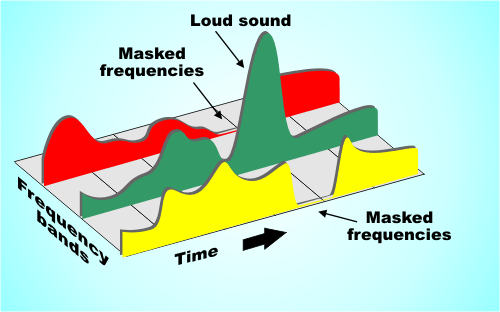
Phenomenon that consists in the alteration of the audibility of a sound (signal) in the presence of another sound (the so-called masker).

Psychoacoustic Model

In general, the deterioration in audibility is expressed in an increase in the threshold to detect or distinguish a signal, and M. h. it can be quantified by the value (decibels) by which the threshold rises in the presence of a masker. Distinguish between simultaneous, forward sequential, and reverse M. s. In the first case, the test signal and the masker sound simultaneously, in the second, the signal follows the masker, and in the third, the signal precedes the masker. Invert M. z. appears only for short signals.

With the simultaneous masking of a noisy tone with a fixed energy and a center frequency equal to the frequency of the signal, the spread of the masker spectrum to a certain value does not affect the value of M. h. Expansion outside this frequency band, called critical, leads to a decrease in M. s. If the masker is amplitude modulated, then adding a sound that changes synchronously with the main. a masker, can lead to a decrease in M. z. (the phenomenon of commodity release from masking).

M. z. it depends on the interural (between ears) relationship of the signal phases and the masker. With zero phase shift M. z. maximum, with an interaural displacement of 180 ° M. h. generally minimal. This effect, called binaural unmasking, defines the cocktail phenomenon, which consists of the ability to follow the signal from a source (interlocutor), ignoring interference with similar spectral-temporal characteristics (other voices, etc.)


Free Download Mp4Gain
picture


Mp4Gain Main Window
picture


Mp4Gain Features
picture


Free Download Mp4Gain
picture

Audio and video analogic & digital
Audio and video analogic & digital

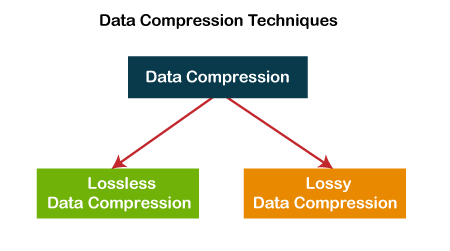
Lossless and Lossy audio compression

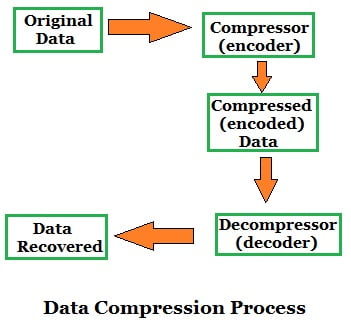
The appearance of multimedia systems, of course, brought about revolutionary changes in areas such as education, computer training, in many areas of professional activity, science, art, computer games, etc. But, you must agree, it is impossible to imagine the modern. multimedia systems without sound or video. In this work, I would like to dwell on the consideration of the fundamental differences in the representation of digital signals from analog, the characteristics of digital audio and video information, their compression algorithms (compression).
Lossy, and Lossless compression

2. Differences between the digital representation of analog signals.

The traditional analog representation of signals is based on the similarity (similarity) of electrical signals (current and voltage changes) with the original signals represented by them (sound pressure, temperature, speed, etc.), as well as on the similarity of electrical signals. signal forms at various points in the transmission or amplification path. The shape of the electrical curve that describes (also called transfer) the original signal is as close as possible to the shape of the curve of this signal.

Such a representation is the most accurate, however, the slightest distortion of the shape of the electrical carrier signal will inevitably involve the same distortion of the shape and signal of the carrier. In terms of information theory, the amount of information in the carrier signal is exactly equal to the amount of information in the original signal, and the electrical representation does not contain redundancy that could protect the carried signal from distortion during storage, transmission. and amplification.

The digital representation of electrical signals is designed to add redundancy to avoid unwanted interference. For this, serious restrictions are imposed on the carrier electrical signal: its amplitude can take only two limit values: 0 and 1.

In this case, the entire zone of possible amplitudes is divided into three zones: the lower one represents zero values, the upper one, individual, and the middle one is prohibited, only interferences can enter. Therefore, any interference, the amplitude of which is less than half the amplitude of the carrier signal, does not affect the correct transmission of the values ​​0 and 1. Interference with a higher amplitude also does not affect whether the duration of the interference pulse is significantly shorter than the duration of the information pulse, and a filter is installed at the pulse noise input of the receiver.

The digital signal formed in this way can carry any useful information that is encoded in the form of a sequence of bits: zeros and ones; Electrical and sound signals are a special case of such information. Here, the amount of information in the digital carrier signal is much greater than in the original encoded signal, so that the carrier signal has some redundancy with respect to the original, and any distortion in the waveform of the carrier signal, which it still retains the ability of the receiver to correctly distinguish between zeros and ones, it does not affect the reliability of the signal transmitted by this information signal. However, in the case of significant interference, the shape of the signal can become so distorted that the precise transmission of the information being carried becomes impossible: errors appear in it, which, with a simple coding method, the receiver does not you can only correct, but also detect. To further increase the resistance of a digital signal to interference and distortion, two types of redundant digital coding are used: verification codes (EDC – Error Detection Code) and correction (ECC – Error Correction Code) . Digital encoding is simply adding extra bits to the original information and / or converting the original bit string into a longer string and other structure. EDC allows you to simply detect the fact of an error: a distortion or loss of a useful one or the appearance of a false digit, but the information transferred in this case is also distorted; ECC allows you to immediately correct detected errors, keeping the information that is transferred unchanged.

Each type of EDC / ECC has its own capacity limit to detect and correct errors, after which undetected errors and distortions of the information being transferred start anew. An increase in the amount of EDC / ECC relative to the amount of initial information generally increases the detection and correction capabilities of these codes.

Like EDC, the popular cyclic redundancy code CRC (Cyclic Redundancy Check), whose essence is the complex mixture of the initial information in the block and the formation of short binary words, whose bits have u

Audio compression algorithms for streaming purposes

Audio compression algorithms for streaming purposes.

Lossy, and Lossless compression

The problem of transmitting the necessary number of audio channels through a network of limited capacity forces us to resort to audio compression.

Lossy and Lossless ata compresion in digital audio

Despite the use of modern digital technologies, compression negatively affects sound quality and causes additional delay in signal transmission.

Currently, there are two fundamentally different approaches to compressing audio signals. This article will provide a general comparison between these two different compression principles. Also presented are graphs of the frequency response (amplitude frequency characteristic) of the sound sample in its original uncompressed form and after one cycle of encoding and decoding using MPEG Layer II and Enhanced apt-X.

Algorithms like MPEG and AAC use encoding using a psychoacoustic model of sound perception. Another approach is time encoding using Adaptive Differential PCM (ADPCM) in algorithms like Enhanced apt-X.

Linear PCM audio
Before compression, the audio is generally digitized in linear PCM format at 32 kHz, 44.1 or 48 kHz with a resolution of 16 or 24 bits.

The analog signal will be digitized in uncompressed digital PCM. The digital inputs of the codecs use oversampling to ensure conversion without timing issues. The uncompressed PCM signal is our benchmark for comparing compressed audio files.

MPEG Layer ll compression
MPEG 1 Layer ll is a widely used format. This is a typical example of a psychoacoustic perception coding algorithm that analyzes the incoming signal and compares it to a theoretical model to determine what frequency and what time domain information can be lost. The need to analyze the audio signal results in a mandatory delay, typically greater than 30 ms.

In theory, high compression ratios can be achieved, but even with relatively low compression, MPEG can seriously degrade audio quality. In Fig. 2 shows the frequency response after one pass of MPEG encoding of the source file.

Be aware of frequencies that are lost or distorted compared to original PCM audio.

Compression Enhanced Apt-X
Enhanced apt-X uses ADPCM audio processing technology. The signal is divided into four frequency bands that can be processed at a quarter of the original sample rate using a variable bit rate and variable quantization step. Since all processing is based on the time domain method, there is no delay other than the actual processing time required.

As a result, a 4: 1 compression ratio preserves the entire frequency content of the original signal with a coding delay of less than 3 ms. Frequency response graph in Fig. 3 shows the result of one pass encoding / decoding using Enhanced apt-X at 256 kbps and illustrates the high fidelity of Enhanced apt-X compared to the original uncompressed signal.

How Enhanced apt-X Works
The improved apt-X encoding algorithm passes the original PCM data through a specially designed two-stage Q-mirror filter to divide the signal into four subbands and reduce the clock frequency to 1/4 of the original clock frequency. The quantization procedure consists of processing four sub-signals to reduce each signal from 16 bits to 7 bits in subband 1, 4 bits in subband 2, 3 bits in subband 3 and 2 in subband 4.

The inverse quantizer and prediction scheme uses the above values ​​to predict the size of the next signal. This value is compared to the actual signal and the “difference” is measured. The encoder transmits this measured “difference” signal to the decoder. Each subband is processed in parallel and the output of the string quantizer and predictor is encoded with a predetermined resolution. The processing output of the four subbands is multiplexed into a single 16- or 24-bit enhanced apt-X signal. Then additional data and sync data is added to it for streaming.

What is digital audio data compression?

What is digital audio data compression?

lossless and lossy compression

It could be said that there are two methods with which it is possible to compress the data in the case of digital audio.

lossless lossy compression

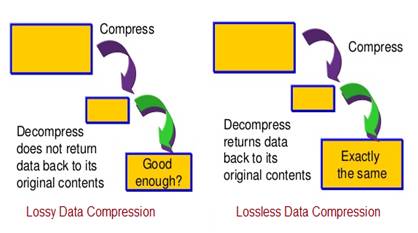
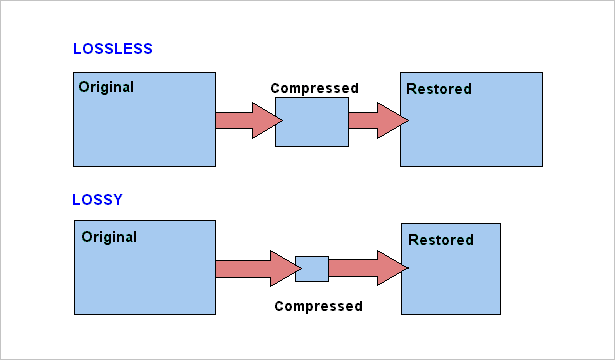
On the one hand, the method known as lossy compression is intended to reduce psychoacoustic redundancy and the other method is to reduce statistical redundancy. And this is known as lossless compression.

Lossless compression

Many people wonder how lossless compression can be achieved.
The Huffman code takes into account the probability that levels of different magnitudes will appear, for example, the most probable values ​​to appear frequently are assigned shorter codes and, on the other hand, the values ​​whose probability of appearance is small are assigned they use longer code words.

If we think about it, we will realize that by replacing the signal values ​​that will appear very frequently with shorter words, this will save us space but it does not imply any loss of quality because no information is being discarded.

If we put an example perhaps very simplified to be able to explain this method, we could imagine that we are going to compress a text. Now suppose this text contains some words that may be repeated very frequently.
For this explanation suppose that our text contains the word “statistically” many times and suppose that we substitute 3 characters for it: xx ÷.
So in each place where the word “statistically” should appear, we will replace it with the characters “xx ÷” And if this word appears enough times we will reduce the size of the text.
If we do this with each of the words that will appear several times, we will be able to make a significant reduction of the text without having to discard any information.

Therefore, when we rebuild or decompress our file, we will obtain a file exactly the same as the initial one, without any loss.

The other method where if there is a loss what is sought is to discard what is audio information the ear cannot distinguish, for example in the masking effect.
This masking what happens in our ears due to the imperfection of the human ear, supposes that two sounds do occur at approximately the same moment And these sounds have a close frequency But one of them has a much higher volume, the ear will only perceive the one who has higher volume and the one with the lowest volume will not perceive. Therefore, it can be discarded and the human ear will not perceive the difference.

This type of compression does use the technique of discarding information, which is why the resulting file has some information loss.

In general terms, today those systems that act without loss of information are being highly valued.

Lossless format: FLAC

Lossless format: FLAC

Flac

What is FLAC

Flac

In the 20th century, we choose between the media and the media to play music. Cassettes, vinyl, CD – each multimedia format had its own player, each had its own advantages and disadvantages. In the 21st century, the approach has changed significantly. Playback tools have become omnivorous and you have to choose not the multimedia format, but the format of the audio file.

At a time when digital music had not yet penetrated the computer in the way it is now, the choice for connoisseurs of high-quality sound was quite simple and straightforward. Most used CDs, while those who could afford to buy more expensive equipment and discs opted for SACD or DVD-Audio players, or universal models that play all optical audio disc formats. Now you can get high-quality audio content without buying discs, in which case the whole choice comes down to the format for storing your music.
Today there are several dozen formats (codecs) that are used to represent audio files. Among them, no more than a dozen can be called an undercarriage. Lossy audio compression is most often done using the MP3 (MPEG-1 Layer3) codec; less frequently, the WMA format, which is a proprietary Microsoft development, is used for this purpose; AAC, developed by Apple or available under the GPL-free Ogg Vorbis format. We will not dwell on the topic of compressed audio in detail, we will limit ourselves to a brief description.

The MP3 format and its aforementioned analogues allow you to compress CD-quality music material into smaller files (the compression ratio ranges from 2: 1 to 11: 1). As the developers envisioned, compression algorithms should process the audio stream in such a way that the sound of the compressed file does not differ from the original. In fact, you can hear the difference between the sound of a compressed file and an uncompressed original, and the higher the quality class of the equipment, the more obvious these differences become. There is no difficulty in attaching a CD to MP3 or getting ready-to-use MP3 files from the Internet or on physical media.
The only specificity of compression files is their ability to embed protection against copying or unauthorized reproduction (DRM). One of the main initiators and distributors of the technology to protect audio files was Apple, which, however, soon put forward a proposal to abandon such solutions and urged all manufacturers of music products to distribute it without protection. Since 2009, music sold on the iTunes Store has no such protection. The vast majority of compressed content sold over the Internet and on physical media is also not protected against unauthorized reproduction.

There are several different formats to store digital music without losing quality. The lossless and uncompressed audio stream is saved to a WAV or AIFF file. In this case, the file type is determined by the type of operating system on which the audio stream is saved. The WAV format is a joint development of Microsoft and IBM, and AIFF is the brainchild of Apple. There are also proprietary lossless audio compression formats: Microsoft’s WMA Loseless (also called WMA9) and Apple’s ALAC. Of these, only the second has become widespread due to the fact that it is almost the only way to listen to high-quality audio from iOS devices.
Another option for storing uncompressed audio content is disc images, which are a single file with the ISO extension, which is an unmodified copy of the content on a digital medium.
The most widely used lossless music compression format is the FLAC (Free Lossless Audio Codec) format. As its name implies, this format is distributed under the terms of a free license, which means that to ensure its support on any audio device, it is not necessary to pay royalties. FLAC allows you to store audio tracks with up to eight channels and a bit depth of up to 32 bits and a virtually unlimited sample rate, allowing it to be used to store any content, including multi-channel HD soundtracks. The popularity of FLAC as a high-quality audio compression codec is as great as the popularity of MP3 among compression audio formats. The vast majority of high-quality music is stored and distributed in the FLAC format.

Lossless format – what is it?

Lossless format – what is it?

Flac format

High quality music in Lossless format.

FLAC

If you take a normal audio CD with analog sound, burn it in WAV format for uncompressed sound, then compress WAV using lossless codec, then unzip the resulting audio file into WAV and burn the result to a blank CD, you can get two completely identical audio CDs.

The advantage of lossless for storing an audio collection is that the quality of the recordings is much higher than that of lossy codecs and they take up less space than uncompressed audio. It is true that lossy files are smaller than lossless music files. Most modern playback programs understand the lossless format. Those programs that cannot play it can easily learn it using the lossless plugin. What are lossless audio formats?

Lossless audio formats

A true music lover is unlikely to be satisfied with the sound of music recorded in Ogg Vorbis or MP3 compression formats. Of course, if you listen to audio recordings on home audio equipment, sound defects cannot be heard with your ear, but if you try to play a compressed file on high-quality Hi-Fi equipment, you will immediately find sound defects. . Of course, creating a collection of quality music on CD or vinyl is not easy. There is a reasonable alternative to this path for lovers of high-quality sound – lossless music. It can be stored on your PC in a format that allows you to keep the original music settings unchanged, even if compression is applied. In this way it simultaneously solves the problems of high-quality music and its compact storage, since the audio equipment for listening (headphones, speakers, amplifiers) is quite affordable.

FLAC – Free Lossless Audio Codec Audio File

FLAC – Free Lossless Audio Codec Audio File

FLAC

FLAC extension

flac

How to open flac files
Windows: ComboPlayer, Roxio Creator 2012, Adobe Audition 3, Nullsoft Winamp Media Player 5.6, VideoLAN VLC media player, Foobar2000, GoldWave, VUPlayer, aTunes.
Mac OS: Roxio Toast 11, Adobe Audition 3, Cog, MacAmp Lite X, VideoLAN VLC media player, aTunes.
Linux: VideoLAN VLC media player, aTunes.

Description of the FLAC extension
Popularity: Frequently used

Section: Audio files

Developer: flac.sourceforge.net

The FLAC extension is an acronym for Free Lossless Audio Codec, an open source audio format that uses lossless audio compression, which means that the audio is compressed into the FLAC format without loss of quality or original data.

In simple terms, FLAC is similar to MP3 but is lossless, which means that the audio is compressed into FLAC with no loss of quality. This is similar to how ZIP works, but in the case of the .FLAC file, you will get much better compression as it is specifically designed for audio, and you can play the compressed FLAC files on your favorite player (or in your car, or in your home stereo system), just like you would play an MP3 file.

FLAC files are freely available and compatible with most operating systems, including Windows, “Unix” (Linux, * BSD, Solaris, OS X, IRIX), BeOS, OS / 2, and Amiga. Systems have been created for Autotools, MSVC, Watcom C, and Project Builder.

MIME type: audio / x-flac
HEX code: 66 4C 61 43 00 00 00 22
ASCII code: fLaC

Audio Lossless, lossless

Audio Lossless, lossless

lossless audio


lossless audio

To avoid as much as possible a decrease in sound quality during the compression of an audio file, special methods have been developed to store audio information, avoiding losses, which in fact can be compared with the file, when the information is simply packed in a zip file, the size of which is significantly smaller than the original data. Subsequently, this data can be clearly restored on each bit. Also, the bit rate itself is not important for these files. These audio files are collectively called Lossless, Music As Is. These algorithms allow you to compress files two to three times. As a result, the size turns out quite large, but at the same time with the preservation of the original sound.

The most popular lossless formats are as follows.

FLAC
Audio Formats The abbreviation is the name “Free Lossless Audio Codec”. Provides complete security of all data in the audio stream, capable of 1.4 to 4x compression with 350-1010 kbps bit rate, used to create audio collections, and used for listening on premium equipment .

Pros:
– high quality;
– a large number of additional features;
– free license.
Disadvantages:
– quite large size;
– on older operating systems, you must additionally download the appropriate players.

Wav
Audio Formats Waveform audio format is one of the oldest formats that was created by Microsoft together with IBM. It is the best audio format for processing and storing uncompressed audio data in CD-like quality. One minute of sound “weighs” about 10 MB. Therefore, it is not recommended to store a music library in .wav or send these audio files over the Internet.

Pros:
– impeccable quality;
– Instant unpacking – “on the fly” with economical use of the processor;
– wide distribution and support of a large number of programs and audio devices.
Disadvantages:
– a lot of weight.

A THE C
Audio Formats
To store lossless compressed information on Apple devices. In terms of compression ratio, it is slightly lower than free FLAC.

Pros:
– there is no loss of quality when copying from a CD;
– the ability to easily convert to any other audio file format with good quality;
– restoration of a collection of CDs by recording new ones with the same quality instead of damaged ones.
Disadvantages:
– big size;
– limitations on compatibility with audio devices.

MONKEY
Audio Formats Monkey’s Audio is a fairly popular format that is released for Windows, but it has several unofficial codecs for other platforms. The format supports 8-, 16-, and 24-bit audio files, so it is widely used in the professional field.

Pros:
– high compression ratio and data processing speed;
– the possibility of direct reproduction of compressed information;
– support for information labels and, as a result, the ability to create convenient sound files.
Disadvantages:
– limited support.

Where can I find lossless music?
Listening to lossless music is a real treat. Also, if ordinary desktop speakers are used for a cheap computer or headphones, the full potential of lossless formats cannot be revealed. This requires high-end audio equipment: turntables, speakers, amplifiers, premium headphones, and even high-quality cables. At the same time, a question remains: where to get music in these formats?

Today, together with AudioCD, you can have high-quality music always at hand. This is facilitated by online music streaming services, which are constantly growing in popularity.

FLAC (Free Lossless Audio Codec File) Ad

FLAC (Free Lossless Audio Codec File)

FLAC AUDIO

The FLAC audio file format

Flac

The FLAC format was developed by the staff of the Xiph.org website. It was used to compress audio files. Compression does not result in loss of quality, which means that no data is lost during this process. The FLAC format allows users to maintain the original quality of the files; it is this property that makes the format an ideal method for backing up audio data, as physical media can deteriorate over time. FLAC files are used for high-quality audio backup from CD. the quality of MP3 files is poor. FLAC files are completely free of charge and widely available. Tools to verify the integrity of records, metadata, and images can be added to the format.

Technical details of FLAC files
Due to the high encoding speed, FLAC files are usually at least 50% smaller than the original file size. However, such compression does not result in any loss of quality. FLAC files are often used for online streaming and real-time online encoding. In this case, a FLAC project contains the following elements: stream format, container format, reference codec library, and input plug-ins. The FLAC format supports fixed point samples with PCM bit ranges from 4 to 32 bits per sample and sample rates up to 655,350 Hz (channels 1 to 8). When new fields are added, existing decoders feel no impact thanks to the protection of FLAC files.

More information about the FLAC file format
.Flac file extension
Audio file category
Example file Download file example.flac (2.5 MiB)
Related programs Real Player
VLC Media Player Player
Windows Media

What is the Flac format?

What is the Flac format?

FLAC

FLAC format description

flac audio format

A FLAC (Free Lossless Audio Codec) file is an audio file that has been compressed without losing sound quality. The .flac file format is considered inferior to MP3 in terms of compression ratio, but FLAC clearly demonstrates the best sound quality results.

FLAC files are very popular among connoisseurs of listening to audio on high-end stereos. Many music lovers prefer to create their own audio collection, where the FLAC format helps improve the quality of listening to music.
There is a type of FLAC Fingerprint file attached, named “ffp.txt”, which stores the data from the .flac file itself, as well as a checksum.

With the right software, the user will be able to listen to this file extension without any problem. There are a large number of all kinds of players distributed for free. The most popular are Nullsoft Winamp and AIMP Player, and VideoLAN VLC Media Player. You should know that you can open a FLAC file using Windows Media Player; however, for full Lossless Audio format operation, you will need CoreFLAC / Illiminable filters.

You can edit the FLAC file format with Adobe Audition or Sound Forge. The hardware of certain mobile devices is also capable of opening a FLAC file. Some users prefer to convert FLAC to another format due to the large amount of memory consumed, but for those who are interested in high sound quality, the FLAC extension will give them a real pleasure in listening to music.