Digital sound compression.


Free Download Mp4Gain
picture

Digital sound compression.
digiTAL SOUND PROCESSING

Principle and method of digital audio compression.
DIGITAL SOUND PROCESSING

Audio data compression is a process of lowering the bit rate by reducing the statistical and psychoacoustic redundancy of the digital loop signal. Methods for reducing the statistical redundancy of audio data are also called lossless compression, and consequently methods for reducing psychoacoustic redundancy are called lossy compression. Lossless compression The reduction of statistical redundancy is based on consideration of the properties of the audio signals themselves. It is determined by the presence of a correlation between adjacent samples of a digital audio signal, the elimination of which allows the amount of transmitted data to be reduced by 15 … 25% compared to its original value. To transmit a signal, you need to obtain a more compact representation of it, which can be achieved with the help of orthogonal transformation. Important conditions for the application of such a transformation method are: the ability to restore the original signal without distortion. the ability to provide the highest energy concentration in a small number of conversion factors. fast computational algorithm

Lossy compression Lossy compression of audio data is based on the imperfection of the human ear in the perception of audio information. The inability of a person in certain cases to distinguish between silent sounds in the presence of louder sounds, called the masking effect, has been used in algorithms to reduce psychoacoustic redundancy. The auditory masking effects can be divided into two main groups: frequency masking (simultaneous). Temporal (non-simultaneous) masking The masking effect in the frequency domain is associated with the fact that, in the presence of large amplitudes of sound, the human ear is insensitive to small amplitudes of nearby frequencies.

24. Analog and digital video signals. Hardware for digital video recording (digital cameras).
A video signal is usually a low-frequency signal, the value of which itself carries information. For example, it controls the strength of an electron beam in a cathode ray tube on a television. The beam “runs” across the screen and changes its value (according to the law, which is set by the video signal) – as a result, you get a frame.

Analog video signal

Analog television: Television produced by analog signals whose magnitude changes continuously over time. Today’s television system uses magnetic waves to transmit and display images and sound.

Digital video signal

Digital television is a method of transmitting and receiving compressed MPEG-2 digital video signals. Simply put, it is a modern replacement for traditional analog television, allowing you to transmit and receive television programs in greater quantities at the same costs and in much higher “digital” quality (as opposed to analog television, where the quality of television programs depends on the level of the received signal and the signal-to-noise ratio, in digital television, the quality of television programs does not change and is initially high.If the received signal exceeds a certain threshold level for open a digital package of television programs, then the programs are displayed with a constant quality that depends only on the quality of the original video material and the bitrate chosen by the broadcaster to broadcast a specific TV program). ..

Digital video cameras.

“What is the difference between digital and analog video cameras?

+ Let’s start by listing the most important advantages of a digital video camera in our opinion. First of all, digital video cameras deliver such excellent image quality that you could hardly have dreamed of more. Also, multiple copies are possible, and each subsequent copy is no worse than the first. In addition, it is important that from the moment of filming until the moment of watching your film, a minimum of time passes, and if you want to print a photo from a separate frame, then if you have a computer and a color printer (which is not necessary, as such services are also provided in classrooms) It only takes a few minutes. The quality of photos taken this way is very high (this, of course, is determined by the quality of your camera).


Free Download Mp4Gain
picture


Mp4Gain Main Window
picture


Mp4Gain Features
picture


Free Download Mp4Gain
picture

Digital sound processing Part 2

Digital sound processing Part 2

DIGITAL SOUND PROCESSING

Psychoacoustic model

Digital Signal Processing

Using psychoacoustic models, the encoder determines the acceptable quantization noise threshold. The MPEG standard defines 2 psychoacoustic models.

The MPEG audio compression standard allows great freedom in the implementation of the model. The essence of this implementation in a particular encoder depends on the required compression ratio. In consumer applications that do not require a high compression factor, the psychoacoustic pattern may not be present at all. In this case, the bit allocation algorithm does not use the SMR (signaltomaskratio) relationship.

Steps of psychoacoustic models:

1. Using Fourier methods, native sounds are transitioned to their frequency coefficients.

2. The received frequencies are distributed in the critical bands.

3. The spectral values ​​of the critical bands are divided into tonal and non-tonal components.

4. Before determining the noise masking thresholds for different critical bands, the model applies the masking function to signals from different critical bands.

5. The model determines the masking thresholds for each subband.

Conclution

The purpose of researching the abstract topic was to provide the necessary theoretical information in the field of digital sound processing.

In addition, the main summary tasks were completed: identify the principles of psychoacoustics and psychoacoustic models, second, explore digital digital sound compression methods, third, investigate the work of the MP3 format, fourth, formulate the concept of adaptive digital sound coding, and fifth, learn more about digital audio storage and digital audio media.

Based on the above, the following conclusions were drawn.

Psychoacoustics is a scientific discipline that studies the psychological and physiological characteristics of the human perception of sound, based on the fact that the human ear perceives only a fairly small region of the spectrum and tolerates small distortions of sound.

Modern digital audio compression techniques use sophisticated mathematical algorithms and psychoacoustic knowledge. Conventionally, they can be divided into two main types: lossless compression (for example, the flac format) and lossy compression (this includes the popular MP3 format).

MP3 is one of the most widespread and popular lossy digital audio encoding formats. It is widely used in file-sharing networks for evaluative transmission of musical works.

Therefore, today there is a great variety of methods and methods to process an audio signal. Various mathematical models are used to compress digital sound, including adaptive algorithms, as well as knowledge in the field of psychoacoustics. One of the most popular digital audio storage formats is the MP3 format, which uses adaptive lossy data compression technology. Despite the enormous variety of existing methods, software tools for digital sound processing and types of electronic media, this area of ​​multimedia technologies does not lose its relevance for both professionals and ordinary listeners and continues to develop actively.

Digital sound processing Part 1

Digital sound processing Part 1

DIGITal sound processiong


Every year, computer technologies are getting better and better, including software designed for professional audio data processing.

Digital sound processing

Microsoft took a big step forward with the development of the DirectX programming interface designed to simplify writing programs to work with graphics and sound.

Digital processing is subdivided into:

Linear processing occurs in real time and requires fast response from the processor.

Offline processing is not limited by time, so any processor can be used. But the processing process can take several hours.

In this article, we will consider aspects of digital audio processing such as compression, AudioMPEGLayer3 (MP3) technology, MP3 digital audio format, psychoacoustic modeling, adaptive encoding, digital audio storage, digital audio carriers.

1. Compress digital audio
With digital encoding, sound and video can be brought to the viewer, significantly reducing stream or bandwidth, and with upgrading computer technologies, known compression methods become cheaper and newer ones are becoming increasingly in demand.

Compression is carried out according to several rules:

If you can’t compress the data, try to do without it.

When compressing, use the lowest compression ratio.

Avoid compressing already compressed data.

Compression can be used to synchronize audio and video streams.

Use data without noise when compressing.

After compression, the possibility of data transmission errors increases.

2 AudioMPEGLayer3. MP3 digital audio format
MPEG (MotionPicturesExpertGroup) is the name of a working group established by the International Organization for Standardization and the International Committee on Electricity (ISO / IEC) to develop standards for video and audio compression. MPEG itself defines audio and video formats that use lossy compression, as well as the operations performed by MPEG decoders.

The MP3 standard is a very lossy audio compression scheme, the full name is MPEG-1 Layer3 (sometimes only MPEG Layer 3).

MP3 uses spectral clipping, based on the psychoacoustic model. The audio signal is divided into equal segments, each of which, after processing, is recorded in its own frame (frame). Spectral decomposition requires continuity of the input signal. Two or more peaks located next to each other are replaced by an averaged one. After spectral removal, mathematical compression and frame packing methods are applied. Each box can have multiple containers, allowing you to store information about multiple streams (per channel).

On the question of sound processing – PART 2

On the question of sound processing – PART 2

Sound Processing

Choir (chorus). As a result of its application, the sound of the signal becomes the sound of a choir or the simultaneous sound of several instruments.

Sound Processing

The scheme for obtaining such an effect is similar to the scheme for creating an echo effect with the only difference that the delayed copies of the input signal are subject to weak frequency modulation (on average 0.1 to 5 Hz) before mixing with the input signal. . Increasing the number of voices in the chorus is achieved by adding copies of the signal with different delay times.

Of course, as in all other areas, signal processing also has problems that are something of a hindrance. So, for example, when decomposing signals into a frequency spectrum, there is an uncertainty principle that cannot be overcome. The principle states that it is impossible to obtain an accurate spectral image of the signal at a specific moment in time: either to obtain a more accurate spectral image, it is necessary to analyze a larger time section of the signal or, if we are more interested At the moment when this or that change in the spectrum occurred, we must sacrifice the precision of the spectrum itself … In other words, it is impossible to get the exact spectrum of the signal at one point: the exact spectrum for a much of the signal, or a very rough spectrum, but for a small portion.

Signal processing mechanisms exist in both software and hardware versions (so-called effect processors). For example, voice coders and guitar processors, choruses, and reverbs exist both as hardware and as programs.

Practical signal processing can be divided into two types: on-the-fly processing and post-processing … On-the-fly processing involves instantaneous signal conversion (i.e. with the ability to output the processed signal almost simultaneously with its input ). A simple example is guitar devices or reverb during a live performance on stage. Such processing occurs instantaneously, that is, the performer sings into a microphone and the effects processor transforms his voice and the listener hears the already processed version of the voice. Post-processing is the processing of an already recorded signal. The processing speed can be much slower than the playback speed. Such processing pursues the same objectives, that is, to give the sound a certain character, or to change the characteristics, but it is used in the stage of mastering or preparing the sound for replication, when rush is not required, but quality and study. scrupulous. of all the nuances of sound are most important.

Signal processing is a complex procedure and, most importantly, it is very resource consuming. It has started relatively recently to be carried out on digital devices; Previously, various sound and other effects were achieved by processing sound on analog devices. In analog equipment, sound in the form of electrical vibrations passes through various paths (blocks of electrical elements), thus changing the phase, spectrum and amplitude of the signal. However, this processing method has many disadvantages. First, the quality of the processing suffers, because each analog element has its own error and several dozen elements can critically affect the precision and quality of the desired result. And secondly, and this is perhaps the most important, almost all the effects are achieved by using a separate device, when each of these devices can be very expensive. The possibility of using digital devices has undeniable advantages. The quality of signal processing in them depends much less on the quality of the equipment, the main thing is to qualitatively digitize the sound and be able to reproduce it qualitatively, and then the quality of processing falls only on the software mechanism. In addition, for various manipulations with sound, a constant change of equipment is not required. And, most importantly, since the processing is carried out programmatically, it opens up simply incredible opportunities for you, which are limited only by the power of computers (and it is increasing every day) and human imagination. However, (at least today) there are some problems here. For example, often, even for simple signal processing, it is necessary to decompose them into a frequency spectrum. In this case, on-the-fly signal processing can be difficult precisely because of the resource intensity of the decomposition stage.

On the question of sound processing

On the question of sound processing

sound processing

Sound processing should be understood as various transformations of sound information to change some characteristics of sound.

Omnia Radio Sound Processor and Audio Signal Processing Tips | Radio)))  ILOVEIT

Sound processing includes methods for creating various sound effects, filtering, as well as methods for cleaning the sound of unwanted noise, changing the timbre, etc. This whole huge set of transformations ultimately boils down to the following basic types:

Amplitude transformations. They are carried out on the amplitude of the signal and lead to its amplification / attenuation or change according to some law in certain parts of the signal.

Frequency conversions. They are performed on the frequency components of the sound: the signal is presented in the form of a frequency spectrum at regular intervals, the necessary frequency components are processed, for example, filtering and reverse “folding” of the signal from the spectrum. on a wave.

Phase transformations. Phase shift of the signal in one way or another; for example, such transformations of a stereo signal allow the effect of rotation or “three-dimensional” sound to be realized.

Temporary transformations. Implemented by overlaying, stretching / compressing signals; They allow you to create, for example, echo or chorus effects, as well as to influence the spatial characteristics of the sound.

The discussion of each of the named types of transformations can become a complete scientific work. It is worth giving several practical examples of the use of this type of transformation when creating real sound effects:

Echo (echo). It is implemented through temporary transformations. In fact, to get an echo, it is necessary to superimpose a delayed copy of the original input signal. In order for the human ear to perceive the second copy of the signal as a repetition and not as an echo of the main signal, it is necessary to set the delay time to approximately 50 ms. On the main signal, you can superimpose not one copy, but several, which will allow you to obtain the effect of multiple sound repetitions (polyphonic echo) on the output. In order for the echo to appear muffled, it is necessary to superimpose on the original signal not only delayed copies of the signal, but also dull in amplitude.

Reverberation (repetition, reflection). The effect is to add the spaciousness of a large room, where each sound generates a corresponding sound that slowly fades away. In practice, with the help of reverb, you can “revive”, for example, a phonogram made in a muffled room. Reverb differs from the “echo” effect in that a delayed output signal is superimposed on the input signal and not a delayed copy of the input signal. In other words, the reverb block is simplified as a loop, where the output of the block is connected to its input, so that the already processed signal is fed back to the input every cycle, mixing with the original signal.

Computer sound processing

Computer sound processing

Sound Processing

MP3 format

Audio processing

The audio compression method as well as the compressed audio file format proposed by the international organization MPEG (Moving Pictures Experts Group) is based on perceptual audio encoding. Work on creating efficient audio coding algorithms (originally for digital broadcasting) started in 1987 as part of the European project EUREKA (code EU147). The result is an extremely powerful algorithm, standardized as ISO-MPEG Audio Layer-3 (IS11172-3 and IS13818-3). It allows you to achieve a compression ratio of up to 12 (sometimes even more) and without a noticeable loss in sound quality. There are three levels of compression for stereo signals:

• MPEG Layer-1 – 1: 4 compression ratio with 384 Kbps data stream;

• MPEG Layer-2 – 1: 6.1: 8 at 256–192 Kbps;

• MPEG Layer-3 (MP3) – 1: 10.1: 12 @ 128-112 Kbps.

The files corresponding to these three levels usually have extensions. mp1, mp2 and. mp3 respectively.

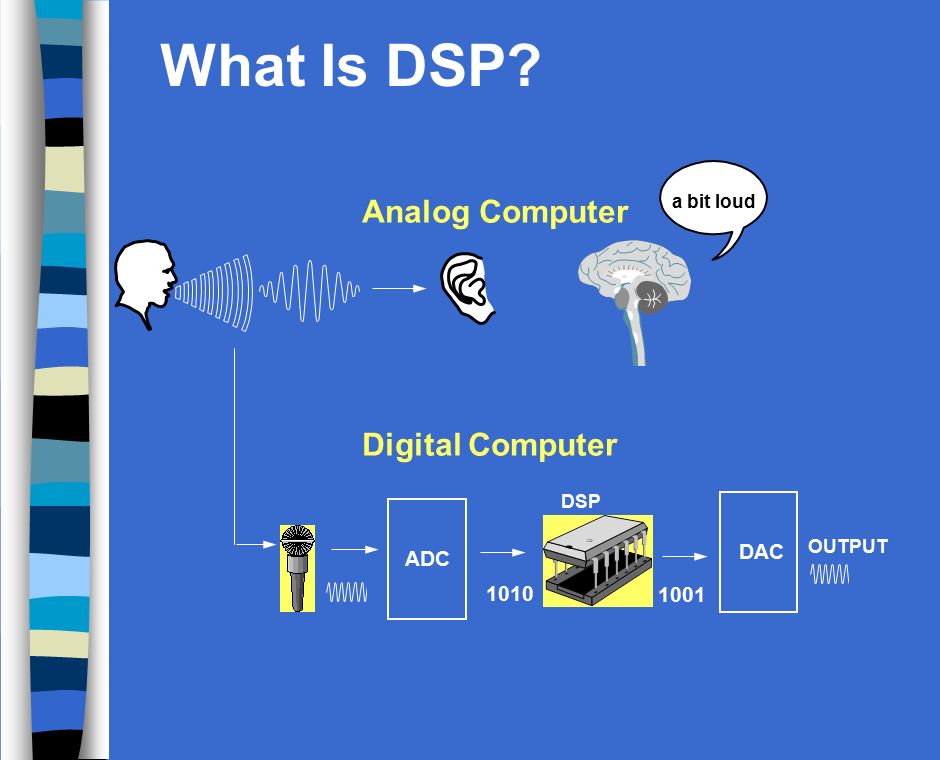
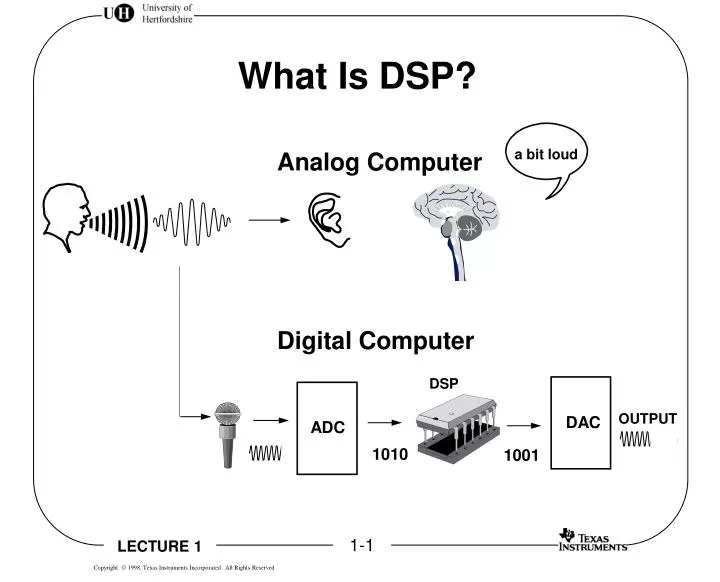
Initially, MPEG audio compression and restoration methods were intended only for hardware implementation using digital signal processors (DSP), but the performance of modern processors is sufficient to reproduce compressed audio in real time. So, to play files recorded in MP3 format, a Pentium processor with a clock frequency of 75 MHz is sufficient.

Such processors are not powerful enough to compress audio in real time, but there are software converters that compress audio files out of the box. Another more convenient way to work with the MPEG Audio format in Windows 95 is to use ACM Codec, automatic format converters that work at the system level. When installing such a converter, MPEG audio files can be given the extension. wav and work with them using any program that supports ACM, for example the standard media player (phonograph).

A compressed MP3 audio file actually offers the audio quality of a CD. There are losses, of course, but they are insignificant and sometimes completely invisible (more, given the possibility of putting 10 to 12 albums on a CD using this format).

Technology is next. You must first create a WAV file from the tracks on the CD. There are two possibilities for this: digitize the sound with a sound card or obtain audio data directly from a CD.

In the former case, the signal from the sound card is sent to the CD or line (line) input and a “normal” audio recording is made.

In the second, special programs are used that allow you to obtain a high-quality WAV file by extracting digital audio data directly from a CD using special functions of the CD drive, namely the Read Long command. Such a program is called a grabber, and hobbyists call the process itself “grabbing an audio disc” (capture trace copy).

The main disadvantage of the first way is the noise of the sound card itself, which is the louder, the cheaper the card. So, this method leads to a loss of quality already in the first step and is often quite noticeable.