Hardware for processing digital audio – Part 2


Free Download Mp4Gain
picture

Hardware for processing digital audio – Part 2

Digital Audio Processing

4. Mixing unit. On sound cards, the mixing unit provides adjustment of:

DIGITAL AUDIO PROCESSING

signal levels of the line inputs;
MIDI input and digital audio input levels;
the level of the general signal;
panorama
doorbell.
Let us consider the most important parameters that characterize sound boards and sound-music. The most important characteristics are: maximum sample rate in record mode and in playback mode, maximum sample rate or bit depth (maximum quantization level) in record and playback mode. Furthermore, since sound cards also have a synthesizer, the parameters of the installed synthesizer also refer to its characteristics. Naturally, the higher the quantization level that the card is capable of encoding the signals, the better the signal quality. All modern sound card models are capable of encoding a signal with a 16-bit level. One of the important features is the ability to simultaneously play and record audio streams. Function cards play and record simultaneously is called full duplex (full duplex). There is another characteristic that often plays a decisive role when buying a sound card: the signal-to-noise ratio (Signal-to-noise ratio, S / N). This indicator affects the purity of the signal recording and playback. The signal-to-noise ratio is the ratio between the signal power and the noise power at the output of the device; this indicator is generally measured in dB. A good ratio is 80 to 85 dB; ideal – 95-100 dB. However, it should be noted that the quality of playback and recording is strongly influenced by interference (interference) from other components of the computer (power supply, etc.). As a result, the signal-to-noise ratio may deteriorate. In practice, there are many methods to solve this problem. Some suggest grounding the computer. Others, to protect the sound card from interference as much as possible, “pull” it out of the computer case. However, it is very difficult to completely protect yourself from interference, as even the map elements themselves are created by floating above each other. They are also trying to fight this by filtering every item on the board. But no matter how much effort is made to solve this problem, it is impossible to completely eliminate the influence of external interference.

Another equally important characteristic is the non-linear distortion coefficient, or total harmonic distortion, THD. This figure also critically affects the clarity of the sound. The non-linear distortion coefficient is measured in percentage: 1% – “dirty” sound; 0.1% – normal sound; 0.01%: pure Hi-Fi sound; 0.002% – High Fidelity Sound – Hi-End .. Non-linear distortion is the result of inaccuracy in restoring the signal from digital to analog. Simplified, the process of measuring this coefficient is carried out as follows. A pure sine signal is supplied to the input of the sound card. At the output of the device, a signal is taken, the spectrum of which is the sum of the sinusoidal signals (the sum of the original sinusoid and its harmonics). Then, using a special formula, the quantitative ratio of the original signal and its harmonics obtained at the output of the device is calculated.

What is a MIDI synthesizer? The term “synthesizer” is commonly used to refer to an electronic musical instrument in which sound is created and processed, changing its color and characteristics. Naturally, the name of this device comes from its main purpose – sound synthesis. There are only two main methods of sound synthesis: FM (frequency modulation) and WT (wave table). Since we cannot dwell on them in detail here, we will describe only the main idea of ​​the methods. FM synthesis is based on the idea that any oscillation, even the most complex, is essentially the sum of the simplest sinusoids. Thus, it is possible to superimpose signals from a finite number of sinusoid generators and, by changing the frequencies of the sinusoids, obtain sounds similar to the real ones. Wavetable synthesis is based on a different principle. Sound synthesis using this method is achieved by manipulating the prerecorded (digitized) sounds of real musical instruments. These sounds (called samples) are stored in the permanent memory of the synthesizer.


Free Download Mp4Gain
picture


Mp4Gain Main Window
picture


Mp4Gain Features
picture


Free Download Mp4Gain
picture

Hardware for processing digital audio

Hardware for processing digital audio

Digital Audio Processing

An important part of the conversation about sound has to do with hardware.

Digital Recording

There are many different devices for audio processing and input / output. With regard to an ordinary personal computer, one should dwell on sound cards in more detail. Sound cards can be divided into sound, music and zvukomuzykalnye. By design, all sound cards can be divided into two groups: main (installed on the computer motherboard and providing audio data input and output) and daughter (they have a fundamental structural difference from main boards ; most of the time they are connected to a special connector located on the main board). Daughter cards are most often used to provide or extend the capabilities of a MIDI synthesizer.

Sound, music and sound cards are created in the form of devices inserted into the motherboard slot (or already integrated from scratch). Visually, they usually have two analog inputs: line and microphone, and several analog outputs: line outputs and a headphone output. Recently, the cards have also been equipped with a digital input and output, which provides audio transmission between digital devices. The analog inputs and outputs usually have connectors similar to the headphone jacks (1/8 ”). Generally, the sound card has a little more than two inputs: analog CD, MIDI, and other inputs. Unlike the mic and line inputs, they are not located on the back panel of the sound card, but on the card itself; there may be other inputs, for example to connect a voice modem. The digital inputs and outputs are usually S / PDIF (digital signal transfer interface) with a corresponding connector (S / PDIF stands for Sony / Panasonic Digital Interface – Sony / Panasonic digital interface). S / PDIF is a “home” version of the more complex professional standard AES / EBU (Audio Engineering Society / European Broadcast Union). The S / PDIF signal is used to digitally transmit (encode) 16-bit stereo data at any sample rate. In addition to the above, sound-music cards have a MIDI interface with connectors for connecting MIDI devices and joysticks, as well as for connecting a daughter music card (although recently the ability to connect the latter has become a rarity). Some sound card models are equipped with a front panel for user convenience,

Let’s define several basic blocks that make up the sound and sound-music boards.

1. Digital signal processing block (codec). This block is used for analog-to-digital and digital-to-analog conversions (ADC and DAC). This block determines the characteristics of the card, such as the maximum sample rate for recording and playback of a signal, the maximum quantization level, and the maximum number of processed channels (mono or stereo). To a large extent, the characteristics of noise also depend on the quality and complexity of the components of this block.

2. Synth Block. Present on musical cards. Made on the basis of FM or WT synthesis, or both at the same time. It can work both under the control of its own processor, and under the control of a special controller.

3. Interface block. Provides data transfer over various interfaces (eg S / PDIF). A purely sound card often lacks this block.

4. Mixing unit. On sound cards, the u

Advantages and Disadvantages of Digital Sound Part 2

Advantages and Disadvantages of Digital Sound Part 2

Digital Sound

Information on all CD types is stored frame by frame and each frame has a header by which it can be identified.

Digital Sound

However, different types of CDs have different structures and use different frame-marking techniques. Since computer CD-ROM drives are designed to read primarily data CDs (I must say that there are several varieties of the data CD standard, each of which complements the basic CD-DA standard), they often fail to they can do it correctly “browse” audio CD. where the method of marking frames is different from that of data CDs (on audio CDs, the frames do not have a special heading, and to determine the offset of each frame, you must follow the information in the table). This means that if, when reading a data CD, the drive easily “navigates” the disc and will never mix frames, then when reading from an audio CD, the drive cannot orient itself clearly, so if, for example , a scratch or dust appears, it may lead to reading the wrong frame, and as a result, skipping or breaking the sound. The same problem (the inability of most drives to position themselves correctly on CD-DA) is the cause of another unpleasant effect: copying information from an audio CD causes problems even when working with fully saved discs due to the fact that the “correct orientation on the disc” is entirely up to the reader and cannot be clearly controlled by software.

The ubiquitous distribution and further development of the aforementioned lossy audio encoders (MP3, AAC, and others) has opened up the widest possibilities for audio distribution and storage. Modern communication channels have been able to send large amounts of data in a relatively short time, but the slowest is still the data transfer between the end user and the communication service provider. Telephone lines, through which most users connect to the Internet, do not allow fast data transfer. It goes without saying that it will take a long time to transfer such volumes of data, which are occupied by uncompressed audio and video information. However, the advent of lossy encoders that provide 10 to 15 times compression made the transmission and exchange of audio data a daily activity for all Internet users and removed all barriers created by weak communication channels. In this regard, it must be said that digital mobile communications, which are developing by leaps and bounds today, are largely due to lossy coding. The fact is that the protocols for transmitting audio over mobile communication channels operate on roughly the same principles as known music encoders. Therefore, further development in the field of audio coding invariably leads to a decrease in the cost of data transmission in mobile systems, from which the end user only benefits: communication becomes cheaper, new opportunities appear, the battery life of mobile devices is extended, etc. . To a lesser extent, lossy encoding helps save money on the purchase of discs of your favorite songs; today you just have to go to the internet and there you can find almost any song that interests you. Of course, this situation has long been an “eyesore” for record companies: in front of their noses, instead of buying records, people exchange songs directly over the Internet, turning the gold mine that once It was in a low-profit business, but this is already a matter of ethics and finances. One thing is certain: you can’t do anything about it, and you can’t stop the boom in Internet music sharing, sparked precisely by the advent of lossy encoders. And this only plays in the hands of a common user. This state of affairs has long been an eyesore for record companies – right under their noses, instead of buying records, people trade songs directly over the internet, turning the old gold mine into a bass business. benefits, but this is already a matter of ethics and finances. One thing is certain: you can’t do anything about it, and you can’t stop the boom in Internet music sharing, sparked precisely by the advent of lossy encoders. And this only plays into the hands of an ordinary user.

Advantages and disadvantages of digital sound

Advantages and disadvantages of digital sound

digital sound

From the point of view of a normal user, there are many benefits: the compactness of modern storage media allows you, for example, to transfer all the disks and records in your collection to a digital representation and save for many years in three small ones.

Digital Sound

one-inch hard drive or on a dozen or two CDs; you can use special software and thoroughly “clean” old records from reels and records, removing noise and crackle from their sound; It can also not only correct the sound, but also beautify it, add richness, volume, restore frequencies. In addition to the listed manipulations with sound at home, the Internet also comes to the rescue of the audio lover. For example, the network allows people to share music, listen to hundreds of thousands of different Internet radio stations, and also to show your sound creativity to the public, and for this you only need a computer and the Internet. And finally, recently, a large number of various portable digital audio equipment has appeared, the capabilities of which even for the most average representative often make it easy to carry a collection of music with a duration equivalent to tens of hours on the road. . .

From a professional’s point of view, digital audio offers truly endless possibilities. If the previous radio and sound studios were located on several tens of square meters, now they can be replaced by a good computer, which surpasses ten of those studios combined in capabilities and is much cheaper than one in terms of cost. This removes many financial barriers and makes recording more accessible to both the professional and the simple amateur. Modern software lets you do what you want with sound. Previously, various sound effects were achieved with the help of ingenious devices that did not always live up to technical thinking or were simply handcrafted devices. Today, the most complex and hitherto unimaginable effects are achieved by pressing a couple of buttons. Of course,

Of course, digital technology has its drawbacks, too. Many (professionals and amateurs) note that the analog sound was heard with greater intensity. And this is not just a tribute to the past. As we said before, the digitization process introduces a certain error in the sound, in addition, various digital amplifier equipment introduces the so-called “transistor noise” and other specific distortions. Perhaps there is no precise definition of the term “transistor noise”, but we can say that they are chaotic oscillations in the high frequency region. Although the human hearing aid can perceive frequencies up to 20 kHz, it appears that the human brain picks up higher frequencies. And it is on a subconscious level that a person still feels analog sound cleaner than digital.

However, the digital representation of data has an indisputable and very important advantage: with a saved medium, the data it contains does not distort over time. If the magnetic tape becomes degaussed over time and the recording quality is lost, if the record is scratched and pops and crackles are added to the sound, then the CD / hard disk / electronic memory is readable (if preserved) or not , and there is no aging effect. It is important to note that we are not talking about audio CDs here (CD-DA is a standard that establishes the parameters and format for recording on audio CDs), since even though it is a carrier of digital information, the effect of aging still won’t get away. This is due to the peculiarities of storing and reading audio data from an audio CD.

Digital Audio Storage Methods – PART 2

Digital Audio Storage Methods – PART 2

Digital Audio

Due to the use of the new SBR (Spectral Band Replication) technology, the codec performs notably better than other formats at low bit rates; however, the quality of encoding at medium and high bit rates is generally inferior to the quality of almost all the codecs described. Therefore, MP3 Pro is more suitable for streaming audio over the Internet, as well as creating previews of songs and music. however, the quality of encoding at medium and high bit rates is often lower than the quality of almost all the codecs described.

Digital Audio

Therefore, MP3 Pro is more suitable for streaming audio over the Internet, as well as creating previews of songs and music. however, the quality of encoding at medium and high bit rates is often lower than the quality of almost all the codecs described. Therefore, MP3 Pro is more suitable for streaming audio over the Internet, as well as creating previews of songs and music.

Speaking of the methods of storing sound in digital form, one cannot help but remember the data carriers. The familiar audio CD, which appeared in the early 1980s, has become mainstream in recent years (which is associated with a sharp reduction in the cost of media and drives). And before that, digital data carriers were magnetic tape cassettes, but not ordinary ones, but specially designed for so-called DAT recorders. Nothing extraordinary: tape recorders are like tape recorders, but the price for them has always been high, and that pleasure was not too difficult for everyone. These recorders were used primarily in recording studios. The advantage of such recorders is that despite the use of familiar media, the data on them was stored in digital form and there was practically no loss during reading / writing on them (which is very important for studio processing and recording. sound storage). Today, a large number of different storage media have appeared, in addition to the usual compact discs. The media are improved and every year they become more accessible and compact. This opens up great opportunities in the field of creating mobile audio players. Today a large number of different models of portable digital players are already on sale. And we can assume that this is far from the peak of the development of this type of technology. This opens up great opportunities in the field of creating mobile audio players. Today a large number of different models of portable digital players are already on sale. And we can assume that this is far from the peak of the development of this type of technology. This opens up great opportunities in the field of creating mobile audio players. Today a large number of different models of portable digital players are already on sale. And we can assume that this is far from the peak of the development of this type of technology.

Digital audio storage methods

Digital audio storage methods

digital audio

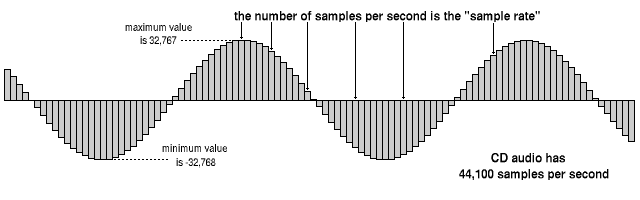
There are many different ways to store digital audio. As we said, digitized sound is a set of signal amplitude values ​​taken at regular intervals. Thus, first, a block of digitized audio information can be written to a file “as is”, that is, a sequence of numbers (amplitude values). In this case, there are two ways to store information.

DIGITAL AUDIO

The first is PCM (Pulse Code Modulation), a method of digitally encoding a signal by recording the absolute values ​​of the amplitudes (there are signed or unsigned representations). In this way, the data is recorded on all audio CDs.

The second method – ADPCM (Adaptive Delta PCM – adaptive relative pulse code modulation) – records signal values ​​not at all, but in relative changes in amplitudes (increments). Second, you can compress or simplify the data so that it takes up less memory than when it was written “as is.” There are also two ways here.

Lossless Data Encoding (Lossless Encoding) – is an audio encoding method that enables data recovery from a fully compressed stream. This method of data compaction is used when it is essential to maintain the quality of the original data. For example, after mixing sound in a recording studio, the data should be saved to the file in its original quality for possible later use. Today’s lossless encoding algorithms (for example, Monkeys Audio) can reduce the volume of data occupied by 20-50%, but at the same time ensure one hundred percent recovery of the original data from the data obtained after compression. Such encoders are a kind of data archivers (such as ZIP, RAR and others), only designed for audio compression.

There is also a second encoding path, which we will dwell on in a little more detail, lossy data encoding (lossy encoding). The purpose of such encoding is to achieve the sound similarity of the reconstructed signal to the original by any means with the least possible amount of packed data. This is achieved through the use of various algorithms that “simplify” the original signal (eliminating “unnecessary” details for the hearing impaired), leading to the fact that the decoded signal is no longer identical to the original, but only sounds similar. There are many compression methods, as well as programs that implement these methods. The most famous are MPEG-1 Layer I, II, III (the latter is the well-known MP3), MPEG-2 AAC (advanced audio encoding), Ogg Vorbis, Windows Media Audio (WMA), TwinVQ (VQF), MPEGPlus, TAC and others. On average, the compression ratio provided by such encoders is in the range of 10-14 (times). It should be noted that at the heart of all lossy encoders is the use of the so-called psychoacoustic model, which is simply involved in “simplifying” the original signal. More precisely, the mechanism of such encoders analyzes the coded signal, in the process of which the signal sections are determined, in certain frequency regions of which there are nuances inaudible to the human ear (masked or inaudible frequencies), after which are removed. of the original signal. Therefore, the degree of compression of the original signal depends on the degree of its “simplification”; Strong compression is achieved by “aggressive simplification” (when the encoder “considers” various nuances unnecessary), such compression naturally leads to strong quality degradation, as not only imperceptible but also significant sound details can be removed .

As we said, there are a lot of modern lossy encoders. The most common format is MPEG-1 Layer III (known as MP3). The format gained its popularity quite deservedly: it was the first widespread codec of its kind, achieving such a high level of compression with excellent sound quality. Today, there are many alternatives to this codec, the choice is up to the user. Unfortunately, the scope of the article does not allow us to provide tests and comparisons of existing codecs here, however, the authors of the article will allow themselves to provide some information that is useful when choosing a codec.

So the advantages of MP3 are the widespread use and a fairly high encoding quality, which is objectively improved thanks to the development of various MP3 encoders by enthusiasts (for example, the Lame encoder). A powerful alternative to MP3 is the Microsoft Windows Media Audio codec (.WMA and .ASF files).

Digital audio encoding

Digital audio encoding

Digital audio encoding

In fact, one or another digital form of representation of analog audio signals is already a coding method – a sequence of numbers that describes an analog audio signal is itself a digital code.

Digital Audio Encoding

However, the encoding that we are going to talk about now is something else. Now let’s look at the methods of encoding digital audio signals.

A digitized audio signal “in its pure form” is a fairly accurate, but not the most compact, way of recording the original analog signal.

Judge for yourself. To obtain complete information about the original analog signal in the frequency range 0-20 kHz (in the audible frequency range), the analog signal must be sampled at a frequency of at least 40 kHz. Therefore, the CD – DA standard (the standard for recording data on audio CDs familiar to all) establishes the following encoding parameters: recording of two or one channel in PCM format with a sampling frequency of 44.1 kHz and a 16-bit quantization bit depth. One hour of music in this format takes up approximately 600 MB of space (60 minutes * 60 seconds * 2 channels * 44100 samples per second * 2 bytes per sample = approximately 605 MB). Taking into account that, for example, the music collection of an ordinary music lover may have 5,000 tracks with an average length of about 3 minutes each, the amount of memory required to store it in its original digital form is quite significant. Awesome. Therefore, storing relatively large amounts of audio data, ensuring fairly good sound quality, requires the use of various “tricks” to compress the data.

In general, all existing methods for encoding audio information can be conditionally divided into only two types.

1. Lossless data compression (“Lossless Encoding”) is a method of encoding (compacting) digital audio information, which enables one hundred percent recovery of the original data from the compressed transmission (the term ” original data “here means the original form of the digitized audio data). This method of data compression is used in cases where one hundred percent absolute preservation of the quality of the original audio data is required. Lossless compression algorithms that exist today can reduce the volume of data occupied by 20-50% and at the same time guarantee a 100% recovery of the original digital material from the compressed data. The operating mechanisms of such encoders are similar to the operating mechanisms of general data archivers, such as ZIP or RAR, but at the same time they are specially adapted to compress audio data …. Lossless encoding While it is ideal in terms of preserving the quality of audio materials, it cannot provide a high level of compression.

2. There is another more modern way to compact data. This so-called lossy data compression (Engl. “Lossy encoding”) The purpose of encoding is to achieve the highest data compression rate by all means while keeping sound quality at an acceptable level. The idea behind lossy encoding is based on two simple underlying considerations:

original digital audio data is redundant: it contains a lot of unnecessary information that is useless to the ear, which can be removed, thereby increasing the compression ratio;
Requirements for the sound quality of audio material may vary and depend on specific purposes and areas of use.
Lossy encoding is therefore called “lossy”, which results in the loss of some of the audio information. Such encoding leads to the fact that the decoded signal, when reproduced, sounds similar to the original, but in reality it is no longer identical to it. Most lossy coding methods rely on the use of the psychoacoustic properties of the human auditory system, as well as various tricks associated with resampling and resampling the signal. In frequency, during the compression process, the encoder analyzes the audio data to identify various details of the sound that can be ignored. Disguised frequencies, inaudible and inaudible sound details can be sacrificed for a higher compression ratio. Where intelligibility is only important in sound (for example, in telephony, where the presence of frequencies above 4 kHz is not necessary), the audio information during the encoding process undergoes a serious “simplification”, which, together with the use of successful “smart” quantifiers and “greedy” data compression algorithms.

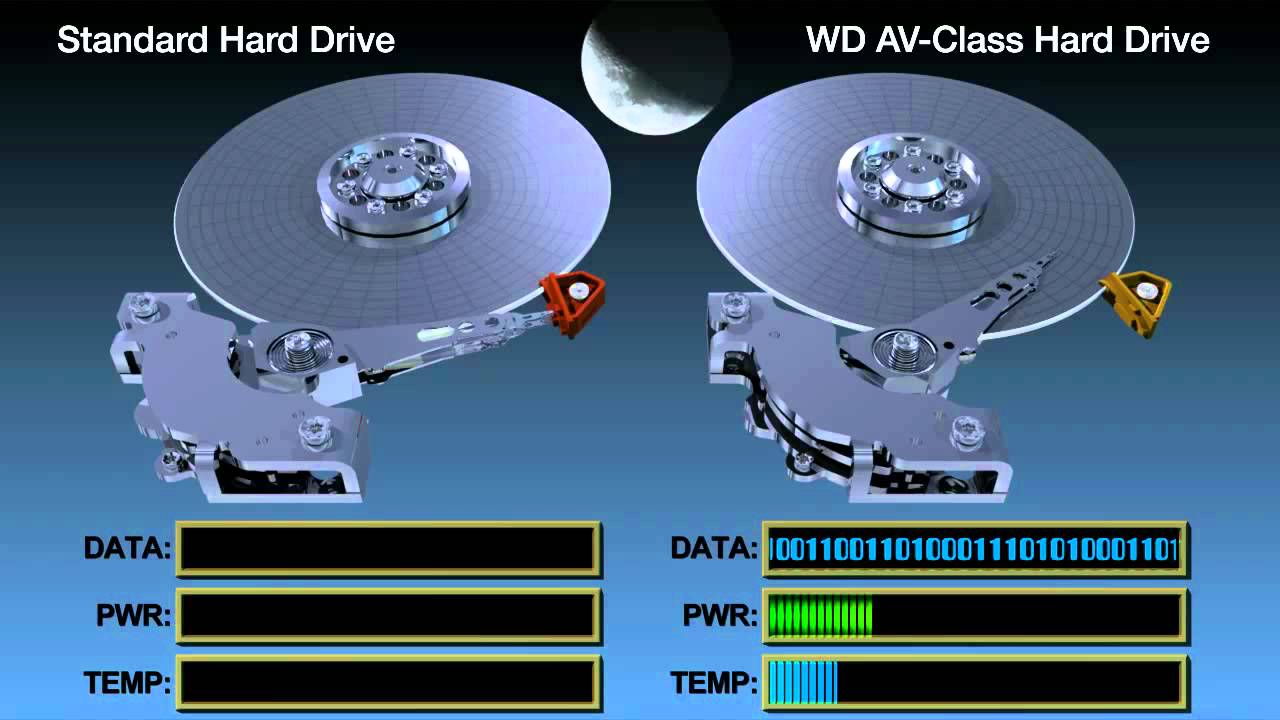
Why are AV hard drives used in digital recording?

Why are AV hard drives used in digital recording?

AV Hard drives


AV HARD DRIVE

The class of AV (audio / video) hard drives means their ability to
read and write streams of data efficiently and smoothly, without pauses. Reserve Army-
some disks ship with a larger internal buffer and are not interrupted
They read / write the process thermal calibration positioning system.
For digital recording systems with insufficient performance and
amounts of RAM to smooth out possible irregularities in the operation of the
discs, AV discs are the only possible output.

Note that the presence of the abbreviation AV in the designation of the disc
it does not mean that it belongs to the Audio / Video class; must be
It must be explicitly mentioned in the passport of the disc.

However, the specified feature is generally necessary only when working
bot with high-quality video information, whose speed
it is approximately 10 megabytes per second per channel. In the case of sound
systems output the rate of a single 16-bit channel stream with a frequency
The 48 kHz sample rate is two orders of magnitude lower and is only 94 kilograms.
bytes per second. At the same time, almost no workstation
to ensure simultaneous operation with hundreds of channels, as well as
the disk cannot process so much data in parallel,
located in different parts of it. In real applications, multichannel
burning disc to disc, most of the overall disc costs
The howling subsystem relies on head movement between recording areas,
and nothing in the data transfer itself. The low speed of sound flows.
kov makes it more convenient and reliable to store them in the computer’s RAM,
disc thermal calibration compensation within 0.5 – 1 s, instead of
use of expensive and rare AV class discs. Also, it is far from
All conventional discs, thermal calibration has a remarkable effect on the
data stream number.

“Broken” data transmission can also occur when using “unintentional”
correct “operating system (DOS, Windows without 32-bit driver
faith on disk, etc.), insufficient number and size of file buffers
get rid of the operating system and the burning program, the use of low-class discs with
transfer rate of the order of 1-2 megabytes per second and lower, incorrect
connect a disc, etc. In any case, these situations are usually
talk about misconfiguration and hardware and software configuration
parts of the system.

What methods are used to compress digital audio effectively?

What methods are used to compress digital audio effectively?

Compress Digital Audio

COMPRESS DIGITAL AUDIO

Currently, the most famous are Audio MPEG, PASC and ATRAC. All of them
use the so-called “perceptual
encoding) in which information is removed from the sound signal,
perceptible to the ear. As a result, despite the change in shape and spectrum
signal, your hearing perception is practically unchanged, and the degree
Compression accounts for the slight reduction in quality. Such encoding
refers to lossy compression methods, when
it is no longer possible to accurately reconstruct the original waveform from the compressed signal
shape.


The techniques to eliminate part of the information are based on the characteristics of the human being.
who to listen to, called masking: if there is a high
strong peaks (dominant harmonics) weaker frequency content
hear in the immediate vicinity of them practically no
accepted (masked). When encoding, the entire audio stream is divided
is divided into small squares, each of which becomes a spectral
presentation and is divided into several frequency bands. Within the stripes there are
performs the definition and removal of masked sounds, after which each frame
it undergoes adaptive coding directly in spectral form. All
these operations can significantly reduce (several times) the volume
data while maintaining acceptable quality for most listeners
I read.

Each of the encoding methods described is characterized by a bit rate
the bitrate with which the compressed information should come
on the cable box when the audio signal is restored. Decoder converts
a series of instantaneous signal spectra compressed into a conventional digital waveform
shape.

MPEG Audio – A group of MPEG standardized audio compression methods
(Moving Pictures Experts Group – a group of experts to process motion
images). MPEG audio methods exist in various
types – MPEG-1, MPEG-2, etc .; currently the most common
not MPEG-1 type.

There are three layers of MPEG-1 audio for stereo compression.
your signals:

1 – 1: 4 compression ratio with a data stream of 384 kbps;
2-1: 6..1: 8 at 256..192 kbps;
3 – 1: 10..1: 12 at 128..112 kbps.

The minimum data rate in each layer is defined as 32
kbps; specified bit rates maintain signal quality
roughly at the level of a CD.

All three levels use the input split spectral transformation
changing the frame in 32 frequency bands. The most optimal in relation
data volume and sound quality recognized as level 3 with bit rate
128 kbps and a data density of approximately 1 Mb / min. When compressed from a bottom
at what speeds the forced limiting of the frequency band starts to
15-16 kHz, and channel phase distortions also occur (effects such as
phaser or flanger).

MPEG audio is used in computer sound systems, CD-i / DVD,
CD-ROM “audio”, digital radio / television and other systems
massive sound transmission.

PASC (Precision Adaptive Subband Coding – Precise Adaptive Intraband
coding) – a special case of Audio MPEG-1 Layer 1 with a speed
Stream 384 kbps (1: 4 compression). Used in the DCC system.

ATRAC (Adaptive TRansform Acoustic Coding – acoustic coding
adaptive transformation) is based on stereophonic sound
16-bit quantized format with a 44.1 kHz sample rate.
When compressed, each frame is divided into 52 frequency bands, resulting in
transmission speed: 292 kbps (1: 5 compression). Applied in the system

What interfaces are used for digital audio transmission?

What interfaces are used for digital audio transmission?

Digital Interfaces

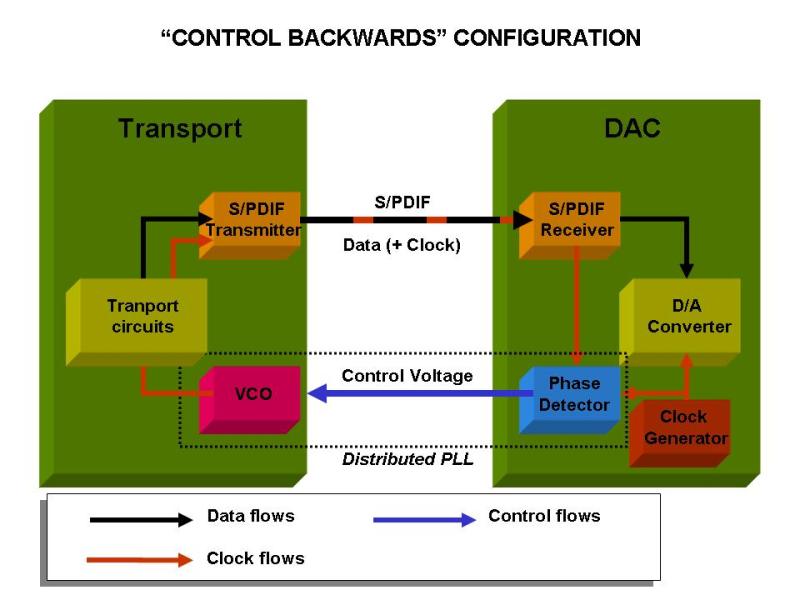
S / PDIF (Sony / Phillips Digital Interface Format – digital information format
terface from Sony and Philiрs) – digital interface for home radio
team.

Digital Audio Interfaces

AES / EBU (Society of Audio Engineers / European Broadcasting Union – Society
sound engineers / European Broadcasting Association) – digital engineering
terface for studio radio equipment.

Both interfaces are serial and use the same form
marking mat and coding system: BMC code with automatic synchronization
(Biphasic brand code: code with a double change representation of a unit
phase) and can transmit signals in PCM format of up to 24 bits
at sample rates up to 48 kHz.

Each signal sample is transmitted as a 32-bit word (frame), in which
rum 20 digits are used to transmit the count, and 12 – to form
synchronization preamble, transmission of additional information and
parity bit. 4 bits of the service group can be used to
extension of the sample format to 24 bits.

192 consecutive frames form a block, the beginning of which is marked
special preamble code of the first frame.

In addition to the parity bit, the service part of the word contains a validity bit
(Validity), which must be zero for each valid answer
accounts. If a word is received with a single bit of Validity or with a violation
parity in the word, the receiver interprets the entire sample as wrong and
you can choose to replace it with the old value or interpolate
based on multiple adjacent valid reads. Counts
marked invalid can transmit CD players that
DAT recorders and other devices, yes, when reading information from
the media could not be corrected during read errors
Ki.

The service part of the word also includes the C bits (Channel Status – Status
channel) and U (user bit). Constant price
kidney of each of these bits, taken one at a time from each block frame,
forms a 192-bit word of block service bits, where information is transmitted
information about the title of the work, track number,
device, CD subcodes, etc. S / PDIF transmits
copy protection settings (SCMS).

The standard encoding format is designed to transmit one and two
channel signal, however, when service bits are used to
By encoding the channel number, a multi-channel signal can be transmitted.

On the electrical side, S / PDIF provides a coaxial connection
cable with characteristic impedance of 75 ohms and RCA connectors (“tulle
pan “), signal amplitude – 0.5 V. AES / EBU provides connection
2-wire shielded symmetrical cable with transformer
decoupling via RS-422 interface with signal amplitude 3-10 V, connectors –
Cannon XLR 3-pin. There are also optical options
transceivers: TosLink (plastic fiber) and AT&T Link
(fiberglass).