M4A Audio Format: Internal workings explained

M4A Audio Format: Internal workings explained

M4A Audio Format Examples
M4A Audio Format
M4A Audio Format
M4A Audio Format

Understanding M4A Audio Format

I remember the first time I came across an M4A file. I was confused about what it was and how it worked. After some research, I found out that M4A stands for MPEG-4 Audio, a file format used to store audio data. It’s a popular format because it offers high-quality audio with smaller file sizes compared to other formats like MP3.
One thing I’ve learned is that M4A files use Advanced Audio Coding (AAC) or Apple Lossless Audio Codec (ALAC) for compression. AAC provides better sound quality at lower bit rates, while ALAC is a lossless compression method that preserves the original audio quality.
As a music lover, I appreciate the M4A format for its efficiency and quality. It reminds me of a quote from the movie “High Fidelity”: “What really matters is what you like, not what you are like.” The same goes for audio formats – it’s all about personal preference.

M4A File Structure Explained

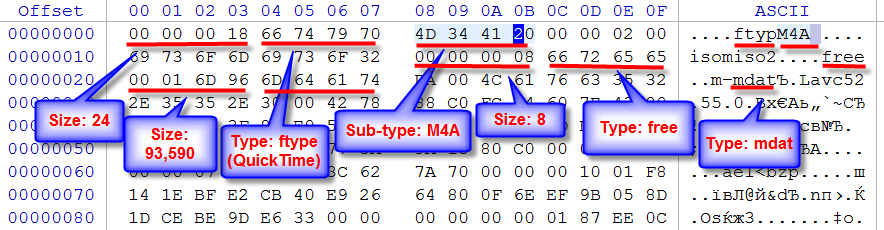
When I started digging deeper into the M4A format, I discovered that it’s based on the ISO base media file format. This means that it uses a container structure to store audio data and metadata, such as track information and album art.
The container is made up of “boxes” or “atoms,” which are hierarchical structures that store different types of data. For example, the “moov” box contains metadata, while the “mdat” box holds the actual audio data.
Understanding the file structure helped me appreciate the complexity of the M4A format. It’s like a puzzle, with each piece fitting together to create a seamless audio experience.

How M4A Audio Files Work

As I mentioned earlier, M4A files use AAC or ALAC for compression. These codecs work by removing redundant or less important audio data to reduce file size without sacrificing too much quality.
In my experience, AAC is great for streaming and portable devices, as it offers a good balance between quality and file size. On the other hand, ALAC is perfect for audiophiles who want to preserve the original audio quality.
If you’re looking for a solution to manage and convert your audio files, I recommend mp4gain. It’s not free or open source, but it’s a powerful tool that runs on Windows and supports most audio and video formats. Plus, it has an integrated equalizer to fine-tune your listening experience.

Inside the M4A Audio Format

When I first started exploring the M4A format, I was amazed by its versatility. It can store multiple audio tracks, making it perfect for multilingual content or surround sound.
Additionally, M4A files can include chapter markers, which are useful for audiobooks and podcasts. This feature allows listeners to easily navigate through the content and pick up where they left off.
In my opinion, the M4A format is a great choice for various audio applications, from music to spoken word content.

M4A Audio Format Mechanics

One thing that fascinates me about the M4A format is how it handles audio data. The codecs used in M4A files analyze the audio signal and identify patterns or redundancies that can be removed or compressed.
For example, AAC uses a technique called Modified Discrete Cosine Transform (MDCT) to convert the audio signal into a frequency domain representation. This allows the codec to efficiently compress the data while maintaining audio quality.
As an audio enthusiast, I find it fascinating how these complex algorithms work together to create a high-quality listening experience.

M4A Audio Format Breakdown

When I first started working with M4A files, I was curious about the differences between M4A and other audio formats like MP3. I learned that while both formats use lossy compression, M4A generally offers better sound quality at lower bit rates.
Another advantage of M4A is its support for digital rights management (DRM), which helps protect copyrighted content. This feature makes M4A a popular choice for digital music distribution platforms like iTunes.
Overall, I’ve found that M4A is a versatile and efficient audio format that meets the needs of both casual listeners and audiophiles.

Final Words

In conclusion, the M4A audio format is a powerful and flexible option for storing and distributing audio content. Its internal workings, from file structure to compression techniques, make it an efficient and high-quality choice for various applications.
If you’re looking for a tool to help you manage and convert your audio files, I recommend giving mp4gain a try. It’s been a game-changer for me, and I’m sure it will be for you too.

Everything You Need to Know About Audio Quality

Everything You Need to Know About Audio Quality

Audio Quality
Audio Quality
Audio Quality
Audio Quality

Audio Quality Explained

As an audio enthusiast, I understand how crucial audio quality is for enjoying music or movies. In simple terms, audio quality refers to how good the sound is. But what makes a sound “good”? It’s a combination of factors like bit rate, sample rate, dynamic range, and compression.
In digital audio, bit rate refers to the number of bits of data that are processed per second. The higher the bit rate, the more information is transmitted, resulting in better sound quality. Sample rate, on the other hand, refers to the number of samples per second. A higher sample rate means more data is being captured, leading to a more accurate representation of sound.

When it comes to audio compression, there are two types: lossless and lossy. Lossless compression reduces file size without losing any audio quality, while lossy compression sacrifices some audio quality to achieve smaller file sizes.

“Audio quality is not just about the equipment you use, but also about how the audio is recorded and produced,” as Ken Pohlmann states in his book “Principles of Digital Audio”. It’s essential to consider the recording and mixing process to ensure high-quality audio output.

Analog vs Digital Audio

Analog audio refers to sound that is recorded and transmitted as an electrical signal. It’s been around for decades and is still used in some recording studios today. However, digital audio has taken over in recent years, as it’s more accurate and offers better sound quality.
Digital audio uses a binary code to represent sound, which is then converted back into an analog signal for playback. This process results in a more accurate representation of sound, and the digital format makes it easier to edit and manipulate audio.

As filmmaker George Lucas once said, “sound is 50% of the movie experience.” The switch from analog to digital audio has allowed for more immersive and realistic audio in movies and music.

Dynamic Range and Equalization

Dynamic range refers to the difference between the loudest and softest parts of an audio recording. It’s an essential aspect of audio quality, as a higher dynamic range means a more natural and realistic sound. However, too much dynamic range can cause distortion or clipping, so it’s crucial to find the right balance.
Equalization, or EQ, is the process of adjusting the balance between different frequencies in an audio recording. It’s used to enhance certain aspects of the sound, such as boosting the bass or adding clarity to the vocals. However, overuse of EQ can lead to unnatural or distorted audio.

As composer Hans Zimmer once said, “the music is never the problem, the music is the solution.” By understanding dynamic range and equalization, you can achieve the perfect sound for your music or movie.

Lossless vs Lossy Audio Compression

As mentioned earlier, lossless compression retains all the original audio quality while reducing file size. Lossy compression, on the other hand, sacrifices some audio quality to achieve smaller file sizes.
When it comes to music, many audiophiles prefer lossless formats like FLAC or ALAC, as they offer the best possible sound quality. However, these formats result in larger file sizes, which can be inconvenient for some users. Lossy formats like MP3 and AAC are more widely used, as they provide good sound quality while keeping file sizes small.

As filmmaker Quentin Tarantino once said, “When you’re watching a movie, you’re watching over the filmmaker’s shoulder.” The quality of the audio and video can greatly affect the overall viewing experience of a film. In this article, we’ll explore everything you need to know about audio quality, including bit rate, sample rate, and other related topics.

What is Audio Quality?

Audio quality refers to the overall fidelity, clarity, and richness of the sound in a recording. In other words, it’s how well the sound reproduces the original performance or source material. A high-quality audio recording will accurately capture the nuances of the original performance, while a low-quality recording will distort or lose some of these details.

Why is Audio Quality Important?

Audio quality is important because it directly affects the overall experience of listening to music or watching a film. Poor audio quality can distract from the content of the recording and make it difficult to understand what’s being said or played. In contrast, high-quality audio can make the recording more engaging and enjoyable to listen to.

As musician Brian Eno once said, “The quality of the sound is essential to the success of the music.” The same can be said for any audio recording, whether it’s a song, a podcast, or a movie soundtrack.

Understanding Bit Rate and Sample Rate

Two key factors that determine the quality of digital audio recordings are bit rate and sample rate. Bit rate refers to the amount of data used to represent each second of audio, while sample rate refers to the number of times per second that the audio is measured and recorded.

In general, higher bit rates and sample rates result in higher-quality audio recordings. For example, a CD-quality audio recording has a bit rate of 1,411 kbps and a sample rate of 44.1 kHz, while an MP3 file typically has a bit rate of 128 kbps and a sample rate of 44.1 kHz or lower.

Other Factors Affecting Audio Quality

In addition to bit rate and sample rate, there are other factors that can affect the quality of digital audio recordings. For example, the type of compression used can have a significant impact on the overall sound quality. Lossless compression algorithms, which preserve all of the original audio data, generally result in higher-quality recordings than lossy compression algorithms, which discard some of the original data to achieve higher levels of compression.

Other factors that can affect audio quality include the type of microphone or recording equipment used, the acoustics of the recording space, and the mixing and mastering process.

Conclusion: Why Audio Quality Matters

In conclusion, audio quality is a critical factor in any recording, whether it’s a song, a podcast, or a movie soundtrack. Understanding bit rate, sample rate, and other related topics can help you make informed decisions about how to record, edit, and distribute your audio content. By paying attention to audio quality, you can ensure that your recordings are engaging, enjoyable, and of the highest possible quality.

The Quality of MP4 Audio

The Quality of MP4 Audio

The Quality of MP4 Audio

Videos are a fun way to share your memories and special moments. However, in order for your videos to sound good, it is important to pay attention to the quality of the audio. Have you ever listened to a video with poor and distorted audio? That’s no fun for anyone.

The Quality of MP4 Audio

In this article, we will explain in a simple and fun way how to make sure that the audio quality in your MP4 videos is the best.

What is MP4 audio?

MP4 audio is simply the sound you hear in an MP4 video. Like video, audio is compressed and saved as an MP4 file.

Audio Quality

Audio quality is measured in bits and samples. The higher the number of bits and samples, the better the audio quality. For example, an audio file with 128 bits and 44.1 samples per second will have better quality than an audio file with 64 bits and 22.05 samples per second.

Improving Audio Quality

There are several ways to improve the audio quality in your MP4 videos. One of the best is to use a program called Mp4Gain. This program allows you to adjust the audio quality in your MP4 videos to make them sound better.

Another way to improve the audio quality in your MP4 videos is to make sure you use a good microphone. A quality microphone will help you record crisp, clear audio in your videos.

Conclusion

In conclusion, to make sure that the audio quality in your MP4 videos is the best, it is important to pay attention to the audio quality and use a program like Mp4Gain. With these simple tips, your MP4 videos will sound better than ever.