H.266/VVC: Entropy Coding for Enhanced Compression Efficiency


Free Download Mp4Gain
picture

H.266/VVC: Entropy Coding for Enhanced Compression Efficiency

H.266/VVC: Entropy Coding for Enhanced Compression Efficiency

H.266/VVC: Entropy Coding for Enhanced Compression Efficiency

Let’s talk about H.266/VVC

When it comes to video compression technology, **H.266/VVC** stands out as a groundbreaking advancement. As a specialist in multimedia compression, I’ve witnessed firsthand the transformative impact of this cutting-edge standard. H.266/VVC, short for High Efficiency Video Coding, represents the next frontier in video compression, promising unparalleled efficiency and quality. In this article, I’ll delve deep into the intricacies of H.266/VVC, exploring its key features, benefits, and implications for the future of digital video.

Understanding H.266/VVC

**H.266/VVC** builds upon its predecessor, H.265/HEVC, with significant improvements in compression efficiency. At its core lies entropy coding, a key technique for reducing redundancy in video data. By employing advanced algorithms and predictive models, H.266/VVC achieves higher compression ratios without sacrificing visual quality. Imagine being able to stream 4K or even 8K video content with minimal bandwidth requirements – that’s the promise of H.266/VVC.

The Role of Entropy Coding

Entropy coding lies at the heart of **H.266/VVC**, enabling more efficient representation of video data. By encoding information in a more compact form, entropy coding reduces the bitrate required for transmission or storage. Think of it as compressing a file to take up less space on your hard drive – except in this case, we’re compressing video frames to reduce bandwidth consumption. With H.266/VVC, content creators can deliver high-resolution video streams to viewers around the world, even in bandwidth-constrained environments.

  • Improved compression efficiency
  • Enhanced visual quality
  • Reduced bandwidth requirements
  • Support for higher resolutions

Key Features of H.266/VVC

H.266/VVC introduces several innovative features that set it apart from previous standards. One notable enhancement is the use of block-based motion compensation, which reduces temporal redundancy in video sequences. Additionally, H.266/VVC incorporates sophisticated tools for intra-frame prediction, enabling more accurate representation of spatial detail. Combined with advanced entropy coding techniques, these features result in significant gains in compression efficiency and visual quality.

  • Block-based motion compensation
  • Intra-frame prediction
  • Adaptive quantization
  • Transform coding

Latest words on H.266/VVC

In conclusion, **H.266/VVC** represents a major milestone in the evolution of video compression technology. With its enhanced compression efficiency and support for higher resolutions, H.266/VVC is poised to revolutionize the way we consume and distribute digital video content. Whether you’re a content creator, streaming service provider, or consumer, H.266/VVC offers tangible benefits that promise to shape the future of multimedia experiences.

Comments:

This article provides a comprehensive overview of H.266/VVC and its potential impact on the future of video streaming. As a video enthusiast, I’m excited to see how this new standard will improve the quality of online video content.

I’ve been following the development of H.266/VVC for some time now, and it’s fascinating to see how far video compression technology has come. This article does an excellent job of explaining the key concepts in a clear and concise manner.

As a professional videographer, I’m always looking for ways to optimize video quality while minimizing file size. H.266/VVC seems like a promising solution, and I appreciate the insights provided in this article.

Video compression technology has come a long way since the early days of MPEG-2. H.266/VVC represents the latest evolution in this field, offering improved efficiency and quality for digital video content.

It’s amazing to think about the technological innovations that have led to the development of H.266/VVC. This article sheds light on the intricacies of video compression and its implications for the future of multimedia.

H.266/VVC has the potential to revolutionize the way we consume video content, from streaming services to virtual reality experiences. This article provides valuable insights into the benefits of this new compression standard.

As someone who works in the video streaming industry, I’m excited to see how H.266/VVC will improve the efficiency and quality of online video delivery. This article offers a thorough examination of the subject, covering both technical details and practical applications.

It’s incredible to think about the amount of data that can be compressed and transmitted using H.266/VVC. This article does a great job of explaining the technical aspects of video compression in a way that’s easy to understand.

H.266/VVC is a game-changer for the video industry, offering unprecedented levels of compression efficiency and visual quality. This article provides valuable insights into the potential impact of this new standard on the future of digital video.

As a consumer of online video content, I’m always looking for ways to improve the quality of my streaming experience. H.266/VVC seems like a promising solution, and I’m eager to see how it will be implemented by streaming platforms.


Free Download Mp4Gain
picture


Mp4Gain Main Window
picture


Mp4Gain Features
picture


Free Download Mp4Gain
picture

Efficient Chroma Intra Prediction in H.266/VVC

Efficient Chroma Intra Prediction in H.266/VVC

Efficient Chroma Intra Prediction in H.266/VVC

Efficient Chroma Intra Prediction in H.266/VVC

Let’s talk about Efficient Chroma Intra Prediction

As an expert in video compression technologies, I understand the importance of efficient chroma intra prediction in the context of H.266/VVC (High Efficiency Video Coding/ Versatile Video Coding). Chroma intra prediction plays a crucial role in reducing redundancy within video frames, leading to better compression ratios without compromising visual quality. By leveraging predictive coding techniques specifically tailored for chroma components, H.266/VVC aims to significantly improve video compression efficiency compared to its predecessors.

Chroma intra prediction involves predicting the chroma (color) components of a video frame based on neighboring pixels within the same frame. Unlike inter prediction, which utilizes motion estimation to predict future frames, intra prediction relies solely on information contained within the current frame. This makes it particularly important for achieving high compression efficiency in scenarios where inter-frame prediction is not feasible or effective, such as still scenes or sudden scene changes.

The Importance of Chroma Intra Prediction in Video Compression

Efficient chroma intra prediction is crucial for achieving substantial bitrate savings in video compression. By accurately predicting chroma components, redundant information can be efficiently removed, resulting in smaller encoded video streams without perceptible loss of quality. This is especially significant for applications with bandwidth constraints, such as streaming services, where minimizing data transfer without sacrificing visual fidelity is paramount.

Reducing Redundancy in Color Information

  • Explaining how chroma intra prediction reduces redundancy in color information
  • Highlighting the importance of accurate chroma prediction for preserving image quality
  • Discussing the impact of chroma subsampling on compression efficiency

Chroma intra prediction techniques exploit spatial correlations between neighboring chroma samples to predict their values. Common prediction modes include DC (average of neighboring samples), horizontal, vertical, and directional modes, each tailored to different patterns of chroma information within a frame. By selecting the most suitable prediction mode based on the characteristics of the chroma data, H.266/VVC achieves superior compression efficiency compared to previous standards.

Adaptive Prediction Modes

  • Discussing the concept of adaptive prediction modes in chroma intra prediction
  • Exploring how H.266/VVC dynamically selects prediction modes based on content characteristics
  • Highlighting the benefits of adaptive prediction for versatile compression performance

One of the key advancements in H.266/VVC is its ability to adaptively switch between different prediction modes within a frame. This adaptive approach ensures optimal utilization of prediction resources, allowing the encoder to accurately capture chroma details while minimizing the overall bitrate. By intelligently adjusting prediction modes based on content complexity, H.266/VVC delivers superior compression efficiency across a wide range of video content.

Transform Coding and Residual Coding

  • Explaining the role of transform coding in video compression
  • Discussing residual coding and its contribution to compression efficiency
  • Highlighting the synergy between prediction, transformation, and entropy coding

In addition to chroma intra prediction, H.266/VVC employs advanced techniques such as transform coding and residual coding to further enhance compression efficiency. Transform coding, typically using the Discrete Cosine Transform (DCT) or similar methods, helps decorrelate spatial information, making it more amenable to compression. Residual coding captures the difference between the original and predicted values, enabling more accurate reconstruction at the decoder.

Efficient Representation of Chroma Information

  • Discussing techniques for efficient representation of chroma information in video coding
  • Exploring the challenges posed by chroma subsampling and color space conversion
  • Highlighting innovations in chroma coding for improved compression performance

Efficient representation of chroma information is critical for achieving high compression ratios while maintaining visual quality. Techniques such as chroma subsampling and color space conversion help reduce the bitrate overhead associated with chroma components, ensuring that the majority of the available bandwidth is allocated to preserving luminance (brightness) information, which is more perceptually sensitive.

Latest words on Efficient Chroma Intra Prediction

In conclusion, efficient chroma intra prediction is a cornerstone of modern video compression standards such as H.266/VVC. By leveraging advanced predictive coding techniques tailored specifically for chroma components, H.266/VVC achieves unprecedented compression efficiency while delivering superior visual quality. The adaptive selection of prediction modes, coupled with innovative approaches to transform and residual coding, ensures optimal compression performance across diverse video content. As bandwidth constraints continue to challenge the multimedia industry, the evolution of chroma intra prediction remains instrumental in enabling next-generation video applications and services.

Comments:

Wow, I never knew there was so much complexity behind video compression! This article really opened my eyes to the intricacies of chroma prediction.

As someone who works in the streaming industry, I appreciate articles like this that dive deep into compression technologies. It’s fascinating to see how much effort goes into optimizing video delivery.

I found this article informative, but I wish it delved more into the technical aspects of chroma prediction algorithms. Maybe a follow-up article could explore that in more detail?

Great overview of chroma prediction in video coding! It’s amazing to see how far we’ve come in terms of compression efficiency, thanks to advancements like H.266/VVC.

As a video enthusiast, I’m always curious about the latest developments in compression standards. This article provided a comprehensive overview of chroma intra prediction and its importance in modern codecs.

This article helped me understand why some videos look better than others even at lower bitrates. It’s all about efficient prediction and compression techniques!

Really insightful article! I never realized how much optimization goes into reducing the size of video files while maintaining quality.

It’s fascinating to learn about the technical intricacies of video compression. This article provided a clear and concise explanation of chroma intra prediction and its role in modern codecs.

I’ve always been curious about how video compression works, and this article provided a great overview of one of its key components. Looking forward to reading more articles like this!

As a content creator, understanding video compression is essential for optimizing the delivery of my videos. This article shed light on the importance of chroma intra prediction in achieving efficient compression.

Entropy Coding Strategies in H.266/VVC Compression

Entropy Coding Strategies in H.266/VVC Compression

Entropy Coding Strategies in H.266/VVC Compression

Entropy Coding Strategies in H.266/VVC Compression

Let’s Talk About Entropy Coding in H.266/VVC

As an expert in video compression, I’ll unravel the complexities of entropy coding in H.266/VVC, shedding light on its significance in the ever-evolving world of video technology. Google’s search results offer a glimpse, but let’s delve deeper into the intricacies that truly matter.

The Landscape of Video Compression

In the realm of video compression, H.266/VVC stands out as a revolutionary standard. Its efficiency in reducing file sizes without compromising quality has reshaped the way we experience digital media. As we explore entropy coding, a fundamental aspect of H.266/VVC, we gain insights into the techniques that enable such advancements.

Understanding Entropy Coding

Entropy coding is a key element in data compression, and H.266/VVC employs sophisticated strategies to achieve maximum efficiency. Unlike earlier standards, H.266/VVC optimally represents data by assigning shorter codes to frequently occurring patterns, reducing redundancy, and ultimately minimizing file size.

The Role of Adaptive Coding

One of the groundbreaking features of H.266/VVC is adaptive coding. This technique dynamically adjusts to the changing characteristics of the video content, allocating bits more efficiently. It’s akin to a smart, real-time adjustment, ensuring that the compression adapts to the unique demands of each frame.

Latest Words on Entropy Coding in Video Compression

As of 2021, the landscape of video compression is evolving rapidly. However, the H.266/VVC standard remains at the forefront, offering unparalleled compression capabilities. This article provides not just a glimpse but a comprehensive understanding of how entropy coding plays a pivotal role in this advancement.

Let’s Make It Deeper: Unveiling Hidden Realities

Beyond the top Google results lies a trove of information that deserves attention. In this section, we’ll uncover nuances and intricacies that often go unnoticed. It’s not just about understanding; it’s about grasping the deeper realities that shape the technology we use daily.

Challenges in Implementation

While H.266/VVC presents a leap forward, it’s not without its challenges in real-world implementation. Addressing these hurdles requires a delicate balance between hardware capabilities, software optimization, and user expectations.

The Future of Video Compression

Looking ahead, the future of video compression holds exciting possibilities. The ongoing research and development in this field promise even more efficient algorithms and enhanced user experiences. As an expert navigating this landscape, I anticipate remarkable innovations that will continue to redefine our digital interactions.

In Conclusion

As we conclude this exploration of entropy coding in H.266/VVC compression, it’s evident that this standard shapes the present and future of digital media. The dynamic strategies employed, coupled with adaptive coding, make H.266/VVC a formidable force in the realm of video compression. For those seeking the optimal balance between quality and file size, this standard remains the pinnacle of achievement.

Comments:

Impressive insights! I never realized the depth of H.266/VVC’s impact on video compression.

-TechEnthusiast21

Great article! Would love more details on the challenges faced in implementing H.266/VVC.

-CuriousCoder

H.266 / VVC codec approved for 4K and 8K video compression

H.266 / VVC codec approved for 4K and 8K video compression

H.266 (VVC)

H.266 / VVC codec approved for 4K and 8K video compression
The Fraunhofer Institute for Telecommunications has announced the approval of a new video codec.

H.266 (VVC)

H.266 / VVC was developed with the need for ultra-high definition content in mind and is intended to be the successor to the popular H.264 / AVC and H.265 / HEVC standards, used by more than 10 billion devices. to handle more than 90% of the global video volume.

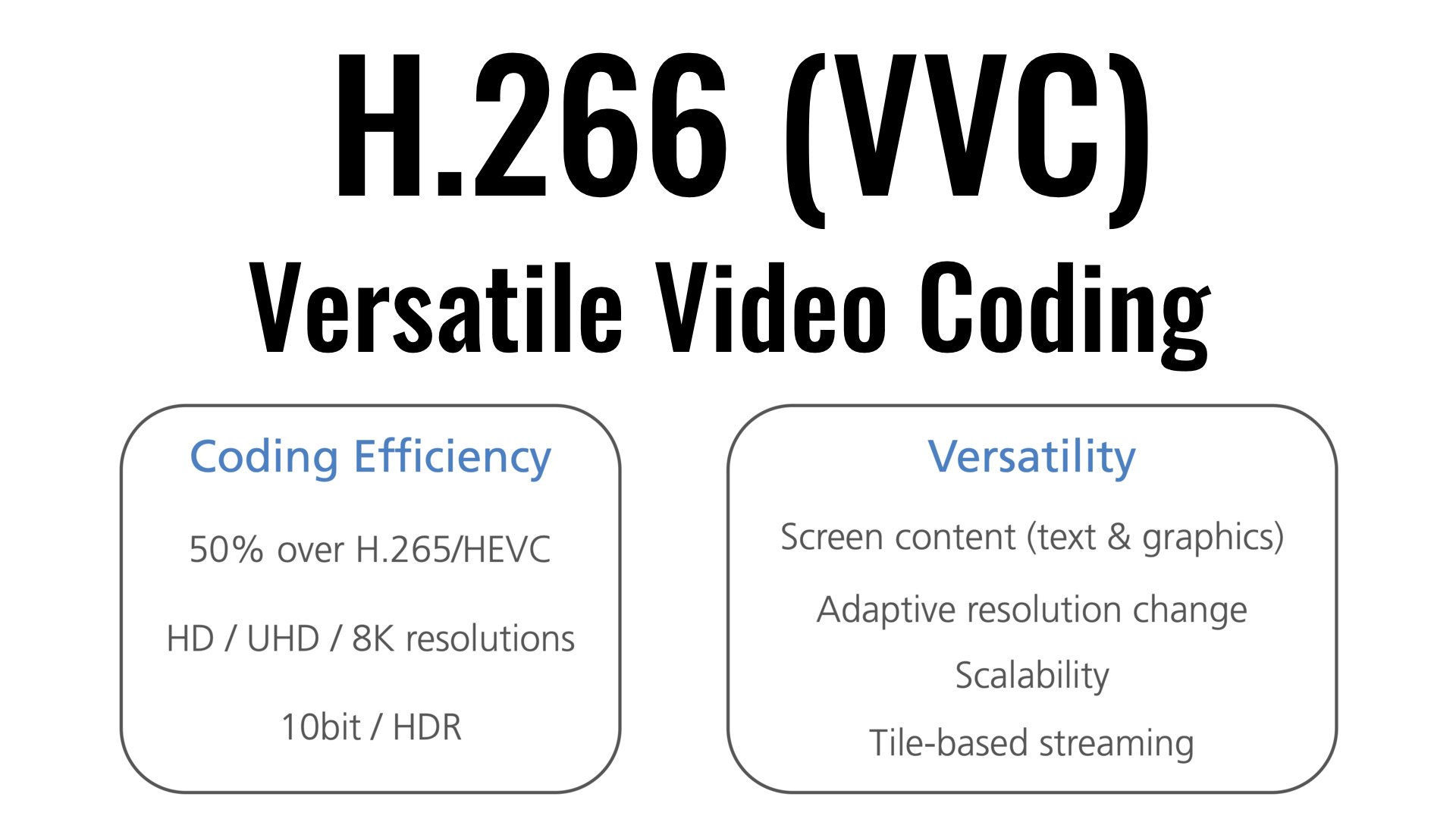
H.266 / VVC (Versatile Video Coding) provides highly efficient transmission and storage of all screen resolutions (from SD and HD to 4K and 8K), supports High Dynamic Range (HDR) video and video 360 degree panoramic … Supports YCbCr color space with 4: 4: 4 and 4: 2: 2 color conversions, color depth from 8 to 16 bpc, and auxiliary channels for data such as depth and transparency.

It is claimed that compared to H.265 (HEVC), the new standard will demonstrate a significant increase in compression ratio and allow a 50% lower bit rate to be used for streaming video with the same quality. For example, if a 90 minute video in UHD quality in H.265 required 10 GB of data transfer, then H.266 will fit in 5 GB while maintaining the same quality level. In comparison, the AV1 format in terms of compression efficiency outperforms HEVC by an average of 17% (at a high bit rate by 30-43%).

The standard has been created for 5 years by the MPEG (ISO / IEC JTC 1) and VCEG (ITU-T) working groups with the participation of Apple, Ericsson, Intel, Huawei, Microsoft, Qualcomm and Sony. The MC-IF (Media Encoding Industry Forum) was established to license overlapping patents, with more than 30 companies and organizations owning the intellectual property used in H.266 / VVC.

The cost of increasing compression efficiency is a significant complication of algorithms, leading to increased computational resource requirements (up to 10 times for encoding and up to 2 times for decoding compared to H.265). Unlike the AV1 video encoding format, the use of H.266 / VVC in your products requires a royalty fee. A reference implementation of an encoder and decoder for H.266 / VVC is expected to be released in the fall.

New standard for digital video compression twice as efficient as HEVC

New standard for digital video compression twice as efficient as HEVC

H.266/VVC Video Compression

German engineers who once developed the popular MPEG-3 audio coding format, as well as AVC and HEVC, which allowed video to be compressed to fit on a smartphone, announced a new standard for VVC compression, which could become a critical element in the era of ultra high definition video.

H.266

Compressed video today represents 80% of global Internet traffic. New standard presented by the Institute of Telecommunications. Fraunhofer, provides improved compression that will reduce file size by 50% compared to the older H.265 / High Efficiency Video Coding (HEVC) format. In other words, the H.266 / VVC standard will provide faster file transfers with the same quality. It supports all video resolutions from SD and HD to 4K and 8K, high dynamic range video, and 360-degree video.

“Today it is increasingly difficult to distinguish a voice robot from a human”
By reducing data requirements, VVC is making video streaming over mobile networks more efficient, according to the Institute’s website.

For example, if HEVC required approximately 10GB of data for 90 minutes of UHD recording, then with VVC you only need 5GB while maintaining the same quality. The new format is especially suitable for 4K and 8K broadcasts on flat screen televisions.
As with each of the previous protocols, VVC will require new encoding chips that are already in development. Apparently this is being done by the Institute’s partners: Apple, Ericsson, Intel, Huawei, Microsoft, Qualcomm and Sony.

To avoid previous licensing problems, the developers will authorize the use of the new standard on FRAND principles (fair, reasonable and non-discriminatory use), which will be enforced by the Media Coding Industry Forum (MC-IF). The first VVC-compliant encoding program will be released this fall.

H.266 / VVC (video compression standard)

H.266 / VVC (video compression standard)

VVC (H.266) CODEC

A new standard for video compression without quality loss appeared
On July 7, 2020, the Fraunhofer Heinrich Hertz Institute research organization introduced a new video compression standard: H.266 / VVC. The codec created will reduce the size of video files in half, while ensuring fast data transfer between devices.

H.266 CODEC

Fraunhofer HHI explained that the new solution focuses on efficient data compression while maintaining original quality. The codec is capable of performing tasks twice as efficiently as the HEVC solution, which was introduced in 2013. The codec does an excellent job of handling ultra high definition video (4K, 8K, 360 degree video) as well as with more common formats (480p, HD (720p) and FullHD (1080p)).

A new video compression standard has been released. The size is reduced by half without loss of quality.
For example, the HEVC codec above would require 10GB for 90-minute long UHD video. The VVC codec will compress video down to just 5GB. H.266 / VVC is also well suited for text, graphics encoding, the solution supports adaptive resolution switching, 10-bit and HDR. H.266 / VVC was developed in partnership with Apple, Intel, Huawei, Ericsson, Qualcomm, Sony, and Microsoft.

Fraunhofer HHI intends to create a uniform licensing model for patents related to basic codecs, adhering to the FRAND principle (“fair, reasonable and non-discriminatory”). Fraunhofer HHI will present a list of the first applications that support encoding and decoding using the H.266 / VVC standard in Autumn 2020. It is assumed that before 2021-2022, hardware solutions that support the new standard, although chip development aimed at accelerating H.266 at the hardware level is actively underway by July 2020.

New H.266 / VVC codec will cut video file sizes in half without losing quality

New H.266 / VVC codec will cut video file sizes in half without losing quality

H. 266 VVC

According to analyst estimates, compressed video data today represents up to 80% of all global Internet traffic, and software developers pay close attention to the quality of processing and transmission of “heavy” content on mobile networks. Germany’s Fraunhofer Institute for Telecommunications has introduced a new video encoding standard: according to the developers, it can cut the amount of transmitted data in half without losing image quality.

H. 266 (VVC)

The codec, whose specification spans more than 500 pages, was created with the popularity of streaming video in 4K and 8K resolutions in mind. It took specialists several years to develop it together with Apple, Ericsson, Intel, HUAWEI, Microsoft, Qualcomm and Sony. The new compression standard is called Versatile Video Coding. It promises to reduce the bit rate and size of video files by about 50% without a noticeable difference in image quality compared to its predecessor (H.265).

H.266 / VVC, according to its creators, makes video transmission on mobile networks more efficient. For example, the old standard requires approximately 10 GB of data to transfer 90 minutes of 4K video, while using the new technology only requires 5 GB of bandwidth. In addition, the codec is suitable for all types of moving images, including 360-degree panoramas and screen capture with live simulcast. Other benefits of H.266 include adaptive resolution switching, as well as support for HDR and 10-bit color depth.

Based on preliminary test results, the efficiency of the new codec turned out to be superior to that of the previously introduced AV1, which was competing with H.265 due to open source code and the lack of a licensing system. Additionally, H.266 has shown significant bitrate savings compared to HEVC, especially when it comes to 4K content. The first software solutions capable of taking advantage of VVC encoding and decoding are expected to appear this fall.

New H.266 codec – same quality, half the file size

New H.266 codec – same quality, half the file size

H.266 Codec

Fraunhofer’s company HHI, which created the H.264 and H.265 video codecs, without which today it is difficult to imagine the production of video content, has introduced an updated video encoding algorithm: H.266. The company didn’t get smart with the names and just added one, but under the hood we’re waiting for changes that they’ve been asking for for a long time, that is, the new codec provides half the amount of data while maintaining image quality. at the level of previous codecs.

After its completion, it means H.266 standard to halve the video size |  Eg24 News

Video resolution and bitrate are growing day by day, today you will not surprise anyone, for example, with the ability to shoot 4K, rather you will surprise with the absence of such a mode, 8K is on the way, and then scary Think about it, since terabytes of data snowballs, you only have time to swap out the hard drives …

The image does not demonstrate the capabilities of the codec, just an image for a change 🙂

The industry needs a new video encoding algorithm and the H.266 codec came in handy. This algorithm is also called Versatile Video Coding (VVC), that is, a universal video codec. The new standard provides improved compression, reducing the amount of data by approximately 50% while increasing the data transfer rate by the same amount as the previous H.265 (HEVC) standard. Most importantly, without sacrificing image quality.

The H.266 / VVC codec allows you to work with video in all resolutions, from SD and HD up to 4K and 8K, it supports video with high dynamic range and omni-directional 360 ° video, which, although in small steps, continues to gain popularity among users.

Fraunhofer HHI spent more than three years working on the codec, and the description of the H.266 / VVC standard has more than 500 pages of small text, and industry monsters like Microsoft, Apple, Sony, and Intel participated in the work. Benjamin Bross, director of Video Coding Systems, called the launch of the new codec a “quantum leap in encoding efficiency.”

In its press release, Fraunhofer HHI says that while a 90-minute video encoded in H.265 / HEVC is about 10GB, the same video with the new codec will only take up 5GB, and this is the same image quality. “Since H.266 / VVC was designed with ultra-high definition video content in mind, the new standard is especially useful for 4K and 8K video transmission,” the press release says. Also, the codec will support all formats from 480p onwards.

Some experts predict the imminent decline of the era of dominance of the JPEG standard for photographs. So the HEIF image compression format, which Apple implemented on the iPhone, is based on the H.265 / HEVC codec and is used, for example, in the new Canon 1D X Mark III SLR camera. In the same way, the widespread adoption of the H.266 / VVC codec may well lead to the popularization of the “VIC” format for photographs.

The H.265 (HEVC) standard has started to gain popularity recently, and the main problem of its use was quickly clarified: the amount of data that needs to be transferred in some way, stored somewhere, and processed in some multi-core processor systems. Processor and storage manufacturers are, of course, delighted, but the introduction of the new format is quite timely, obvious, and expected by many users and developers alike.

The implementation process itself depends on the hardware manufacturers that could record data using the new codec and on the software manufacturers that could process this highly recorded data. Experts predict the emergence of a new codec by the end of 2020. This process can be greatly accelerated, as recently online streaming has gained particular popularity, and no one will refuse to stream high-quality, high-bit-rate videos, for example, 8K or 4K, and at high speed.

H.266 / VVC video format introduced: same quality as H.265 / HEVC when compressed 2x

H.266 / VVC video format introduced: same quality as H.265 / HEVC when compressed 2x


The Fraunhofer Institute foH.266r Integrated Circuits in Germany, which developed the popular MP3 (MPEG-1 Layer 3) audio encoding format, as well as AVC and HEVC, announced a new video compression format: H.266 / VVC, or Encoding. versatile video player. Someday it should completely replace the current H.265 / HEVC.

H.266

The new H.266 claims twice the video stream compression efficiency with the same level of quality as H.265. As noted in the institute, in the case of 90 minute 4K video when using the H.265 / HEVC codec, approximately 10GB of data will need to be transferred, while H.266 / VVC provides identical video quality with half the volume of data.

“By reducing the [volume of] data requirements, H.266 / VVC makes video transmission on mobile networks (with limited traffic) more efficient. For example, the H.265 / HEVC standard above requires approximately 10GB of data for 90 minutes of recording in UHD resolution. The new H.266 / VVC will require only 5 GB while maintaining the same quality, ”said the Institute.

The Institute highlights that the new standard has been developed specifically for 4K (3840 × 2160) and 8K (7680 × 4320) ultra-high definition video, and is especially suitable for transmitting the corresponding signal to flat-screen televisions. The Institute also calls H.266 / VVC the “ideal solution” for all types of moving images, from high-resolution 360-degree panoramic images to screen sharing.

The most widely used codec now is H.264 / AVC, although the H.265 / HEVC standard has been around for quite some time. To avoid previous licensing problems, the developers will authorize the use of the new standard under FRAND (fair, reasonable and non-discriminatory terms), which the Media Coding Industry Forum (MC-IF) will enforce. The first VVC-compliant encoding program will be released in the fall. Hopefully the new H.266 / VVC will not follow the same fate as H.265 / HEVC and will be accepted by the market faster.